
Welcome to the mesmerizing island of Crete, Greece, where ancient history intertwines with stunning landscapes, vibrant culture, and warm hospitality. With My Greece Tours, embark on an unforgettable adventure that showcases the island’s magnificent beauty and diverse attractions. From exploring hidden villages and picturesque hiking trails to indulging in culinary delights and relaxing on sun-kissed beaches, our Crete Travel Guide will help you uncover the island’s hidden treasures. Whether you seek a romantic getaway, a family-friendly vacation, or a luxury escape, Crete is your perfect destination. Discover why this enchanting paradise has captivated travelers for centuries.
Discover the wonders of Crete with My Greece Tours. Explore sun-kissed beaches, ancient ruins, and lush hiking trails in this captivating travel guide. Experience authentic island life through wine tours, cooking classes, and hidden village explorations. Whether you’re looking for romantic getaways, family adventures, or luxury escapes, Crete offers something for everyone. Find the best hotels, plan your road trip, and uncover the best time to visit this enchanting island. Let Crete steal your heart with its breathtaking landscapes and vibrant culture. Book your unforgettable Crete vacation now and embrace the adventure.
The tours below cover the landmarks of Crete: the Palace of Knossos, Spinalonga, the Lasithi Plateau and the Cave of Zeus, and the palm beach of Vai in the east.
Brief Overview
Immerse yourself in the vibrant culture and breathtaking landscapes of Crete, Greece, where history and modern allure intertwine seamlessly. With My Greece Tours, explore the island’s sun-kissed beaches, ancient ruins such as the Palace of Knossos, and lush hiking trails like the Samaria Gorge for both adventure and tranquility. Experience authentic local life through wine tours in Chania, olive oil tastings, and cooking classes. Whether you desire a romantic getaway, family adventure, or a luxurious retreat, Crete offers it all, inviting you to explore hidden villages and stunning coastlines, making each moment unforgettable.
Key Highlights
- Discover Crete’s stunning landscapes, warm hospitality, and ancient ruins with My Greece Tours.
- Explore Crete through distinct adventures like wine tours, cooking classes, and hidden village exploration.
- Top activities include hiking the Samaria Gorge, wine tasting, and diving into vibrant marine life.
- Chania and Rethymno offer enriching wine tours and olive oil tasting experiences.
- Embark on a serene journey through Crete’s charming hidden villages and picturesque hiking trails.
Discover the Best of Crete
When it comes to seeking the perfect balance of history, beauty, and adventure, look no further than the island Crete, the destination that truly captures the heart. Crete experiences offer a rich tapestry that weaves together stunning landscapes, warm hospitality, and a journey through centuries. Starting your journey with the ancient trails that wind their way through olive groves and towering trees, you’ll find yourself stepping back in time. The best time to visit Crete offers mild, sun-kissed days that allow you to fully immerse in its enchanting culture. Whether you’re exploring the lively streets of Heraklion or the serene beauty of Chania, each corner of Crete offers something unique. The sea Crete glistens enticingly, beckoning travelers for a refreshing dip. Our travel guide reveals hidden coves, where the sands are golden and the waters crystal-clear, the perfect escape for lovers of leisure. The journey doesn’t stop there, as you’ll encounter local secrets in our island Crete travel guide. Dive into the flavors with wine tasting tours amongst sprawling vineyards, and let the authentic tastes enchant your palate. With every step, Crete welcomes you to discover, relax, and fall in love all over again, leaving you with unforgettable memories and a longing to return.
Why Crete is a Must-Visit Destination
Crete, Greece, the largest Greek island, is a must-visit destination that captivates every traveler’s heart, just as it did mine. Imagine a place where ancient history dances with mesmerizing beaches and towering mountains, all under the brilliant Cretan sun.
This island beckons adventurers eager to delve into the unique culture and cuisine, making it a perfect exploration destination. My Greece Tours can help you tailor your journey to discover hidden gems, like serene villages tucked away in the Cretan landscape, offering genuine Greek hospitality. Journey through olive groves with centuries-old trees or explore the historical treasures that tell tales of the Minoan civilization, such as the renowned Palace of Knossos. Indulge in rich culinary experiences with local wine tastings and traditional cooking classes, guaranteed to intrigue any foodie.
For those seeking the thrill of the great outdoors, Crete boasts incredible hiking trails that reward your efforts with breathtaking vistas. Whether lounging on pristine beaches, admiring the crystal-clear waters, or wandering through bustling towns, Crete offers a myriad of experiences that make it a remarkable travel destination. No matter what type of traveler you are, the island of Crete caters to every desire, ensuring your visit is unforgettable. Don’t miss out on the chance to explore this enchanting Greek island and experience the wonders of this extraordinary destination.
Top Things to do in Crete
Nestled in the heart of the Mediterranean, Crete is a vibrant tapestry of history, landscape, and culture that promises unforgettable activities for any traveler. Start by diving into the island’s ancient past at the Palace of Knossos, where myths of the Minotaur echo in its labyrinthine ruins. If you’re an outdoor enthusiast, don’t miss the opportunity to hike the stunning Samaria Gorge, one of Crete’s most remarkable natural landscapes.
Offering a rich variety of trails, it’s perfect for a day trip filled with adventure and breathtaking vistas. For those passionate about local experiences, a visit to the traditional village of Archanes can provide an authentic insight into Cretan life and flavor. Indulge in wine tasting at local vineyards or participate in a traditional cooking class to savor the island’s delicious cuisine. With Crete’s crystal-clear waters beckoning, consider exploring the vibrant marine life through scuba diving adventures.
Finally, unwind on the sandy beaches of Elafonissi or Balos, each offering a unique backdrop for relaxation. These breathtaking, turquoise shores make for the perfect end to a day of exploration. Whether you seek cultural enlightenment, thrilling physical activities, or simply the serenity of a sunset by the sea, Crete offers an array of experiences that ensure your trip to this magnificent island is nothing short of extraordinary.
Chania: Explore the Secrets of Wine and Olives
Embark on a journey to discover the heart of Crete, where the vibrant city of Chania lies waiting for you to uncover its secrets. Chania is not only a haven of stunning landscapes and enchanting architecture but also a treasure trove of Cretan tradition and flavors. Nestled between Chania and Rethymno, the region bursts with olive groves and vineyards that are pivotal to the island’s heritage. Dive into the world of olive oil, a staple in Cretan cuisine, and learn the art of its production through immersive tours. Sample the rich, golden hues of freshly pressed olive oil which are testament to Chania’s dedication to quality. Simultaneously, let the essence of the wine region captivate your senses. Explore family-operated vineyards where passionate winemakers unveil the secrets behind their aromatic creations.
Hands-on workshops where guests make olive oil soap with Cretan herbs are covered on the Crete soap making page.
This region is none short of a dream for those who savor every drop of fine wine. With our travel guide, delve into both modern and traditional experiences, crafting lasting memories of your time in Crete. Immerse yourself in the cultural tapestry that intricately weaves through Chania, discovering the symbiotic relationship between wine and olive oil that defines the Cretan essence. Your journey through Chania isn’t just sightseeing; it’s an invitation to taste the past and savor the future.
Chania’s Must-Visit Wineries
Discover the enchanting world of wine as you explore Chania, Crete, offering a delightful blend of tradition and innovation. Chania’s wineries are the epitome of authentic Greek experiences, where the passion for winemaking is as intoxicating as the wines themselves.
With our guide, uncover the hidden gems among the vineyards of Chania and Rethymno, two key stops for any wine enthusiast. The warm Crete sun bathes the landscape, creating perfect conditions for producing some of Greece’s most beloved wines. Expect an extraordinary journey filled with rich aromas and robust flavors. As you sip and savor, learn about the deep-rooted culture and history that flow through every vineyard in Crete. Wineries in this region are not just about wine tasting; they offer immersive Crete experiences, where you can engage with the vintners themselves, gaining insights into centuries-old techniques.
This Crete wine tour is a feast for the senses, inviting you to partake in tastings paired with local delicacies. Rethymno’s scenic elegance complements Chania’s rustic charm, both surrounded by mountainous vistas that add a dramatic backdrop to your travels. Embark on this journey and find out why Chania and Rethymno are among Crete’s most cherished wine destinations. It’s a trip that perfectly marries cultural enrichment with the simple pleasure of tasting an excellent glass of Greek wine.
Here are some essential tips for visiting Chania’s wineries, ensuring a memorable and enriching experience:
- Schedule visits early to avoid crowds and enjoy personalized attention.
- Opt for guided tours to delve deeper into wine-making traditions.
- Pair tastings with local cheese or olive oil for a fuller flavor experience.
- Engage in conversations with vintners for unique insights on Greek winemaking.
- Visit Rethymno’s vineyards to contrast its wines with Chania’s offerings.
- Capture the scenic beauty of the vineyards—perfect for your travel photo collection.
- Participate in wine-making workshops for an interactive experience.
These pointers can help elevate your winery visits, adding depth to your cultural journey.
Olive Oil Tastings and Tours
If there’s one quintessential experience you shouldn’t miss while on your Crete travel, it’s indulging in olive oil tastings and tours. Here, in the heart of Crete, you’ll find some of the finest olive oil in the world. Explore the Cretan region’s lush olive groves scattered across Heraklion and venture deeper into the rustic allure of Chania and Chania Rethymno.
These tours offer fascinating insights into the Greek tradition of olive oil production, from tree to table. You’ll learn about the different varieties of Cretan olives and how they’re meticulously harvested and processed to perfection. During your olive oil tour, expect to be surrounded by the fragrant scent of fresh olives and taste the vibrant flavors they impart.
As you savor each spoonful, you’ll find yourself immersed in the rich heritage and culture that defines this extraordinary island. Olive oil is an essential part of the Crete experiences and plays a pivotal role in Cretan and Greek cuisine.
From robust oils harvested in Heraklion to the more subtle notes found in Chania, every tasting is a testament to the Cretan landscape’s bounty. These immersive tours are a perfect way to enrich your travel, allowing you to not only taste but also tailor your own culinary journey through the olive-dotted landscapes of Crete.
| Experience | Description | Key Highlights |
| Wine Tours | Guided explorations of Chania’s renowned vineyards. | Tasting sessions, vineyard visits, expert commentary. |
| Olive Oil Tastings | Opportunities to sample local olive oils. | Fresh produce, local varieties, educational sessions. |
| Cultural Workshops | Engaging activities around wine and olive oil. | Hands-on experiences, understanding production methods. |
| Pairing Events | Pairing wine and olive oil with local cuisine. | Culinary pairings, local recipes, cultural immersion. |
This table highlights how Chania’s rich tradition in wine and olive oil tourism is woven into the cultural fabric of Crete.
Chania also has an airborne way to see the coast: Crete paragliding flights go up with a certified tandem pilot for views over the White Mountains, Souda Bay and the Venetian harbour, with no experience needed.
West of Chania the island also brews its own beer: a Crete beer tasting visits a Cretan craft brewery for guided pours with meze, or pairs the brewery with an olive oil factory or a sunset craft beer walk through the old town.
Hidden Villages of Crete
Beyond the sun-kissed beaches and bustling cities, Crete unveils a tapestry of hidden villages that hold the essence of its timeless charm. Nestled in various regions of this enchanting island, these villages offer a glimpse into the heart of authentic Crete experiences. Meandering through the narrow winding streets, travelers will be transported to a world where the echoes of ancient Greek life still resonate.
In the Lasithi region, where tranquility reigns supreme, you’ll discover a community of villages that uphold Crete’s rich traditions. A visit to the village of Kritsa, perched high amidst olive groves, dazzles with its Byzantine remains and local artisans showcasing their crafts. Nearby, the village of Mochlos invites you to experience traditional Cretan hospitality and sample delicious local cuisine. Each village, from the picturesque streets of Archanes to the time-forgotten beauty of Agios Myron, tells a unique story etched in stone.
Embracing these hidden gems rewards travelers with unforgettable experiences and deeper connections to Crete’s ancient soul. Wander through landscapes painted with olive trees and vineyards, engage in heartfelt conversations with hospitable villagers, and become enraptured with traditions that continue to thrive. Don’t miss out on this captivating side of Crete that continues to enchant and capture the hearts of those who dare to venture off the beaten path.
Authentic Experiences in Lasithi
Nestled on the easternmost tip of Crete, the enchanting region of Lasithi promises a blend of breathtaking landscapes and rich Cretan culture. This slice of Crete is famed for its traditional villages and stunning views of the shimmering Mediterranean. Our Crete travel guide invites you to explore the hidden gems of this Greek terrain. Begin your journey with a scenic drive through lush plains, revealing a patchwork of olive groves and vineyards that define the Lasithi landscape. Stop by the Mesa Potamos Waterfall, a delightful surprise in the hinterlands of Crete, where the sea of tranquility surrounds you.
For those seeking cultural immersion, visit the ancient Village of Kritsa, known for its Byzantine chapels and captivating artisan crafts. A must-do in the region is a visit to the captivating Dikteon Cave, said to be the mythical birthplace of Zeus, offering a remarkable insight into Greek mythology. Complete your adventure by indulging in the authentic Cretan cuisine at local tavernas, with dishes infused with locally produced olive oil and herbs.
Whether you’re a history buff, a nature lover, or someone simply looking to escape, Lasithi embodies the timeless appeal of Crete, offering travelers a genuine taste of its unique heritage. Don’t miss the sea view from the charming coastal towns, where the azure waters of Crete flank your travel experience.
Exploring the Tranquil Villages of Crete
As you delve deeper into the heart of Crete, the tranquil villages offer a unique blend of Cretan charm and traditional experiences that will captivate your senses. This travel guide unfolds the hidden gems that these villages hold. Particularly, the Lasithi region stands out as a must-visit for anyone wanting authentic Crete experiences.
The landscape is dotted with quaint hamlets, each boasting its own unique allure. You’ll find yourself strolling along cobblestone streets, where locals greet you with warm smiles and hearty “Kalimera!” Providing insights into the rich heritage of these areas, this guide captures the essence of village life and how it’s been intrinsically woven into the cultural fabric of Crete.
Uncover the timeless beauty of places like Kritsa and Mochlos, where time seems to stand still, and tradition holds strong. Taste wine made from locally grown grapes or immerse yourself in village festivals that echo with the sound of lyra and tsikoudia. This guide ensures your travel experiences go beyond the ordinary, presenting hidden and authentic encounters. Let the tranquil Cretan villages of Crete be a memorable part of your journey as they invite you to slow down, reflect, and indulge in the unhurried pace of Cretan life. Trust in the guide to lead you to intriguing corners of Crete that often remain uncharted by the modern traveler.
Heraklion: A City of Culture and History
Heraklion, a vibrant city situated on the north coast of Crete, is a treasure trove of cultural insights and historical wonders. For anyone fascinated by ancient Greek civilization, Heraklion is a must-visit. The city is home to the Heraklion Archaeological Museum, one of Greece’s most significant museums, showcasing artifacts that date back to the Minoan era. Nestled between lively streets and bustling markets, Heraklion offers a perfect blend of modern Greek life and ancient allure.
The city’s proximity to Knossos, the renowned palace complex of the Minoans, is another reason why Heraklion stands out as a focal point for exploring ancient history. When you visit, you’ll find yourself captivated by the rich tapestry of stories each monument and ruin tells, offering a unique glimpse into the heart of Greek heritage.
Heraklion is not just about the past; it’s a buzzing hub of culture today, with an array of cafes, tavernas, and vibrant nightlife. It’s also well-connected with other key cities like Heraklion and Chania by comfortable public transport and scenic roadways. Whether you’re wandering through charming lanes, sipping local wines, or diving deep into historical sites, Heraklion, steeped in ancient and Greek culture, promises an unforgettable journey through one of Crete’s crown jewels.
Top Attractions in Heraklion
Visitors to Heraklion are in for a treat as the city is brimming with captivating activities and cultural experiences. Begin your exploration of the island Crete with a visit to the renowned Heraklion Archaeological Museum. This museum boasts a comprehensive collection of Minoan artifacts that offer a window into the island’s ancient past. Just a short distance away is the magical Knossos Palace, where you can wander through ruins that tell tales of the legendary King Minos.
If you’re a fan of art, the Heraklion Museum of Visual Arts should be on your list. This vibrant center showcases contemporary Cretan artists and contributes greatly to the thriving cultural scene of Heraklion. Taking a stroll through the Venetian Walls offers stunning views and a glimpse into the city’s fortified history. As the sun sets, wander through the charming Old Town, where delightful Cretan cuisine and lively street performers await.
For a relaxing escape, head to the vibrant Morosini Fountain and marvel at the surrounding architecture. Don’t miss out on the opportunity to explore both Heraklion and Chania, where coastal beauty meets local charm. Whether you’re immersing yourself in the rich history or indulging in authentic local flavors, Heraklion promises an unforgettable journey through Crete. Let My Greece Tours be your ultimate guide to unlocking the best of Heraklion’s attractions.
Cultural Insights and Highlights
When you think about the rich historical tapestry of Crete, one cannot overlook the impact of Heraklion and Chania, two key cities that offer profound cultural insights. As your guide on this journey, let’s explore how these places intertwine with the ancient past. Heraklion, the capital of the region, is an archaeological treasure trove, showcasing the legacy of the Minoans, Ancient Greeks, and subsequent civilizations. Wander through the iconic Heraklion Archaeological Museum, where you’ll find relics that whisper stories of a bygone era. Equally enticing is Chania, where Venetian and Ottoman influences create a unique blend of styles.
Here, the Cretan Renaissance comes alive through architecture and art. These cultural experiences are enriched by the local Cretan spirit, known for its hospitality and vibrant traditions. Whether it’s savoring local cuisines in Heraklion or exploring hidden alleyways in Chania, each moment is a step back in time. Embrace this journey of discovery by delving into traditional Cretan customs that still resonate in the hearts of locals. With cultural insights at every corner, you’ll find yourself captivated by an island that wears its history proudly, making it an essential stop for those seeking to understand the essence of the ancient Greek world.
The charm of Crete isn’t just in its landscapes, it’s in its soul.Discover the captivating blend of historical depth and vibrant contemporary life that characterizes Crete, particularly in the enchanting cities of Heraklion and Chania. This island’s cultural tapestry offers no shortage of engaging experiences for the eager traveler.
- Explore the Archaeological Museum of Heraklion: Dive into the extensive collection of Minoan artifacts that narrate the stories of one of Europe’s earliest civilizations.
- Wander through the Old Venetian Harbor in Chania: Stroll along the picturesque waterfront, admiring the historic lighthouse and vibrant maritime atmosphere.
- Savor Traditional Cretan Cuisine: Relish seasonal ingredients and traditional dishes at a local taverna, experiencing the flavors that define Cretan gastronomy.
- Attend a Cretan Music Performance: Immerse yourself in the island’s musical heritage by enjoying a live show of traditional songs and dances, known for their distinct rhythms and lyra tunes.
- Visit the Knossos Palace: Lose yourself in the labyrinthine ruins of this famous Minoan palace, uncovering the legends of King Minos and the Minotaur.
- Explore Local Artisan Markets: Discover unique handcrafted goods, from ceramics to textiles, made by skilled Cretan artisans that capture the island’s creative spirit.
- Delve into Crete’s Nature on Samaria Gorge Trek: Experience the breathtaking landscapes and biodiversity while hiking one of Europe’s longest gorges.
- Participate in Olive Oil Tasting: Learn about the production process and savor various olive oils, a cornerstone of Cretan culture and cuisine.Embrace every moment in Crete, where each experience is a doorway into the island’s vibrant past and lively present, offering memories that last a lifetime.
Village and wine routes around Heraklion, Chania and Rethymno also run as a guided Crete e-bike tour, on pedal-assist bikes that flatten the climbs to Arkadi Monastery and the vineyards south of Heraklion.
Plan Your Crete Travel
Are you ready to embark on an unforgettable journey?
Let our Crete Travel Guide be your compass as you delve into one of the world’s most enchanting destinations. Whether you’re strolling through quaint villages or lounging on sun-drenched beaches, the key is thoughtful preparation. Begin by determining the best time to visit Crete. Spring and fall offer mild weather and fewer crowds, a perfect setting for exploration. Our guide also provides practical tips for a seamless trip. Tackle the logistics early: book your Crete flights and ensure your transportation is in order. Renting a car is advisable for those keen on discovering hidden treasures off the beaten path.
Accommodation is varied, from charming budget lodgings to luxurious retreats, so tailor your choice based on your planned activities. Dive into the top things to do in Crete, immerse in the rich history of Heraklion or bask in the idyllic beauty of pristine beaches like Elafonissi. Don’t forget to make room for spontaneous adventures, for Crete thrives on its ability to surprise. As you plan this life-enriching Crete trip, remember that our ultimate Crete travel guide caters to every traveler, ensuring a journey that resonates with personal wonder and awe.
Best Time to Visit Crete
When planning your dream trip to the island Crete, understanding the best time to visit Crete is essential for a memorable experience. Nestled gracefully in the Mediterranean, Crete beckons with its dazzling vistas and rich cultural heritage. The months between April and October are generally considered the idyllic time to immerse yourself in everything from Heraklion to the renowned region of Chania. During this period, the weather is mostly sunny, allowing you to explore the intricate tapestry of Crete experiences, bask on stunning beaches, or lose yourself wandering through the cobblestone streets of Rethymno.
Spring bursts with wildflowers, making it perfect for scenic hiking, while summer invites you to dive into crystal clear waters. For those keen on uncovering authentic Crete, September is a beautiful time to visit, as the crowds wane, yet the weather remains pleasant for travel. Lesser-known villages like Lasithi and towns like Heraklion offer both tranquility and adventure year-round!
With any in-depth guide, you’ll find myriad opportunities for fun and relaxation tailored to your preferences. Let Crete be your escape, a place where every dream trip becomes a reality. Our travel guide will assist in planning your itinerary, leaving you astounded by Crete’s magic. So, mark your calendar and savor your journey on wonderful Crete!
Practical Tips for a Seamless Trip
If you’re planning a trip to the stunning island of Crete, a bit of preparation can go a long way in ensuring an unforgettable experience. Start by deciding what type of accommodation suits your style, from luxury resorts to quaint boutique hotels nestled in hidden villages. Once you’ve picked your perfect base, plan your journey carefully. Flights to the island arrive in various cities, including Heraklion, the gateway to many of Crete’s wonders.
To explore all Crete has to offer, consider renting a car. A drive across the island not only reveals its scenic beauty, but also offers the flexibility to visit lesser-known spots on your own terms.
As you map out your Crete travel guide, include landmark attractions like the ancient Palace of Knossos and the beautiful Samaria Gorge. Before you set out, remember the practical tips of carrying enough water, wearing comfortable shoes, and having a map handy for hiking adventures. Finally, immerse yourself in the local Crete culture by trying delicious traditional foods and engaging with the hospitable locals. Whether it’s your first time or a returning visit, these practical tips will make your Crete travel seamless and truly delightful.
Exploring Crete’s Stunning Beaches
Crete’s coastlines are like an artist’s palette, boasting some of the most stunning beaches you’ll ever encounter. As you journey through this Greek island, let yourself be mesmerized by the dazzling shades of the azure sea. The island of Crete offers an array of beach experiences, from serene, untouched coves to lively, bustling shores. For those seeking solitude, there are hidden, less frequented beaches that promise tranquility and pristine beauty, while families will find exactly what they need in the more family-friendly spots where amenities abound.
Every beach has its unique charm, yet all have in common the spectacular backdrop of Crete’s magnificent landscape, where rugged mountains meet the sea. As a travel guide to the island, I can’t help but share my admiration for these natural wonders. Imagine sinking your toes into soft, golden sands, where the sun kisses your skin, and the gentle waves create a soothing melody. Whether you prefer the thrill of water sports or the peace of a quiet swim, Crete’s beaches cater to all desires.
Don’t miss the opportunity to explore these oceanfront paradises that are the pride of Crete. So, pack your beachwear and get ready to immerse yourself in the breathtaking beauty of Crete’s coastal havens.
| Beach Name | Unique Feature | Suitable For | Family-Friendly Amenities | Relaxation Spots |
| Elafonissi Beach | Pink Sand | Sunbathers, Swimmers | Shallow Waters, Picnic Areas | Secluded Coves |
| Balos Lagoon | Turquoise Waters | Hikers, Explorers | Shaded Areas, Snack Stalls | Beach Lounges |
| Vai Beach | Palm Forest | Adventurers, Nature Lovers | Playgrounds, Restrooms | Hammocks |
| Matala Beach | Hippie Caves | Cultural Enthusiasts | Sand Play Area, Cafés | Beachside Tents |
This table provides a concise overview of the diverse beach experiences Crete offers to travelers, ensuring every visit meets different desires for recreation and relaxation.
Family-Friendly Beaches on the Island
Looking for an unforgettable family vacation in Crete, Greece? Let our guide lead you to the splendid family-friendly beaches scattered along the Cretan coast. Crete’s beaches are renowned not only for their stunning beauty but also for their welcoming atmosphere that delights both kids and adults.
One standout is the serene Elafonissi Beach known for its pink sand and shallow, turquoise waters that young ones can safely splash in. This beach offers conveniences that make family travels a breeze, from available shower areas to snack kiosks lining the shore. Another gem is the picturesque Balos Lagoon, a must-see with its mesmerizing landscape that perfectly blends the Greek Mediterranean charm. You’ll marvel at the diverse sea life, adding an educational twist for curious minds.
For more active families, Falassarna Beach is perfect for water sports enthusiasts, ensuring no boredom in sight. The Cretan hospitality extends to these beautiful beaches, with local eateries offering genuine Greek flavors right by the sea. These charming spots guarantee a perfect day filled with sunshine and smiles. Let the warmth of the Cretan sun and the gentle sea breeze create lifelong memories on these captivating family-friendly beaches. With a bit of exploration, you’ll discover why Crete’s coastline is truly a family’s delight.
The Best Beach Retreats for Relaxation
If there’s anything more captivating than the crystal-clear waters of the Mediterranean, it’s the breathtaking beaches of Crete. This enchanting island offers some of the best retreats for those seeking relaxation by the sea. Nestled along the coast, these beaches promise unparalleled tranquillity and a chance to unwind. Imagine strolling along the sandy shores of Balos beach, where the vivid contrast of azure waters and pristine sands beckon for sunbathing.
Or perhaps you’re drawn to Elafonissi, a pink-sand paradise that feels secluded and magical. These idyllic spots serve as perfect Crete experiences for those wanting a break from the bustling life. Many hotels on the island offer private access to these serene beaches, ensuring that your stay is as relaxing as possible. Whether you’re lounging under the warm sun or taking a leisurely swim, the coast here offers something for every traveler.
As you explore the rich tapestry of Crete, from its beaches to its vibrant culture, you’ll understand why this island remains a favorite. Crete flights bring travelers closer to a dream-like escape, and it’s no wonder that many find solace in the rhythmic lull of the sea waves. Let the island of Crete capture your heart with its captivating beaches that promise a haven for relaxation.
As we wrap up this Crete travel guide, let your heart yearn for the island’s timeless allure. With My Greece Tours, you’re invited to unearth Crete’s hidden gems, whether it’s basking under the sun on pristine beaches, indulging in vibrant local cuisine through Crete cooking classes, or venturing on evocative Crete hiking trails. Dive into exciting escapades such as Crete scuba diving and unwind at luxurious resorts that promise to pamper your senses. Let Crete, Greece captivate you; it’s more than a destination, it’s a journey into a world that captivates and inspires every traveler.
Crete also works as a base for a day on Santorini. High-speed ferries leave Heraklion in the morning and return in the evening, and our Santorini day trip from Crete page covers the timetable, the pickups and what the tours include.
For speed on the water, a Crete jet ski ride runs from the beaches of Rethymno and Hersonissos, or as an instructor-led safari along the coast to Balos lagoon.
For a quieter way onto the water, a Crete stand up paddle tour sets out from Chania on small-group, sunset and pilates sessions along the coast.
Above the north-coast beaches the sea also offers a ride in the air: Crete parasailing flights off Rethymno lift you on a tow line behind a speedboat, with take-off and landing on the boat deck and views of the Fortezza.
How big is Crete, and which regions make up the island?
Crete covers 8,336 km², stretches 260 km from west to east and ranks as the largest Greek island and the fifth-largest island in the Mediterranean. The Region of Crete counted 624,408 residents in the 2021 census, split across 4 regional units governed from Heraklion.
The island lies 160 km south of the Greek mainland, between the Sea of Crete to the north and the Libyan Sea to the south. Its shape is long and narrow: it spans 3 degrees of longitude but only half a degree of latitude, measures 60 km at its widest point and shrinks to 12 km at the isthmus of Ierapetra. The coastline runs for 1,046 km, and among Mediterranean islands only Sicily, Sardinia, Cyprus and Corsica are larger.
The Region of Crete is the southernmost of the 13 regions of Greece and includes offshore islands such as Gavdos, the southernmost point of Europe. The Kallikratis reform turned the 4 former prefectures into regional units and divided them into 24 municipalities. Heraklion replaced Chania as the capital of Crete in 1971 and, with 179,302 residents in its municipality in 2021, ranks as the fourth-largest city in Greece. Nikos Kazantzakis Airport at Heraklion and Daskalogiannis Airport at Chania serve international travellers, and a third airport operates at Sitia.
- Chania: the westernmost quarter of Crete, with the White Mountains, the island of Gavdos and the city of Chania as its capital.
- Rethymno: the central-western unit around Mount Psiloritis, run from the town of Rethymno and its Venetian harbour.
- Heraklion: the central unit with Knossos, Phaistos and Heraklion city, the seat of the regional government.
- Lasithi: the easternmost unit, governed from Agios Nikolaos, with Ierapetra and Sitia as its other main towns.
Which mountains and gorges shape the landscape of Crete?
Crete has 3 main mountain ranges: Psiloritis (Mount Ida) at 2,456 m, the White Mountains (Lefka Ori) at 2,453 m and Dikti at 2,148 m. The Samaria Gorge (16 km), Imbros Gorge (11 km) and Aradena Gorge cut through the White Mountains of southern Chania.
- Psiloritis (Mount Ida): 2,456 m in the Rethymno regional unit, the highest peak of Crete and the mountain with the highest topographic prominence in Greece; one legend places the birth of Zeus in the Idaean Cave on its slopes.
- White Mountains (Lefka Ori): 2,453 m at Pachnes in the Chania regional unit, with more than 30 summits above 2,000 m and a high desert above 1,800 m.
- Dikti: 2,148 m at Spathi in the Lasithi regional unit, above the Lasithi Plateau, the largest plateau in Crete, and the Psychro Cave, the rival birthplace of Zeus in myth.
The Samaria Gorge in southwest Crete runs 16 km from its northern entrance at 1,250 m to Agia Roumeli on the Libyan Sea. At the Gates, its walls close to a width of 4 m and rise almost 300 m. The gorge has been a national park since 1962, shelters the kri-kri, the Cretan wild goat, and carries World Biosphere Reserve status; the walk takes 5 to 7 hours.
The Imbros Gorge near Hora Sfakion is 11 km long and narrows to 1.6 m, and its walking route descends 650 m over 8 km to the village of Kommitades. Its mule trail was the only link between Chania and Hora Sfakion before the road opened. The Aradena Gorge divides the village of Aradena from the Anopolis plateau; a 70 m iron bridge, opened on 28 December 1986, spans it 138 m above the gorge floor, and Daskalogiannis fought his last battle there in 1770.
Above the gorges, hiking in Crete climbs into the Lefka Ori, where 4 mountain refuges stand: Volikas at 1,450 m, Kallergi at 1,650 m, Tavris at 1,200 m and Svourichti at 1,980 m. The same range holds Gourgouthakas and the Cave of the Lion, the only caves in Greece deeper than 1 km.
Who were the Minoans of Crete, and which palaces did they build?
The Minoans were a Bronze Age civilisation on Crete that grew from local Neolithic roots around 3100 BC and built complex towns from around 2000 BC. Their main palaces stand at Knossos, Phaistos, Malia and Zakros, and their Linear A script remains undeciphered.
Minoan Crete exported farm produce and luxury crafts in exchange for metals, and its influence reached the Aegean and the eastern Mediterranean. The Minoans wrote in Cretan hieroglyphs and in Linear A, a script in use from 1800 to 1450 BC. After around 1450 BC, Mycenaean Greeks from the mainland dominated the island, and the hybrid culture that followed lasted until around 1100 BC.
- Knossos: the Palace of Knossos stands on Kephala hill, 5 km south of central Heraklion, where settlement began around 7000 BC; its first palace dates to around 1900 BC.
- Phaistos: the Palace of Phaistos lies 62 km south of Heraklion; its first palace dates to around 2000 BC, and the Phaistos Disc came to light in Room 101 in 1908.
- Malia: the Palace of Malia sits 3 km east of Malia town around a central court of 48 m by 23 m and was first uncovered by Joseph Hadzidakis in 1915.
- Zakros: the Palace of Zakros on the east coast of Lasithi guarded a harbour for trade with the east until its destruction around 1450 BC.
Arthur Evans began excavating Knossos in 1900, uncovered a complex of more than 1,000 interlocking rooms and popularised the term Minoan after the mythical King Minos. The Minoan palaces of Crete share a single UNESCO World Heritage listing, the Minoan Palatial Centres, which joins Knossos, Phaistos, Malia and Zakros with Zominthos and Kydonia.
The Heraklion Archaeological Museum holds the great majority of finds from Knossos and the other Minoan sites of Crete. Its collection spans more than 5,500 years, from the Neolithic period to Roman times, and it occupies a building raised between 1937 and 1940 to a design by Patroklos Karantinos.
What happened in Crete after the Minoans?
Mycenaean Greeks dominated Crete after around 1450 BC, and Dorian settlers, Rome, Byzantium, an Arab emirate, Venice and the Ottoman Empire followed. Crete became the autonomous Cretan State in 1898, joined Greece in 1913 and fell to a German airborne invasion in 1941.
The Linear B archive of Knossos, dated to around 1425–1375 BC, holds the oldest known writing in the Greek language, which Michael Ventris deciphered in 1952. After the Bronze Age collapse, Dorian Greeks settled Crete and built cities such as Kydonia, Lato, Dreros, Gortyn and Eleutherna. The powers that followed took the island in this order:
- Rome: Quintus Caecilius Metellus conquered the island with 3 legions in a 3-year campaign, and Gortyn, home of the Gortyn Code found in 1884, became the capital of the province of Crete and Cyrenaica.
- Byzantium: the Byzantine Empire ruled the island until the late 820s and again from 961 to 1205.
- Emirate of Crete: Andalusian exiles held the island from the late 820s until Nikephoros Phokas retook it in 961, and they founded Chandax, the moated fortress that grew into Heraklion.
- Venice: Venetian troops occupied the island in 1205, secured it by 1212 and ruled it as the Kingdom of Candia until 1669.
- Ottoman Empire: the siege of Candia lasted 21 years, from 1648 to 1669, and Egyptian forces governed the island from 1830 to 1840.
Heraklion and Rethymno each keep a Venetian fortress. The Koules Fortress, the Castello a Mare at the entrance of the old port of Heraklion, was built between 1523 and 1540 with walls up to 8.7 m thick. The Fortezza of Rethymno went up between 1573 and 1580 to a design by Sforza Pallavicini and fell to the Ottomans in 1646.
After the Cretan Revolt of 1866–1869 and the Pact of Halepa of 1878, the island gained wide autonomy. The Cretan State of 1898–1913 had Prince George of Greece as high commissioner and Eleftherios Venizelos as minister of justice, and on 1 December 1913 the Greek flag rose over the Firka Fortress in Chania. The Battle of Crete, codenamed Operation Mercury, began with German paratroop landings 12 days before the island fell on 1 June 1941; the Royal Navy evacuated 18,600 of the 32,000 British troops, and the German occupation lasted until 1945.
What is Chania like, and why do first-time visitors to Crete choose it?
Chania is the Venetian port town of western Crete, home to 111,375 people in its municipality (2021 census), and it served as the capital of Crete until 1971. Its harbour, lighthouse, Firka fortress and Old Town lanes form one compact walking circuit for a first visit.
Guided segway rides through the old towns of Chania and Rethymno are covered on the Crete segway tour page.
The Old Town grew inside Venetian walls begun in 1538, whose eastern and western stretches still stand. Kasteli, the small hill beside the harbour, sits over remains of Minoan Kydonia. West of it, Topanas and the former Jewish quarter of Evraiki fill narrow alleys with restored buildings now used as hotels and tavernas. A walk through the Chania Old Town quarters links each district, and the list of things to do in Chania adds the 1913 covered market and the Maritime Museum of Crete.
- Venetian harbour: the Akti Tompazi and Akti Kountouriotou quays and the Küçük Hasan Pasha (Yali) Mosque.
- Lighthouse: a stone tower at the harbour mouth, rebuilt by Egyptian troops in 1864 on Venetian foundations.
- Firka fortress: the Venetian fort where the Greek flag rose on 1 December 1913, the day Crete joined Greece.
- Splantzia: the old Ottoman quarter east of Kasteli, where Agios Nikolaos church, once the central mosque, has served Orthodox worship since 1918.
Nea Chora, an early 18th-century district west of the Old Town, runs down narrow lanes to a small fishing harbour and Nea Chora beach. Rooms split between the Old Town, Nea Chora and Koum Kapi, the beach district east of the walls, and where to stay in Chania sets out each area. Lying 145 km west of Heraklion, Chania is a base for western Crete.
What is Rethymno like on Crete?
Rethymno is a port town of over 35,000 people on the north coast of Crete, 70 km east of Chania. Its Fortezza citadel, Rimondi Fountain, Neratze minaret and long sandy beach all sit inside or beside an old town built almost entirely under Venetian rule.
Under Venice, Rethymno ranked third among the cities of Crete after Heraklion and Chania, and its old town remains one of the best-preserved in Crete. The Fortezza crowns Paleokastro hill, the acropolis of ancient Rhithymna. Designed by the military engineer Sforza Pallavicini, it rose between 13 September 1573 and 1580, with 107,142 Cretans and 40,205 animals on the build. Its 1,307 metres of walls enclose the Mosque of Sultan Ibrahim, once the cathedral of St Nicolas, and the Erofyli open-air theatre, opened on the St Elias bastion in 1993.
- Rimondi Fountain: built around 1626 and named after the city governor Alvise Rimondi, it pours water from three lion-head spouts set between four fluted half-columns.
- Neratze Mosque: the former Augustinian church of Santa Maria, a mosque under Ottoman rule and a music conservatory after 1924, with a two-balcony minaret of 1890, the tallest in town.
- Porta Guora: the Great Gate, a surviving piece of the Venetian town walls at the head of Antistaseos Street.
A guided Rethymno walking tour threads these monuments through lanes of 16th-century arched doorways, stone staircases and the small Venetian harbour. The University of Crete runs a Rethymno campus with about 8,000 students. The town holds a Wine Festival at the start of July, and on 7–8 November it marks the 1866 siege of nearby Arkadi Monastery, a centre of Crete’s revolt against Ottoman rule.
What are Agios Nikolaos and Elounda like in eastern Crete?
Agios Nikolaos is the capital of Lasithi in eastern Crete, a town of 13,605 people (2021) centred on Lake Voulismeni by Mirabello Bay. Elounda, 12 km north by road, lines its bay with seaside luxury resorts and faces Spinalonga, the former leper island off Plaka.
Lake Voulismeni measures 137 metres across and 48.8 metres deep, and a canal finished by the French Army in 1907 joins it to the harbour. Mirabello Bay, which the town overlooks, is the largest bay of the Greek islands and the fifth largest in the Mediterranean. At midnight each Orthodox Easter, residents gather around the lake for fireworks, and the archaeological museum, the small town beaches and the islet of Agioi Pantes complete the town’s sights.
- Elounda: seven villages with 2,254 residents (2021) beside the sunken ruins of ancient Olous; Walt Disney filmed The Moon-Spinners (1964) on Elounda’s resort coast.
- Spinalonga: a Venetian fortress begun in 1579 and the last Venetian stronghold on Crete until 1715, then a leper colony from 1904 to 1957; Spinalonga island now ranks second among Crete’s sites for visitors, after Knossos.
- Kritsa: a village of about 2,200 people at 375 metres, counted as the largest village in medieval Crete; the church of Panagia Kera at the entrance to Kritsa village holds 13th- and 14th-century Byzantine frescoes.
Boats to Spinalonga leave from Plaka, 5 km north of Elounda, and from Elounda and Agios Nikolaos; Victoria Hislop set her novel The Island in the leper colony. From Kritsa, a climb reaches the Katharo plateau, with views over Mirabello Bay, and the Dorian city of Lato lies 3 km north of the village.
What is the far east of Crete like, from Sitia to Ierapetra?
The far east of Crete takes in Sitia, a port town of 11,166 people (2021), Toplou Monastery, the Vai palm forest and Ierapetra, the largest town in Lasithi with 17,710 residents, on the Libyan Sea. Sitia has stayed outside mass tourism.
The Kazarma, a Venetian fort named from the Italian casa di arma, overlooks the harbour of Sitia town, which the Ottoman governor Hüseyin Avni Pasha rebuilt by 1870. Sitia starts European route E75, and its airport carries the name of Vitsentzos Kornaros, poet of the Erotokritos. Toplou Monastery, 6 km north of Palaikastro on the promontory ending at Cape Sidero, the easternmost point of Crete, stands behind 10-metre walls; its Turkish name means “place of the cannon”, and its monks make wine and olive oil.
- Vai: the largest natural palm forest in Europe, of Phoenix theophrasti palms, fenced off behind a sandy beach between two headlands.
- Ierapetra: the fourth-largest town on Crete and Greece’s main port on the Libyan Sea, with the Venetian Kales fortress and daily ferries to Chrysi island, 12 km offshore.
- Xerokampos: a coastal settlement in the southeast corner of Crete, 44.1 km from Sitia, that averages 219 mm of rain a year, the driest area in Greece.
The palm grove stays closed to walkers, so visitors to Vai beach swim below it and cross a trail over the southern headland to Psili Ammos cove. On the south coast of Crete, the town of Ierapetra keeps the narrow alleys of Kato Mera, a former mosque and the “house of Napoleon”, while 15 square kilometres of greenhouses stretch west to Neos Myrtos.
Which south-coast villages of Crete suit a slower stay?
Seven villages on the south coast of Crete suit a slower stay: Matala, Agia Galini, Plakias, Loutro, Paleochora, Frangokastello and Chora Sfakion. All seven face the Libyan Sea, and car-free Loutro, reached only on foot or by boat, counts 23 residents (2021 census).
Matala village, on Crete’s south coast 75 km south-west of Heraklion, served as the port of Phaistos in Minoan times and of Gortys under Rome; its Neolithic cliff caves housed hippies in the 1960s, and Joni Mitchell sang of Matala in “Carey”. The harbour village of Agia Galini rises in tiers on an east-facing headland 55 km from Rethymno, and Plakias beach village, 21 km south of Rethymno, fronts a 1.5 km beach with small boats to Preveli Beach.
- Loutro: a bay on the site of ancient Phoenix, between Chora Sfakion and Agia Roumeli; Loutro village has no road and is reached by ferry, taxi boat or the E4 path.
- Chora Sfakion: 322 residents, 74 km south of Chania near the end of the Imbros Gorge; Sfakia harbour lands the ferries that carry Samaria Gorge hikers from Agia Roumeli.
- Frangokastello: a Venetian castle of 1371–1374 with a tower at each corner, 12 km east of Chora Sfakion, beside the sheltered sand of Frangokastello beach.
- Paleochora: 2,181 residents on a peninsula 400 metres wide, 70 km south of Chania; ferries from Paleochora in Crete sail to Sougia, Loutro, Chora Sfakion and Gavdos.
The Venetians named Frangokastello the Castle of St Nikitas, and Turkish forces captured the rebel Daskalogiannis there in 1770. With daily ferries and the E4 walking trail passing through Loutro and Paleochora, a traveller crosses this coast of Crete by boat and on foot.
Which islets off Crete can you visit by boat?
Five islands off Crete are reached by boat: Gramvousa with its Venetian fort in the north-west, Chrissi with its juniper forest south of Ierapetra, Gavdos as the southernmost point of Europe, Dia 13 km north of Heraklion, and Spinalonga in the Gulf of Elounda.
Guided walks through the Venetian fortress and the old leper village of Spinalonga, with boat crossings from Agios Nikolaos, Elounda and Plaka and day tours from Heraklion, are compared on the Spinalonga guided tour page.
The Gramvousa islets and their Venetian fortress lie off the Gramvousa peninsula at the north-western tip of Crete. Venice built the fort on Imeri Gramvousa between 1579 and 1584 and held it until 1691, 22 years after the rest of Crete passed to the Ottomans. On 9 August 1825, Cretan insurgents disguised as Turks captured the fort; besieged for more than two years, they turned to piracy, until British and French ships destroyed every pirate vessel there in 1828. The insurgents also built a school and the church of Panagia i Kleftrina, dedicated to the wives of the pirates.
- Chrissi: An uninhabited island 15 km south of Ierapetra, Chrissi island holds the largest naturally formed Juniperus macrocarpa forest in Europe, with junipers, called cedars locally, up to 300 years old. Boats sail from Ierapetra and Myrtos, and in summer the excursion boats leave the Ierapetra quay every morning and return in the afternoon.
- Gavdos: The southernmost island of Greece lies 26 nautical miles (48 km) south of Chora Sfakion on the south coast of Crete. Ferries reach Gavdos island from Paleochora, Sougia, Agia Roumeli, Loutro and Chora Sfakion, and the poet Callimachus identified it with Ogygia, where Calypso held Odysseus.
- Dia: An uninhabited Natura 2000 island 7 nautical miles north of Heraklion, Dia shelters kri-kri goats and 300 to 380 breeding pairs of Eleonora’s falcons. A Heraklion to Dia island cruise moors in the four southern coves that served as anchorages since the Minoan period.
- Spinalonga: A fortress island in the Gulf of Elounda, fortified by Venice from 1579, Spinalonga held a leper colony from 1904 to 1957. Tourist boats reach it from Plaka, Elounda and Agios Nikolaos.
Cretan myth explains the outline of Dia: a giant lizard tried to destroy Crete, and Zeus turned it to stone with a thunderbolt, leaving the lizard-shaped island that is visible from Knossos.
What are Balos, Elafonisi and Preveli, the lagoons and palm beach of Crete?
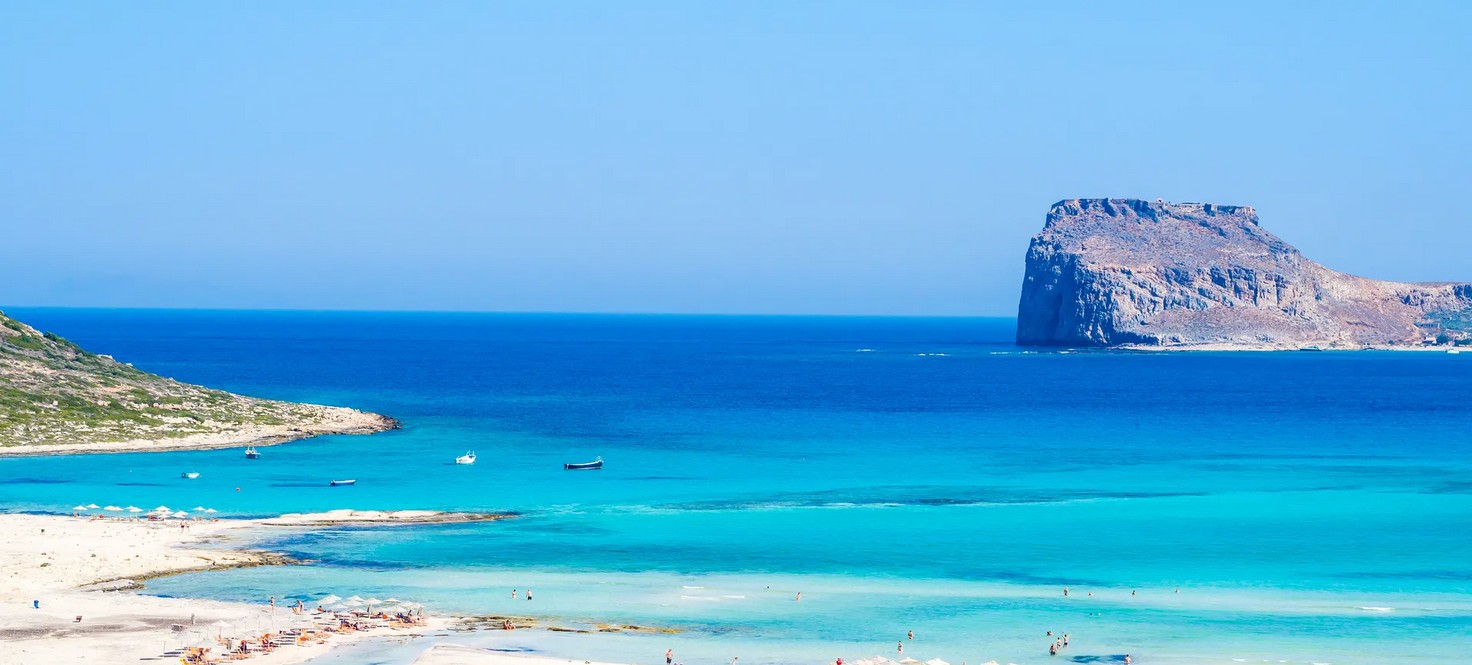
Balos is a lagoon on the Gramvousa peninsula in north-west Crete, Elafonisi is a protected pink-sand islet off the south-western corner of Crete, and Preveli is a palm-lined beach in the Rethymno regional unit where the Megalopotamos river meets the Libyan Sea.
The Balos lagoon spreads between the islet of Imeri Gramvousa and the coast of Crete, and the rocky Cape Tigani, Greek for frying pan, rises from its water. North of Balos, at Cape Korykon, lie the ruins of Agnion, a small Roman town with a temple of Apollo.
Elafonisi beach takes its name from the Greek for Deer Island and belongs to the Kissamos municipality. Its pink sand comes from pigmented microorganisms that live in symbiosis with the native seaweed, and the islet ranks among the environmentally protected areas of Crete. A plaque on its highest point recalls Easter Sunday, 18 April 1824, when Ottoman soldiers killed or enslaved between 640 and 850 refugees sheltering there.
Preveli beach lies below the Preveli Monastery, where the Megalopotamos leaves the Kourtaliotiko gorge and forms a lagoon. The Preveli palm beach is lined by a 1 to 2 km grove of Phoenix theophrasti, the Cretan date palm that also grows at Vai in eastern Crete and one of the two native palm species of the Mediterranean basin. A fire on 22 August 2010 burned close to 70% of the grove, which regenerated naturally by 2011. The monastery sheltered Australian soldiers in 1941 until a submarine took them off Preveli beach. It keeps two complexes 2 km apart: the ruined Lower Monastery of St John the Baptist and the working Rear Monastery of St John the Theologian.
- Balos: A Balos boat trip sails from the port of Kissamos and adds the fort on Imeri Gramvousa to the day.
- Elafonisi: Visitors walk from the main beach to the islet through the shallow water when the weather is fine.
- Preveli: Small boats run from Plakias, and a path along the river links the Kourtaliotiko gorge with the beach.
Where was Zeus born, according to the myths of Crete?
The myths of Crete place the birth of Zeus in two caves: the Dictaean Cave at Psychro on the Lasithi Plateau and the Idaean Cave on Mount Ida, or Psiloritis, where the goat Amalthea fed him and the Kouretes hid his cries from Cronus.
Day tours to the Cave of Zeus above the Lasithi plateau, the Sfendoni and Melidoni caves, the Agia Sofia cave and the Matala caves are compared on the Crete cave tour page.
Hesiod’s Theogony, composed around 730 to 700 BC, sends Rhea to Lyctus in Crete to give birth, and Gaia hides the newborn in a cave on Mount Aegaeon while Cronus swallows a stone wrapped in swaddling clothes. The mythographer Apollodorus moves the birth to a cave on Mount Dikte, where the nymphs Adrasteia and Ida raise Zeus on the milk of Amalthea and the Kouretes guard the cave, beating their spears on their shields.
Arthur Evans and David Hogarth identified Psychro Cave with the Dictaean Cave around 1900, a link that later scholars dispute, and its finds now sit in the Heraklion Museum, the Ashmolean, the Louvre and the British Museum. The Lasithi Plateau around the cave lies at an average 840 m and once held around 10,000 white-sailed wind-pumps. The Idaean Cave opens on a plateau of Mount Ida, at 2,456 m the highest mountain of Crete, and excavations there since 1884 have yielded bronze shields.
- Amalthea: The goat, or the nymph with a goat, that nursed Zeus; her horn became the cornucopia, and the poet Aratus linked her with the star Capella.
- Kouretes: Armed guardians who clashed spears on shields at the cave entrance so that Cronus never heard the infant cry.
- Europa: A Phoenician princess whom Zeus, disguised as a white bull, carried over the sea to Crete, where she bore Minos, Rhadamanthus and Sarpedon.
- Minos: The king of Knossos who kept the snow-white bull of Poseidon instead of sacrificing it, a choice Poseidon punished with the birth of the Minotaur.
- Minotaur: The bull-headed son of Pasiphaë, locked in the Labyrinth that Daedalus built near Knossos and killed by Theseus with the thread of Ariadne.
Every nine years, Minos demanded 14 young Athenians, 7 men and 7 women, as tribute for the creature. The story of the Minotaur and the Labyrinth of Knossos ties the myths of Crete to the palace at Knossos and to the Minoan civilization that Arthur Evans named after the king.
Which boat trips and sea activities does Crete offer?
Crete offers boat trips and fishing trips from Chania, Rethymno, Heraklion and Agios Nikolaos, snorkelling over sunken Olous and the shallows of Chrissi, scuba dives along the 1,046 km coast of Crete, and skippered yacht charters between the Sea of Crete and the Libyan Sea.
The 1-hour jet boat ride from Hersonissos port, with spins at speed and a snorkel stop, is covered on the Crete jet boat page.
Semi-submarine trips from Agios Nikolaos and the old port of Chania are covered on the Crete submarine page.
Self-drive boats without a licence and private motorboats or RIBs with an optional skipper, from Almyrida and Kalyves to Kissamos, Hersonissos and Agios Nikolaos, are compared on the Crete boat rental page.
Boat trips in Crete start from the four northern harbours, and each harbour serves a different stretch of sea:
- Chania: Boats leave the old Venetian harbour and pass its lighthouse on the way out to the Gulf of Chania.
- Rethymno: Cruises depart from the small Venetian harbour near the Fortezza, one of the best-preserved castles in Crete.
- Heraklion: Boats pass the Koules fortress, the Venetian Castello a Mare, on the 7-nautical-mile crossing to Dia.
- Agios Nikolaos: Tourist boats cross Mirabello Bay, the largest bay of the Greek islands, to Spinalonga, and the kri-kri islet of Agioi Pantes lies off the town.
Pirate-ship cruises from Hersonissos, Heraklion, Rethymno and Elounda have their own Crete pirate boat trip page.
For snorkelling in Crete, swimmers in the bay of Elounda reach the sunken city of Olous, where scattered wall bases show through the water. Around Chrissi, the shallow bays of Belegrina, Hatzivolakas and Kataprosopo hold a wide diversity of shells, and on Dia, day visitors swim and snorkel in the four south-coast coves, where camping is not allowed. Scuba diving in Crete meets wreck history: Jacques Cousteau surveyed Dia in 1976 and found the remains of an ancient port and the French ship La Thérèse, sunk on 24 June 1669 during the siege of Candia, while the steamer Imperatrix has rested off the cliffs of Elafonisi since 22 February 1907.
A Crete yacht charter gives a private group a skippered sailing yacht or motor yacht for the day, with routes to Balos and Gramvousa in the west or Spinalonga and Mirabello Bay in the east. Fishing trips in Crete go out on local boats from the same harbours, and Kissamos and Ierapetra keep working fishing harbours on the north-west and south coasts.
How do you get to Crete by air and sea?
Crete takes flights from Athens and Europe at 3 airports, Heraklion Nikos Kazantzakis (HER), Chania Ioannis Daskalogiannis (CHQ) and Sitia (JSH), and overnight ferries from Piraeus dock at Heraklion and at Souda, the port of Chania, 7 km east of the old town.
The Heraklion airport sits 5 km east of the city centre and ranks as the second-busiest airport in Greece after Athens International, and a replacement airport is under construction at Kasteli, 39 km south-east of Heraklion. The Chania airport stands on the Akrotiri peninsula, 14 km from Chania, and carries the name of Daskalogiannis, the 18th-century Sfakiot rebel against Ottoman rule. Sitia airport opened on 9 June 1984, 1 km from the town, and bears the name of the poet Vitsentzos Kornaros, born in Sitia in 1553. Domestic flights from Athens reach the island in under 1 hour.
Car ferries leave Piraeus, the port of Athens, in the evening and dock on the island at dawn. ANEK Lines, founded by Cretans in 1967 with its head office in Chania, and Minoan Lines, whose Knossos Palace and Festos Palace sail to Heraklion, run the overnight crossings. The Athens to Crete ferry and flight comparison weighs the 9-to-10-hour sailing against the 55-minute flight, the how to get to Crete guide maps every arrival route, and high-speed catamarans on the Santorini to Crete ferry reach Heraklion in 1 hour 35 minutes. Each port serves its own routes:
- Heraklion: Piraeus, the Cyclades and the Dodecanese.
- Souda: Piraeus, with daily ANEK Lines sailings.
- Kissamos: Kythira, Antikythira, Gytheio and Piraeus.
- Rethymno: Santorini, with Seajets excursion sailings.
- Sitia: Piraeus, the Cyclades and the Dodecanese, with Blue Star Ferries.
How do you get around Crete?
Crete has no railway, so island travel runs by road: a hire car on the VOAK north-coast highway, KTEL coaches between towns, or a taxi or pre-booked transfer. Chania to Heraklion covers 145 km in 2 hours, and the island spans 260 km.
Days with your own driver or licensed guide, on a route you choose from the hotel or the cruise port, are covered on the Crete private tour page.
Guided tuk tuk rides through Heraklion, Hersonissos, Malia, Sissi and Chania are covered on the Crete tuk tuk tour page.
A car rental in Crete reaches the gorges, hill villages and south-coast beaches that coaches skip, with desks at Heraklion and Chania airports and at the ports. The VOAK, Greek National Road 90, links Kissamos with Sitia through Chania, Rethymno, Heraklion and Agios Nikolaos, and east of Chania it carries European route E75, which starts at Vardø in Norway and ends at Sitia, the southernmost point of the E-road network. Only the bypasses around Chania, Rethymno and Heraklion run as 4-lane motorway. The driving in Crete guide covers the hairpin mountain roads, the sparse inland fuel stations and the unsealed track to Balos.
Two KTEL companies run the intercity coaches: KTEL Chania-Rethymno in the west and KTEL Heraklion-Lasithi in the centre and east. Their routes cover the whole Region of Crete except Loutro and Agia Roumeli, 2 south-coast villages without a road link that boats serve from Chora Sfakion, Sougia and Paleochora. Heraklion has 2 regional bus stations. Taxis wait at the airport and port ranks, and pre-booked Crete transfers put a driver with a name board in the arrivals hall or at the ferry ramp. Key road distances:
- Chania to Georgioupoli: 39 km east.
- Heraklion to Malia: 34 km east.
- Heraklion to Agios Nikolaos: 64 km east.
- Heraklion to the Lasithi Plateau: 70 km, at 840 m altitude.
- Heraklion to Phaistos: 62 km south.
Where is the best place to stay in Crete?
Crete splits into 5 bases: Chania and its Venetian harbour for the west, Rethymno for a midway stay, Heraklion or Hersonissos for Knossos and the airport, Agios Nikolaos and Elounda on Mirabello Bay, and Plakias or Paleochora on the quiet south coast.
The base sets the length of every day trip, and the where to stay in Crete guide matches each town to its beaches and sights. Heraklion suits a first or last night beside the airport and the ferry quay. Each base serves a different trip:
- Chania: a Venetian old town around the harbour, with day trips to Balos, Elafonisi and the Samaria Gorge.
- Rethymno: the Fortezza citadel, a compact old town and a long sandy beach beside the centre.
- Heraklion and Hersonissos: the archaeological museum and Knossos on the city side, water parks and a harbour promenade on the resort side.
- Agios Nikolaos and Elounda: an inner lake ringed by cafes, the calm water of Mirabello Bay and boats to Spinalonga.
- South coast: Plakias on a 1.5 km beach and Paleochora on a 700 m peninsula facing the Libyan Sea.
Hotel types follow the regions. Restored Venetian mansions in the old towns of Chania and Rethymno hold boutique rooms, while five-star resorts with private-pool villas line Mirabello Bay around Elounda, as the Crete luxury hotels guide details. Large beach complexes fill the Hersonissos, Stalis and Malia strip east of Heraklion and the coast from Rethymno to Georgioupoli, the 2 zones mapped in all-inclusive resorts in Crete. Hersonissos sits 25 km from Heraklion airport and adds the hill village of Koutouloufari above the resort.
How long do you need in Crete?
Crete needs 7 days to cover the west, the centre and the east, while 5 days cover Chania and Heraklion and 3 days fit a single region. Each region earns its own base: Knossos lies 5 km from Heraklion but 150 km from Chania.
One base per region cuts packing and road time. The Crete 3-day itinerary stays in a single town, the Crete 5-day itinerary adds one move from the west to the centre, and the Crete 7-day itinerary runs west to east without doubling back:
- 3 days: a Chania base for the harbour, the Samaria Gorge and Balos or Elafonisi, or a Heraklion base for Knossos, the archaeological museum and the Lasithi Plateau.
- 5 days: 3 nights in Chania, then a day-4 drive east past Rethymno and the Arkadi Monastery, 23 km south-east of Rethymno, to a Heraklion base.
- 7 days: 3 nights near Chania, then a second base further east for Knossos on day 5 and for Agios Nikolaos, Elounda and Spinalonga on days 6 and 7.
Three day trips set the pace of every plan. The Samaria Gorge walk runs 15 km from the Omalos plateau to Agia Roumeli, lasts 5 to 7 hours and ends with a boat, because Agia Roumeli has no road. Knossos and the Heraklion Archaeological Museum, which displays the finds from the palace, share a second day. Spinalonga, a Venetian island fortress and a leper colony from 1904 to 1957, takes half a day by boat from Plaka, 750 m across the water.
Is Crete good for families, honeymoons and winter trips?
Crete suits all three: families get the shallow beaches of Georgioupoli and Almyrida plus the Cretaquarium, couples get the Elounda resorts and the Venetian harbours of Chania and Rethymno, and winter visitors get mild coastal cities with snow on the White Mountains.
Families who want a day of slides and pools can compare Acqua Plus, Watercity and Limnoupolis on the Crete water park page.
Families get calm water and short drives. Georgioupoli sits at the head of Almyros Bay, where 3 rivers meet the sea beside long sandy beaches, and Almyrida, 20 km from Chania, keeps a long village beach. The Cretaquarium near Gournes, 15 km east of Heraklion, shows Mediterranean sharks and rays, and pedal boats cross Lake Kournas, the only freshwater lake on Crete. The Crete with kids guide adds the Water City and Limnoupolis water parks and a myth-first visit to Knossos.
Couples split their days between resort privacy and old-town evenings. Elounda, 12 km from Agios Nikolaos along the shore road, holds five-star villas with private pools that overlook Mirabello Bay and Spinalonga. Chania adds the 1864 lighthouse on its Venetian harbour, and Rethymno adds a small Venetian harbour and 16th-century lanes. The Crete honeymoon guide pairs those bases with beach days at Balos, Elafonisi and Seitan Limania and a stay in car-free Loutro. Winter trips centre on Chania, Rethymno and Heraklion, which stay open all year:
- Weather: the coast stays mild, and snow falls on the White Mountains, Psiloritis and the Lasithi range between November and April.
- Sunshine: the south coast logs more than 3,257 hours of sun a year, and Crete holds the European heat records for October, November, January and February.
- Closures: the Samaria Gorge shuts from 1 November to 30 April, and beach resorts close from November to March.
- Traditions: the olive harvest runs from November to January, and Epiphany water blessings fill the harbours on 6 January, as the Crete in winter guide details.
What is Cretan cuisine, and which dishes define Crete?
Cretan cuisine is the plant-based food tradition of Crete, built on barley rusks, wild greens, pulses, sheep and goat cheeses and olive oil. The dishes that define Crete are dakos, kalitsounia, staka, gamopilafo, chochlioi snails, graviera and mizithra cheese, horta and tsikoudia.
Farm tours with fresh tastings of dragon fruit grown near Heraklion are covered on the Crete dragon fruit farm page.
Tastings of graviera, xinomyzithra and the other island cheeses, at farms, wineries and cooking classes, are compared on the Crete cheese tasting page.
The Cretan diet entered medical science in 1948, when the Rockefeller Foundation surveyed island households at the invitation of the Greek government. Ancel Keys then placed Crete among the 16 cohorts of the Seven Countries Study, which enrolled 12,763 men aged 40 to 59 from 1958, and the Cretan men showed the lowest coronary death rates of all. Orthodox fasts of 180 to 200 days a year kept meat and dairy off the table, and UNESCO listed the Mediterranean diet as Intangible Cultural Heritage in 2010.
- Dakos: a barley paximadi rusk softened with water, topped with grated tomato, mizithra or feta, oregano and olive oil, also called koukouvagia, “owl”.
- Kalitsounia: small pies filled with mizithra or wild herbs, salty or honey-topped in Chania and sweet with cinnamon in Lasithi.
- Staka: fermented sheep’s-milk cream cooked with flour; the fat that separates is stakovoutyro, and staka me avga pairs it with fried eggs.
- Gamopilafo: the wedding pilaf, rice cooked in goat and rooster broth and enriched with staka butter.
- Chochlioi boubouristoi: land snails fried with rosemary and vinegar.
- Graviera and mizithra: Graviera Kritis is a PDO sheep’s-milk cheese ripened for at least five months; mizithra is a whey cheese, sold fresh or salted and aged as xynomizithra.
Horta, boiled wild greens, arrive with oil and lemon, as does stamnagathi, a spiny wild chicory. Tsikoudia, the grape-pomace spirit of Crete, is distilled once to 40% to 65% alcohol by one or two licensed distillers per village over two to three weeks in late October and early November; the east of the island calls it raki. A Crete food tour links these tastes in one outing, a Crete cooking class teaches the recipes by hand, and each city runs its own tasting: a Heraklion food tour in the capital and a Chania food tour in the west.
Which music, poetry and people shaped the culture of Crete?
The culture of Crete rests on the three-string Cretan lyra and the laouto, on 15-syllable mantinades, rizitika songs and the pentozali dance, on the Erotokritos of Vitsentzos Kornaros, and on two Cretans known worldwide: the painter El Greco and the writer Nikos Kazantzakis.
Village evenings of dinner, lyra music and dances such as the pentozali are covered on the Cretan night page.
Workshops where visitors throw a pot on the wheel or fire raku with a Cretan potter are compared on the Crete pottery class page.
The Cretan lyra is a pear-shaped, three-string bowed instrument held upright on the lap, its strings stopped from the side with the fingernails, not pressed onto a fingerboard. The laouto, a long-neck lute with four pairs of strings, plays the rhythm beside it. Over this duo, singers trade mantinades, rhyming couplets in 15-syllable verse on love or satire, named after the Venetian matinada, “morning song”. Rizitika are the oldest song form of Crete; rizes means “roots”, the foothills of the White Mountains, Ida and Dikti. These songs are sung, not danced, and divide into songs of the table and songs of the road. They come mainly from western Crete, where the museums of Chania display finds from the region’s prehistoric and historic periods.
The pentozali, the trademark dance of Crete, means “five steps” yet runs through 10 moves. Dancers link shoulders while the leader improvises leaps, the lyra carries the tune and the laouto beats the rhythm; the music is credited to the violinist Stefanos Triantafillakis in 1770–1771.
Vitsentzos Kornaros, born near Sitia in 1553, wrote the Erotokritos in the Cretan dialect: 10,012 rhymed 15-syllable verses on the love of Erotokritos and Aretousa, and its couplets serve as mantinades. Doménikos Theotokópoulos, known as El Greco, was born on Crete in 1541, trained there as a post-Byzantine painter and signed his canvases in Greek letters with the word Κρής, “Cretan”. The Historical Museum of Crete in Heraklion shows his View of Mount Sinai and Baptism of Christ, his only works on the island, and the Antibes study of Nikos Kazantzakis. Kazantzakis, born in Heraklion in 1883 and author of Zorba the Greek, lies on the Martinengo Bastion, the highest point of the Venetian walls of Heraklion, under the epitaph “I hope for nothing. I fear nothing. I am free.”
Which monasteries of Crete are worth a visit?
The monasteries of Crete worth a visit are Arkadi, the national sanctuary of the 1866 revolt, Preveli on the south coast, Toplou in the far east, Chrysoskalitissa above the Libyan Sea, and the Akrotiri pair of Agia Triada Tzagarolon and Gouverneto near Chania.
Arkadi stands at 500 metres on the northwest side of Mount Ida, 23 km southeast of Rethymno; its church façade dates from 1586. In November 1866 it sheltered 964 people, 325 of them men and 259 armed, against 15,000 Ottoman troops with 30 cannons. Abbot Gabriel Marinakis refused to leave; when the attackers reached the powder room, Konstantinos Giaboudakis set the gunpowder barrels alight, and 846 of the 964 died. Victor Hugo and Giuseppe Garibaldi wrote in support of the Cretans, Crete marks the anniversary on 8 November, and UNESCO has named Arkadi a European Monument of Freedom. The Arkadi Monastery page tells the full story.
- Preveli: a ruined lower monastery of St John the Baptist and a working rear monastery of St John the Theologian, 2 km apart above the south coast of Crete; in 1941 abbot Agathangelos Lagouvardos sheltered Allied soldiers, and a group of Australians escaped by submarine from Preveli beach.
- Toplou: a fortified monastery 6 km north of Palekastro in Lasithi, named after the Turkish word top, “cannon”, for the gun once mounted over its door; its bell tower of 1558 rises 33 m.
- Chrysoskalitissa: a 17th-century monastery on rocks 35 m above the Libyan Sea, 72 km southwest of Chania; local tradition holds that one of its 90 steps is golden and visible only to believers.
On the Akrotiri peninsula, Agia Triada Tzagarolon, 15 km from Chania, was rebuilt from 1611 by the monk Jeremiah Tzagarolos to his own design after the Italian architect Sebastiano Serlio, and his brother Laurentios continued the work until the Ottomans took Chania in 1645. Gouverneto, Our Lady of the Angels, founded between 1537 and 1548, is a Venetian-style fortress 5 km further north; a footpath runs from it past the Arkoudiotissa cave and down 140 steps to the abandoned, cliff-built Katholiko monastery. The Akrotiri peninsula of Crete page covers both.
Which outdoor adventures can you try in Crete?
Outdoor adventures in Crete include jeep safaris over mountain plateaus, ATV quad tours on dirt tracks, horse riding, hot-air balloon flights, canyoning down the 26 abseils of the Ha Gorge, and hiking the E4 European long-distance path across the island.
Guided canyoning with rappels and jumps in the Kourtaliotiko and Diplochahalo gorges is covered on the Crete canyoning page.
A jeep safari in Crete suits the high plateaus. The Omalos Plateau lies 38 km south of Chania inside the White Mountains, whose summit, Pachnes, reaches 2,453 m, and shepherds there make graviera in round stone huts called mitata. In the east, the Lasithi Plateau spreads 11 km by 6 km at an average altitude of 840 m, where white-sailed wind-pumps irrigated the fields from the 1920s onwards. An ATV quad tour in Crete covers dirt tracks on a four-wheeled machine with low-pressure tyres, handlebars and a straddle seat, steadier than a motorcycle at low speed.
Crete has its own horse, the Messara, a native mountain pony present on the island for at least 1,000 years and named after the Messara Plain. It stands 127 to 142 cm, keeps its footing on rocky ground and moves in a natural pacing gait that is comfortable to ride; a studbook has protected the rare breed since 1994. Riders can join horse riding in Crete on country trails, and a hot-air balloon flight over Crete lifts a wicker basket beneath a nylon envelope whose air a propane burner heats.
Canyoning moves through a gorge by walking, scrambling, jumping, abseiling and swimming. The Ha Gorge in eastern Crete, named after the Cretan verb hasko, “to gape”, runs 1.5 km between walls up to 300 m high, narrows to 1.5 m and holds 26 abseils of 10 to 45 m. For distance, the E4 European long-distance path, a route of more than 10,000 km that ends in Cyprus, arrives by ferry from Gythio at Kastelli Kissamou and crosses Crete from the Chania region to Lasithi. A branch starts west of the Nida Plateau, at 1,400 m, and climbs to Timios Stavros, the summit of Mount Ida and the highest point of Crete at 2,456 m.
Crete Guide FAQ
What is the best time to visit Crete?
The best time to visit Crete is between April and October when the weather is sunny and perfect for exploration. Spring offers scenic hiking with wildflowers, while summer invites for swimming, and autumn provides a pleasant climate with fewer crowds.
What are some top activities to do in Crete?
Top activities include exploring ancient ruins such as the Palace of Knossos, hiking the Samaria Gorge, indulging in cooking classes, and participating in wine and olive oil tasting tours. Don’t miss the vibrant marine life through scuba diving adventures.
What are the must-visit places in Crete?
Must-visit places include the cities of Heraklion and Chania for their historical and cultural riches, the beautiful beaches of Elafonissi and Balos, and the traditional village of Kritsa for authentic experiences. Don’t forget to explore hidden villages for genuine Cretan hospitality.
What kind of accommodations can I expect in Crete?
Crete offers a wide range of accommodations to fit every traveler’s needs, from luxury resorts with private beach access to charming boutique hotels nestled in quaint villages. You can tailor your choice based on your activities and experiences planned.
What culinary experiences should I not miss in Crete?
Indulge in rich culinary experiences including wine tastings at local vineyards, olive oil tours, and traditional Greek cooking classes. Try local dishes featuring fresh, locally sourced ingredients and sample the diverse flavors of typical Cretan cuisine.