
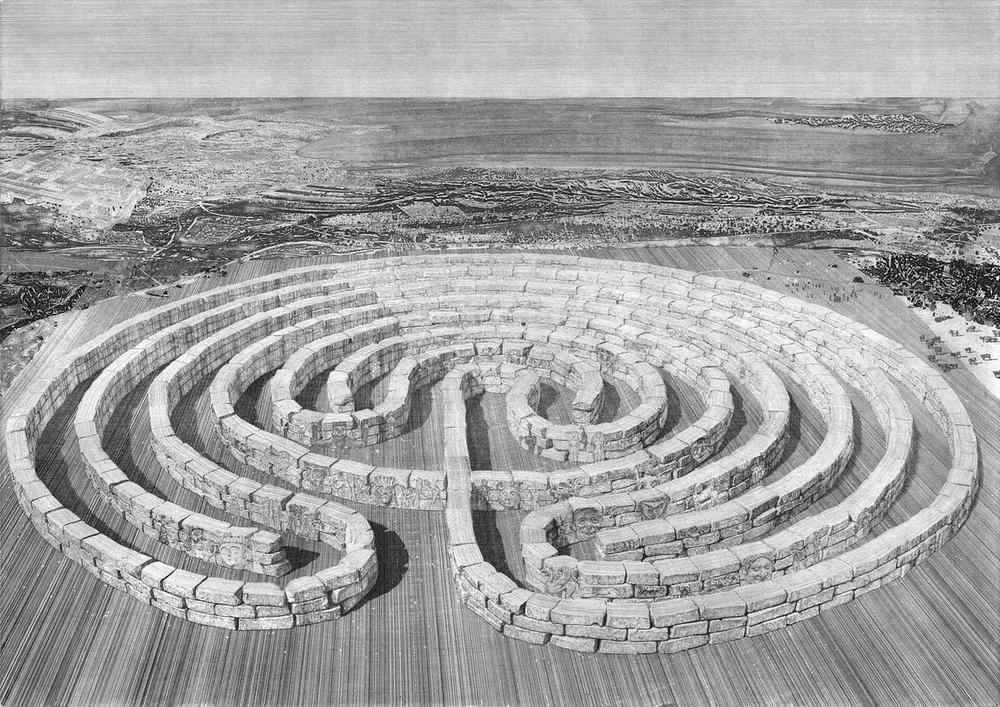
The Minotaur and the Labyrinth are the famous myth of Knossos, where Theseus slew the bull-headed beast in King Minos’s maze. Plan tickets and tours through My Greece Tours.
The legend is woven into the story of the Palace of Knossos. The sections below cover the myth, whether Knossos is the labyrinth, who the Minotaur and King Minos were, the roles of Daedalus and Ariadne, how the legend links to the real palace and whether you can see the labyrinth today.
What is the myth of the Minotaur and the Labyrinth?
The myth tells of the Minotaur, a creature half-man and half-bull, kept by King Minos of Crete in a vast labyrinth beneath his palace. Athens sent youths as tribute until the hero Theseus killed the beast and escaped with Ariadne’s thread.
The myth of the Minotaur and the Labyrinth is one of the most famous in all Greek mythology, and it is set at Knossos. King Minos of Crete kept a monstrous creature, the Minotaur, half-man and half-bull, hidden within a vast and bewildering labyrinth built beside his palace by the master craftsman Daedalus. To feed the beast, the city of Athens was forced to send young men and women as tribute to be devoured.
The hero Theseus, prince of Athens, volunteered to be among the tribute in order to kill the Minotaur and end the horror. On Crete, Minos’s daughter Ariadne fell in love with him and gave him a ball of thread to unwind as he entered the maze. Theseus slew the Minotaur in the heart of the labyrinth and followed the thread back out to safety.
The tale of courage, love and the inescapable maze has captivated audiences ever since, retold by Greek poets and painted on countless vases. It carries themes that still resonate: the monster within, the debt of tribute, the thread of guidance through confusion. Our guide to the mysteries of the Palace of Knossos explores its legends.
The story does not end with the killing of the beast. Sailing home, Theseus abandoned Ariadne on the island of Naxos, where the god Dionysus found and married her, and then forgot to change his ship’s black sails for white. Seeing the black sails from afar, his father Aegeus believed his son dead and threw himself into the sea, which took his name as the Aegean. The myth thus binds triumph to tragedy at every turn.
Is Knossos the Labyrinth of Knossos from the myth?
Knossos is traditionally identified as the site of the mythical labyrinth, and its huge, complex, multi-storey layout of corridors and rooms likely inspired the legend. No literal maze survives, but the palace’s confusing plan gave rise to the Labyrinth of Knossos.
Knossos is traditionally identified as the home of the mythical labyrinth, and most scholars believe the palace itself inspired the legend. The Minoan palace was enormous and astonishingly complex, a sprawling, multi-storey structure of hundreds of interconnected rooms, twisting corridors, staircases, light-wells and storerooms, so intricate that a first-time visitor could easily feel lost among its passages.
To people in later ages, the ruins of such a vast and confusing building could readily be imagined as a labyrinth. There is no literal maze or hidden tunnel housing a monster at the site; the labyrinth is a myth. Yet the connection between the maze-like architecture of Knossos and the legend is widely accepted, and the fame of one has long fed the fame of the other.
The very word labyrinth is possibly linked to the labrys, the double-headed axe that was a sacred Minoan symbol found carved throughout the palace. On this reading, the labyrinth was originally the house of the double-axe, the palace of Knossos itself, and only later became the winding maze of legend. Our guide to the key features of Knossos Palace covers its complex layout.
The excavator Arthur Evans reinforced the identification when he uncovered the palace in the early twentieth century. Struck by its scale and complexity, he named the Minoan civilisation after King Minos and often spoke of the site in terms of the labyrinth legend. His reconstructions, from the throne room to the grand staircase, deliberately evoked the mythic palace, so that today’s visitor meets a Knossos already half-shaped by the story it inspired.
Who were the Minotaur and King Minos?
King Minos was the legendary ruler of Crete, a son of Zeus, who built a great sea power from Knossos. The Minotaur, the bull of Minos, was a monster with a man’s body and a bull’s head, born to Minos’s wife Pasiphae.
King Minos is the legendary king of Crete who ruled from Knossos, described in myth as a son of the god Zeus and a powerful monarch who commanded a great fleet and dominated the Aegean. So central was he that the whole civilisation was later named Minoan after him. In the legends he is a figure of authority and dread, demanding tribute from Athens and enforcing his will across the sea.
The Minotaur, whose name means the bull of Minos, was a monstrous being with the body of a man and the head of a bull. It was born to Minos’s wife Pasiphae after a curse involving a magnificent bull sent from the sea, a creature Minos had failed to sacrifice. Ashamed of the monster, Minos had Daedalus build the labyrinth to confine it away from human sight.
The pairing of the powerful king and the terrible beast lies at the heart of the legend. In later Greek belief Minos became so associated with justice that he served as a judge of the dead in the underworld, a striking afterlife for the king whose palace held the maze. The father who ruled the sea and the son-monster hidden in the dark are two faces of the same dark story.
Ancient writers also gave Minos a family of famous figures, which knits the myth into the wider Greek tradition. His wife Pasiphae was a daughter of the sun, his daughter Ariadne became the bride of Dionysus, and his craftsman Daedalus fathered the doomed Icarus. Around the single hall of Knossos, the legend gathers gods, inventors, princesses and monsters into one closely linked web of story.
What roles did Daedalus and Ariadne play?
Daedalus was the master craftsman who designed the labyrinth for Minos, then fled Crete on wings of feathers and wax. Ariadne, Minos’s daughter, loved Theseus and gave him the ball of thread that let him escape the maze after killing the Minotaur.
Daedalus is the ingenious inventor of the myth, credited with building the labyrinth so cunningly that even he could barely find the way out. When his part in Theseus’s escape angered Minos, Daedalus was imprisoned, and he famously fashioned wings of feathers and wax to fly from Crete with his son Icarus, who fell to the sea when he flew too near the sun.
Ariadne is the pivotal human figure who turns the story. As the daughter of Minos, she held the secret of the maze, and her love for Theseus led her to hand him the clue, the ball of thread that unwound behind him. Her gift gave the language a lasting phrase, Ariadne’s thread, for any method that guides a person through a bewildering problem.
Together the two supply the myth’s cleverness and its heartbreak. Daedalus embodies human skill turned to both the maze and the escape, while Ariadne embodies love and betrayal, since Theseus later abandoned her on the island of Naxos. Their roles show that the legend is as much about wit and feeling as about the monster at its centre.
How does the myth connect to the real palace?
The myth reflects real features of Minoan Knossos: the maze-like palace inspired the labyrinth, the bull was a central sacred symbol, and the powerful sea-kingdom of Minos echoes the real Minoan civilisation of the Bronze Age Aegean.
The legend is not pure invention; it reflects real aspects of Minoan Knossos, transformed by memory and imagination. The maze-like complexity of the palace inspired the idea of the labyrinth. The bull, central to the Minotaur myth, was genuinely a sacred and prominent symbol at Knossos, appearing in the famous bull-leaping frescoes, in sculpted horns of consecration around the site, and in ritual vessels shaped as bulls’ heads.
The figure of King Minos and his sea power also echoes reality. The Minoan civilisation was a sophisticated, prosperous Bronze Age culture that dominated the Aegean through trade and seafaring from its base at Knossos, exactly the kind of power the legendary Minos commands. Ancient writers even spoke of a Minoan thalassocracy, a rule of the sea, that matches the archaeology of a far-reaching trading network.
Later Greeks who encountered the ruins and memories of this lost civilisation used the myth to explain the grandeur and mystery of Knossos. A giant, half-ruined palace of endless rooms, decorated with bulls and marked with the double-axe, invited a story of a maze, a monster and a sea-king. Our guide to the Minoan civilization at Knossos covers the real culture behind the legend.
Can you see the Labyrinth of Knossos today?
There is no literal labyrinth to see at Knossos, since it is a myth, but visiting the palace lets you experience the maze-like complex that inspired it. Walking its corridors and interconnected rooms gives a vivid sense of the confusion that seeded the legend.
Visitors sometimes arrive at Knossos expecting a literal labyrinth or a hidden lair of the Minotaur, but there is none, because the labyrinth belongs to myth rather than reality. What you experience instead is the extraordinary palace whose maze-like architecture gave rise to the legend. Walking through its surviving corridors, staircases, light-wells and hundreds of interconnected rooms conveys how confusing the complete multi-storey building once was.
This is, in a way, the most authentic encounter with the labyrinth available: standing in the real place that inspired one of the world’s most enduring myths. A guide can point out the features that fed the legend, from the complex plan to the omnipresent bull symbolism, bringing the story to life among the ruins. The restored throne room and grand staircase help visitors picture the palace at its height.
The Heraklion Archaeological Museum deepens the encounter. There the bull-leaping fresco, the bull-headed rhyton and other objects from Knossos put the real bull cult in front of you, the imagery that the Minotaur myth drew on. Seeing these pieces and then walking the palace, or the reverse, lets the legend and the archaeology explain each other rather than compete.
For anyone drawn to the tale of Theseus and the Minotaur, exploring Knossos with the myth in mind is deeply rewarding. Reading the site as both a real Bronze Age palace and the seed of a legend gives a double pleasure, part archaeology and part storytelling. Plan your visit and tours through our Palace of Knossos guide.
Where does the myth come from and what might it mean?
The myth likely grew from Athenian memory of Minoan power, dramatised as a debt of tribute. The bull-headed Minotaur and the maze echo real Minoan bull rituals and the palace’s plan, reshaped by later Greeks into a hero-tale of Theseus.
Historians read the tribute of Athenian youths as a folk memory of a time when mainland Greek towns paid dues to a dominant Crete. In this view the story preserves, in mythic form, the real dominance of Minoan Knossos over the early Aegean, later inverted into a heroic tale in which Athens throws off Cretan control through the courage of Theseus. The myth thus carries political memory as well as monsters.
The number of victims, seven youths and seven maidens sent at intervals, hints at a ritual pattern rather than a random tale. Scholars have connected it to cycles of the calendar and to initiation rites, in which the young faced a symbolic ordeal before entering adult life. Whether or not real tribute was ever paid, the tidy count gives the legend the shape of a remembered ceremony, a rite dressed as a story of a monster and a maze.
The Minotaur itself may reflect Minoan religion rather than a real beast. Bull imagery saturates Knossos, from the daring bull-leaping frescoes to the stone horns of consecration and the bull-shaped rhyta used in ritual. A priest or performer in a bull mask, or the sheer strangeness of these bull cults to outsiders, could easily be remembered and exaggerated into a bull-headed man devouring victims in a dark maze.
The tale also works as timeless allegory, which helps explain its endurance. The labyrinth stands for confusion and the unconscious, the Minotaur for the monstrous within, and Ariadne’s thread for the reason or love that guides a person out. Read as history, ritual or symbol, the myth keeps yielding meaning, and Knossos remains the place where all three readings meet.
Its afterlife stretches far beyond Crete. Roman mosaics laid out the maze in stone, medieval churches set labyrinths into their floors as paths of pilgrimage, and modern writers from the poets to the novelists have returned again and again to the image of the maze and the beast at its heart. Few stories rooted in a single ancient building have travelled so widely or lasted so long, which is part of what makes standing at Knossos feel like reaching the source.
Frequently Asked Questions
Is the Labyrinth of Knossos real?
The labyrinth of the Minotaur is a myth, so there is no literal maze or monster’s lair to find at Knossos. The palace, however, is widely believed to have inspired the legend. The Minoan palace was an enormous, multi-storey complex of hundreds of interconnected rooms, twisting corridors and staircases, so intricate that it could easily seem like a labyrinth to people of later ages.
The word labyrinth may even be linked to the labrys, the sacred double-headed axe found throughout the site, suggesting the name first meant the house of the double-axe. So while the labyrinth itself is legendary, the maze-like reality of Knossos is very much real and can be explored today.
What is the connection between Knossos and the Minotaur?
Knossos is the setting of the myth of the Minotaur, the creature half-man and half-bull that King Minos of Crete kept in a labyrinth built beside his palace. The hero Theseus came from Athens and killed the Minotaur, escaping the maze with the help of Princess Ariadne and her thread.
The connection reflects real features of Minoan Knossos: the maze-like palace inspired the labyrinth, the bull was a central sacred symbol seen in the bull-leaping frescoes and horns around the site, and the powerful sea-king Minos echoes the real Minoan civilisation that dominated the Bronze Age Aegean from Knossos.
Who killed the Minotaur at Knossos?
In the myth, the Minotaur was killed by Theseus, the hero prince of Athens. Athens had been forced to send young men and women as tribute to be devoured by the Minotaur in the labyrinth of King Minos at Knossos, and Theseus volunteered to be among them in order to slay the beast.
On Crete, Minos’s daughter Ariadne fell in love with Theseus and gave him a ball of thread to unwind as he entered the maze. Theseus killed the Minotaur in the heart of the labyrinth and then followed the thread back out to escape. The tale of courage and the inescapable maze remains one of the most famous in Greek mythology.
Who built the Labyrinth of Knossos in the myth?
In the legend, the labyrinth was built by Daedalus, the master craftsman and inventor who worked at the court of King Minos. Minos ordered the maze to confine the Minotaur, and Daedalus designed it so cunningly that its winding passages made escape almost impossible for anyone who entered.
Daedalus later fell foul of Minos for helping Theseus and Ariadne, and fled Crete on wings of feathers and wax, losing his son Icarus in the flight. His double role, as the maker of the maze and as the ingenious escapee, makes him one of the most memorable figures in the whole cycle of Knossos legends.
What is Ariadne’s thread?
Ariadne’s thread is the ball of string that Princess Ariadne gave Theseus so he could find his way out of the labyrinth. He tied one end near the entrance and unwound it as he pushed deeper into the maze, so that after killing the Minotaur he simply followed the thread back to the door and freedom.
The image has outlived the myth as a phrase for any method that guides a person through a bewildering problem step by step. In logic, computing and everyday speech, an Ariadne’s thread is a way of keeping track of your path so you can retrace it, a small detail of the Knossos legend that entered the language for good.