
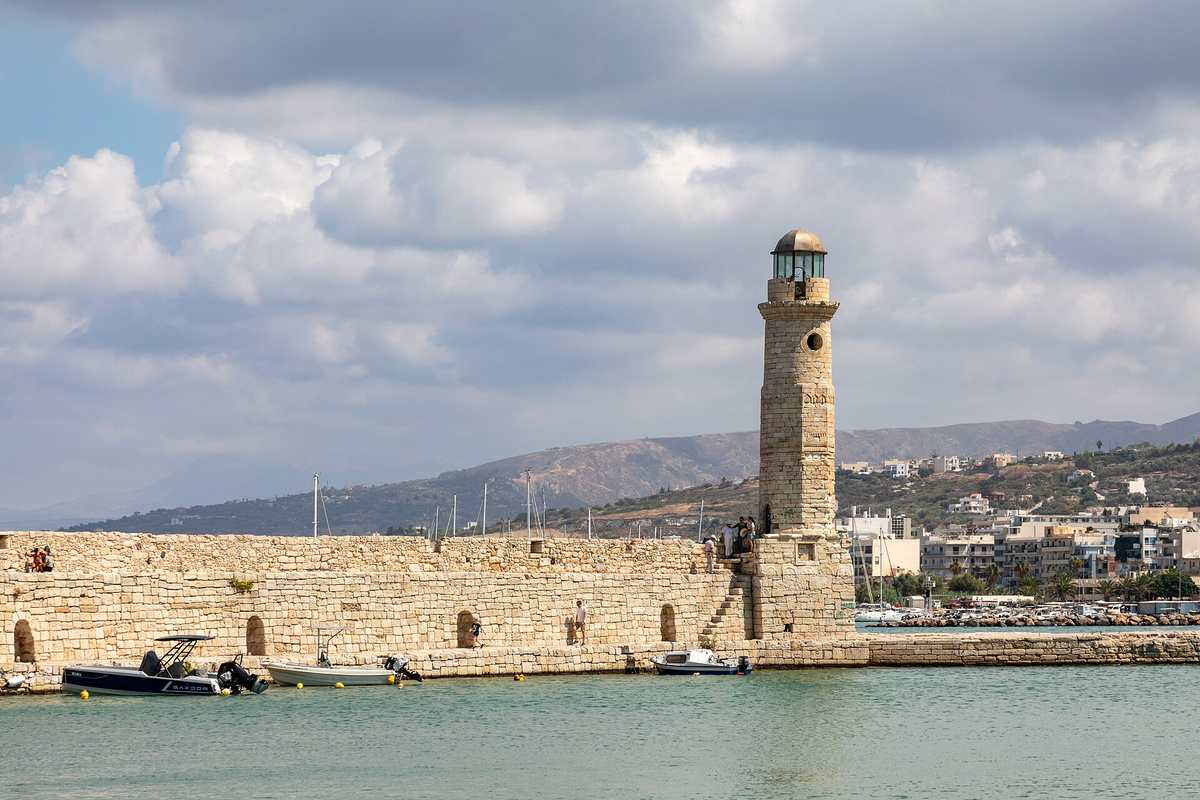
Rethymno sits on the north coast of Crete, halfway between Chania and Heraklion. It holds the best-preserved Renaissance old town on the island, a tight grid of Venetian and Ottoman lanes running below the Fortezza fortress. The Rimondi Fountain still pours through its carved lion spouts, the Neratze mosque keeps its Ottoman minaret, and the small Venetian harbour ends in a stubby lighthouse. A long sandy town beach stretches east from the centre. This guide maps the old town, the fortress, the food scene and the day-trip beaches and monasteries you can reach inland, and it opens with My Greece Tours.
Rethymno is Crete’s third city and a working university town, which keeps its cafes, tavernas and bars busy year-round rather than only in July. The old town rewards slow walking: minarets, wooden Turkish balconies, Venetian doorframes and the Fortezza’s ramparts sit within a ten-minute stroll of each other. For the wider island context, see the Crete travel guide before you plan routes west or south. The sections below cover the old town layout, the Fortezza, the beach and food scene, the inland trips to Preveli, Arkadi and the Amari Valley, and how Rethymno works as a touring base.
What makes Rethymno old town special on Crete?
Rethymno keeps the best-preserved Renaissance old town on Crete, a walkable grid of Venetian doorways and Ottoman minarets below the Fortezza, centred on the lion-spouted Rimondi Fountain and a small Venetian harbour with a lighthouse.
The old town fills the low ground between the Fortezza hill and the sea, and its lanes are narrow enough that traffic mostly stays out. Venetian merchants laid the street grid, so you pass carved stone doorframes, coats of arms and loggias. Ottoman additions then layer on top: wooden balconies that overhang the alleys, fountains and the minaret of the Neratze mosque, now a music school. The Rimondi Fountain, built by a Venetian governor, still runs water through three lion-head spouts under Corinthian columns. Rethymno changed hands from Venice to the Ottoman Empire in the middle of the seventeenth century. Both rulers left their mark on the same twenty streets.
The quarter therefore reads as two overlapping cities rather than one, packed into six or seven walkable blocks around the central fountain.
You can cross the whole historic core on foot in fifteen minutes, but the point is to get lost in it. Start at the Rimondi Fountain, thread down toward the Venetian harbour with its ring of fish tavernas and the little lighthouse on the mole, then climb back up Ethnikis Antistaseos past leather workshops and bakeries. The Archaeological Museum and the Historical and Folklore Museum both sit inside the quarter and give context to the stonework outside. Evening is the best time to walk here. The day-trip crowds thin, the wooden balconies glow under lamplight, and the smell of grilled fish drifts up from the harbour tavernas below.
Among things to do in Crete, this compact old town is one of the easiest to enjoy on foot without a rental car.
How do you visit the Fortezza fortress in Rethymno?
The Fortezza crowns the Paleokastro hill above the old town. You enter through the main gate, walk the star-shaped ramparts for sea and rooftop views, and see the domed Sultan Ibrahim mosque and rebuilt bastions inside the walls.
The Venetians built the Fortezza on the Paleokastro headland in the late sixteenth century. Corsair raids had shown the town needed a proper stronghold. It is one of the largest Venetian fortresses in the Mediterranean, a low star-shaped ring of bastions designed to deflect cannon fire rather than the tall walls of an older castle. You climb up from the old town in ten minutes and enter through the eastern gate. Inside, the standout building is the central mosque with its wide dome, converted from a Catholic cathedral after the Ottoman capture, along with restored powder magazines, a small church and the rectangular counterscarp walls.
The ramparts give the clearest overview of how the old town, harbour and the modern city all fit together on the shore below, seen from the walls of the Fortezza above the harbour.
Walk the full circuit of the walls for the payoff. From the seaward bastions you look straight down at the surf and out along the north coast; from the landward side you see the tiled roofs and minarets of the quarter you just left. The open interior hosts the Rethymno Renaissance Festival in summer, when concerts and plays use the ramparts as a stage. Bring water and a hat, since the site is exposed with little shade. Pair the fortress with the Archaeological Museum, which stands just outside the gate in a former Ottoman prison building.
Together the two give you the military and the everyday sides of the same story, and the climb from the old town is gentle enough for most visitors to manage comfortably on foot.
What is the beach and food scene like in Rethymno, Crete?
A long sandy beach runs east from Rethymno’s old town along the coastal avenue, lined with sunbeds and cafes. The food scene leans on Cretan cooking: raki, dakos, snails and grilled fish in the harbour and old-town tavernas.
The town beach starts right at the edge of the old quarter and runs east for roughly twelve kilometres of soft sand backed by the seafront road, so you can swim without leaving the city. Sunbeds, showers and cafes line the first stretch; walk or drive further and the crowds thin toward the resorts of Platanias and Adelianos Kampos. The water shelves gently, which suits families, though the exposed north coast can pick up afternoon wind and chop. For quieter swimming, locals head a short way east or west of the built-up centre toward calmer coves.
The beach and the old town sit close enough that you can spend a morning on the sand and an afternoon among the Venetian lanes without ever moving your car. Just south of town, the Myli gorge threads past ruined watermills under plane trees.
Rethymno eats well because it is a real town, not only a resort. Cretan cooking dominates the menus: dakos rusks topped with tomato and mizithra cheese, snails in rosemary, slow-cooked lamb, wild greens, and gamopilafo rice at celebrations, washed down with tsikoudia, the local raki. The Venetian harbour tavernas serve fish by the kilo with a sea view, while the old-town lanes hide family kitchens and modern bistros run by returning graduates. Rethymno is a university city, so it also keeps a young bar and cafe culture alive around Petihaki square and the harbour front.
The food here rates as a step more local and less packaged than the tourist strips further along the coast toward Heraklion, and prices sit lower too. Reserve a harbour table for sunset in high summer.
Which day trips and hidden gems in Crete start from Rethymno?
Rethymno reaches Preveli palm-beach and its river, the Arkadi Monastery, and the green Amari Valley below Psiloritis. West lie Chania and Elafonisi; east lies Knossos, so the town works as a hub for both halves of the island.
Head south over the mountains and you reach Preveli, where a palm-lined river meets a cove of coarse sand below a clifftop monastery; you park above and walk down, or arrive by boat from Plakias. Inland sits the Arkadi Monastery, the most important historical site in the region. Its defenders blew up the powder store during the uprising against Ottoman rule rather than surrender, and the ruined refectory and ossuary make it a national symbol. West of the monastery the Amari Valley threads between old stone villages, frescoed Byzantine churches and olive terraces under the bulk of Psiloritis, the island’s highest mountain at 2,456 metres.
These inland routes are where you find the quieter, greener side of the region, and the valley chapels rank among the genuine hidden gems in Crete that most coastal visitors never reach.
Rethymno’s position halfway along the north coast makes it a strong touring base in both directions, with quiet seaside villages such as Panormos a short drive east. Drive west on the national road and you reach Chania and its Venetian harbour in under an hour, with the pink-sand lagoon of Elafonisi beach a longer push into the far southwest corner of the island. Drive east and the Minoan palace at Knossos is reachable as a half-day trip; see Knossos from Rethymno for the route and timing. Fewer visitors base themselves here than in Chania or Heraklion, yet Rethymno sits closer to the island’s middle, which cuts your daily driving in half whichever way you choose to explore.
That central footing is the town’s practical trump card for a road trip that wants to reach both ends.
How long should you stay in Rethymno on a Crete trip?
Two nights cover Rethymno’s old town, Fortezza and beach at an easy pace. Three or four nights let you add Preveli, Arkadi, the Amari Valley and a day trip west to Chania or east toward Knossos without rushing.
A first evening and full day are enough to see the historic core. The list runs to the Rimondi Fountain, the harbour and lighthouse, the Neratze minaret, the two town museums and a full circuit of the Fortezza, with a swim off the beach to finish. That gives you the shape of the city and its two-empire history in a relaxed twenty-four hours. Rethymno makes a natural stop on a north-coast itinerary. It breaks the run between Chania and Heraklion almost exactly in the middle, so most travellers spend one or two nights here and treat the old town as a walkable, car-free base before pushing on to the next stop.
Even a short stay leaves a strong impression, since the whole centre sits within a ten-minute walk. South of the town, the Platys river carves the wild Prassano Gorge for experienced hikers.
Stretch to three or four nights and Rethymno turns from a stop into a hub. Give one day to the south coast for Preveli and the drive over the mountains. Give a second day to Arkadi and the Amari Valley for history and village lunches. Keep a third day flexible for a longer run to Chania in the west or the Minoan sites in the east. That rhythm balances town time with the interior and both coasts while keeping your drives short. Families and slower travellers can happily fill five nights by adding beach days and a boat trip.
The town itself has enough range, from Venetian ruins to harbour restaurants to swimming, that it rarely feels like you have run out of things to do.
What do Rethymno tours see at Margarites, Melidoni and Eleftherna?
Rethymno tours on the hinterland loop see Margarites, the pottery village where workshops still throw and fire clay pots, the cave of Melidoni, with its great chamber of stalactites and the memorial to the villagers who died there in 1824, and ancient Eleftherna, a Dorian city with a necropolis and a modern museum.
Margarites sits on a hillside of olive groves, its lanes lined with potters’ workshops and a square with a view to the sea. The clay of the area has fed the village kilns for centuries, and the workshops sell everything from small bowls to the tall storage jars of the Cretan tradition.
The Melidoni cave, above the village of the same name, opens into a huge chamber of dripstone. In 1824, during the Greek War of Independence, the Ottoman army sealed its entrance with fire and smoke, and the villagers sheltering inside died; a memorial stands in the chamber. Eleftherna, nearby, has one of the most important excavations of Crete, with its finds shown in the museum beside the site.
The necropolis of Orthi Petra at Eleftherna yielded the burials of warriors and noblewomen with gold jewellery and weapons, and the museum beside the site shows the finds in modern halls next to the excavation.
- Margarites – the village of potters and kilns.
- Cretan storage jars – the traditional pots of the workshops.
- Melidoni cave – the great chamber of dripstone.
- 1824 memorial – the villagers who died in the cave.
- Ancient Eleftherna – the Dorian city and its necropolis.
- Eleftherna museum – the finds of the excavation.
Our Margarites page covers the village. Rethymno tours drive the loop in half a day from the town.
What do Rethymno tours see at the Kourtaliotiko and Kotsifou gorges?
Rethymno tours at the Kourtaliotiko and Kotsifou gorges drive through two narrow ravines that cut the mountains between the north and the south coasts, see the waterfalls and springs of Kourtaliotiko below the chapel of Agios Nikolaos, and join river trekking tours that wade and swim down the gorge to Preveli.
The road to the south coast runs through the bottom of both gorges, with cliffs rising on either side and birds of prey circling above. In Kourtaliotiko, a stairway leads down from the road to the chapel and to the springs where the river of Preveli begins, with small waterfalls between the rocks.
The gorge takes its name from the sound of the wind whistling through the rocks. River trekking tours walk, wade and swim along the stream with guides and wetsuits, ending at the palm beach of Preveli.
- Kourtaliotiko gorge – the ravine of the whistling wind.
- Kotsifou gorge – the narrow road to Plakias.
- Waterfalls and springs – the source of the Preveli river.
- Agios Nikolaos chapel – the church in the gorge.
- River trekking – the wade and swim down to Preveli.
- Birds of prey – the vultures and eagles over the cliffs.
Our Kourtaliotiko gorge and Kotsifou gorge pages cover both ravines. Rethymno tours stop at the springs on the way south.
What do Rethymno tours see on the south coast?
Rethymno tours on the south coast see Plakias, a resort in a wide bay under the mountains, the sandy coves of Damnoni and Ammoudi next to it, the village of Spili with its Venetian fountain of lion heads, the harbour village of Agia Galini, and the wild beaches of Triopetra and Agios Pavlos below the Kedros mountains.
Plakias has a long beach, tavernas and walking paths along the cliffs to the neighbouring coves, and it is the base for the boat trips to Preveli. Damnoni and Ammoudi, a short walk away, are small sandy bays with clear water.
Spili, on the road south, is a mountain village where a long row of Venetian lion heads pours spring water into a trough, and Agia Galini is a steep harbour village of terraces and restaurants over the sea. Further west, Triopetra and Agios Pavlos are quiet beaches of sand and rock with few buildings.
Plakias is also a base for walks to the villages of Myrthios and Sellia on the hills above the bay, with paths through olive groves and views over the Libyan Sea at sunset.
The harbour of Agia Galini runs small boats along the coast to nearby beaches and to Preveli, and the terraces of the village face west over the Libyan Sea, which makes it a favourite place for dinner at sunset after a day on the south coast.
- Plakias – the resort bay of the south coast.
- Damnoni and Ammoudi – the sandy coves beside Plakias.
- Spili – the village of the lion-head fountain.
- Agia Galini – the harbour village on the terraces.
- Triopetra – the beach of the three rocks.
- Agios Pavlos – the dunes and coves of the south.
Our Plakias and Agia Galini pages cover the coast. Rethymno tours reach Plakias in about 40 minutes.
What do Rethymno tours see in Anogia and on Mount Psiloritis?
Rethymno tours in the mountains see Anogia, the village of shepherds, weavers and lyra musicians on the slopes of Psiloritis, the Nida plateau above it, the Ideon cave where myth says the infant Zeus was raised, and the summit of Psiloritis, at 2,456 m the highest point of Crete.
Anogia was burned by the German army in 1944 and rebuilt, and it keeps the strongest traditions of the Cretan mountains: black-shirted shepherds, woven blankets hung outside the shops, and the lyra music of its famous players. Its tavernas roast lamb in the antikristo style, on skewers around an open fire.
A road climbs from Anogia to the Nida plateau at about 1,400 m, a flat grazing basin ringed by peaks. From there a path leads to the Ideon cave, a shrine of Zeus since Minoan times, and the long hike to the summit of Psiloritis starts from the same plateau.
Anogia’s weavers sell blankets, bags and rugs in bright patterns, and its musicians have given Crete some of its best-known lyra players and singers, among them Nikos Xylouris.
The Nida plateau also holds the Partisan, a land-art monument of stones laid on the ground in the shape of a winged figure, visible in full only from the slopes above, in memory of the Cretan resistance.
- Anogia – the village of shepherds, weavers and musicians.
- Lyra music – the tradition of the village players.
- Antikristo lamb – the lamb roasted around the fire.
- Nida plateau – the grazing basin at about 1,400 m.
- Ideon cave – the cave where Zeus was raised in myth.
- Psiloritis – the 2,456 m summit of Crete.
Rethymno tours to Anogia and Nida take a full day and join the jeep safaris of the mountain.
Which beaches do Rethymno tours visit?
Rethymno tours visit the long sandy beach of the town, the resort beaches of Platanes and Adelianos Kampos to the east, the coves of Bali and Panormos on the north coast, Preveli, Plakias, Damnoni and Triopetra on the south coast, and the wide beach of Episkopi and Georgioupoli to the west.
The north coast east of the town is one long stretch of sand, lined with hotels and beach bars, with shallow water for families. Bali, a village of small bays under cliffs, and Panormos, with a small harbour and a sandy cove, are quieter options on the road to Heraklion.
The south coast beaches face the Libyan Sea and are wilder and clearer, and they are the choice when the summer north wind raises waves on the north coast. Preveli, with its river and palms, is the best known, and Plakias and its coves have the most facilities.
The beaches east of the town catch the summer north wind, which raises waves in the afternoon, so families swim there in the morning and spend the windy hours in the old town.
- Rethymno beach – the long sand by the town.
- Platanes and Adelianos Kampos – the resort coast to the east.
- Bali – the small bays under the cliffs.
- Panormos – the harbour and sandy cove.
- Preveli and Plakias – the south coast favourites.
- Triopetra – the wild beach of the south.
Our Triopetra page covers the south coast beach. Rethymno tours pick the coast by the wind of the day.
What food and wine do Rethymno tours taste?
Rethymno tours taste the dishes of the Cretan mountains and villages, such as gamopilafo, the wedding pilaf of rice cooked in meat broth, antikristo lamb of Anogia, kalitsounia and staka, the graviera cheese of Psiloritis, Cretan olive oil, raki and the wines of local grapes from the wineries of the unit.
Rethymno’s food comes from the shepherd culture of Psiloritis and the olive groves of the lowlands. Gamopilafo, served at weddings and feasts, is rice cooked in rich lamb or goat broth with butter and lemon, and staka is a thick cream of sheep milk butter eaten with bread or eggs.
The cheeses of the mountain villages, above all graviera and the soft anthotyro, are sold at the dairies of Anogia and the Amari valley. Wine tours visit estates in the hinterland, and every village taverna ends the meal with raki.
- Gamopilafo – the wedding pilaf of the villages.
- Antikristo – the fire-roasted lamb of Anogia.
- Staka – the sheep milk butter cream.
- Graviera – the hard cheese of Psiloritis.
- Olive oil – the oil of the lowland groves.
- Raki – the spirit of every village meal.
Our Rethymno food tour page covers the tastings. Rethymno tours eat in the old town lanes in the evening.
Which boat trips and outdoor activities do Rethymno tours offer?
Rethymno tours offer sailing catamaran cruises from the town harbour, boat trips from Plakias and Agia Galini to Preveli and the south coast caves, river trekking in the Kourtaliotiko gorge, gorge walks at Patsos and Kotsifou, quad and jeep safaris through the villages, and hikes on Psiloritis.
The catamaran cruises leave the Venetian harbour for a day along the north coast, with swimming stops, lunch on board and views back to the Fortezza. On the south coast, small boats run from Plakias and Agia Galini to Preveli beach and to sea caves along the cliffs.
On land, the Patsos gorge in the Amari hills is a short, shaded walk with pools and a chapel, and quad and jeep safaris follow dirt roads through the olive groves to villages, monasteries and viewpoints. Psiloritis offers a full-day hike to the summit from the Nida plateau.
Walkers follow the E4 path across the unit, from the slopes of Psiloritis through the villages of the Amari valley to the south coast, with village guesthouses for overnight stops.
- Catamaran cruises – the day sails from the old harbour.
- South coast boats – Plakias and Agia Galini to Preveli.
- River trekking – the Kourtaliotiko gorge to the sea.
- Patsos gorge – the shaded walk of the Amari hills.
- Quad and jeep safaris – the village routes.
- Psiloritis hike – the summit from Nida.
Our Rethymno boat trips page covers the cruises. Rethymno tours book the boats and safaris a day ahead.
Frequently Asked Questions
Where is Rethymno and how do you get there?
Rethymno lies on the north coast of Crete, roughly midway between Chania to the west and Heraklion to the east, about seventy kilometres from each. The E75 national road runs along the coast and links all three cities, so the drive from either airport takes around an hour in normal traffic. Chania airport is the closer of the two arrival points for most European flights, though Heraklion airport handles more traffic overall. Intercity KTEL buses run frequently along the coast and stop at Rethymno’s bus station near the centre, making the town reachable without a rental car.
Rethymno has a small port used mainly by seasonal ferries rather than a main year-round crossing, so most visitors arrive by road. The old quarter, harbour, Fortezza and town beach all sit within walking distance of one another, so you only need a car for the inland trips to Preveli, Arkadi and the green Amari Valley.
What are the main landmarks to see in Rethymno old town?
The Fortezza dominates the skyline: a huge star-shaped Venetian fortress on the Paleokastro hill with a domed mosque, restored bastions and wide sea views. Below it, the Rimondi Fountain pours through three carved lion-head spouts under Corinthian columns and marks the heart of the old town. The Venetian harbour curves round to a small stone lighthouse and rings itself with fish tavernas. The Neratze mosque keeps its Ottoman minaret and now serves as a music conservatory, one of the tallest points in the quarter. Wooden Turkish balconies, Venetian doorframes and stone coats of arms line the lanes in between.
The Archaeological Museum sits just outside the fortress gate, and the Historical and Folklore Museum occupies a Venetian mansion in the centre. All of these landmarks lie within a ten-minute walk of one another, which is what makes Rethymno so easy to explore on foot without any car or bus transport at all.
Is Rethymno a good base for exploring Crete?
Rethymno makes an excellent base because it sits almost exactly halfway along the north coast, which shortens the drive to both ends of the island. West on the national road you reach Chania and its Venetian harbour in under an hour, with the southwest beaches beyond. East you reach Heraklion and the Minoan palace of Knossos within a comfortable half day. Directly south, over the spine of the mountains, lie Preveli beach with its palm-lined river, the Amari Valley below Psiloritis and the historic Arkadi Monastery, all reachable as day trips. The town itself gives you an old town, a fortress, museums and a long sandy beach, so evenings are covered without any driving.
Rethymno draws fewer overnight visitors than Chania or Heraklion, which keeps prices and crowds a little lower while leaving you central. For anyone wanting one base for a whole Cretan trip, the town balances location, character and quiet better than either bigger city.