
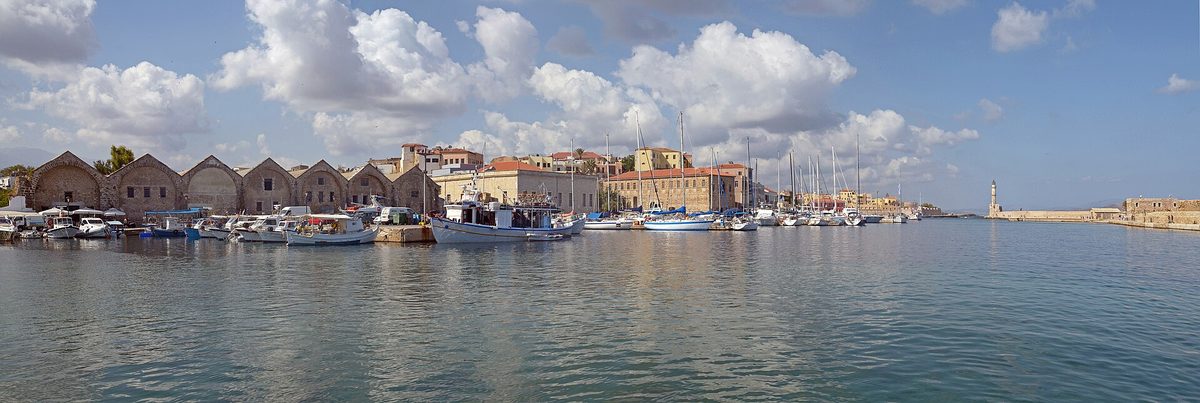
Chania sits on the north-west coast of Crete, the island’s second city and its most photographed harbour. Pastel Venetian buildings ring the waterfront, and a stone Venetian lighthouse marks the tip of the harbour mole. Behind the quay stretches an old town of narrow Venetian and Ottoman lanes, arched doorways, and shaded courtyards. The city keeps its own airport and serves as the gateway to west Crete, where the Samaria Gorge and the beaches of Balos and Elafonisi lie within reach. Cretan tavernas fill with the smell of grilled fish and raki at dusk. Plan your visit to Chania with My Greece Tours.
This page introduces Chania as a base for exploring the western third of Crete, from its harbourfront monuments to the day trips that begin at its port and bus station. Read it alongside our Crete travel guide for wider context on the island. The sections below cover the Venetian harbour and lighthouse, the old town’s fortresses and market, the tavernas and food culture of the waterfront, the day trips west and south, and the practical routes that connect Chania to the rest of Crete by road, air, and ferry.
What makes Chania’s Venetian harbour the landmark of Crete’s north-west coast?
Chania’s Venetian harbour curves around a sheltered basin, lined with pastel buildings and closed at its mouth by a stone lighthouse on the mole. The Venetians built it as a naval port during their rule.
The Venetians developed Chania’s harbour during their control of Crete from the thirteenth century onward, shaping the basin that still defines the city today. Ships once loaded grain and wine here for Venice, and the waterfront warehouses that stored those cargoes now hold cafes and tavernas. A curving mole runs out from the eastern quay and ends at the lighthouse, an Egyptian-era reconstruction of the original Venetian beacon. Walking its length gives a full view back across the pastel facades to the White Mountains rising inland. Explore more things to do in Crete once you have found your footing on this stretch of waterfront.
The harbour changes character through the day, which is part of its appeal for visitors staying nearby. Morning light falls on the eastern buildings and the fishing boats moored along the inner quay, while the afternoon warms the western facades near the Firkas Fortress. At dusk the tavernas set out their tables and the lighthouse switches on, drawing walkers along the mole for the view. The Mosque of the Janissaries, a domed Ottoman building at the harbour edge, now hosts exhibitions and marks the transition from Venetian to Ottoman rule. Chania rewards a slow circuit of the waterfront on foot, since the basin is small enough to loop in under an hour.
Which old-town monuments should you see on foot in Chania, Crete?
Walk the Firkas Fortress, the Nautical Museum, the covered market, and the leather street of Odos Skridlof, then explore the quieter Splantzia quarter of Venetian and Ottoman lanes east of the harbour.
The Firkas Fortress anchors the western end of the harbour, a Venetian bastion that later served as an Ottoman garrison and now houses part of the Nautical Museum of Crete. Its ramparts give a clear view over the basin to the lighthouse, and the Greek flag was first raised here at the island’s union with Greece. Below the fortress, Odos Skridlof runs as a narrow street of leather workshops selling boots, bags, and sandals made on site. The covered market, or Agora, occupies a cross-shaped stone hall where stalls sell Cretan cheeses, honey, herbs, and raki. These monuments cluster within a short walk of one another.
The Splantzia quarter, east of the harbour, keeps the old town’s quieter side, with shaded squares, churches converted between faiths across the centuries, and lanes of restored Venetian houses. Plane trees shade the main square of Splantzia, where cafes spread tables under the branches. The Etz Hayyim Synagogue, tucked into a lane near the harbour, recalls the city’s Romaniote Jewish community. Chania’s street plan preserves the layers of its rulers, with Venetian doorways, Ottoman fountains, and Byzantine churches standing along the same route. Walking without a fixed plan works well here, since the lanes are short and the harbour is never far. Discover the hidden gems in Crete that hide in these back streets.
What food and evening life define Chania’s waterfront?
Chania’s tavernas serve dakos, boiled wild greens, local cheeses, and raki, with grilled fish along the quay. The waterfront comes alive at dusk as tables fill and the lighthouse lights the harbour mole.
Cretan cooking sits at the heart of Chania’s appeal, built on olive oil, mountain herbs, and the produce of the surrounding valleys. Dakos, a barley rusk topped with grated tomato, soft cheese, and oregano, appears on almost every taverna menu. Boiled wild greens dressed with lemon and oil, known as horta, accompany grilled meat or fish, and the covered market supplies the graviera and mizithra cheeses that flavour Cretan tables. Raki, the clear grape spirit distilled across the island each autumn, arrives at the end of a meal without charge in many places. Eating in Chania means slow courses and shared plates rather than rushed single dishes.
The waterfront reaches its liveliest point at dusk, when the day’s heat fades and tables spill onto the quay. Tavernas along the inner harbour compete for walkers, while quieter courtyards in the back lanes serve residents and returning visitors. Musicians sometimes play the Cretan lyra, the three-string fiddle bowed upright on the knee, at evening gatherings and festivals. The lighthouse switches on as the sky darkens, and its reflection stretches across the basin toward the tavernas. Dining prices near the harbour run higher than in the Splantzia lanes a few streets back, so walking inland finds calmer tables. Chania’s evenings reward lingering, since the pace of the meal is the point.
Which day trips into west Crete start from Chania?
Chania is the gateway to the Samaria Gorge and to the beaches of Balos lagoon and Elafonisi. Boats and buses from the city reach these sites, making Chania the natural base for touring west Crete.
The Samaria Gorge ranks as the headline day trip from Chania, a sixteen-kilometre walk down through the White Mountains to the Libyan Sea at Agia Roumeli. Buses leave Chania early for the Omalos plateau at the gorge’s head, and walkers finish by boat and bus back to the city. The step-by-step of getting from Chania to the Samaria Gorge covers the pre-dawn bus, the walk and the ferry-and-bus return. Reaching the full route and its logistics is covered in our guide to the Samaria Gorge. The gorge opens seasonally once the winter water levels drop, so the walk suits the warmer months. Sturdy shoes and water matter, since the descent is long and the river bed is rocky underfoot.
Balos lagoon and Elafonisi draw visitors for their pale sand and shallow turquoise water at the far west of Crete. Balos sits on the Gramvousa peninsula, reached by boat from Kissamos harbour or by a rough track and a walk down to the sand. Elafonisi lies on the south-west coast, an islet of pink-tinged sand joined to the shore by a wadeable channel. On the west coast, the long pink-tinged sand of Falassarna and, on the south-west shore, the two-beach town of Paleochora with its Venetian castle add two more day trips. The harbour town of Kissamos, which launches the Balos boats, anchors the far west, while Georgioupoli with its long beach and causeway chapel lies an easy drive east. Further across the island, the cross-Crete routes to the cave beach of Matala on the south coast and to the resort bay of Elounda in the east round out the how-to-reach guides. The lake town of Agios Nikolaos sits beyond Elounda in the far east, and the routes off the island to Athens by ferry or flight close the set. The quiet pebble-beach village of Sougia fills a south-west gap on the roadless coast, and the party resort of Hersonissos rounds out the far-east routes. The party strip of Malia lies just beyond Hersonissos in the east, and the ferry on from Chora Sfakion reaches Gavdos, the southernmost island of Europe. On the Rethymno south coast, Plakias pairs a grey-sand bay with the palm-lined Preveli beach, and at the far eastern tip Sitia opens the Vai palm forest and the Minoan palace of Kato Zakros. Further along the south-east coast, Ierapetra is the southernmost town of Europe and the gateway to Chrissi island, while Agia Galini stacks its whitewashed houses above a harbour on the Gulf of Messara near Phaistos and Matala. Close to home, Almyrida pairs a shallow blue-flag bay with the beaches of Kalyves in the Apokoronas, while far east beyond Ierapetra Makrigialos spreads a long warm-water beach under the sunniest sky on Crete. Inland and along the north coast, the Rethymno region adds more: Bali nestles four sheltered coves on the coast between Rethymno and Heraklion, Spili pours spring water from its row of Venetian lion-head fountains, and high on Mount Psiloritis Anogia keeps the weaving, lyra music and mountain cooking of Crete alive. More coast and village stops round out the region: Panormos wraps a stone village around a small Venetian harbour east of Rethymno, the far-eastern hamlet of Mochlos faces a Minoan island across its bay, and close to the city Vamos keeps the restored stone houses and agrotourism of the Apokoronas. Nearer the city and out to the wild east, three more round out the map: Kalives spreads a sandy river-mouth beach on Souda Bay below ancient Aptera, Neapoli is the plane-shaded market town of the Lasithi uplands, and at the far south-east tip Xerokambos hides turquoise coves and a salt lake below Zakros. The west coast and the Apokoronas add a lighter set of days out: Platanias is the lively beach-resort strip just west of the city, Maleme holds the German War Cemetery on Hill 107 and the ground of the Battle of Crete, and inland from Georgioupoli Lake Kournas is the only natural freshwater lake on the island, a turquoise bowl for pedal boats and swimming. Heritage and mountain days round out the region too: Arkadi is the monastery that became the national symbol of Cretan freedom, Argyroupoli pours cold spring water under giant plane trees on the ruins of ancient Lappa, and just south of the city the road threads the Therisso gorge to the village bound to Eleftherios Venizelos. The west coast and the deep south add three more: Kolymbari sits below the fortified Gonia Monastery at the base of the Rodopou peninsula, Agia Marina is the family beach resort facing the Thodorou islet just west of the city, and high in Sfakia the plateau village of Anopoli looks down on Loutro across the Aradena gorge. Three closer villages complete the picture: Stalos is the first beach resort west of the city, Tavronitis sits at its river mouth by the Battle-of-Crete bridge next to Maleme, and Vryses pours spring water under giant plane trees at the gateway to Sfakia. The Akrotiri peninsula on the city’s doorstep holds three of the best: Stavros is the calm lagoon under the mountain of the Zorba the Greek dance scene, Seitan Limania hides a turquoise beach at the head of a fjord between sheer cliffs, and the grand Venetian monastery of Agia Triada makes its own olive oil and wine below the hills. More of Akrotiri and the Apokoronas fills out the map: Kalathas is the shallow Blue-Flag family beach with an islet in its bay, Gouverneto is the fortified monastery whose path drops to the hermit cave and the ruined Katholiko in its gorge, and Gavalochori preserves an Apokoronas stone village of Venetian wells and needle lace. Two of the island’s set-piece sights bookend the map: at the far north-east tip, Vai spreads the largest natural palm forest in Europe behind a curve of golden sand, and on the far south-west coast the white monastery of Chrysoskalitissa stands on its sea rock above the Libyan Sea near Elafonisi. On the Akrotiri peninsula east of the city, the sheltered family coves of Marathi and Tersanas hold calm shallow water a short drive from the old town. On the south coast, the palm-forest river beach of Preveli makes a longer day trip over the mountains. For a shorter, gentler walk, the Imbros Gorge descends 8 kilometres to the south coast, the easy alternative to Samaria. The Sfakia port of Chora Sfakion is the harbour that launches every one of those south-coast boats. Further along the Sfakia coast, the Venetian fortress and shallow beach of Frangokastello and the car-free village of Loutro, reached only by boat, round out the south-coast day trips. Both draw crowds at midday, so early starts reward the effort with quieter water. Chania’s own city beaches, running east along the coast at Nea Chora and beyond, give a swim without the drive.
The city’s position makes it the practical launch point for the western beaches and the monasteries and coves of the Akrotiri peninsula.
How do you reach Chania and travel on to the rest of Crete?
Chania has its own airport on the Akrotiri peninsula and a ferry port at Souda. Roads link it east to Rethymno and Heraklion, connecting the city to central and eastern Crete along the north coast.
Chania International Airport sits on the Akrotiri peninsula east of the city, taking flights from Athens and seasonal routes from across Europe. Ferries from Piraeus dock overnight at Souda, the deep bay a short drive from the old town and overlooked by the ancient hilltop city of Aptera, giving an alternative to flying. The national road runs east from Chania along the north coast to Rethymno and then Heraklion, the island’s capital and largest city. Buses on this corridor are frequent and cheap, while a hire car opens the mountain villages and southern beaches that public transport reaches slowly. Chania works well as a first or last stop on a wider Cretan trip.
Travelling east from Chania puts the Minoan sites of central Crete within a half-day drive, so the city pairs with a run to the island’s archaeological heartland. A guided route covering the palace visit is set out in our page on Knossos from Chania, which handles the driving distance and timing. The finds from those excavations are displayed in the capital, described in our guide to the Heraklion Archaeological Museum. Combining Chania’s Venetian harbour with the Minoan interior gives a trip that spans several eras of the island’s history. The north-coast road ties these stops together, keeping the drives short between the west and the centre of Crete.
What do Chania tours see on the Sfakia coast?
Chania tours on the Sfakia coast see Chora Sfakion, the harbour village at the foot of the White Mountains, Loutro, a car-free village reached only by boat or on foot, the Venetian castle of Frangokastello on its sandy beach, and the gorges of Imbros and Aradena that cut down to the sea.
Sfakia is the mountain region of Crete known for its resistance, a land of mountain shepherds who resisted Venetians and Ottomans for centuries. The road from Chania crosses the White Mountains and drops in hairpin bends to the south coast, with views over the Libyan Sea.
Loutro is a small bay of white houses and blue shutters with no road, served by the coastal boat, and Frangokastello is a square Venetian fort of the 14th century beside a shallow sandy beach. Local legend tells of the Drosoulites, the ghostly figures of rebels who fell there, said to appear in the dawn mist in late spring.
The coastal path of the E4 links Chora Sfakion, Loutro, Marmara and Agia Roumeli along the cliffs, a classic coastal walk of Crete, with the boat for the return when the legs are tired.
The Sfakia villages keep their own customs, from the black shirts and boots of the older shepherds to the mantinades, rhyming couplets sung at weddings and feasts, and the tavernas of Chora Sfakion serve the Sfakian pie fresh from the pan.
- Chora Sfakion – the harbour of the south coast.
- Loutro – the car-free village of the coastal boat.
- Frangokastello – the Venetian castle on the beach.
- Drosoulites – the legend of the dawn ghosts.
- Imbros gorge – the shorter walk down to the coast.
- Aradena gorge – the deep ravine and its bridge.
Our Loutro and Frangokastello pages cover the coast. Chania tours to Sfakia take about 90 minutes over the mountains.
What do Chania tours see at Lake Kournas and Georgioupoli?
Chania tours at Lake Kournas see the only natural freshwater lake of Crete, a deep green lake below the mountains with pedal boats, turtles and tavernas on its shore, and nearby the resort of Georgioupoli, with its long beach, river mouth and the chapel of Agios Nikolaos on a rock in the sea.
Kournas lies in a bowl of hills east of Chania, fed by springs, with its colour changing from turquoise near the shore to dark blue in the centre. The water is cool even in summer, and a path runs around part of the shore.
Georgioupoli, a few kilometres away, is a village at the mouth of a small river lined with eucalyptus trees, with a long sandy beach that runs east toward Rethymno. The little chapel on a rock at the end of a stone causeway is its best-known picture.
The lake is part of a protected wetland, and ducks, coots and herons feed in the reeds along the shore, with the peaks of the White Mountains reflected in the water on calm mornings.
- Lake Kournas – the only natural freshwater lake of Crete.
- Pedal boats – the way to explore the lake.
- Lake turtles – the freshwater turtles near the shore.
- Georgioupoli – the beach village at the river mouth.
- Agios Nikolaos chapel – the church on the sea rock.
- Long beach – the sands east toward Rethymno.
Our Lake Kournas page covers the lake. Chania tours combine Kournas with Rethymno on the same day.
Which war sites and history do Chania tours visit?
Chania tours visit the Souda Bay War Cemetery of the Commonwealth, the sites of the Battle of Crete of May 1941, the Venetian walls and bastions of the town, the village of Theriso where Venizelos led a revolt in 1905, and the archaeological museum with the finds of western Crete.
The Battle of Crete began on 20 May 1941 with the largest German airborne assault of the war. British, Australian, New Zealand and Greek troops and Cretan civilians fought for days around Maleme, Galatas and Chania before the evacuation from the south coast at Sfakia. The war cemetery at Souda Bay holds the graves of the Commonwealth soldiers who fell.
Theriso, in a gorge south of the town, is the mountain village where Eleftherios Venizelos gathered his followers in 1905 in the revolt that led toward the union of Crete with Greece. The museum of the town holds Minoan and later finds of the unit, and the Venetian walls still ring parts of the old town.
The German war cemetery at Maleme, on the hill above the airfield of 1941, holds the German soldiers who fell in the battle, and together the two cemeteries tell both sides of the Battle of Crete.
At Galatas, west of the town, New Zealand and Greek troops and the villagers made a famous counter-attack during the battle, and memorials in the village recall the fighting and the civilians who joined it.
- Souda Bay War Cemetery – the Commonwealth graves of 1941.
- Battle of Crete – the airborne invasion of May 1941.
- Maleme and Galatas – the battlefields west of the town.
- Theriso – the village of the 1905 revolt.
- Venetian walls – the bastions of the old town.
- Archaeological museum – the finds of western Crete.
Chania tours on the history route pair Souda with Theriso and the old town walls.
Which beaches do Chania tours visit?
Chania tours visit Balos, Elafonisi and Falasarna in the west, the long sandy beaches of Agia Marina and Platanias west of the town, Marathi and Stavros on Akrotiri, Seitan Limania in its cove, the pebble bays of Loutro and Marmara on the south coast, and the beaches of Paleochora and Sougia.
The north coast west of the town is a long strip of resorts, with sandy beaches, sunbeds and calm water at Agia Marina, Platanias and Kalamaki. Akrotiri has smaller, quieter bays such as Marathi, with shallow water and fish tavernas, and the shallow round bay of Stavros.
The south coast faces the Libyan Sea, with clear water and fewer buildings. Marmara, near Loutro, is a pebble cove under the mouth of the Aradena gorge, reached by boat or on foot, and Paleochora and Sougia are relaxed villages with long pebble and sand beaches.
Kissamos, on its own bay west of the town, has a long beach and a quiet harbour town. It is the base for the boats to Balos and for the climb to the ancient city of Polyrrinia on the hill above.
- Balos and Elafonisi – the lagoons of the west.
- Falasarna – the sunset beach of the west coast.
- Agia Marina and Platanias – the resort beaches west of the town.
- Marathi and Stavros – the bays of Akrotiri.
- Marmara – the cove at the mouth of the Aradena gorge.
- Paleochora and Sougia – the south coast villages.
Our Platanias page covers the resort coast. Chania tours choose the south coast when the north wind blows.
What food and wine do Chania tours taste?
Chania tours taste boureki, the Chania pie of courgette, potato and mizithra cheese, Sfakian pies drizzled with honey, kalitsounia, staka and gamopilafo, the olive oil of the Kolymvari and Kissamos groves, graviera cheese, raki and the wines of the Romeiko grape from the local vineyards.
The Chania kitchen is built on olive oil, wild greens, cheese and slow-cooked meat. Boureki layers sliced courgette and potato with soft cheese and mint, and the Sfakian pie is a thin cheese-filled round fried and served with thyme honey.
Western Crete is olive country, and olive oil tours visit mills and groves around Kolymvari and Kissamos, where the oil is pressed in autumn. Wineries near the town make wine from local grapes such as Romeiko, and every meal ends with raki and a small sweet.
The cheese makers of the White Mountains produce graviera, mizithra and the soft cheese of the Sfakian pies, and the honey of thyme and pine is sold in every village along the mountain roads.
The street markets of Chania, held on set days in different quarters, sell the fruit, vegetables, cheese and honey of the villages, and the covered market in the centre has bakeries, butchers and spice shops for picnic supplies before a day on the road.
- Boureki – the courgette, potato and cheese pie.
- Sfakian pie – the cheese pie with honey.
- Staka and gamopilafo – the rich dishes of the villages.
- Chania olive oil – the groves of Kolymvari and Kissamos.
- Romeiko wine – the local red grape of Chania.
- Raki – the spirit at the end of every meal.
Our Chania food tour page covers the tastings. Chania tours end in a taverna of the old town.
Which boat trips and outdoor activities do Chania tours offer?
Chania tours offer boat cruises to Balos and Gramvousa, self-drive boats from the harbour, sea kayaking along Akrotiri, the coastal boat of the south coast between Chora Sfakion, Loutro and Agia Roumeli, hikes in the Samaria, Imbros and Aradena gorges, mountain walks in the White Mountains and diving off the north coast.
The south coast boat is a lifeline as much as a cruise: it links villages that have no road, and it carries hikers from the gorge mouths back to the road at Chora Sfakion. From Chania harbour, small boats and self-drive boats without a licence explore the coast west of the town.
The White Mountains offer high walks above the tree line, with the peak of Pachnes at 2,453 m and a lunar landscape of bare rock, and mountain refuges for overnight treks. Sea kayak tours paddle the coast of Akrotiri to caves and coves, and dive centres run trips to reefs and wrecks.
- Balos cruises – the boats from Kissamos.
- Self-drive boats – the small boats of Chania harbour.
- South coast boat – the link between Loutro and Agia Roumeli.
- Gorge hikes – Samaria, Imbros and Aradena.
- White Mountains – the high walks to Pachnes.
- Sea kayaking – the coast of Akrotiri.
Our Chania kayak tour page covers the paddling. Chania tours book the boats a day ahead in July and August.
Frequently Asked Questions
Is Chania or Heraklion the better base for visiting Crete?
Chania suits travellers drawn to atmosphere, west-coast beaches, and mountain walks, while Heraklion suits those focused on Minoan archaeology and central Crete. Chania’s Venetian harbour, old-town lanes, and proximity to the Samaria Gorge, Balos, and Elafonisi make it the more scenic base for a relaxed trip. Heraklion, the island’s capital and largest city, puts the palace of Knossos and the archaeological museum on its doorstep and offers wider ferry and flight connections. The two cities lie about two and a half hours apart by road along the north coast, so a car or bus links them for day trips in either direction.
Travellers with a week often split their stay, starting in Chania for the western sights and moving east to Heraklion for the Minoan interior. Both cities hold airports, so flying into one and out of the other saves backtracking across the island.
When is the best time to visit Chania in Crete?
Late spring and early autumn give Chania its most comfortable conditions, with warm days, sea temperatures that allow swimming, and lighter crowds than the peak summer weeks. The Samaria Gorge opens once winter water levels drop, so the walk becomes possible from the warmer part of spring through to autumn. Midsummer brings the hottest weather and the busiest harbour, with tavernas full and beaches like Balos and Elafonisi crowded by midday. Spring adds wildflowers across the White Mountains and green hillsides that fade to gold by high summer. Autumn coincides with the raki distilling season, when villages fire up their stills and the grape harvest colours the countryside.
Winter turns quiet and cool, with rain and snow on the mountains, though the old town stays open and prices fall. Aim for May, June, September, or early October to balance warm water against manageable crowds in Chania.
How many days should you spend in Chania on a Crete trip?
Two to four days lets you see Chania and use it as a base for the main day trips into west Crete. One full day covers the Venetian harbour, the Firkas Fortress, the Nautical Museum, the covered market, and the Splantzia lanes at a walking pace, with a taverna dinner on the quay. A second day fits the Samaria Gorge, which fills the whole day from the early bus to the evening boat and coach return. A third day reaches Balos lagoon or Elafonisi, each a long outing to the far west of the island.
Add a fourth day to slow the pace, swim at the city beaches near Nea Chora, or drive into the villages of the Akrotiri peninsula and the turquoise cove of Seitan Limania. Travellers touring the wider island often give Chania two nights and move east, while those focused on the west stay longer and treat the city as their hub.
Wander the Chania old town, the Venetian harbour with its lighthouse, the Mosque of the Janissaries and the maze of alleys.
Beyond the town lie the best beaches near Chania — Balos lagoon, Elafonisi pink sand and Falassarna.
For the neighbourhoods, hotels and beach suburbs, see where to stay in Chania.
For the tavernas, Cretan dishes and the covered market, see where to eat in Chania.
For the sights, beaches and experiences, see the full list of things to do in Chania.
For the Samaria Gorge, Balos and Rethymno, see the best day trips from Chania.
For flights, ferries and transfers, see how to get to Chania.
For the weather, the seasons and the best month, see the best time to visit Chania.
Short on time? Follow the perfect one day in Chania itinerary.
For the bars, the Splantzia squares and the beach clubs, see the guide to Chania nightlife.
Travelling as a family? See the guide to Chania with kids.
Island-hopping onward? See how to get from Chania to Santorini.
Crossing the island? See how to get from Chania to Heraklion.
For the monasteries, the tomb of Venizelos and Stavros beach, explore the Akrotiri peninsula.
Still deciding? See the honest case for whether Chania is worth visiting.
For the beach-resort strip west of town, see Platanias, Crete.
Choosing a base? Compare Chania vs Rethymno.
For the Zorba the Greek bay on Akrotiri, see Stavros beach, Crete.
For the car-free Sfakia bay on the south coast, see Loutro, Crete.
For the calm Apokoronas family beach east of town, see Almyrida, Crete.
For the south-west beach town and the boats to Elafonisi and Gavdos, see Paleochora, Crete.
For the authentic Apokoronas beach village next to Almyrida, see Kalyves, Crete.
For the gateway to the wild Sfakia coast and the Samaria return, see Chora Sfakion.
For the quiet south-west beach village and the Agia Irini Gorge, see Sougia, Crete.
For the traditional agrotourism village inland, see Vamos, Crete.
For the closest town beach to the old harbour, see Nea Chora, Chania.
For the calm family beach a short hop west of town, see Agioi Apostoloi, Chania.
For the Battle of Crete history and the war cemetery, see Maleme, Crete.
For the off-grid mountain eco-village in the west, see Milia, Crete.
For the archaeological, maritime and folklore collections, see the Chania museums.
For the lush chestnut village and its festival, see Elos, Crete.
For the ancient sanctuary and wild turquoise cove on Rodopou, see Diktynna, Crete.
For the sandy town beaches and the launch point for Balos, see Kissamos beach.
For the quiet west-coast sunset beach, see Sfinari beach.
For the native Cretan wines and vineyard tastings, see the Chania wineries.
For the calm sandy family cove on Akrotiri, see Kalathas beach.
For the long sandy beach and its island chapel east of town, see Georgioupolis beach.
For a hands-on Cretan kitchen, book a Chania cooking class.
For the Balos cruise, sunset sailings and glass-bottom boats, see Chania boat trips.
Flying in? See the guide to Chania airport.
For the freedom to reach the beaches and gorges, see Chania car hire.
For the turquoise lagoon by boat or road, see how to get from Chania to Balos.
For the pink-sand lagoon by road, bus or boat, see how to get from Chania to Elafonisi.
For the neighbouring Venetian town, see how to get from Chania to Rethymno.