
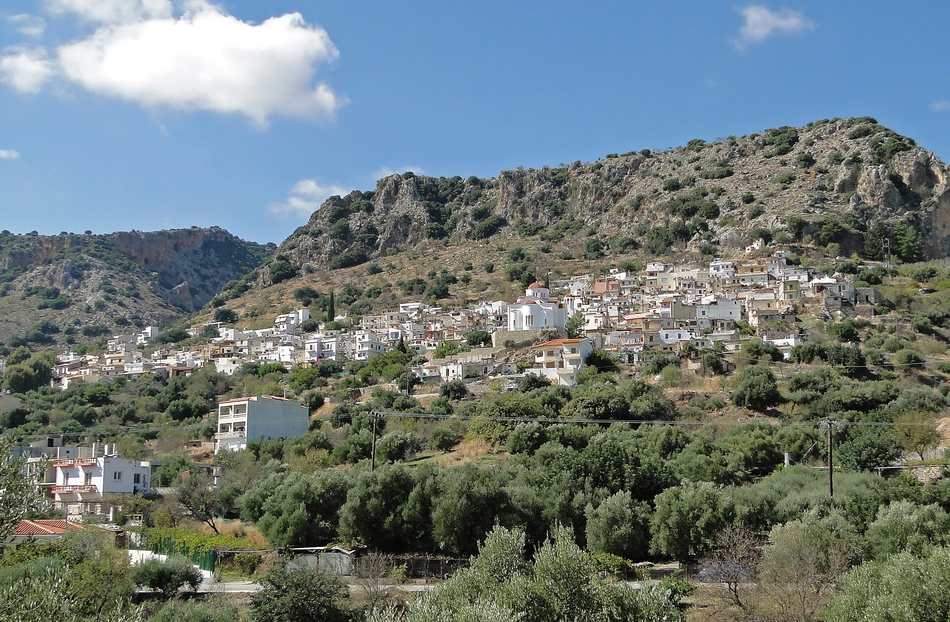
Kritsa spreads across a steep hillside in the Lasithi region of eastern Crete, its whitewashed houses and narrow lanes climbing the slope just minutes inland from the coast. This large traditional village has long been celebrated for its woven textiles, embroidery, herbs and local oil, with craft shops lining the streets. The Byzantine church of Panagia Kera sits just below the village, preserving some of the finest medieval frescoes on the island, while the ruins of ancient Lato command views over Mirabello Bay from the heights above. Explore this authentic mountain settlement and the surrounding region with My Greece Tours.
Kritsa offers an accessible introduction to Cretan mountain village life without straying far from the resort town on the coast. Cafes and tavernas fill the lively central square, and the steep lanes reveal glimpses of daily life unchanged for generations. The sections below cover the village’s craft traditions, its Byzantine and ancient heritage, and practical details for your visit. For broader context on the island’s attractions and itineraries, consult our comprehensive Crete travel guide before planning your journey through the Lasithi region.
What makes Kritsa village special in Crete?
Kritsa preserves traditional mountain village character while remaining easily accessible from the coast. Its steep lanes, craft shops selling textiles and embroidery, and lively central square offer authentic Cretan atmosphere within minutes of Agios Nikolaos and Mirabello Bay.
The village climbs a dramatic hillside in eastern Crete, its whitewashed houses stacked along narrow, winding lanes that reward exploration on foot. Local shops display woven goods, embroidered linens, dried herbs and bottled olive oil, continuing craft traditions the settlement has maintained for generations. The central square gathers cafes and tavernas where residents meet throughout the day, creating a social hub that pulses with genuine village life rather than tourist performance. Kritsa has appeared in film productions drawn to its photogenic architecture and authentic atmosphere, yet it remains a working community rather than a museum piece.
The combination of accessibility and tradition makes it one of the most rewarding things to do in Crete for visitors seeking cultural immersion without venturing deep into remote mountain territory.
The village sits just a short drive inland from Agios Nikolaos, making it an easy half-day excursion from the coastal resort. The elevation brings cooler temperatures and mountain breezes even in summer, offering relief from the heat of the shore. Kritsa’s size supports a full range of services including bakeries, grocers and traditional workshops, so the village functions as a living community rather than a preserved relic. Visitors can wander the steep lanes, browse craft shops at their leisure, and pause in the square for coffee or a meal while observing the rhythms of daily life.
The authentic atmosphere and proximity to both coast and ancient sites position Kritsa as an ideal introduction to the mountain villages that define inland Crete’s character and cultural continuity.
What can I see at Panagia Kera church near Kritsa?
Panagia Kera, a Byzantine church just below Kritsa, houses some of Crete’s finest medieval frescoes. The interior walls display vivid religious scenes painted across centuries, offering exceptional examples of Byzantine art in a small, atmospheric setting accessible to all visitors.
The church stands a short distance downhill from the village proper, its modest exterior giving little hint of the artistic treasures within. The interior walls carry layers of frescoes painted from the thirteenth through fifteenth centuries, depicting biblical narratives, saints and theological themes in the distinctive style of Byzantine religious art. The paintings retain remarkable color and detail despite their age, with blues, reds and gold tones still vibrant against the plastered walls. Art historians regard the frescoes as among the most significant examples of medieval painting surviving on Crete, comparable to the best work found in monasteries and churches across the island.
The intimate scale of the building allows close viewing of the artistic technique and iconographic details that larger monuments often place beyond reach. This celebrated church, Panagia Kera, ranks among the greatest medieval monuments of Crete.
Visitors can examine the frescoes at leisure, noting the narrative sequences that unfold across the walls and the expressive faces of saints and biblical figures. The church operates as a museum with regular opening hours and a small admission fee, and interpretive materials help identify the scenes and their theological significance. Photography policies vary, so confirm current rules before your visit. The site combines easily with exploration of Kritsa village itself and the ancient ruins higher up the slope, creating a compact cultural itinerary. The frescoes represent a high point of Cretan food Byzantine artistic achievement, preserved in a setting that maintains its sacred atmosphere while welcoming scholarly study and tourist appreciation of this medieval heritage.
What remains at the ancient site of Lato above Kritsa in Crete?
Ancient Lato, a Dorian city reached by a short drive uphill from Kritsa, preserves stone foundations, walls and terraces spread across two hilltops. The ruins command sweeping views over Mirabello Bay, and the site reveals urban planning from Crete’s classical period.
The archaeological site occupies a dramatic position on twin peaks above the village, its stone remains tracing streets, houses, public buildings and defensive walls. Lato flourished as a city-state during the classical and Hellenistic periods, controlling territory that extended to the coast and engaging in the political and economic networks of ancient Crete. The urban layout remains legible, with a central agora, stepped streets and residential quarters visible in the foundations. Excavations have revealed inscriptions, pottery and architectural elements that illuminate daily life in this mountain settlement.
The site receives fewer visitors than Crete’s Minoan palaces, yet it offers equally compelling evidence of the island’s long urban history and the engineering skill required to build a functioning city on such challenging terrain. High above the village, the pastoral plateau of Katharo spreads across the Dikti mountains.
The views from Lato rank among the finest on the island, with Mirabello Bay spreading below and the mountains of eastern Crete rising to the south and west. The site requires sturdy footwear and reasonable fitness, as paths climb over uneven stone and the terrain offers little shade. Interpretive signs explain the major structures, though a guidebook or advance research enhances understanding of the ruins. Lato combines naturally with visits to Kritsa village and Panagia Kera church, forming a historical sequence from ancient through Byzantine to modern times. The site represents one of the hidden gems in Crete for travelers interested in classical archaeology and dramatic landscapes, rewarding the short detour with panoramic vistas and well-preserved urban remains.
Where should I eat and what should I try in Kritsa?
Tavernas around Kritsa’s central square serve traditional Cretan dishes using local ingredients. Menus feature mountain greens, grilled meats, dakos, cheese pies and seasonal vegetables, accompanied by village wine and oil. The authentic setting enhances the dining experience beyond the food itself.
The village’s elevated position and agricultural hinterland supply tavernas with fresh produce, herbs and olive oil from nearby groves and gardens. Menus emphasize traditional preparations rather than tourist adaptations, with dishes like lamb with wild greens, snails in tomato sauce, and cheese or greens-filled pies baked in wood ovens. Dakos, the Cretan barley rusk topped with tomato, cheese and oil, appears as a standard starter, while seasonal vegetables prepared simply with lemon and oil showcase local growing practices. The tavernas maintain family ownership and traditional recipes, creating an atmosphere where food connects directly to the surrounding landscape and agricultural calendar.
Meals unfold at a leisurely pace, with multiple small dishes shared across the table and conversation flowing between courses in the Cretan manner.
Dining in Kritsa offers cultural immersion alongside sustenance, as the tavernas function as social centers where locals gather and visitors join the daily rhythms of village life. Prices remain modest compared to coastal resorts, and portions reflect mountain appetites rather than delicate tourist servings. The village produces its own wine and oil, both available for tasting and purchase in shops and tavernas. Meals pair naturally with exploration of the lanes and craft shops, creating a full sensory experience of traditional Cretan mountain culture. The proximity to Elounda and the coast means visitors can combine seaside and mountain dining within a single day, contrasting the fish tavernas of the shore with the meat and vegetable focus of the interior.
How do I reach Kritsa from Agios Nikolaos and other parts of Crete?
Kritsa lies eleven kilometers inland from Agios Nikolaos via a well-maintained road that climbs steadily into the hills. The drive takes fifteen to twenty minutes. Rental cars, taxis and organized tours all provide access. Public buses connect the village with the coastal town.
The road from Agios Nikolaos to Kritsa is clearly signposted and suitable for all vehicles, rising through olive groves and offering expanding views over Mirabello Bay as elevation increases. Rental cars provide maximum flexibility for combining the village with Panagia Kera church and ancient Lato in a single outing, and parking is available near the village center. Taxis from Agios Nikolaos charge reasonable fixed rates for the round trip with waiting time, making them economical for small groups. Local buses run on a published schedule connecting Kritsa with the coastal town, though service frequency varies by season and day of the week.
Organized excursions from Agios Nikolaos and other resorts often include Kritsa alongside other sites in the region, providing guided interpretation and eliminating navigation concerns.
Visitors based in other parts of Crete can reach Kritsa via the national highway that runs along the north coast, exiting at Agios Nikolaos and following signs inland. The village serves as a natural stop on itineraries exploring eastern Crete, combining easily with visits to Spinalonga island, the beaches of Mirabello Bay, and the mountain villages of the Lasithi plateau. The compact geography of the area allows efficient touring without excessive driving, and the quality of the roads makes navigation straightforward. The village itself is best explored on foot once you arrive, as the steep lanes and narrow passages suit walking rather than driving.
Plan two to three hours for a thorough visit including the church and either the ancient site or extended browsing in the craft shops and tavernas.
Frequently Asked Questions
What crafts and products is Kritsa known for?
Kritsa has maintained a reputation for textile crafts extending back generations, and shops throughout the village display woven goods, embroidered linens and traditional fabrics produced locally and in the surrounding region. The narrow lanes hold workshops where artisans still practice weaving on traditional looms, creating tablecloths, runners, bags and decorative pieces in patterns passed through families. Embroidery work features geometric and floral motifs characteristic of Cretan folk art, applied to household linens and clothing. Beyond textiles, shops sell locally produced olive oil from the groves surrounding the village, dried mountain herbs gathered from the hillsides, and honey from hives kept in the area.
The village has resisted the shift to imported mass-produced souvenirs that dominates coastal resorts, maintaining instead a focus on authentic local production. Prices reflect genuine craft work rather than tourist markup, and the quality of materials and workmanship justifies the cost. Purchasing directly from village shops supports traditional skills and local economies while providing visitors with distinctive, functional items that carry the character of Cretan mountain culture back home.
Can I visit Kritsa year-round or only in summer?
Kritsa functions as a living village rather than a seasonal resort, so it remains active and accessible throughout the year with shops, tavernas and services operating on a permanent basis. The church of Panagia Kera maintains regular opening hours across all seasons, though winter schedules may be slightly reduced. Ancient Lato is an open-air site accessible at any time, though winter weather can make the climb more challenging and views may be obscured by clouds or haze. Spring brings wildflowers to the hillsides and comfortable temperatures for walking the steep village lanes and exploring the archaeological site.
Summer sees the most visitors but also the highest temperatures, making early morning or late afternoon the best times for outdoor exploration. Autumn offers harvest season atmosphere with olive picking and wine production visible in the surrounding countryside. Winter brings cooler weather and occasional rain, but the village takes on a quieter, more intimate character and tavernas maintain their welcoming warmth. The elevation means Kritsa stays cooler than the coast in summer and slightly colder in winter, so dress accordingly regardless of season.
How long should I spend in Kritsa and what else is nearby?
A thorough visit to Kritsa village, Panagia Kera church and ancient Lato requires three to four hours, allowing time to wander the lanes, browse craft shops, view the frescoes and climb to the ruins with their panoramic views. The compact geography means these three sites cluster within a few kilometers, easily combined in a single morning or afternoon. Visitors often pair Kritsa with other attractions in the Agios Nikolaos area, creating full-day itineraries that balance mountain and coastal experiences. The beaches of Mirabello Bay lie just minutes away, offering swimming and waterfront dining as a contrast to the village atmosphere. The resort town of Agios Nikolaos itself merits exploration for its lake, harbor and archaeological museum.
Elounda and the boat trips to Spinalonga island are a short drive north along the coast. The Lasithi plateau with its windmills and the Dikteon Cave associated with Zeus mythology lie further inland, reachable in under an hour. This concentration of diverse attractions within a small radius makes eastern Crete efficient for touring, and Kritsa serves as an ideal cultural counterpoint to the beaches and resort amenities that draw most visitors to the region.