
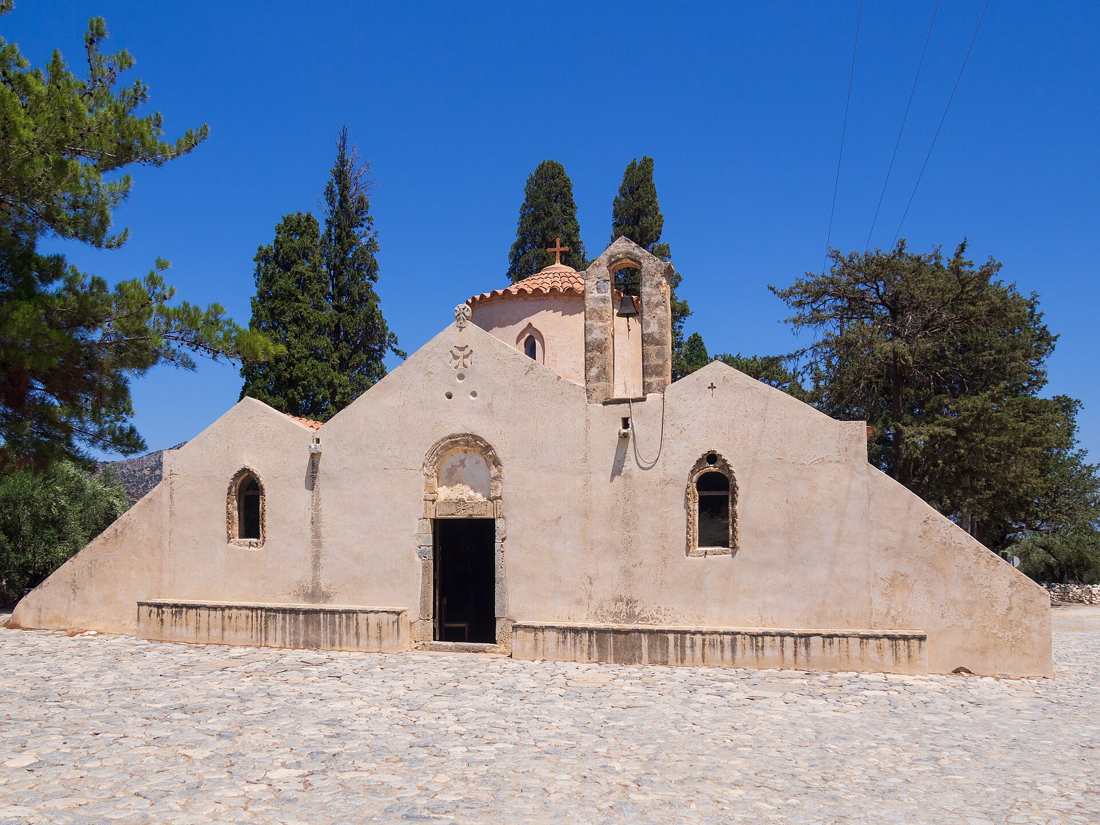
Panagia Kera is a small Byzantine church standing among olive and cypress trees just outside the village of Kritsa, in the Lasithi district of eastern Crete near the town of Agios Nikolaos. The whitewashed, buttressed building holds the finest and most complete set of Byzantine wall paintings on the island, covering its interior with scenes from the life of Christ, the Virgin and the Last Judgement. Three aisles honour the Virgin, Saint Anthony and Saint Anne. It ranks among the most important medieval monuments of the island, a protected site with a small entrance fee. Plan a quiet cultural morning inland with My Greece Tours.
The church rewards travellers drawn to Byzantine art, frescoes and Cretan history, an easy and satisfying short stop from Agios Nikolaos. Above it in the hills lie the ruins of ancient Lato, while the craft village of Kritsa sits just beyond the church door. The sections below cover where Panagia Kera stands, the frescoes that make it famous, its three aisles, the sights that surround it, and how a visit fits a wider eastern route. For the full regional picture, our Crete travel guide sets this monument against the island’s other cultural landmarks.
Where does Panagia Kera stand on Crete?
Panagia Kera stands among olive and cypress trees just outside the village of Kritsa, in the Lasithi district of eastern Crete near Agios Nikolaos. The ancient city of Lato lies in the hills above the church.
The church occupies a gentle rural setting on the road up to Kritsa, a short drive inland from the coastal town of Agios Nikolaos in eastern Crete. Olive and cypress trees surround the whitewashed walls, and the ground rises steadily behind toward the mountains of the Lasithi district. This position keeps Panagia Kera close to the sea yet firmly in the older, quieter interior, where village life and Byzantine history carry more weight than resort traffic. The approach from the coast climbs through terraced groves and past stone houses, framing the church as a destination rather than a roadside glance.
Travellers reach it easily by car or on a short excursion, arriving to find a modest medieval building that has held its ground for centuries beneath the eastern Cretan hills.
The wider landscape around the church stitches together the strands of the island’s past. Higher in the hills sit the ruins of ancient Lato, a city of the classical age reached by a rough road above Kritsa. Those ruins give the area a reach back far beyond the medieval church itself. The craft village of Kritsa lies just beyond the church door, its lanes known across the island for weaving and local work. This layering of ancient city, Byzantine church and living craft village turns a short drive from Agios Nikolaos into a genuine cultural circuit. Readers weighing wider itineraries and things to do in Crete often thread Panagia Kera into a single inland morning.
It carries real depth without a long transfer from the coast, a compact circuit of art, craft and ruins.
What makes the frescoes at Panagia Kera so famous?
Panagia Kera holds the finest and most complete set of Byzantine wall paintings on Crete. Frescoes cover the interior with scenes from the life of Christ, the Virgin and the Last Judgement, painted across the thirteenth and fourteenth centuries.
The reputation of Panagia Kera rests entirely on its painted interior, widely regarded as the richest surviving example of Byzantine wall painting on the island. Frescoes cover the walls and vaults from floor to ceiling, filling the whitewashed shell with colour and figure work that has drawn art historians and pilgrims alike. The scenes trace the life of Christ and the Virgin and open onto a vivid rendering of the Last Judgement, a theme that fills medieval churches with both warning and wonder. The paintings were carried out across the thirteenth and fourteenth centuries, layering the work of more than one hand and period into a single dense programme.
Standing inside, a visitor reads the full narrative of the faith across the surfaces, an experience closer to entering a painted book than viewing a gallery of separate panels.
The survival of so complete a scheme sets Panagia Kera apart from other medieval churches on Crete, where time and whitewash have often thinned the painted record to fragments. Here the density and condition of the frescoes let the eye follow entire cycles rather than isolated saints, which is why the church anchors cultural routes through the east of the island. The village that grew up around it, Kritsa, adds its own draw for travellers, and a walk through its lanes pairs naturally with the visit. Those hunting for quieter cultural corners and hidden gems in Crete place this church high on the list.
It carries the weight of a museum while keeping the intimate scale of a village chapel among the olive trees.
What are the three aisles of Panagia Kera?
The church has three aisles, each dedicated to a different figure of the faith: the central aisle to the Virgin, and the two flanking aisles to Saint Anthony and Saint Anne. Together they give the church its buttressed, whitewashed form.
The plan of Panagia Kera reveals itself in three parallel aisles, each carrying its own dedication and its own painted programme. The central and oldest aisle honours the Virgin and holds the heart of the church, while the flanking aisles are given to Saint Anthony and Saint Anne. This arrangement grew over time rather than arriving whole, and the added aisles brace the older core, which is why heavy buttresses lean against the whitewashed exterior. From outside the church reads as a compact, sturdy mass of white walls and stone supports set among the trees.
Inside, the division into aisles guides a visitor through distinct painted spaces, each with its own concentration of frescoes, so that the building rewards a slow, deliberate circuit rather than a single glance from the door.
Each aisle carries frescoes suited to its dedication, deepening the sense of moving through separate chapters under one roof. The Virgin’s aisle holds the central narrative of Christ and his mother, while the aisles of Saint Anthony and Saint Anne broaden the cast of the painted story. This three-part structure, unusual and memorable, is part of what marks Panagia Kera out among the medieval monuments of the island. A visit sits comfortably alongside the great religious sites elsewhere on Crete, and travellers who admire the frescoes here often go on to Arkadi Monastery further west for a very different chapter of Cretan sacred history.
The pairing sets a small, dense, painted village church against a large and storied monastery, giving a fuller picture of how faith shaped the island across its long medieval and later centuries.
What surrounds Panagia Kera for a fuller visit?
Ancient Lato sits in the hills above, and the craft village of Kritsa lies just beyond the church. The coastal town of Agios Nikolaos is a short drive away, making Panagia Kera an easy and rewarding cultural stop.
The ground around Panagia Kera packs three distinct sights into a small area, which is part of its appeal for travellers short on time. Just beyond the church door sits Kritsa, a hillside craft village whose narrow lanes are known across Crete for weaving and handmade work, an easy and natural continuation of the visit on foot. Higher up, a rough road climbs to the ruins of ancient Lato, a classical city commanding wide views over the coast and the interior. Between the medieval frescoes, the living village and the ancient ruins, a single inland loop from the sea gathers three very different layers of the island’s past.
The area asks for a slow half-day rather than a rushed stop, letting each site register on its own terms before the drive back down.
The coast lies close enough to make Panagia Kera an easy addition to a wider eastern base. The town of Agios Nikolaos, with its harbour and lake, sits a short drive down from Kritsa and serves as the natural gateway to the church for most visitors. From there a morning inland to the frescoes, the craft village and the ruins pairs neatly with an afternoon by the water. This closeness of coast and culture is the quiet strength of the eastern corner of the island, where a celebrated Byzantine monument stands within easy reach of a lively seaside town.
Travellers leave with both the intimate detail of the painted interior and the wider sweep of village, ruin and shore that surrounds it in the Lasithi hills.
How does Panagia Kera fit a Crete itinerary?
Panagia Kera fits neatly as a short cultural stop from Agios Nikolaos, best paired with Kritsa and ancient Lato. It rewards travellers interested in Byzantine art and Cretan history who want depth without a long detour from the coast.
Panagia Kera works best as a focused cultural highlight within a wider eastern itinerary rather than a destination in its own right. From a base at Agios Nikolaos, the church slots into a half-day inland that also takes in the craft village of Kritsa and, for the energetic, the classical ruins of ancient Lato above. This keeps the pace gentle and the driving short, so the frescoes register as the quiet centrepiece of a morning rather than a rushed tick on a long list. The small entrance fee and protected status reflect the monument’s standing, and a visit rewards travellers who slow down long enough to read the painted cycles across the aisles.
The church suits anyone drawn to Byzantine art, frescoes and the deeper medieval history of the island.
Timing shapes the experience as much as the route does, and the cooler, quieter months often serve a visit best. Cultural sights like Panagia Kera reward travellers who arrive outside the fiercest heat and the fullest crowds, when the interior stays cool and the village lanes of Kritsa are calm. Readers planning around the seasons will find guidance in our notes on the best time to visit Crete, which set the shoulder weeks against the height of summer for touring the island’s monuments. Fitted into a broader eastern loop of coast, ruins and painted churches, Panagia Kera gives an itinerary a genuine anchor of Byzantine art.
The interior of this small building carries far more weight than its modest whitewashed shell suggests to travellers arriving from the coast.
Frequently Asked Questions
How do you visit Panagia Kera and is there an entrance fee?
Panagia Kera stands just outside Kritsa in eastern Crete, reached by a short drive inland from Agios Nikolaos up a road that climbs through olive groves. A hire car gives the most freedom, though the church also features on guided excursions from the coast. It is a protected monument with a small entrance fee, and the painted interior is the reason to go. Allow time to stand and read the frescoes across the aisles rather than pass through quickly. Modest dress suits a working church of this standing, and photography rules may apply inside to protect the wall paintings. The village of Kritsa sits within walking distance beyond the church door and pairs naturally with the visit.
The town of Agios Nikolaos, a short drive down toward the sea, serves as the usual gateway and makes an easy base for combining the church with the coast in a single day out.
What is the best way to combine Panagia Kera with nearby sights?
The strongest plan threads Panagia Kera together with the sights that share its patch of eastern Crete. Start with the church and its Byzantine frescoes, then walk on into the craft village of Kritsa just beyond, known across the island for weaving and handmade work. For a deeper morning, drive the rough road higher into the hills to the ruins of ancient Lato, a classical city with wide views over the coast. This inland loop gathers medieval, living and ancient layers of the island into one gentle half-day. The coastal town of Agios Nikolaos, with its harbour and lake, lies a short drive below and makes the natural base for the whole circuit.
Travellers with more time often carry the cultural thread further afield to Arkadi Monastery in the west for a contrasting chapter of sacred history. Kept unhurried, the combination turns a single Byzantine church into a rounded day of art, craft and history in the Lasithi district.
Why is Panagia Kera considered so important on Crete?
Panagia Kera earns its standing through the quality and completeness of its Byzantine wall paintings, widely held to be the finest on the island. Medieval churches on Crete often keep only fragments of their painted decoration. This one preserves whole cycles instead, its interior covered from floor to vault with scenes from the life of Christ, the Virgin and the Last Judgement. The work spans the thirteenth and fourteenth centuries, layering more than one period into a single dense programme across three aisles dedicated to the Virgin, Saint Anthony and Saint Anne. That survival makes the church a rare and complete window onto medieval religious art in the region.
It ranks among the most important monuments of its kind on the island and draws art historians alongside ordinary travellers. Set among olive and cypress trees near Kritsa, it holds the scale of a village chapel while carrying the weight and significance of a major cultural landmark.