
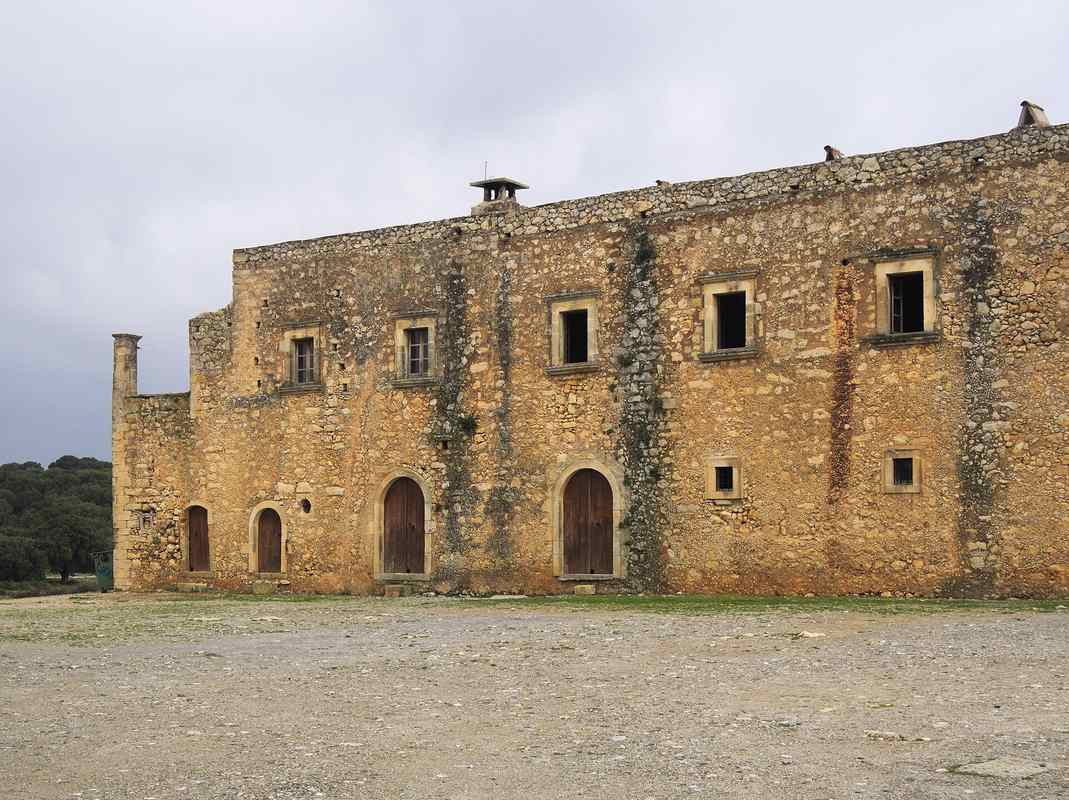
Arkadi Monastery, known in Greek as Moni Arkadiou, stands in the green hills about 23 km south-east of Rethymno in central Crete. This fortified complex is more than a place of worship. It is the great symbol of Cretan resistance, remembered across Europe for a sacrifice that turned a monastery into a monument of freedom. Its ornate Renaissance church, twin bell-towers, museum, and ossuary draw travellers who want the island’s deeper story, not only its beaches. A short drive inland from the coast brings you to one of Crete’s most moving sites, easy to add to any tour planned with My Greece Tours.
Set apart from the busy resorts, Arkadi rewards visitors who slow down and read the walls, the ossuary, and the old powder room. Our Crete travel guide places the monastery within a wider circuit of history and landscape across the island’s centre. The sections below cover how to reach Arkadi from Rethymno, what the resistance story means, what you actually see on site, how the church earns its fame, and how the monument fits a fuller Cretan itinerary. Each part gives concrete details so you can plan a visit that respects both the place and its memory.
Where is Arkadi Monastery in Crete?
Arkadi Monastery sits about 23 km south-east of Rethymno in central Crete, reached by a short drive inland into the green hills. It stands well apart from the coastal resorts along quiet roads.
The monastery rests on a plateau ringed by low hills and olive groves, a landscape that feels far removed from the crowded northern shore. Most travellers base themselves in Rethymno and drive up through villages and terraced fields, a route that climbs gently inland from the coast. The road is paved and clearly signposted, and the whole trip takes well under an hour from the old town. That short distance makes Arkadi an easy half-day outing rather than a long expedition into the interior. The approach itself sets the tone, trading the bustle of the seafront for quiet farmland, grazing sheep, and the first glimpse of the fortified walls rising ahead.
You arrive already slowed down, ready for a site built on memory rather than spectacle and shaped by centuries of Cretan history.
The setting matters deeply to the story of Arkadi. Its isolation once gave the monastery a defensive role, and today that same quiet lends the site its solemn, reflective atmosphere. Visitors driving from Heraklion can reach it too, though the journey is longer and usually pairs Arkadi with other stops across central Crete. The hills that shelter the complex are green and cool in spring, golden and dry in high summer, so the drive changes character with the seasons. Whichever direction you come from, the winding approach prepares you for a place that trades seaside colour for contemplation.
The final stretch reveals the monastery’s outer walls and the twin bell-towers of its famous church, an arrival that quietly signals you have left the tourist coast behind.
Why is Arkadi the great symbol of Cretan resistance?
During a nineteenth-century uprising against Ottoman rule, hundreds of Cretans sheltering at Arkadi chose to ignite the monastery’s gunpowder store rather than surrender, a sacrifice that echoed across Europe as a cry for freedom.
The events unfolded during the nineteenth-century uprising against Ottoman rule, when the monastery became a refuge from the surrounding violence. Arkadi sheltered fighters and also families who had fled their homes, its thick walls promising a measure of safety. Surrounded and facing certain capture, the defenders confronted an impossible choice between surrender and death. They chose to ignite the powder magazine rather than yield to the attackers. The explosion killed hundreds of Cretans inside, fighters together with sheltering women and children, and it took many of the besieging soldiers as well. That single act transformed a local stand into a symbol recognised far beyond the island.
The powder-magazine room still preserves the space where the decision was carried out, its scarred stone a direct link to the moment the monastery passed from refuge into enduring legend.
The resonance of that sacrifice is why Arkadi carries such weight today. News of the explosion spread through European capitals and stirred deep sympathy for the Cretan cause, drawing attention from writers, artists, and wider public opinion abroad. The monastery was later honoured both as a Greek national monument and as a European Freedom monument, a rare double recognition that reflects how far the story travelled. Grasping this layer of Cretan history reframes any journey through the island’s past and links Arkadi to the broader nineteenth-century struggle for independence. Travellers exploring the many things to do in Crete often find that a stop here changes the whole trip.
The beaches and villages gain a historical backdrop, and the monastery becomes the point where the island’s deeper identity comes sharply into focus.
What can you see at Arkadi Monastery today?
The complex holds a museum, an ossuary displaying skulls of the fallen, and the old powder-magazine room where the sacrifice took place. Together they turn the visit into a moving act of remembrance.
The ossuary is the most solemn stop at Arkadi, displaying the skulls of those who died in the sacrifice. It stands as a stark, honest memorial rather than a polished exhibit, and many visitors find it the emotional centre of the whole site. Nearby, the powder-magazine room preserves the space where the explosion was triggered, its blackened stone a quiet testimony to what happened there. Reading the resistance story first makes both rooms far more meaningful and far more affecting. The two spaces work together, one holding the physical remains of the fallen, the other holding the scene of their final decision.
Visitors often move through them in near silence, and the memory of these rooms tends to linger long after the brighter details of the courtyard and the church have faded from mind.
The museum rounds out the visit with religious icons, relics, manuscripts, and objects tied directly to the resistance. These exhibits give context to the monastery’s dual role as both sanctuary and stronghold, showing how faith and defiance existed side by side within the same walls. Allow time to walk the courtyard, study the ornate church facade, and simply sit with the silence of the complex. The layout encourages a slow, thoughtful pace rather than a quick loop through the buildings. For travellers hunting hidden gems in Crete, Arkadi offers something rarer than a photogenic viewpoint.
Here architecture, faith, and history meet in one deeply affecting whole, from the Renaissance facade to the ossuary, and the combined effect leaves an impression that few other sites on the island can match.
What makes the Arkadi church one of the finest in Crete?
The Venetian-era church has an ornate Renaissance facade and twin bell-towers, widely regarded as one of the finest on the island. Its elegant proportions set it apart from Crete’s simpler village chapels.
The Venetian-era church blends classical Renaissance forms with local Cretan craftsmanship, its columns, arches, and carved detail rising to a pair of graceful bell-towers. This ornate front stands in striking contrast to the plainer monastic buildings around it, and it explains why the church ranks among the finest on the whole island. The facade carries a rhythm and symmetry more familiar from Italian architecture, a legacy of the long Venetian presence in Crete before Ottoman times. Photographers gravitate to the golden light of late afternoon, which draws out the texture of the stone and the depth of the carving.
Standing directly before it, you sense both the ambition of the builders and the wealth the monastery once commanded, a reminder that Arkadi was a respected centre of learning and manuscripts as well as a house of faith.
The building reflects the wider Venetian influence that shaped much of Crete’s architecture across the centuries. Comparing it to the churches and fortress walls in Rethymno shows how the same design language spread from the coast into the hinterland, tying town and monastery together. The twin bell-towers have themselves become an emblem of Arkadi, printed on postcards and used to represent Cretan heritage in books and museums. Their silhouette is instantly recognisable, and it reappears again and again in images of the island’s history. The facade survived the violence of the nineteenth-century uprising and still presides over the courtyard today.
Looking up at it, visitors take in the artistry of its makers alongside the faith that carried this community through long centuries of upheaval and eventual sacrifice.
How does Arkadi fit into a wider Crete itinerary?
Arkadi pairs naturally with Rethymno’s old town and inland villages, adding depth to a coastal trip. A short drive links seaside relaxation with one of Crete’s most significant historical monuments.
A typical plan bases you on the north coast and treats Arkadi as a focused morning or afternoon excursion inland. From the monastery you can loop back through mountain villages such as the potters’ village of Margarites, small family tavernas, and viewpoints that reveal the island’s rural character away from the resorts. The route rewards drivers who take their time, stopping for coffee or a plate of local food along the way. Choosing the right season helps a great deal, so it is worth consulting advice on the best time to visit Crete to dodge the fiercest summer heat and catch the hills at their greenest.
Spring and autumn suit the reflective mood of the monastery especially well, offering cooler air, softer light, and thinner crowds through the courtyard and the memorial rooms of the complex.
Arkadi also balances a beach-heavy holiday with real substance and memory. Many visitors combine the monastery with the wider draws found among the many things to do in Crete, weaving history, food, and landscape into a single route through the island’s centre. The monastery’s inland position means it slots neatly between the coast and the mountains, giving an itinerary a natural rhythm of relaxation and discovery. Its standing as both a national and a European Freedom monument makes it a fitting centrepiece rather than a mere add-on to a busy schedule. Most travellers agree that a visit here anchors the whole trip.
A string of pleasant beach days becomes a genuine journey through the real Crete, one that carries the weight of the nineteenth-century sacrifice alongside its sun and sea.
Frequently Asked Questions
How long do you need to visit Arkadi Monastery?
Most visitors spend between one and two hours at Arkadi, though the site rewards a slower pace. The core stops include the ornate Renaissance church, the museum, the ossuary, and the old powder-magazine room, each deserving unhurried attention. Reading the resistance story first makes the ossuary and powder room far more affecting, so budget extra time for reflection rather than rushing through the complex. The courtyard invites quiet walking, and the twin-towered church facade repays a long look, particularly in softer afternoon light. Travellers who arrive early or late in the day often find fewer crowds and a more contemplative mood among the memorials.
Pairing the visit with a drive through the surrounding hills and villages easily fills a half day, with time for coffee at a local taverna along the way. Allow at least ninety minutes on site so the nineteenth-century history has room to land properly and you leave without feeling hurried. Guided tours may add commentary that explains the sacrifice in greater detail.
Is Arkadi Monastery easy to reach from Rethymno?
Yes, Arkadi is one of the easiest historical sites to reach from Rethymno. The monastery lies about 23 km south-east of the town, and the drive inland takes well under an hour along a paved, clearly signposted road that climbs gently through villages and olive groves. A hire car gives the most flexibility, letting you set your own pace and pair the monastery with mountain villages nearby. The route itself is scenic, trading the busy coast for a quieter, greener landscape that prepares you for the solemn atmosphere on arrival. Drivers coming from Heraklion can reach Arkadi as well, though the journey is longer and usually forms part of a broader day trip.
The monastery sits apart from the resorts, so it feels like a genuine escape into the island’s interior. Planning the excursion around cooler hours makes the walk through the complex far more comfortable, especially in the warmer months.
Why is Arkadi called a European Freedom monument?
Arkadi earned recognition as a European Freedom monument because of the sacrifice made there during a nineteenth-century uprising against Ottoman rule. Hundreds of Cretans sheltering at the monastery, fighters alongside women and children, chose to ignite the gunpowder store rather than surrender to the surrounding forces. That act of defiance moved far beyond the island, stirring sympathy across European capitals and casting Crete’s struggle as part of a wider fight for liberty. The monastery was in time honoured both as a Greek national monument and as a European Freedom monument, a rare dual distinction that reflects how deeply the events resonated abroad. The ossuary, the powder-magazine room, and the museum all keep that memory alive for visitors today.
This recognition is why Arkadi holds a place in Cretan history that no beach or resort can match, and why it remains a pilgrimage for those seeking to understand the island’s long road toward freedom.