
Heraklion, sometimes written Iraklion, is the capital and largest city of Crete, spread along the island’s north-central coast around a working harbour. It pairs a Venetian old town with a busy modern port, so a sea fort, a lion fountain, and pedestrian shopping streets sit within a short walk of ferries and cafes. The city is Crete’s main transport hub, with an airport and a ferry port that make it a variety of travellers’ first stop on the island. It also serves as a comfortable base for reaching famous sites nearby. This guide walks you through the harbour, the old-town landmarks, the walls, and a stay, so you can plan your visit with My Greece Tours.
A day in Heraklion moves easily on foot, from the Koules Fortress at the harbour mouth up through Lion Square to the great walls that once ringed the town. The city rewards travellers who treat it as more than an airport gateway, giving history, a strong food scene, and quick access to the famous sites nearby. For the island as a whole, our Crete travel guide sets the capital within a wider route across the island. The sections below cover the old harbour and its fort, the central squares and streets, the Venetian walls and Kazantzakis’s tomb, the day trips within reach, and how to base yourself here.
What is there to see in Heraklion’s old harbour?
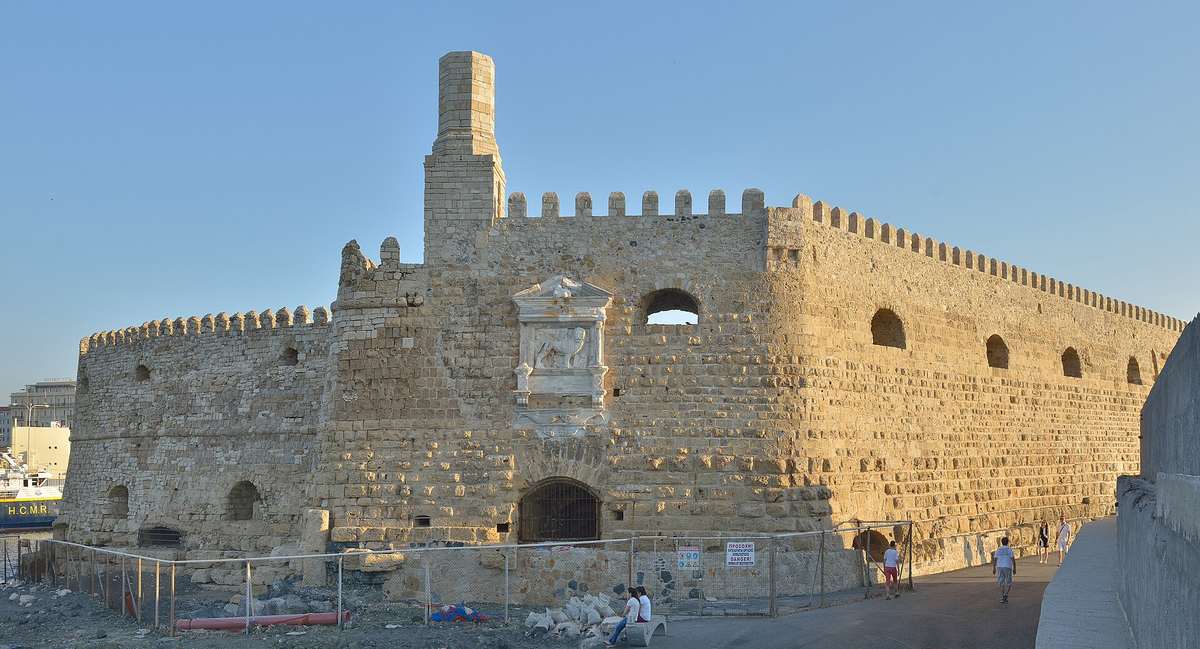
The Koules Fortress, a squat Venetian sea fort, guards the harbour mouth and gives the port its defining silhouette. Restored and open to visitors, it faces the fishing boats and the arched shipyards along the quay.
The Koules Fortress anchors the whole harbour scene, a thick-walled Venetian stronghold that once held cannon aimed out to sea and now welcomes visitors onto its ramparts. Inside, vaulted chambers and displays trace the port’s long defence, and the roof gives a sweeping view over the boats, the breakwater, and the city rising behind. Carved stone lions of Saint Mark, the emblem of Venice, mark the fort’s walls and recall the centuries when the city was a key harbour of that maritime power. The walk out along the mole to reach it is a pleasure in itself, with the open sea on one side and the working port on the other.
Fishing boats still tie up nearby, so the quay keeps a lived-in feel rather than a purely museum one. The Venetian Koules fortress guards the harbour mouth at its end.
Behind the fort, a row of arched Venetian shipyards, the old arsenals where galleys were once built and repaired, lines the inner harbour. The waterfront is a natural place to start or end a day, with cafes and tavernas looking out over the masts and the fort. Ferries to and from the mainland and other islands use the larger commercial port alongside, so the harbour blends leisure and transport in one busy stretch. Sunset draws locals and visitors alike to stroll the mole, and the fort’s floodlit walls make an evening walk worthwhile. Small fishing boats unload their catch in the morning, so the same quay shifts in mood across the day.
For travellers weighing how to fill their hours, our guide to things to do in Crete puts this harbour walk alongside the island’s beaches and mountain routes.
What are the main squares and streets in Heraklion, Crete?
Lion Square, named for the Morosini Fountain and its stone lions, forms the social heart of the old town. From it the pedestrian 25th of August street runs down toward the harbour, lined with cafes and shops.
Lion Square, known locally as Liontaria, centres on the Morosini Fountain, whose four seated stone lions spout water into a carved basin and give the plaza its affectionate name. The fountain once carried fresh water into the town along an aqueduct, a piece of practical Venetian engineering turned into the city’s best-loved meeting point. Cafes and dessert shops ring the square, and the water mixes with the buzz of people pausing between errands. A short walk away stands the Basilica of Agios Titos, dedicated to the saint who brought Christianity to the island, its solid stone form standing over a long and eventful history.
Together the fountain and the church give the old town a clear, walkable core that visitors return to again and again. The CretAquarium at Gournes lies a short drive east along the coast.
From Lion Square the pedestrian 25th of August street slopes down toward the old harbour, its handsome facades now filled with cafes, travel offices, and shops. Off to the side, the 1866 market street packs stalls of herbs, cheese, honey, and Cretan produce into a narrow, lively lane that rewards a slow browse. The grand Cathedral of Agios Minas, one of Greece’s larger churches, rises over its own square nearby and dominates that quarter of the centre. These streets link the harbour, the squares, and the market into an easy loop, so travellers can see the core of the capital in a relaxed morning.
Travellers keen to compare towns can turn to our guide to Agios Nikolaos, which shows a smaller, harbour-focused alternative sitting further east along the coast.
Can you walk Heraklion’s Venetian walls and Kazantzakis’s tomb?
Yes. The massive Venetian walls still ring most of the old town, and you can climb the Martinengo bastion to the simple tomb of writer Nikos Kazantzakis, which looks out over the city and the sea beyond.
The Venetian walls of Heraklion count among the most complete in the Mediterranean, thick ramparts and pointed bastions built to withstand a long siege centuries ago. Stretches of the fortification are open to walkers, and the earthen ramparts give a raised path with views over the rooftops, the port, and the mountains inland. The Martinengo bastion, at the southern point of the circuit, is the highest and most visited section, reached by a short walk from the surrounding streets. The walls tell the story of a city that stayed under siege for years before it finally fell, and their scale still impresses when you stand on top of them.
Grassy slopes and shady corners make the circuit a pleasant walk. Walking a section is a quiet counterpoint to the bustle of the squares below. East of the city, the potters’ village of Thrapsano still fires giant clay jars.
On the Martinengo bastion lies the tomb of Nikos Kazantzakis, the Cretan author of works that carried the island’s spirit into world literature. His grave is a plain stone slab with a wooden cross, and its famous inscription about hope and freedom draws readers who make the climb as a small pilgrimage. The spot commands a wide view over Heraklion and the sea, a fitting resting place for a writer so tied to this land. The walk up and back fits easily into a half-day of old-town sightseeing, pairing history, literature, and a rewarding outlook. Benches near the tomb let you pause and take in the panorama before heading back down into the streets.
Travellers planning where to spend the night nearby can consult our guide on where to stay in Crete to match a base to their route.
What day trips can you take from Heraklion in Crete?
The palace of Knossos sits about five kilometres south of the city, an easy trip by bus or car. The city’s museum, gorges, beaches, and hill villages all lie within comfortable reach for a day out.
Heraklion makes an ideal base for exploring central Crete, since its road and bus links fan out to sites in every direction. The most famous is the Bronze Age palace at Knossos, roughly five kilometres south of the centre and reached in minutes by local bus, taxi, or rental car. The finds from that site and other Cretan digs fill the Heraklion Archaeological Museum in the city itself, so a variety of travellers pair the two into a single half-day of Minoan history. Both deserve their own unhurried visit, and combining them early in a stay sets the historical scene for the rest of a Crete trip.
A good site plan helps the ruins make sense to first-time visitors. Timing an arrival for the opening hour helps you beat the tour coaches to the palace gate.
Beyond the Minoan sites, the capital’s central position opens up most of the island for day trips, from the green El Greco village of Fodele to the wine country south of town. Beaches, mountain villages, and wineries in the hills south of the city give a change of pace from the ancient ruins, and the coast east and west offers a string of resorts and coves. Rental cars and organised excursions leave from the city daily, and the compact centre makes it easy to return each evening to the same base. A visitor with a range of days can radiate out to different corners without repacking, treating Heraklion as a hub rather than a single stop.
Boat trips add another option for travellers who want time on the water. Planning a loose order for these outings keeps the driving manageable and leaves room for the capital’s own sights between trips.
The high-speed ferry to Santorini leaves Heraklion port in the morning and returns in the evening, which makes the island a day out from the city. Our Santorini day trip from Crete page covers the tours and the timetable.
How do you reach Heraklion and where should you base yourself in Crete?
Heraklion has Crete’s main airport and a busy ferry port, so most island visitors pass through it. The compact old town near the harbour makes a central, walkable base for both sightseeing and onward travel.
Heraklion is Crete’s principal gateway, served by an airport just east of the city and a ferry port with overnight and daytime crossings to the mainland and other islands. The airport handles both international and domestic flights in the busy season, and it lies close enough that a variety of travellers reach the centre in a short taxi or bus ride. Ferries dock at the commercial port beside the old harbour, so arriving by sea puts you within walking distance of the Venetian core. This concentration of transport makes the city a natural first and last stop on a Crete itinerary, whether you fly, sail, or drive in.
Buses from the central station also connect Heraklion to towns and resorts along the north coast, and taxis wait at the port and airport for shorter hops into the centre.
For a stay in the city, the old town around Lion Square and the harbour puts you within walking distance of the fort, the squares, the market, and the waterfront tavernas. That central position suits travellers who want to sightsee on foot and dine out in the evening without needing a car for every outing. A variety of visitors treat the capital as a base for two or three nights before moving on, since its links reach so most of the island. The strong cafe and food scene, from bakeries to seafood tavernas, gives ample reason to linger between excursions.
Weighing the capital against quieter coastal towns and villages comes down to your route, since certain travellers prefer a lively city base while others want a calmer seaside village within easy reach of the sites.
Frequently Asked Questions
Is Heraklion worth visiting, or just an airport gateway?
Heraklion is well worth a visit in its own right, not merely a place to land and leave. The capital packs a walkable old town with a Venetian sea fort, the lion-topped Morosini Fountain on Lion Square, the pedestrian 25th of August street, and the huge walls that once ringed the town. The Basilica of Agios Titos and the Cathedral of Agios Minas add historic churches, while the 1866 market street and a strong cafe and taverna scene fill the hours between sights. A variety of travellers do treat the city only as a transport hub, given its airport and ferry port, and rush straight out to the beaches.
That is a missed chance, since the harbour walk to the Koules Fortress and the climb to Kazantzakis’s tomb on the walls reward even a half-day. A stay of a night or two lets you enjoy the centre unhurried and use the city as a base for the famous sites nearby, so the capital earns its place on a Crete itinerary.
How far is Knossos from Heraklion and how do you reach it?
The palace of Knossos lies about five kilometres south of Heraklion’s centre, close enough to count as a short local outing rather than a full-day expedition. Local buses run frequently from the city to the site through the season, dropping visitors near the entrance for a modest fare, which makes it the simplest car-free option. A taxi covers the distance in minutes, and drivers with a rental car reach the signed site quickly, with parking near the gate. The nearness means a variety of travellers combine the palace with the city’s archaeological museum, where the finds from the excavation are displayed, turning the two into a linked half-day of Minoan history.
Arriving soon after opening helps you explore the ruins before the tour coaches and the midday heat arrive. The short distance lets Heraklion serve as an easy base for seeing this landmark without a long drive, leaving the rest of your day free for the capital’s own harbour, squares, and walls.
What is the best way to spend a day in Heraklion?
A satisfying day in Heraklion follows the old town on foot, starting at the harbour and the Koules Fortress in the cool of the morning before the heat builds. From the waterfront, walk up the pedestrian 25th of August street to Lion Square, where the Morosini Fountain and its stone lions mark the social heart of the centre. Nearby stand the Basilica of Agios Titos and the grand Cathedral of Agios Minas, and a short detour into the 1866 market street brings the smells of herbs, cheese, and honey. In the afternoon, climb the Venetian walls to the Martinengo bastion, where the tomb of Nikos Kazantzakis looks out over the city and the sea.
Break the sightseeing with a long lunch at a taverna, since the capital’s food scene is one of its pleasures. A second day lets you pair the archaeological museum with the palace a handful of kilometres south, and the capital then serves as your base for reaching the island’s beaches and villages beyond.