
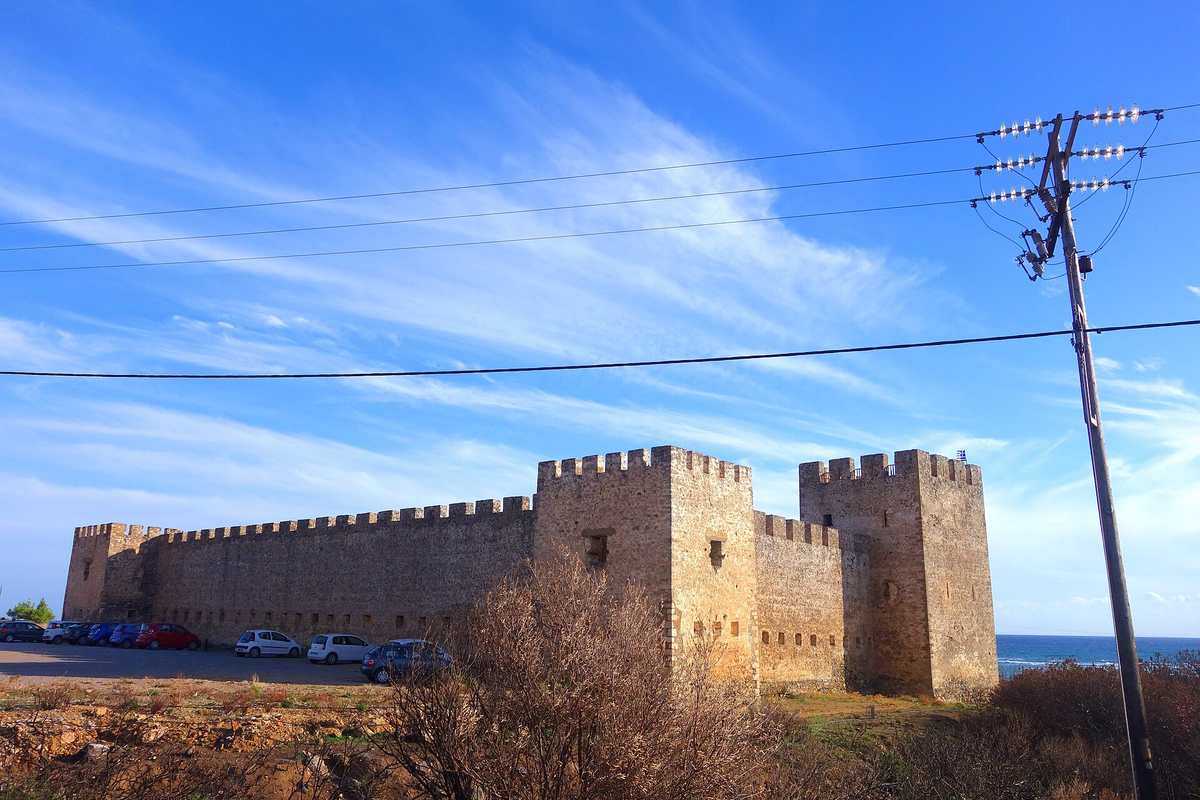
Frangokastello stands as a perfectly preserved Venetian fortress on the remote southern coast of Crete, its honey-coloured walls rising dramatically against turquoise waters and rugged mountains. Built in the fourteenth century to control the fiercely independent Sfakia region, this rectangular castle with four corner towers guards a pristine sandy beach where shallow, warm waters lap gently at the shore. The fortress remains one of the island’s most atmospheric historical sites, combining military architecture with natural beauty and a haunting legend of ghostly warriors. Explore this remarkable coastal stronghold with My Greece Tours.
The castle sits in splendid isolation on Crete’s wild south coast, reached by winding mountain roads that descend from the north or along the coastal route from Chora Sfakion. The Lion of St Mark carved above the main gate testifies to Venetian ambitions in this rebellious corner of the island. Frangokastello offers visitors a rare combination of historical exploration, beach relaxation, and the mystique of the Drosoulites, shadowy figures said to march across the plain at dawn each spring. Our Crete travel guide provides comprehensive information for planning your visit to the south coast. The sections below cover the castle’s history, the beach, the famous mirage phenomenon, practical travel advice, and the surrounding Sfakia region.
What is the history of Frangokastello in Crete?
The Venetians built Frangokastello in the fourteenth century as a military outpost to suppress rebellion in the mountainous Sfakia district. Its rectangular walls and four corner towers held a garrison, though the Sfakiot clans resisted Venetian rule throughout.
The fortress takes its name from the Frankish Catholic occupiers, as Orthodox Cretans called all western Europeans ‘Franks’ during the medieval period. Venetian engineers designed the castle with thick defensive walls, corner bastions, and a central courtyard to house soldiers far from the safety of northern coastal cities. The Lion of St Mark relief above the main entrance proclaimed Venetian sovereignty over this defiant region. The castle’s strategic position allowed the garrison to monitor the southern coast and control access to the mountain villages where Sfakiot warriors maintained their independence.
The fortress changed hands multiple times during Cretan uprisings against foreign rule, witnessing centuries of conflict between occupiers and the famously rebellious local population who valued freedom above all else.
The most famous battle at Frangokastello occurred in the nineteenth century when Cretan rebels led by Hatzimichalis Dalianis occupied the fortress and fought Ottoman forces in a desperate last stand. Hundreds of fighters died in the engagement, and this tragedy gave birth to the Drosoulites legend that still draws visitors today. The castle remained in use through the Ottoman period before finally falling into peaceful abandonment in the modern era. Restoration work has preserved the walls, towers, and gateway, allowing visitors to walk the ramparts and explore the interior courtyard.
Frangokastello represents one of the finest examples of Venetian military architecture on the island, standing as a monument to centuries of struggle for Cretan independence and the indomitable spirit of the Sfakia region.
What makes the beach at Frangokastello special?
A long sandy beach fronts the castle, with exceptionally shallow, calm, warm water that suits families with young children. The sheltered bay stays gentle, and the fortress and White Mountains form a dramatic backdrop.
The beach extends for over a kilometre along the coast, with fine golden sand and crystal-clear water that remains shallow for dozens of metres from shore. Parents appreciate the gradual depth and absence of strong currents, making this one of the safest swimming spots on the south coast. The water temperature rises quickly in spring due to the shallow bay and southern exposure, offering comfortable swimming from May through October. Tamarisk trees provide natural shade at the eastern end of the beach, while the western section remains open and sun-drenched. The castle walls rising directly from the sand create an unforgettable setting, particularly at sunset when the stone glows golden against the darkening mountains.
Tavernas line the road behind the beach, serving fresh fish and traditional Cretan cuisine within sight of the fortress. High above, the Kallikratis Gorge drops from the White Mountains to this coast.
The beach remains remarkably uncrowded compared to northern coastal resorts, preserving a peaceful atmosphere even during peak summer months. Visitors can rent sunbeds and umbrellas, though plenty of space exists for those who prefer to lay towels on the open sand. Snorkelling reveals rocky areas at both ends of the bay where fish gather in the clear water. The combination of historical significance, natural beauty, and practical family-friendly features makes Frangokastello beach one of the hidden gems in Crete that rewards travellers willing to venture beyond the typical tourist circuit. The beach offers a perfect counterpoint to castle exploration, allowing visitors to combine cultural interest with seaside relaxation in a single memorable location.
What are the Drosoulites of Frangokastello?
The Drosoulites are shadowy figures that seem to march across the plain at dawn on humid May mornings, an eerie spectacle witnessed for generations. The mirage is tied to a nineteenth-century battle at the castle.
The name Drosoulites translates as ‘dew shades’ or ‘dew shadows’, referring to the misty conditions under which the phenomenon occurs. Witnesses describe seeing dark silhouettes moving in formation across the coastal plain toward the fortress, sometimes appearing as armed warriors on horseback. The spectacle typically lasts around ten minutes before the figures fade as the sun rises higher and burns off the morning moisture. Scientific explanations suggest the Drosoulites result from a mirage effect created when specific atmospheric conditions bend light rays, projecting images of distant objects or creating reflections of the sea. The phenomenon requires particular combinations of temperature, humidity, and still air that occur most frequently in late spring.
Local tradition insists the shadows represent the souls of fighters who perished in the battle, condemned to re-enact their final march each year.
The legend adds a layer of mystery and melancholy to Frangokastello that distinguishes it from other Venetian fortifications on the island. Visitors hoping to witness the Drosoulites should arrive before dawn on humid May mornings and position themselves with a clear view across the plain toward the mountains. The phenomenon remains unpredictable, and many observers wait in vain, yet the possibility of encountering this ghostly spectacle enhances the already powerful atmosphere of the site. The story reflects the deep connection between landscape, history, and folk memory in Crete, where past struggles for freedom remain vivid in collective consciousness.
The Drosoulites have inspired poems, songs, and countless retellings, cementing Frangokastello’s place in Cretan cultural imagination alongside its architectural and historical significance.
How do you reach Frangokastello from other parts of Crete?
Frangokastello sits on the south coast, reached by a winding mountain road down from the north or the coastal route from Chora Sfakion. The drive from the Chania side runs roughly ninety minutes through traditional villages and gorges.
The main approach from the north begins in Chania or nearby towns, following the national highway east before turning south toward the Sfakia region. The road climbs into the White Mountains, passing through villages where time seems to have slowed, then descends dramatically toward the Libyan Sea. Drivers navigate hairpin bends with breathtaking views across the mountains and coast, requiring careful attention but rewarding travellers with some of the most spectacular scenery on the island. The route passes near the Imbros Gorge, offering opportunities to combine hiking with castle exploration.
The final descent brings you suddenly to the coast where Frangokastello appears like a vision from the past, its walls rising from the plain with the sea beyond. Road conditions remain good, though the mountain sections demand respect and cautious driving.
The coastal approach from Chora Sfakion follows a narrower road eastward along the southern shore, passing through tiny settlements and offering constant sea views. This route takes roughly thirty minutes and provides easier driving than the mountain crossing. Visitors arriving from eastern Crete face a longer journey but can combine Frangokastello with other things to do in Crete along the south coast. Limited bus service connects the fortress to Chora Sfakion and Chania during summer months, though a rental car provides far greater flexibility for exploring this remote region.
The journey itself forms an essential part of the Frangokastello experience, immersing visitors in the wild beauty and isolation that characterize the Sfakia district and explain why this region maintained its fierce independence throughout centuries of foreign occupation.
What else can you explore in the Sfakia region of Crete?
The Sfakia district holds dramatic mountain villages, deep gorges, isolated beaches, and the port of Chora Sfakion. The region preserves traditional Cretan culture and rewards hikers with outstanding trails, far from the island mass tourism.
Chora Sfakion serves as the regional centre, a small port town clinging to steep slopes above a harbour where ferries connect to coastal villages and beaches accessible only by boat or foot. The town maintains its authentic character, with tavernas serving local specialities and older residents still wearing traditional dress. Mountain villages like Anopoli perch high above the coast, offering cooler temperatures, stone architecture, and insights into the pastoral way of life that sustained Sfakiot communities for centuries. The region’s gorges provide world-class hiking through dramatic limestone landscapes, with routes ranging from the challenging descent through the Samaria Gorge to shorter walks like Aradena Gorge.
Coastal trails connect isolated beaches where turquoise water meets white pebbles in settings of pristine natural beauty. The Sfakia region rewards adventurous travellers with experiences of wild Crete that remain largely unchanged despite tourism development elsewhere on the island.
Local cuisine emphasizes lamb, goat, wild greens, and exceptional cheeses produced in mountain dairies using traditional methods passed down through generations. Sfakiot hospitality remains legendary, with villagers maintaining the fierce pride and independence that made this region ungovernable throughout foreign occupations. The landscape tells stories of resistance and survival, from cave hideouts used by rebels to memorials commemorating battles against Venetians, Ottomans, and German occupiers. Visitors can combine Frangokastello with gorge hiking, village exploration, beach hopping by boat, and immersion in a culture that embodies the Cretan spirit. The region offers a complete contrast to northern resort areas, providing authentic encounters with landscape, history, and tradition.
The Sfakia district represents the soul of Crete, where mountains meet the sea and the past remains vividly present in daily life.
Frequently Asked Questions
Is Frangokastello suitable for young children?
Frangokastello ranks among the best family destinations on the south coast of Crete, combining safe beach conditions with fascinating historical exploration. The shallow, calm water remains gentle and warm throughout the summer, allowing even toddlers to play safely at the water’s edge while parents relax nearby. The gradual depth means children can wade out considerable distances without encountering strong currents or sudden drop-offs. The castle itself captivates young imaginations, offering opportunities to explore towers, walk along walls, and play in the courtyard while learning about knights, battles, and legends. The compact size of the site prevents children from wandering too far, and the flat terrain around the fortress makes stroller access straightforward.
Tavernas behind the beach provide family-friendly dining with simple options that appeal to younger palates. The peaceful atmosphere and lack of crowds create a relaxed environment where families can spend entire days alternating between castle exploration and beach time without feeling rushed or overwhelmed by tourist masses.
Can you visit Frangokastello year-round?
The fortress remains accessible throughout the year, though the experience varies considerably with the seasons. Summer brings warm weather, calm seas, and the full beach experience, with all facilities operating and the water perfect for swimming. Spring offers wildflowers covering the plain, comfortable temperatures for castle exploration, and the possibility of witnessing the Drosoulites phenomenon in May. Autumn provides excellent conditions with lingering warm water, fewer visitors, and beautiful light for photography as the summer heat subsides. Winter transforms the site into a windswept, dramatic location where waves crash against the shore and clouds gather over the mountains, creating a moody atmosphere that emphasizes the fortress’s isolation and military purpose.
Tavernas close during the winter months, and swimming becomes inadvisable due to cold water and rougher seas. The castle itself never closes, allowing visitors to explore the walls and courtyard regardless of season. Winter visits suit those interested primarily in history and photography rather than beach activities, offering a completely different perspective on this atmospheric site.
What should you bring when visiting Frangokastello?
Sun protection proves essential, as the fortress and beach offer limited natural shade during the hottest hours. Bring high-factor sunscreen, hats, and sunglasses, plus a beach umbrella if you prefer not to rent one from the tavernas. Swimwear and towels allow you to enjoy the excellent beach, while water shoes protect feet from occasional hot sand and rocky patches at the bay’s edges. Carry drinking water, particularly if arriving during midday heat when temperatures soar. A camera captures the stunning combination of castle, mountains, and sea, especially during golden hour when the fortress glows in warm light. Comfortable walking shoes help when exploring the castle’s uneven stone surfaces and climbing tower stairs.
Snorkelling gear reveals underwater life in the rocky areas flanking the sandy beach. Cash remains important, as card acceptance may be limited at smaller tavernas. Binoculars enhance views across the plain toward the mountains and help spot details on the fortress walls. Light layers prove useful even in summer, as breezes off the Libyan Sea can cool the air, particularly during early morning or evening visits when the site feels most atmospheric.