
The Lasithi Plateau is a wide farming plain that sits high in the mountains of eastern Crete, roughly 840 metres above the sea. The Dikti range wraps the whole plain in a rocky wall, holding a patchwork of green fields at its centre. For centuries thousands of white-sailed windmills pumped water up to those fields, and the plateau still carries their memory in every direction. It is cooler, quieter and greener than the busy coast below, which makes it a rewarding change of scene. A slow drive up the hairpin passes rewards you with mountain air and a landscape unlike the beaches, and you can fit it into a wider itinerary with My Greece Tours.
This upland plain works best as a scenic day trip from the north-coast resorts, an easy add-on to a beach-based week. Our wider Crete travel guide places it within the eastern half of the island so you can gauge the driving before you set out. The sections below cover what the plateau actually is, the story behind its famous windmills, the ring of farming villages around the rim, the cave above Psychro tied to the myth of Zeus, and how to plan a comfortable day trip up from the coast.
What is the Lasithi Plateau in Crete?
The Lasithi Plateau is a fertile upland plain about 840 metres high, ringed by the Dikti mountains in eastern Crete. Cool and green, it grows apples, potatoes and other crops well above the warm coast.
The Lasithi Plateau is a flat, fertile basin set high among the Dikti mountains in the east of the island, sitting around 840 metres above sea level. The surrounding peaks form a near-continuous ring, so the plain feels like a green bowl cupped by grey rock. That height gives it a cool, fresh climate that stands apart from the hot northern shore. Snow can dust the rim in winter, and even summer days stay milder than the beaches far below. The floor of the basin is rich farmland, worked in small plots that turn various shades of green through the growing season.
Reaching this hidden plain is one of the more unusual things to do in Crete, since so much of the island’s fame rests on its coast rather than its highlands.
The plateau grows apples, potatoes and a range of other crops that thrive in the cooler mountain air, and orchards and fields cover much of the level ground. The cool climate suits produce that would struggle in the coastal heat, so the region has long fed the villages around its edge. A quiet road loops the basin, linking the settlements and passing field after field of cultivation. The whole plain measures only a few kilometres across, yet it feels remote and self-contained once the mountains close behind you. This mix of altitude, farming and encircling peaks gives the plateau a character found nowhere else on the island.
It rewards travellers who want to see the working, agricultural side of Crete rather than only its harbours and sands.
Why is the Lasithi Plateau famous for windmills?
The plateau is famous for the thousands of white-sailed windmills that once pumped water to irrigate its fields. Most now stand ruined or have given way to metal water-pumps, yet they remain its enduring emblem.
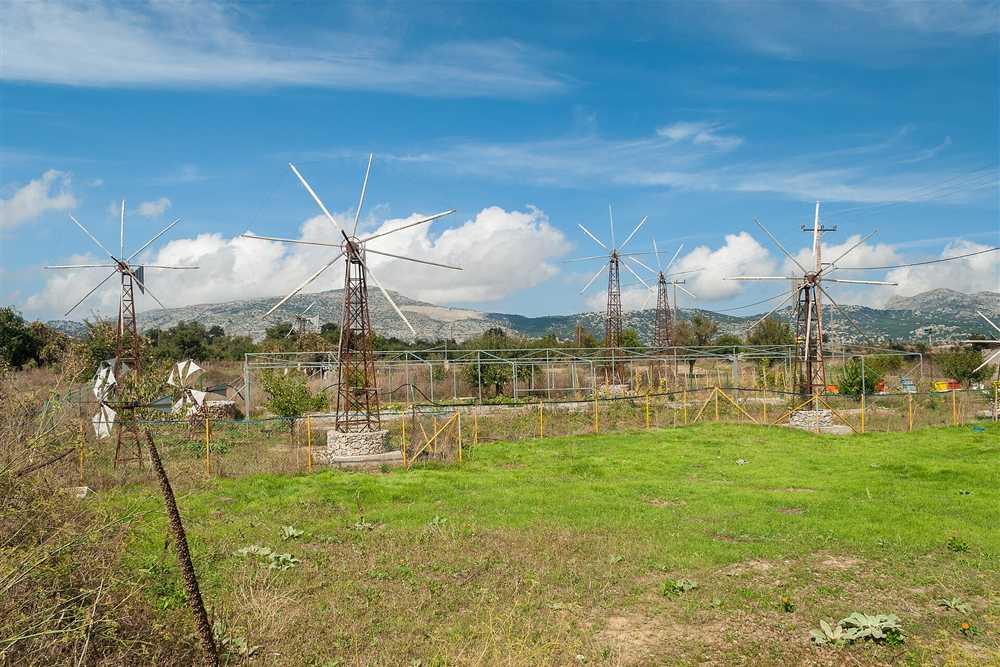
The windmills are the signature image of the Lasithi Plateau, and old photographs show the plain dotted with thousands of them turning at once. These were not grain mills but water pumps, built with cloth sails to draw water up from below and spread it across the thirsty fields. The cool climate still needs irrigation through the dry summer, and for generations the wind did that work. Cresting the mountain passes to a sea of white sails spinning across the green basin was a sight that drew visitors from far away. The mills gave the plateau its postcard identity and tied the farming here to the mountain winds that sweep the high plain.
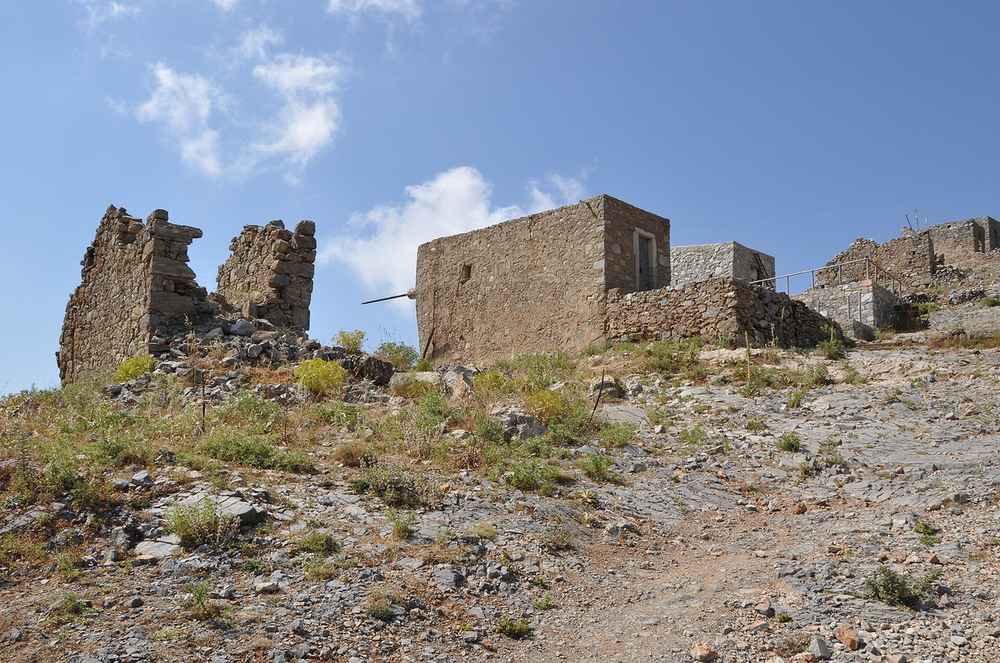
Times changed, and most of the cloth-sailed windmills fell out of use as motorised and metal water-pumps took over the irrigation. Many of the old towers now stand ruined or empty, their sails long gone, while the newer metal pumps do the daily work. A scattering of the classic white mills survives, and their frames still mark the landscape enough to explain the plateau’s reputation. The ruins themselves have become part of the scenery, photographed by travellers who come up for the views.
Sitting at the heart of the eastern highlands, the plateau pairs naturally with a coastal base such as Agios Nikolaos down on Mirabello Bay, an easy drive away when you plan a day in the mountains.
Which villages ring the Lasithi Plateau?
A ring of small farming villages dots the rim of the plateau, among them Tzermiado, Agios Georgios and Psychro. They sit around the edge of the plain, each looking out over the encircling Dikti mountains.
A string of villages traces the rim of the plateau, set just above the farmland where the flat basin meets the rising slopes. Tzermiado is the largest of them and acts as the main gateway on the plain, with Agios Georgios and Psychro among the other settlements around the ring. The looping road connects them, so a slow drive can take in several in a single visit. Each village keeps a traditional, agricultural feel, built from stone and centred on small squares, churches and tavernas. The pace here is unhurried, shaped by the seasons of the fields rather than the rhythm of the tourist coast.
Wandering these hamlets gives a genuine sense of mountain life on Crete, far removed from the resort strips, while the historic Milatos cave lies on the coast below to the north.
The villages make natural stops for a meal or a rest during a loop of the plain, and their tavernas serve local produce grown in the surrounding fields. Small folklore collections and old churches turn up here and there for those who want to linger. The plateau lies well inland from the eastern beaches, so a day here contrasts sharply with the shore. Travellers heading further east on other days often pair it with the palm-fringed Vai beach or the island fortress of Spinalonga out on the water, spreading these eastern sights across a longer stay.
On the plateau itself the appeal is simpler: mountain air, quiet lanes and a working farming community ringed by the peaks of the Dikti mountains.
What is the cave above Psychro on the plateau?
Above the village of Psychro sits the Dikteon Cave, which myth names as the birthplace of Zeus. It is the plateau’s best-known single sight and draws visitors up from the plain to its dramatic chambers.
The most celebrated single landmark tied to the plateau is the cave that opens in the mountainside above Psychro. Known as the Dikteon Cave, it carries one of the great stories of Greek myth, which names it as the place where the god Zeus was born and hidden away. That legend has drawn travellers up the slope for a very long time, and it remains the headline reason many people climb to the plateau at all. The cave sits above the village, reached by a walking path from the parking area, and its deep chambers and rock formations make a striking contrast with the open farmland below.
You can read the full story of the Dikteon Cave on its own page.
A visit pairs naturally with a loop of the plateau’s villages and fields because the cave stands on the rim of the plain. Most people climb from Psychro in the morning, then spend the rest of the day exploring the ring road and stopping for lunch. The walk up is short but steep, so sturdy shoes help on the rocky path. Together the cave and the surrounding highland make a full and varied day out, mixing myth, mountains and farmland in one compact area. The plateau gives the cave its setting, and the cave gives the plateau its most famous name.
For anyone drawn to the older layers of the island, this corner of the east rewards the drive up more than most.
How do you plan a day trip to the Lasithi Plateau in Crete?
Drive up from the north coast on the winding mountain road, allow a full day, and loop the plateau’s villages and cave. Pack a light layer, since the upland air stays cooler than the beaches below.
A day trip to the plateau starts with the drive up from the north coast, which climbs through mountain passes on a road of steady hairpin bends. The ascent is scenic in its own right, opening long views back over the coast and the sea before the road tops out on the high plain. Give the outing a full day, since the winding roads slow the pace and the plateau itself deserves unhurried time. From the eastern resorts the climb is the most direct approach, gaining height quickly as the villages of the coast fall away behind you.
Take the bends gently, pull over at the viewpoints, and treat the journey as part of the day rather than a chore to rush through.
Once on the plateau, follow the ring road to string together the villages, the surviving windmills and the cave above Psychro at a relaxed pace. Bring a light layer, as the upland air stays noticeably cooler than the coast even in high summer, and pack water and sturdy shoes for the short climb to the cave. Tavernas in the villages handle lunch, so there is no need to carry much beyond that. Planning the trip is easier once you know when to come, and our notes on the best time to visit Crete help you pick a month with comfortable mountain weather.
Set off in the morning, loop the plain through the day, and drop back down to the coast in the late afternoon for a full and rewarding outing.
What does a Lasithi Plateau tour include, and how long does it take?
A Lasithi Plateau tour includes the drive up to about 840 metres, the wind pumps, a village stop, the Cave of Zeus above Psychro and, on most tours, the Kera Kardiotissa monastery, the village of Krasi and an olive oil farm. A jeep safari takes about eight hours; a coach tour that adds Knossos takes ten.
Tours spend 1.5 to 2 hours at Psychro for the cave. The stop at Krasi lasts about 20 minutes, and the Kera monastery about 30.
Pickups run from Malia, Hersonissos and Heraklion on the north coast, from Elounda and Agios Nikolaos in the east, and from Rethymno in the west. Malia is the closest resort to the plateau road.
The Lasithi Plateau lies about 70 kilometres east of Heraklion. A pass on the rim gives views out to sea and over the whole plain.
Is the Cave of Zeus on the Lasithi Plateau really the birthplace of Zeus?
The link is disputed. Early twentieth-century excavators identified the cave above Psychro with the Dikte of the ancient writers, where Zeus was born. Later scholars question the identification, and some place the Dikte of the myths near Palaikastro in the far east of Crete.
Apollodorus placed the birth of Zeus in a cave on Mount Dikte. There, nymphs raised the infant god on the milk of the goat Amalthea.
Hesiod placed the cave on Mount Aegaeon instead. The ancient sources do not agree on one mountain.
Guides on the Lasithi Plateau tell the myth and the debate together. The cave was the most visited shrine of the area by Middle Minoan times, whatever its link to the myth.
What did excavators find in the Cave of Zeus?
Excavators found a stuccoed altar in the upper cave, surrounded by ash, pottery and offerings of bronze, clay, iron and bone. In the lower grotto they found small bronze double axes, knife blades and needles pushed into the cracks of the stalactites.
Joseph Hatzidakis and Federico Halbherr first dug the cave in 1886. Arthur Evans examined it in 1896, and David Hogarth of the British School at Athens excavated it in 1900.
Animal bones show sacrifices of bulls, sheep, goats, deer and a boar.
The visit descends from the upper cave to the lower grotto, where stalactites rise from a pool. The air is cool in summer, and the steps are uneven, so wear shoes with grip. The walk up from the Psychro car park is steep; donkeys carry visitors who find it hard.
Which monasteries stand on and around the Lasithi Plateau?
Three monasteries stand on and around the Lasithi Plateau: Kera Kardiotissa, a convent on the road up near the village of Kera; Vidiani, on the plateau itself; and Kroustalenia, the seat of the revolutionary committee in the Cretan revolt of 1866 to 1869.
Kera Kardiotissa is dedicated to the Virgin Mary and is the first stop on tours from the north coast. The road climbs sharply to the pass after it.
Vidiani sits on the plain and pairs with Krasi on the second half of the day.
Kroustalenia was demolished by Ottoman and Egyptian forces in May 1867 and later rebuilt. All three are working religious houses, and visitors cover shoulders and knees.
What is Krasi, on the road to the Lasithi Plateau?
Krasi is a small village on the slopes of Mount Selena on the road to the Lasithi Plateau. It is known for the freshwater springs in its main square and for its huge old plane trees, one of them among the largest on Crete.
Coach tours stop here for about 20 minutes, on the way up or on the way back.
Cafes sit in the shade of the plane trees beside the springs.
A guided hiking tour of the plateau starts from Krasi and crosses the plain on foot.
How is the Lasithi Plateau drained?
The Lasithi Plateau is a closed basin: mountains ring it on every side and impermeable rock lies just below the soil, so water gathers on the plain. Venetian drainage ditches, the linies, carry it west to the sinkhole of Chonos, the plain’s single natural outlet.
The Venetians dug the grid of ditches between 1514 and 1560. The ditches are still in use, and the field pattern follows them.
The sinkhole feeds the Aposelemis river. A 3.5-kilometre tunnel now carries the flood water to the Aposelemis reservoir below.
The high water table is the reason the plateau once held around 10,000 wind pumps. Snowmelt brings the alluvial soil that makes the plain fertile.
What is the Aposelemis dam below the Lasithi Plateau?
The Aposelemis dam holds the reservoir below the Lasithi Plateau that receives the plateau’s flood water. The reservoir covers the old village of Sfentyli, whose houses and church appear when the water level falls.
Jeep safaris make the dam their first stop, on a road through olive groves.
The water level changes with the season and the rain.
The sunken village is the dam’s best-known sight, and late summer shows the most of it.
Why did Venice empty the Lasithi Plateau?
Venice emptied the Lasithi Plateau because its frequent rebellions made it a base of resistance. From 1293, the Venetians demolished its villages, banned farming and forced the people out on pain of death, calling the plateau a thorn in the heart of Venice.
The ban lasted more than two centuries. The plain lay empty through that time.
In the fifteenth century, Venice let refugees from the Peloponnese resettle the plateau.
The Venetians then dug the drainage ditches, and the plain returned to grain and vegetables. People had farmed here since Neolithic times, around 6000 BC, before the Venetian ban.
What part did the Lasithi Plateau play in the Cretan revolts and the Second World War?
In January 1823, an Ottoman and Egyptian army under Hassan Pasha seized the Lasithi Plateau and killed the residents who had not fled. In May 1867, Ottoman forces defeated the rebels there and burned the villages. From 1941 to 1944, resistance fighters used the surrounding peaks as hideouts.
In 1867, the rebels retreated to the slopes of Dikti. Between 21 and 29 May, villagers were killed or enslaved, and homes, crops and livestock were destroyed.
The Kroustalenia monastery, seat of the revolutionary committee, was demolished in the same attack.
The mountains that ring the plain gave cover and a view over it, which is why every generation of resistance used them.
What is Karfi, above the Lasithi Plateau?
Karfi is an archaeological site at about 1,100 metres above the northern entrance to the Lasithi Plateau. It began as a Minoan peak sanctuary and became a large town between about 1200 and 1000 BC, where Minoan culture survived after the fall of Knossos.
Karfi means the nail in Greek, after the limestone knob on the peak. John Pendlebury excavated it in 1937 and 1939.
The finds include clay goddesses with raised arms, now in the Heraklion Archaeological Museum. The site holds houses, a shrine and paved streets.
The Trapeza cave, a Neolithic and Bronze Age burial cave on the plateau, adds to the archaeology of the area. Its name means table in Greek.
What are the Dikti mountains, and can you climb Mount Dikti from the Lasithi Plateau?
The Dikti mountains ring the Lasithi Plateau and rise to 2,148 metres at Spathi. Agios Georgios, on the plateau, is a starting point for the climb to the summit, and the E4 long-distance trail passes through the village.
The range holds the plateaus of Lasithi, Katharo, Omalos Viannou and Limnakaro. Calabrian pine, kermes oak, cypress, holm oak and Cretan maple cover its slopes.
The climb to Spathi is a full-day mountain hike. Snow lies on the summits into spring.
Walking boots and water are essential. Guided hikes suit first-time visitors to the mountains.
What is the Knossos and Lasithi Plateau combination tour?
The combination tour is a day trip from Heraklion or the north coast that visits the Palace of Knossos in the morning and the Lasithi Plateau with the Cave of Zeus and an olive farm in the afternoon. One version runs ten hours, from 08:00 to 18:00.
The day stops at Krasi, the Kera monastery and a ceramics workshop.
Lunch is taken at a village taverna. Guests learn how wine, raki and olive oil are made.
The Knossos entry ticket is paid on top of the tour on most listings. Our Knossos guided tours page covers the palace.
Can you visit the Lasithi Plateau from Rethymno, Elounda or by car?
Yes. A tour from Rethymno visits the Cave of Zeus, the Kyra monastery and the villages; a tour from Elounda visits the plateau, the cave and Krasi. By car, the Lasithi Plateau lies about 70 kilometres east of Heraklion.
Rethymno lies far to the west, so its tour has the longest drive. Elounda sits close to the eastern approach.
The road from the north coast climbs through Krasi and Kera to the pass, which gives the first view of the plain.
Parking at Psychro serves the cave. A hire car sets its own pace, and a guided tour adds the commentary.
When is the best time to visit the Lasithi Plateau?
The best time to visit the Lasithi Plateau is late spring to autumn, after the snow leaves the plain. Spring brings green fields and blossom, summer brings the coolest escape from the coast, and autumn brings the harvest.
Winters on the plateau are harsh, and snow on the plain and the mountains lasts into spring.
A layer is needed on summer evenings at 840 metres.
Morning starts beat the crowds at the cave, and clear days give the best view from the pass.
Is a Lasithi Plateau tour good for families?
Yes. A Lasithi Plateau tour suits families: the drive has regular stops, the olive farm has space to walk around, and the donkey ride up to the cave is optional. The cave path is steep, so a carrier helps with toddlers.
Snacks and water help on the long day.
Private tours let a family set the pace and choose the stops.
Children remember the cave and the story of the infant Zeus hidden from his father.
What are the common mistakes on a Lasithi Plateau tour?
The common mistakes are forgetting cash for the cave ticket, wearing sandals on the cave path, dressing for the coast instead of 840 metres, booking a combination tour without checking its ten-hour length, and skipping the photo stop at the pass.
The cave ticket is rarely included in the tour.
The cave floor is uneven and wet in places.
Combination days start at 08:00, and pickup times change with the route.
How do you book a Lasithi Plateau tour?
Book a Lasithi Plateau tour online a day or more ahead. Choose the coach tour, the jeep safari, the hiking tour or a private tour, give the hotel name for pickup, and bring cash for the cave ticket.
Free cancellation up to 24 hours before is standard on the booking platforms.
Operators send the pickup details with the travel documents. Hotel lobby pickups start 15 minutes before the stated time.
Private tours are requested in advance, with stops such as Karfi, Kroustalenia or a longer village walk added on request.
Frequently Asked Questions
How high is the Lasithi Plateau?
The Lasithi Plateau sits at roughly 840 metres above sea level, high in the Dikti mountains of eastern Crete. That altitude sets it well apart from the warm coastal resorts, giving the plain a cooler, fresher climate through the year. Summer days on the plateau stay milder than on the beaches far below, and the surrounding peaks can hold snow through the colder months. The height is a large part of what makes the region feel so different from the rest of the island. It supports crops such as apples and potatoes that suit the cool mountain air, and it explains why the plain has long relied on irrigation to water its fields.
For travellers, the practical effect of the altitude is simple: the plateau is noticeably cooler than the coast, so a light layer is worth packing even on a hot summer day. The drive up gains that height quickly, climbing through mountain passes on a road of hairpin bends before the land opens onto the flat, encircled basin.
Can you still see windmills on the Lasithi Plateau?
You can still see windmills on the Lasithi Plateau, though far fewer than in the plain’s heyday. The plateau was once famous for thousands of white-sailed mills that pumped water to irrigate the fields, and old images show them turning across the whole basin at once. Most have since fallen out of use, replaced by motorised and metal water-pumps that handle the irrigation today. Many of the old cloth-sailed towers now stand ruined or empty, their sails long gone, while a scattering of the classic white mills survives around the plain. Even in their ruined state, the frames remain a defining part of the landscape and explain the plateau’s lasting reputation.
Travellers still come up to photograph the surviving mills and the empty towers against the ring of mountains. The windmills are the plateau’s enduring emblem, so seeing them, whether working, weathered or restored, is a large part of why people make the drive into these eastern highlands.
Is the Lasithi Plateau worth visiting on a trip to Crete?
The Lasithi Plateau is well worth a day for travellers who want to see a different side of the island beyond its beaches. It offers cool mountain air, quiet farming villages, the famous windmills and the mythic cave above Psychro, all set within a ring of dramatic peaks. The scenic drive up through the mountain passes is a highlight in itself, opening long views over the coast as the road climbs. On the plateau you can loop the villages, stop for lunch in a taverna serving local produce, and climb to the cave tied to the legend of Zeus.
The plain stays quieter and cooler than the crowded shore, which makes it a refreshing change of pace on a beach-based holiday. It suits anyone curious about the working, agricultural interior of the island rather than only its resorts. Set aside a full day, take the winding roads gently, and the plateau rewards the effort with mountain scenery and a genuine slice of rural Crete.