
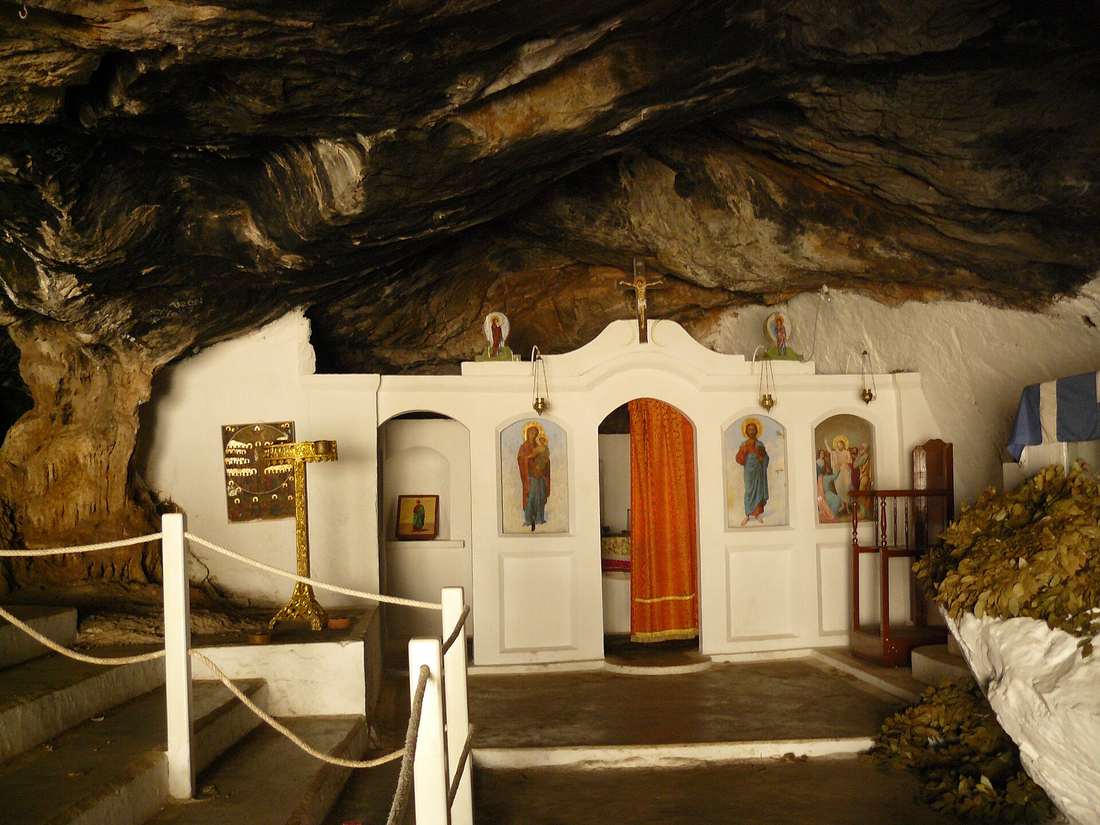
The Milatos cave sits in the hills above the village of Milatos, on the north coast of Crete in the Lasithi region near Neapoli and the fishing village of Sissi. This wide, low stalactite cavern spreads through interconnected chambers rather than one tall hall, and a small whitewashed chapel dedicated to Saint Thomas stands inside. The site carries a solemn story from the Greek War of Independence, and an ossuary honours the villagers and fighters who died here. Legend ties the place to ancient Milatos, the mother-city of Miletus in Asia Minor. Plan the geology, the history and the walk with My Greece Tours.
The cave blends dramatic geology with deep, moving history away from the busier show caves of the island. A track and a short walk from the village lead to the entrance, so the visit pairs well with the harbour of Sissi and the town of Neapoli. The sections below cover the geology of the chambers, the War of Independence tragedy, the Saint Thomas chapel, the ancient legend, and the practical route in. Read this page alongside the Crete travel guide to place Milatos within a full eastern itinerary of villages, coast and mountain history.
What is the Milatos cave in Crete?
The Milatos cave is a large stalactite cavern above the village of Milatos on the north coast of Crete, in the Lasithi region near Neapoli. It forms a wide, low run of interconnected chambers and holds a small whitewashed chapel.
The Milatos cave opens in the hillside above the coastal village of the same name. It lies in the eastern Lasithi region of the island, close to the inland town of Neapoli. The cavern reads as a wide, low spread of interconnected chambers rather than one tall hall. Daylight fades fast past the entrance into cool, dim passages of rock. Stalactites hang from the low ceilings. The floor runs uneven underfoot across the linked spaces, and the air stays cool through the hottest months. The setting places the cave within easy reach of the harbour at Sissi.
A visit here slots neatly between a swim down on the coast and a drive up into the quiet interior hills of the eastern part of the island.
The cave counts among the quieter historic sites of the region. It stands apart from the crowded, ticketed show caves found elsewhere on the island. No lighting rigs or concrete walkways dress the chambers here. The low ceilings keep the atmosphere close, still and shaded. A small whitewashed chapel dedicated to Saint Thomas sits deep inside the rock. An ossuary rests among the passages, tied to the harder history of the site. The mix of geology, faith and memory gives the place a weight that a plain cave visit rarely carries. Travellers reach it on a short, rough track that climbs from the village below.
The detour off the main coast road rewards the effort with quiet, shade and a genuine, unhurried sense of the Cretan past.
What happened at the Milatos cave during the War of Independence?
During the Greek War of Independence, hundreds of villagers and fighters sheltered inside the Milatos cave and were killed or captured by Ottoman forces. An ossuary within the chambers honours the dead, and the tragedy defines the site’s solemn character today.
The cave holds its most solemn story from the Greek War of Independence. Hundreds of villagers and fighters took refuge in the chambers to escape advancing Ottoman forces. The sheltering people held out inside the rock. They trusted the depth and the confusion of the interconnected passages to hide them from the troops outside. The refuge failed in the end. Ottoman forces broke the resistance, and the trapped villagers and fighters were killed or captured. The event marks the cave as a place of mourning rather than spectacle. Visitors reach it in a reflective frame of mind.
A route that takes in this history pairs well with the town of Agios Nikolaos, the regional hub a short drive east along the coast from the village of Milatos.
An ossuary set among the chambers gathers and honours the bones of the dead. It turns the cavern into a lasting memorial rather than a simple geological curiosity. Candles, icons and quiet respect from visitors keep the memory alive within the rock. The Saint Thomas chapel deepens the sense of a sanctified, guarded space. The story sits within the long Cretan struggle against Ottoman rule. That thread runs through fortresses, monasteries and mountain villages right across the island. Reading the Milatos tragedy against that wider history makes the short walk into the hills far more than a geology stop.
A trip that also weaves in the ring-shaped plateau country of the Lasithi Plateau ties the cave into the broader eastern landscape of resistance and refuge.
What can you see inside the cave and the Saint Thomas chapel?
Inside the cave you find a wide run of low, interconnected stalactite chambers, a small whitewashed chapel dedicated to Saint Thomas, and an ossuary honouring the dead. The chapel gives the dim rock passages a place of quiet worship and remembrance.
The chambers form the core of the visit. They make up a linked series of low, wide spaces hung with stalactites and worn smooth by long use and shelter. The chapel dedicated to Saint Thomas stands out at once. Its whitewashed walls glow bright against the dark rock, a small place of worship built into a cavern that doubled as a refuge. The nearby ossuary anchors the memory of the War of Independence dead in physical form. The three elements, rock, faith and memorial, give the site a layered character together. Travellers assembling a full list of things to do in Crete often set Milatos beside the beaches and Minoan palaces of the north coast.
The cave brings a welcome change of tone and a slower pace to a busy eastern route.
Movement through the cave stays low and careful. The ceilings press down, and the floor runs uneven across the connected chambers. Sturdy shoes and a torch both help on the visit. Natural light drops away fast past the entrance, and the far passages sit in near darkness. The whitewashed chapel gathers what little brightness reaches it. The contrast with the surrounding grey stone marks the spiritual heart of the place clearly. Quiet is the rule inside, both for the fragile setting and out of respect for the dead who lie in the ossuary. A visit here fills about an hour of the day.
That leaves time to continue along the coast or up into the hill villages of the interior on the same eastern loop through this corner of the island.
What is the ancient legend of Milatos in Crete?
Legend links the site to ancient Milatos, said to be the mother-city of Miletus in Asia Minor. The old town lends the modern village and its cave a claim to deep antiquity, connecting eastern Crete to the Ionian coast across the water.
The name carries an old legend that ties the village to ancient Milatos. Tradition holds that town to be the mother-city of Miletus on the coast of Asia Minor. The story draws a line of settlement outward from this eastern shore of the island to the wider Ionian world. It casts the modern coastal village as heir to a place named in myth and early history. The legend adds a layer of antiquity beneath the more recent, tragic memory of the cave itself. Visitors who enjoy this depth of history often extend the theme across the region.
They read it against the broader run of hidden gems in Crete, quiet places that carry their own founding tales, ossuaries, chapels and generations of local pride passed down through the villages.
The legend gives the cave and the village a double timescale. One strand reaches back into distant myth, and the other stays rooted in the harder record of the War of Independence. The pairing rewards travellers who like their sites to hold more than one story at once. No grand ruins mark the ancient claim on the ground today. The antiquity lives mainly in the name and the tradition passed down through the village. That understated quality suits the low-key coast around Milatos and Sissi well. Reading up before the trip helps the visit land with its full weight. The chambers themselves make the geology plain enough on arrival.
The layered history, ancient and modern together, is the part that rewards a little study on the drive out to the cave.
How do you reach the Milatos cave in Crete?
You reach the Milatos cave by driving to Milatos village near Neapoli in eastern Crete, then following a track and taking a short walk uphill to the entrance. The route lies close to Sissi, Agios Nikolaos and the coastal highway through Lasithi.
The cave sits above Milatos village, reached from the coastal highway that runs through Lasithi near the town of Neapoli. Drivers follow the road down into the village. They then continue on a rough track that climbs the hillside toward the entrance. The route finishes on foot with a short uphill walk over open ground. The drive is simple in a hire car, and the village makes a natural staging point with rooms and tavernas near the sea. The cave sits close to the harbour at Sissi and within a manageable drive of the eastern hubs. It folds easily into a wider day out along the coast.
Choosing the best time to visit Crete shapes the walk, since spring and autumn spare the fierce heat on the exposed final path up to the cave.
The short walk up crosses open, rocky ground. Sturdy shoes, water and sun cover all help on the approach, above all through the dry summer months when shade runs thin. The chambers inside stay cool, a welcome contrast after the climb in the heat. Planning the visit as part of a longer eastern loop makes the most of the drive out. The coast road links Milatos to Sissi, Neapoli and the wider region within short hops. A full day out combines the cave with a swim, a harbour lunch and a run inland to the plateau. The historic chapel and ossuary anchor the stop with real depth. A well-built eastern itinerary keeps the sights in a sensible order.
That planning spares wasted backtracking along the coast between the village, the harbour and the hills.
Frequently Asked Questions
Is the Milatos cave worth visiting?
The Milatos cave rewards visitors who value history and quiet over polished tourist attractions. It combines a wide stalactite cavern, a whitewashed chapel dedicated to Saint Thomas, and an ossuary tied to the Greek War of Independence, when hundreds of sheltering villagers and fighters were killed or captured by Ottoman forces. The layered story gives the short walk real weight on the ground. The ancient legend linking the site to Miletus in Asia Minor adds further depth to the visit. The cave stays free of the crowds and ticket gates of the island’s big show caves. It keeps a still, reflective atmosphere throughout the chambers.
The visit fills about an hour and folds neatly into an eastern loop of coast and mountain. Travellers reach it easily from the harbour at Sissi and the town of Agios Nikolaos, so the cave works as a natural detour rather than a long trip out of the way for anyone touring the eastern part of the island.
How long does a visit to the Milatos cave take?
A visit to the Milatos cave usually takes about an hour. That covers the short uphill walk from the village track, time inside the interconnected chambers, and a pause at the Saint Thomas chapel and the ossuary. The walk up crosses open, rocky ground, so allow a little extra time in hot weather and wear sturdy shoes for the approach. Movement inside stays slow across the low, uneven chambers, and a torch helps in the darker far passages beyond the entrance. Most travellers pair the cave with nearby stops rather than treating it as a standalone destination. The drive suits a wider day out through the eastern part of the island.
The coast road links Milatos to the harbour at Sissi, the town of Neapoli and the plateau country of the interior. Building the cave into a loop of coast, village and mountain makes the short detour off the main road well worth the time spent.
Where is the Milatos cave and what is nearby?
The Milatos cave lies above Milatos village on the north coast, in the eastern Lasithi region near the town of Neapoli. The fishing village of Sissi sits close by, with its harbour of fish tavernas and quiet coves. The regional hub of Agios Nikolaos lies a short drive east along the coast, with rooms, restaurants and boat trips. Inland, the road climbs to the ring-shaped Lasithi Plateau, giving a natural pairing of coast and mountain in a single day out. The cave itself holds interconnected stalactite chambers, the Saint Thomas chapel and a War of Independence ossuary. It stands apart from the busier, ticketed attractions of the island.
The legend of ancient Milatos adds a further layer of interest to the stop. Travellers weave the site into a broad eastern route, linking the quiet coast with the beaches, palaces and towns that anchor the rest of an itinerary through this part of the region.