
Crete Stand Up Paddle
A Crete stand up paddle tour is an instructor-led session on a wide inflatable board, where each rider stands and crosses calm sea water with one long paddle. The tours on sale run from Chania, and our Greece Tours pages list them with the other sea activities on the island. A first Crete stand up paddle lesson starts on the knees, so beginners find their balance before they stand.
Crete stand up paddle sessions run from May to October, and the north coast is calmest in the morning and at sunset. Around Chania, the Akrotiri coves and the bays of Agioi Apostoloi suit a board, and further afield the lagoons of Elafonisi and Balos do too.
What is a Crete stand up paddle tour?
A Crete stand up paddle tour is a paddleboard outing led by an instructor on the coast around Chania, in which riders learn to kneel, stand and stroke on a wide board before they follow the shoreline of Greece’s largest island.
Stand up paddleboarding, known as SUP, grew out of Hawaiian surfing and is now a flat-water sport around the world. The rider stands upright on a long, wide board, holds a paddle with a T-shaped grip at the top and pulls the blade through the water on alternate sides. On a Crete stand up paddle tour, the instructor leads the group along the shore, teaches each skill on the water and keeps every rider in sight.
Crete suits the sport for three reasons. The island has sheltered bays on its north, south and east coasts, so riders find calm water close to the main towns and resorts. The sea is clear, and riders see rocks, sand and fish below the board. The warm months are long, and Crete stand up paddle tours run through the summer and into autumn. Paddling fits into a wider trip around Crete, alongside beaches, old towns and mountain villages.
Which Crete stand up paddle tours are on sale in Chania?
Four Crete stand up paddle formats are on sale in Chania: a small-group coastal tour, a coastal sunset paddle, a paddle out to the small Lazareta islet and a stand up paddle pilates class held in the morning or at sunset.
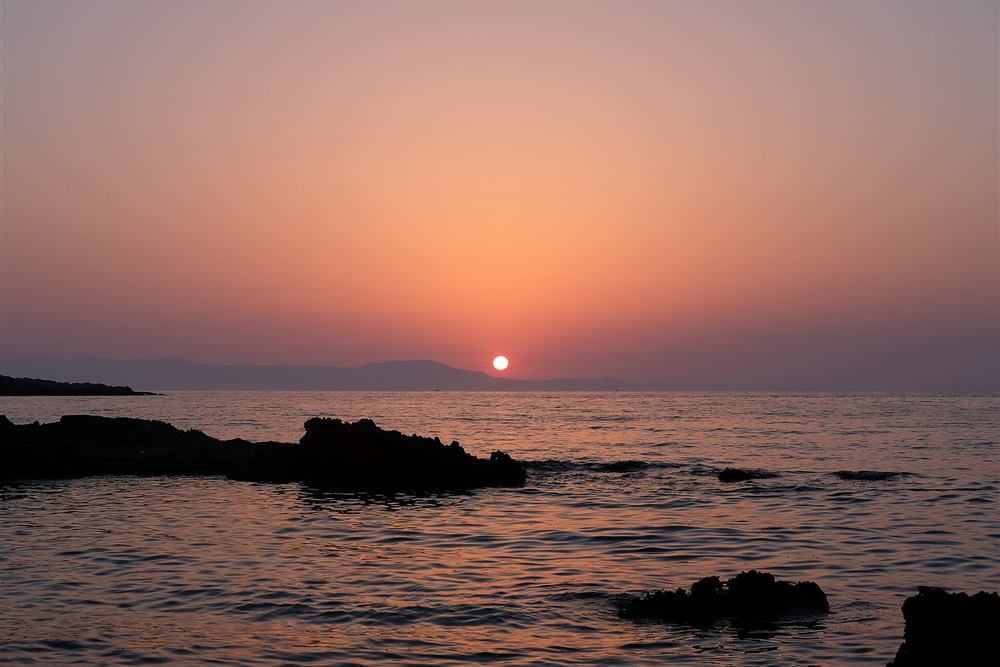
The small-group coastal tour is the entry format. The instructor teaches the kneeling start, the forward stroke and turning in shallow water, then leads the group along the Chania coast at an easy pace. The coastal sunset paddle takes place in the last hours of daylight, when the wind on the north coast drops and the water settles. A Crete stand up paddle tour at sunset draws couples and photographers.
The Lazareta format adds a destination to the paddle. Riders cross open water from the Chania coast to the small Lazareta islet and back, so the instructor checks the wind before the group leaves the shore. The pilates format turns the board into a floating mat, and riders hold pilates positions on calm water, which works the core and balance together. The class runs in the morning or at sunset, the two calmest times for a Crete stand up paddle session on the north coast.
How does the first lesson on the water work?
The first lesson starts on the knees in shallow water, moves to standing once the rider feels steady, then covers the paddle grip, the forward stroke, turning and a safe fall, all taught in the first part of a Crete stand up paddle tour.
In a Crete stand up paddle lesson, riders kneel in the middle of the board, just behind the carry handle, which marks the balance point. A few strokes on the knees give the board speed, and a moving board is steadier than a still one. To stand, the rider places one foot and then the other where the knees were, rises slowly and keeps the knees soft. Feet sit parallel, hip-width apart, with the eyes on the horizon.
The instructor sets the adjustable paddle so the grip sits above the rider’s head. One hand holds the T-grip, the other holds the shaft, and the angled blade points forward, away from the rider. The forward stroke reaches ahead, buries the whole blade and pulls it back to the feet, with power from the torso. Switching sides keeps the board straight, a wide sweep stroke from nose to tail turns it, and every lesson covers a safe fall.
- Fall sideways – drop into the water, clear of the board and its fins.
- Hold the paddle – keep a grip on it through the fall.
- Pull the leash – draw the board back within reach.
- Climb back on – grip the handle, kick and slide onto the knees.
Why do tours use inflatable all-round boards?
Tours use inflatable all-round boards because they are wide, thick and stable, soft to land on in a fall and light to carry, and a Crete stand up paddle tour pairs each board with a paddle, a leash and a buoyancy vest.
An all-round board has a rounded nose, a broad middle and one or three fins underneath, a shape built for stability on flat water rather than speed. The inflatable version is made of layered PVC with a drop-stitch core, pumped up until it feels rigid underfoot. It weighs less than a hard board, rolls into a bag and takes the knocks of a Crete stand up paddle day around rocky coves.
The leash is a coiled cord that straps to the ankle or calf and attaches to the tail of the board. After a fall, it keeps the board within reach, which matters in wind, because a loose inflatable board drifts faster than a swimmer can follow. The buoyancy vest keeps the rider afloat and is standard kit on tours. The tour listing names the full kit included with each format.
Where can riders paddle around Chania?
The main Crete stand up paddle spots around Chania are the sea off the Venetian harbour, the small Lazareta islet, the coves of the Akrotiri peninsula, the sheltered bays of Agioi Apostoloi to the west and Almyrida in Apokoronas.
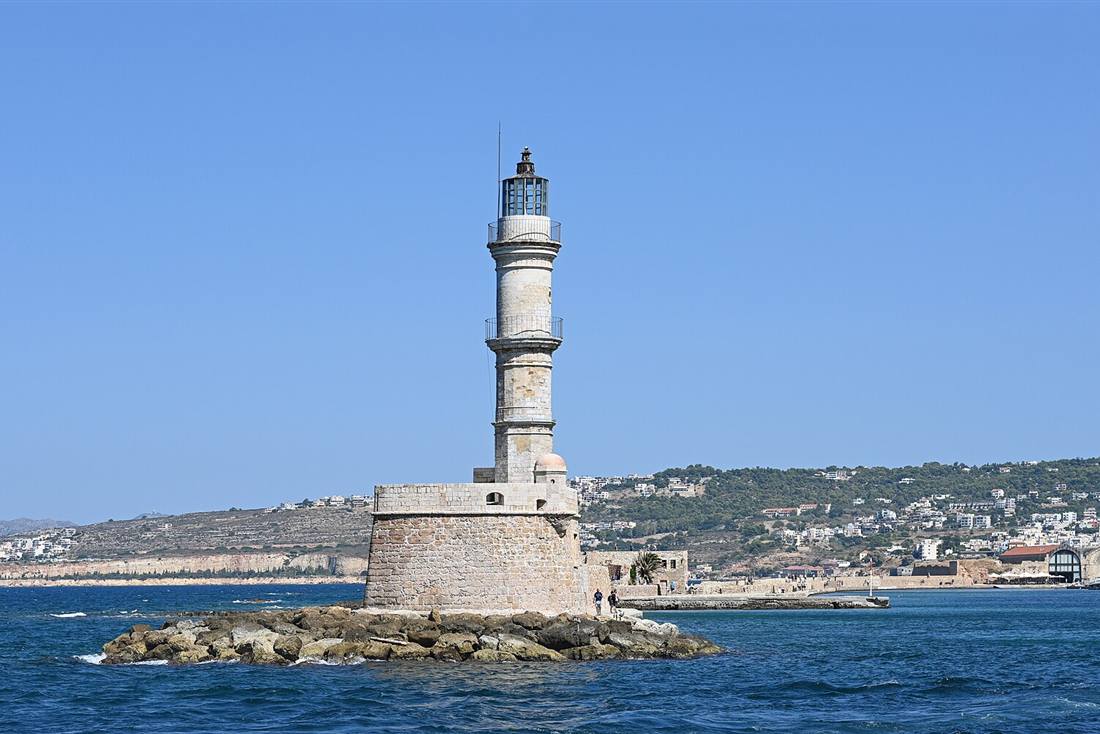
From the sea, Chania shows its harbour front in full. The Venetian harbour sits behind a long breakwater, with a 16th-century lighthouse at its entrance and the domes and facades of the Chania old town behind the quay. The small Lazareta islet lies off the same coast, and a Crete stand up paddle tour to the islet gives riders a view back to the town with the White Mountains behind it.
East of Chania, the Akrotiri peninsula has small coves such as Seitan Limania, Stavros and Marathi. Seitan Limania is a narrow inlet between steep rock walls with a tiny beach at its end, Stavros has a shallow, almost enclosed bay under a bare mountain, and Marathi has small beaches beside a little harbour. The rock and sand below these coves show clearly through the water from a standing position on a Crete stand up paddle board.
West of the town, Agioi Apostoloi is a group of small sheltered bays with sandy beaches and shallow water near the shore, which suits first attempts at standing. East of the town, Almyrida lies on the western side of Souda Bay in Apokoronas, with a sandy beach along the village front. Its water is flattest in the morning, before the summer north wind fills in, so morning is the time for a paddle there.
Can paddlers explore the lagoons of Elafonisi and Balos?
Yes, Elafonisi in the south-west and Balos in the north-west are shallow turquoise lagoons, and a Crete stand up paddle board glides over their sandy bottom, but both are protected Natura areas, so paddlers follow local rules and keep off dunes and plants.
At Elafonisi beach, a sand bar links the shore to a small island, and the lagoon beside it stays shallow and clear, with pink tints in the sand. Balos lies on the Gramvousa peninsula, where a lagoon of pale water sits between the mainland and Cape Tigani. Both lagoons suit slow, flat-water paddling on a wide board, and in knee-deep water the safe way to fall is flat, never head first.
The Crete stand up paddle tours on sale run from Chania, so a paddle at either lagoon means carrying an inflatable board on a day trip. Sheltered bays on the south and east coasts offer calm water too. The south coast faces the Libyan Sea, and in a north wind its bays stay flat close to the shore, but that wind blows offshore there and pushes a loose board out to sea.
How do wind and sea shape a Crete stand up paddle day?
Wind decides the paddling day: the summer north wind raises chop on the north coast in the afternoon, mornings and sunsets bring calmer water, and an offshore wind pushes a board out to sea, so Crete stand up paddle tours read the forecast before every session.
The meltemi is the north wind of the Aegean summer, and it blows in July and August. It builds through the late morning and peaks in the afternoon, when north-coast water around Chania turns choppy. Short, steep waves tilt a board from side to side and make standing difficult for a beginner, so a Crete stand up paddle session in those hours turns into hard work. Mornings and sunsets avoid the peak.
Offshore wind is the main risk. It blows from the land toward the sea, so the water near the beach looks flat while the wind pushes a board away from the shore, and paddling back against it tires a beginner fast. A standing rider acts like a sail, so even a light offshore breeze moves the board. Instructors check the forecast before each session and pick the bay and the hour to match.
- Glassy water – still air and the easiest conditions to learn.
- Whitecaps – wind too strong for a first session.
- Wind from the land – an offshore breeze that pushes boards out.
When is the water warmest for paddling in Crete?
The Crete stand up paddle season runs from May to October, and the sea is warmest in August and September, after a full summer of sun, while May brings the coolest water of the six months.
Sea temperature lags behind air temperature, because water stores heat slowly. The sea off Crete warms through June and July and reaches its peak in August and September, which makes those months the most comfortable for riders who expect to fall in. In May, the water is fresh, and beginners on a Crete stand up paddle lesson feel the chill after the first fall, so a rash vest or a thin wetsuit top helps.
Wind shapes the calendar as much as temperature does. July and August pair the warm sea with the meltemi, so the morning and sunset slots matter most in those months. September pairs the warmest water with a weaker north wind, and a Crete stand up paddle outing in October still meets mild water and calm mornings. Late May and June bring lighter winds, quieter beaches and the longest days of the year.
- May and June – cooler water, lighter wind and long days.
- July and August – warm water and an afternoon meltemi.
- September – the warmest water and a weaker north wind.
- October – mild water, calm mornings and shorter days.
Who is stand up paddleboarding in Crete for?
A Crete stand up paddle tour suits beginners on wide, stable boards, families with a child riding on the board with an adult, fitness lovers who want balance and core work, and couples who paddle at sunset.
The coastal and sunset formats welcome complete beginners. The wide board and the kneeling start make the first stand manageable, no surfing background is needed, and a basic level of fitness covers a paddle at an easy pace. Riders need to feel at ease in deep water, even with a buoyancy vest on, and the tour listing states any swimming or age rule for each Crete stand up paddle session.
Families share a board: a child sits or kneels at the front while an adult stands behind and paddles, which keeps the child close to a parent the whole time. Fitness lovers pick the morning or sunset pilates format, which turns the balance of a Crete stand up paddle session into a core workout. Couples pick the sunset paddle, which ends the day on the water as the light fades over the sea.
- Beginners – a wide board and a kneeling start.
- Families – a child on the board with an adult.
- Fitness lovers – pilates moves for core and balance.
- Couples – a coastal paddle as the sun sets.
Do paddlers need special clothing and gear?
No special clothing is needed for a Crete stand up paddle tour: riders wear a swimsuit and a rash vest, add sun protection and a hat with a strap, and bring water and a waterproof pouch for a phone.
Riders paddle barefoot, since bare feet grip the soft deck of an inflatable board and feel each shift in balance. A rash vest covers the shoulders and back, the parts of the body that face the sun for the whole session, and it dries fast after a fall. The Cretan sun reflects off the water as well as shining from above, so sun cream goes on before the session and again after a swim.
A hat with a strap holds on in a gust and after a fall, and sunglasses need a cord for the same reason. Drinking water matters in the Cretan heat, and a small bottle rides under the cords on the nose of the board. A waterproof pouch keeps a phone dry for photos from a Crete stand up paddle board, and anything that cannot get wet stays ashore with the towel and dry clothes.
- On the body – swimsuit, rash vest, sun cream and a strapped hat.
- On the board – water and a phone in a waterproof pouch.
- On the beach – a towel and dry clothes.
How does paddleboarding compare with kayaking and snorkeling?
A Crete stand up paddle tour gives a higher view and a full-body balance workout, a kayak sits lower, feels steadier and covers distance faster, and snorkeling puts the face in the water for a close look at fish and rock.
Standing gives the paddler a view down into the water and along the coast that a seated kayaker lacks. A kayak copes better with chop and wind and covers more coast in the same time, and a Chania kayak tour suits paddlers who want distance rather than balance work. A Crete stand up paddle session trades that range for balance training and a slower, closer look at the rocks and the shore.
Snorkeling works in the water rather than on it: a mask and snorkel give a face-down view of fish, sea urchins and rock at close range, while a board shows the same seabed from above. The two fit together on a day at the coast, with a paddle in the calm morning and a swim with a mask afterwards. Crete snorkeling spots and paddling coves overlap on the Akrotiri peninsula.
How does booking a Crete stand up paddle tour work?
Booking a Crete stand up paddle tour happens online through its listing, which shows the dates, start times, group size, session length and cancellation terms, and the confirmation gives the meeting point on the Chania coast.
July and August are the busiest months on the Chania coast, and a small-group format has a set number of boards, so riders in those months book ahead. Sunset slots move with the season, because the sun sets later in June than in October, and the listing shows the start time for each date. Morning slots, where a listing offers them, give the calmest water of the day on a Crete stand up paddle outing.
Each Crete stand up paddle tour sets its own length and group size, so check the tour listing for both. The age rule and any swimming requirement on the listing decide whether young children and nervous swimmers can join. The weather policy matters most in July and August, when the meltemi cancels or moves some sessions on the north coast, and it states what happens to a booking on a windy day.
Is a Crete stand up paddle tour worth it?
Yes, a Crete stand up paddle tour is worth it for travellers who want an active, low-impact session on calm water, because it teaches a new skill from the first stroke, shows the Chania coast from the sea and needs no special kit.
The entry format combines a lesson and a coastal paddle in one outing, and the four formats on sale cover four goals: learning the basics, a sunset on the water, a crossing to an islet and a pilates workout. The balance work of a Crete stand up paddle session trains the legs, core and shoulders at an easy pace, and the standing view takes in the clear seabed and the coast at the same time.
The tour suits calm days and the calm hours of windy ones. Travellers who want distance or speed get more from a kayak, and riders who want to see marine life up close get more from a snorkel. For everyone else, a Crete stand up paddle outing adds a quiet, active morning or evening to a stay in Chania, and pairs with a beach day, an old town walk or a meal by the harbour.
Frequently Asked Questions
Do beginners need experience for a Crete stand up paddle tour?
No. The lesson starts from zero: riders kneel on a wide inflatable board in calm water, learn the grip and the forward stroke, and stand once the board feels steady. Riders need to feel at ease in deep water.
Can children join a Crete stand up paddle tour?
Yes, children join on the board with an adult: the child sits or kneels at the front while the adult stands and paddles behind. The minimum age and any weight limit are set per tour, so check the tour listing before booking a family session.
What time of day suits a Crete stand up paddle session?
Morning and sunset are the calmest times, because the summer north wind builds through the day and raises chop on the north coast in the afternoon, while the early and late hours bring flatter water, softer light and cooler air.
What happens after a fall from the board?
A fall on a Crete stand up paddle tour is part of learning: the rider drops sideways into the water, the leash keeps the board within reach and the buoyancy vest keeps the rider afloat. The rider climbs back on from the side and kneels before standing again.
When does the Crete stand up paddle season run?
The season runs from May to October. The sea is warmest in August and September, the meltemi north wind blows in July and August, and May brings the coolest water, so a thin wetsuit top adds warmth early in the season.