
A Heraklion food tour walks the capital of Crete from a Greek coffee brewed in hot sand and a plate of bougatsa to the olives, rusks and graviera of the market, then kalitsounia, gyros, meze with raki and a glass of Cretan wine, past Lions Square and the Venetian harbour. Plan the rest of the trip with Greece Tours.
This page covers the Heraklion food tour and its stops: the coffee and bougatsa, the market, the pies and meat dishes, raki and wine, the Cretan way of eating, the landmarks on the route, and how the walk fits a day with Knossos.
What does a Heraklion food tour taste?
A Heraklion food tour tastes Greek coffee, bougatsa, olives, rusks, local cheeses, olive oil, kalitsounia, gyros, meze with local wine and Cretan raki, and traditional sweets. One tour stops at nine different places; another runs four hours.
Heraklion is the largest city and the administrative capital of Crete, the fourth largest city in Greece and the largest city in the Greek islands.
Cretan cooking is known as the original Mediterranean diet, and the island has one of the healthiest and best-known cuisines in the world.
Guides on a Heraklion food tour share tips on the best bars and eateries of the city for the rest of the stay.
Where does a Heraklion food tour walk and how long does it last?
A small-group Heraklion food tour walks about 1.5 miles (2.4 km) on easy ground through the heart of the city and lasts 4 hours. It passes the Cathedral of Saint Titus, Lions Square, Liberty Square and the Heraklion harbour.
Meeting points for that walk are the cruise ship port, the airport or a hotel; soft drinks and bottled water are included. Another food and wine walk takes groups of at most 12 people with an English-speaking local guide.
Food walks in Heraklion are not recommended for people with walking difficulties. The walks suit food lovers, families and groups of friends.
Why does a Heraklion food tour start with Greek coffee and bougatsa?
One food walk starts with a traditional Greek coffee, ellinikos kafes, brewed the traditional way in hot sand, and the guide explains cup reading, the old custom of reading the future in the grounds. The next stop is bougatsa.
The family-owned shop has made bougatsa for more than a hundred years. Heraklion bougatsa comes with a filling of semolina custard, cheese or minced meat between layers of phyllo.
Another walk stops at the most popular bougatsa shop of the city. A different Heraklion food tour starts with original Cretan herbal tea sweetened with thyme honey.
What do you taste at the market on a Heraklion food tour?
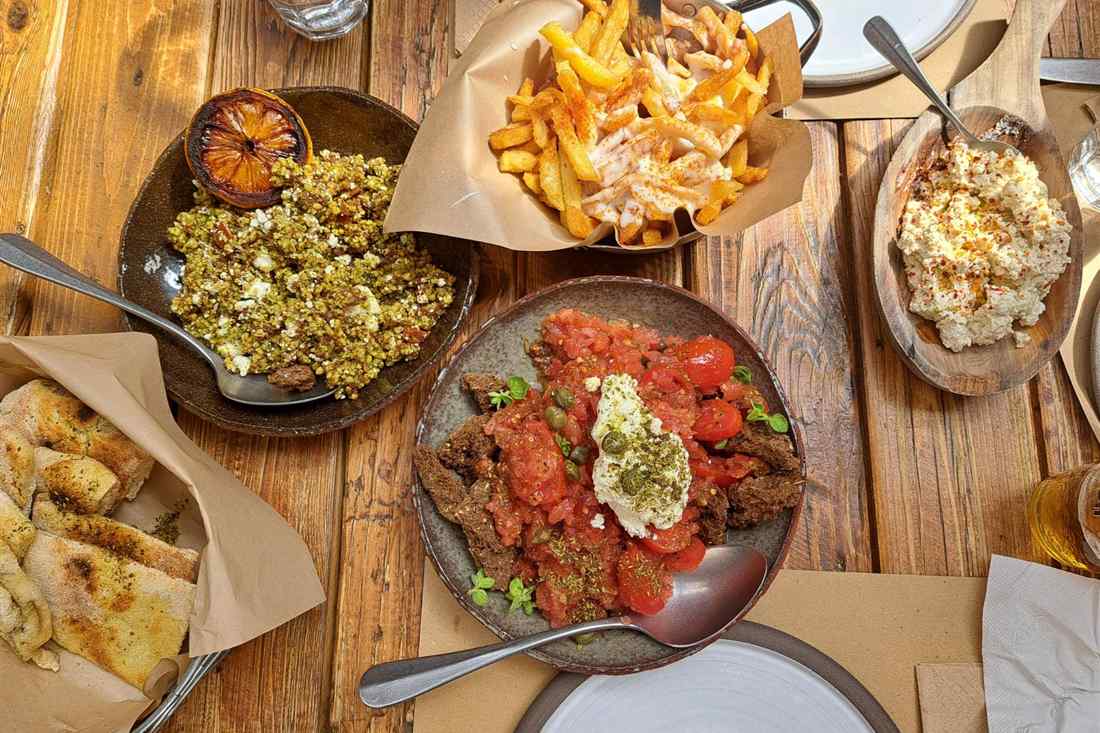
At the market you taste the basics of Cretan cooking: olives, rusks (paximadi), local cheese and the island’s olive oil, and you get hints on how to spot the best local cheeses among the stalls.
A Heraklion food tour walks through the historic centre to a local market to meet the vendors and learn about their products.
Dakos is the Cretan dish of a slice of soaked paximadi rusk topped with tomato and cheese such as feta or mizithra, flavoured with dried oregano, with olives, capers or caper berries. It is also called koukouvagia, “owl”, so you can recognise it under either name on a menu.
Graviera of Crete is a hard cheese made from sheep’s milk and ripened for at least five months; it is slightly sweet with a burnt-caramel taste. Its wheels carry the criss-cross mark of the draining cloth. Look for that mark on a whole wheel at the cheese counter. Graviera is Greece’s second most popular cheese after feta.
Other Cretan cheeses include xynomizithra, xygalo, pichtogalo, amarino, seliano, tirozouli and tiromalama. Ask for these by name at a cheese stall.
What are kalitsounia and the other Cretan pies?
Kalitsounia are small cheese or herb pies of Crete, served salty or sweet, and other Cretan pies include mizithropita (flatbread stuffed with mizithra), sarikopita (a cheese pie twisted into the shape of the sariki, a traditional Cretan headwear), kolokythopita (courgette pie) and marathopita (fennel pie).
In the Chania region, salty kalitsounia hold mizithra, a mild local whey cheese, or wild Cretan herbs without cheese; sweet ones hold mizithra with honey poured on top. In the Lasithi region they are mainly sweet, filled with mizithra, cinnamon and sometimes lemon zest.
A Heraklion food tour stops at a bakery known for the best kalitsounia in Crete. A Greek custard pie with phyllo is one of the tastings on a nine-stop food walk.
Which street food and meat dishes come on a Heraklion food tour?
A Heraklion food tour stops at a grill restaurant for Greek gyros and sits down for local organic meat or fried snails. Hohlioi boubouristoi are snails fried with rosemary and vinegar; antikristo, apaki, tsigariasto, staka, and sfougato also appear.
Antikristo, also called ofto, is a Cretan lamb dish. Apaki is smoked pork. Tsigariasto is lamb or goat meat, a dish of the Sfakia region.
Staka is a Cretan roux made from goat-milk fat. Sfougato is an omelette with vegetables, mainly potatoes, courgettes and onions, and cheese. Fried snails are loved by most Cretans.
Which Cretan dishes do you order after a Heraklion food tour?
After a Heraklion food tour, order gamopilafo, kreatotourta, tzoulamas, soupies me maratho, rofos me bamies, katsikaki me stamnagathi, arni me askolibrous, sofegada, hirino me selino, and Cretan pasta, plus appetisers such as stamnagathi salad, askordoulakoi, raw cardoons, and sykoti savore.
Gamopilafo is rice cooked in goat and rooster broth. Kreatotourta is a meat pie from western Crete, and tzoulamas is a traditional meat pie from the Messara plain. Soupies me maratho is cuttlefish with fennel, while rofos me bamies is grouper baked with okra.
Katsikaki me stamnagathi is goat, or lamb, cooked with avgolemono and stamnagathi, a local wild chicory. Arni me askolibrous is a lamb stew with golden thistle and avgolemono. Sofegada is a vegetable stew, and hirino me selino is pork with celery.
Cretan pasta includes skioufichta, magiri, chilofta and avgochilos, and triftoudia is a local orzo. Cretan appetisers include stamnagathi salad, askordoulakoi (pickled bulbs of the tassel hyacinth), raw cardoons and sykoti savore, liver cooked in vinegar.
How are raki and Cretan wine served on a Heraklion food tour?
On a Heraklion food tour, one walk pairs meze dishes with local wine and Cretan raki. Another walk ends with local Cretan wines and a spirit in a family-run shop. The pomace ferments for about six weeks in a sealed barrel before it is distilled.
Tsikoudia is the grape-pomace brandy of Crete, 40 to 65 percent alcohol; in eastern Crete, where Heraklion lies, it is called raki. Tsikoudia is related to tsipouro of mainland Greece and to Italian grappa and French marc.
Rakomelo is raki with honey. Winemaking in Crete goes back to the Bronze Age. In traditional Cretan eating, wine was drunk in moderation, mainly red wine with meals.
What makes Cretan cooking different on a Heraklion food tour?
On a Heraklion food tour, the core of traditional Cretan cooking is food from plants, while food of animal origin sat at the edge of the table. Fresh and dried fruit, pulses, wild herbs and aromatic plants, and whole grains were eaten in large amounts.
Cretans ate seasonal produce from the local area with little or no processing, and historically ate only what their land produced. Olive oil was the main fat, used in salads and in cooking.
Dairy was eaten daily in small to moderate amounts; poultry and fish weekly; red meat only a few times a month. The usual dessert was yogurt with fresh fruit, and honey pastries were eaten a few times a week. This way of eating changed toward more meat once living standards rose.
Which Heraklion landmarks does the food walk pass?
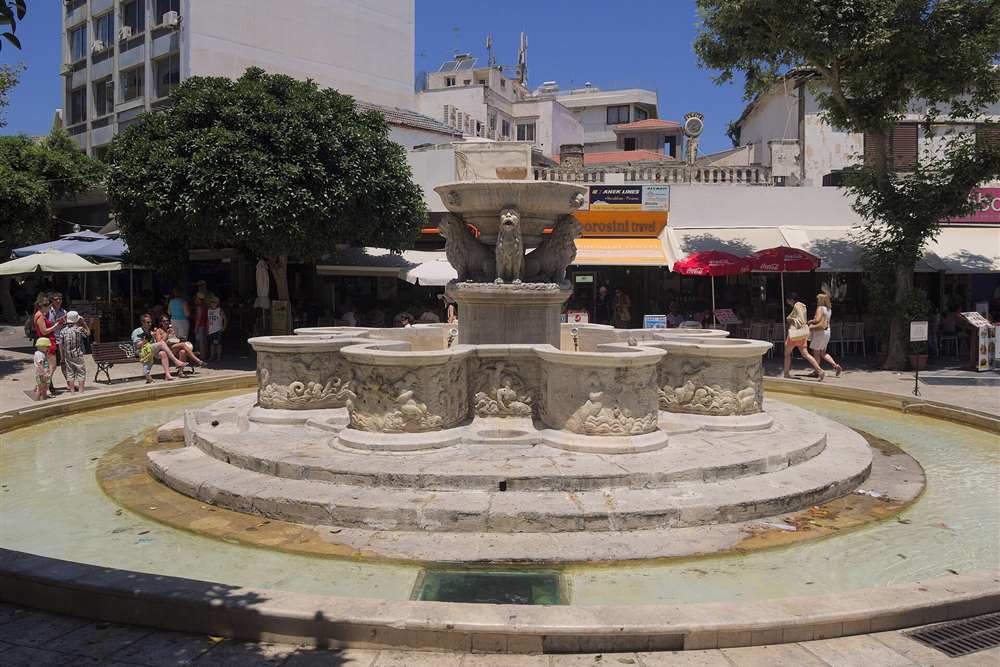
The food walk passes Lions Square, the Cathedral of Saint Minas, and the Koules. A Heraklion food tour stops at the Cathedral of Saint Minas and takes photos at Lions Square, which is the main square of Heraklion.
Lions Square, officially Eleftheriou Venizelou Square after the Cretan statesman Eleftherios Venizelos, dates from the Venetian era. In its middle stands the Venetian Morosini Fountain, called “The Lions”, with four lions holding up the main basin.
The Agios Minas Cathedral is the seat of the Archbishop of Crete and is dedicated to Saint Menas, the patron saint of Heraklion. The old small church beside it is called the little Agios Minas.
The Koules, or Castello a Mare, is the Venetian fortress at the entrance of the old port. Old ships filled with stone were sunk to form its breakwater.
What is the Koules fortress at the Heraklion harbour?
The Koules, or Castello a Mare (“Fort on the Sea” in Italian), stands at the entrance of the old port of Heraklion and is still in good condition. The Arabs possibly fortified the site first, and later a Byzantine tower called Castellum Comunis stood there.
An earthquake damaged the Byzantine tower before it was repaired. The Venetian Senate approved a programme to improve the defences of Candia, the Venetian name of Heraklion. The Byzantine tower was pulled down and the Republic of Venice built the Castello a Mare in its place. One Heraklion food tour passes the Heraklion harbour.
Which other food experiences start from Heraklion?
Bookable on GetYourGuide from Heraklion are a food city tour with a pastry museum visit, a history and culture walk with food tasting, and a Cretan night dinner with a live show at Pano Karouzanos village.
Other Heraklion food tour options bookable on GetYourGuide from Heraklion are cooking lessons on the Lasithi plateau and a guided winery tour with tastings. Wine tastings run at the Douloufakis vineyards at Dafnes, near Heraklion.
A catamaran cruise from Heraklion to Dia island serves a meal on board. Cooking classes in the city are covered on our Heraklion cooking class page.
How does a Heraklion food tour fit a day with Knossos?
A Heraklion food tour fits a day with Knossos because the palace lies about 5 km south of the historic centre. The Heraklion Archaeological Museum holds the most important and complete collection of Minoan art, including most of the finds from the palace at Knossos.
Knossos was the largest centre of the Minoan civilisation and is widely considered Europe’s oldest city. It is one of the most visited archaeological sites in Greece, second only to the Parthenon. The name Heraklion comes from Heracleium, the ancient port of Knossos, named in honour of the hero Heracles.
A skip-the-line guided tour of the museum is bookable on GetYourGuide. The sights of the old town on foot are covered on our Heraklion walking tour page.
Frequently Asked Questions
How long does a Heraklion food tour last?
The walks listed here run 4 hours, over about 1.5 miles (2.4 km) of easy ground in the city centre.
What is raki in Crete?
Tsikoudia, the grape-pomace brandy of Crete, which eastern Crete calls raki.
Which cheese does Crete make?
Graviera of Crete, a hard sheep’s-milk cheese ripened for at least five months.
Who is a Heraklion food tour for?
Food lovers, families and groups of friends; the walks are not recommended for people with walking difficulties.
Which sweets does Crete make?
Xerotigana, a fried dessert, patouda, amygdalopita (almond cake), portokalopita (orange cake) and stafidota, cookies with a raisin filling.
What is dakos?
A slice of soaked paximadi rusk topped with tomato and cheese such as feta or mizithra, flavoured with dried oregano.
What is rakomelo?
Raki mixed with honey.
How far is Knossos from Heraklion?
About 5 km south of the historic centre of Heraklion.
Where does the name Heraklion come from?
From Heracleium, the ancient port of Knossos, named in honour of the hero Heracles.