
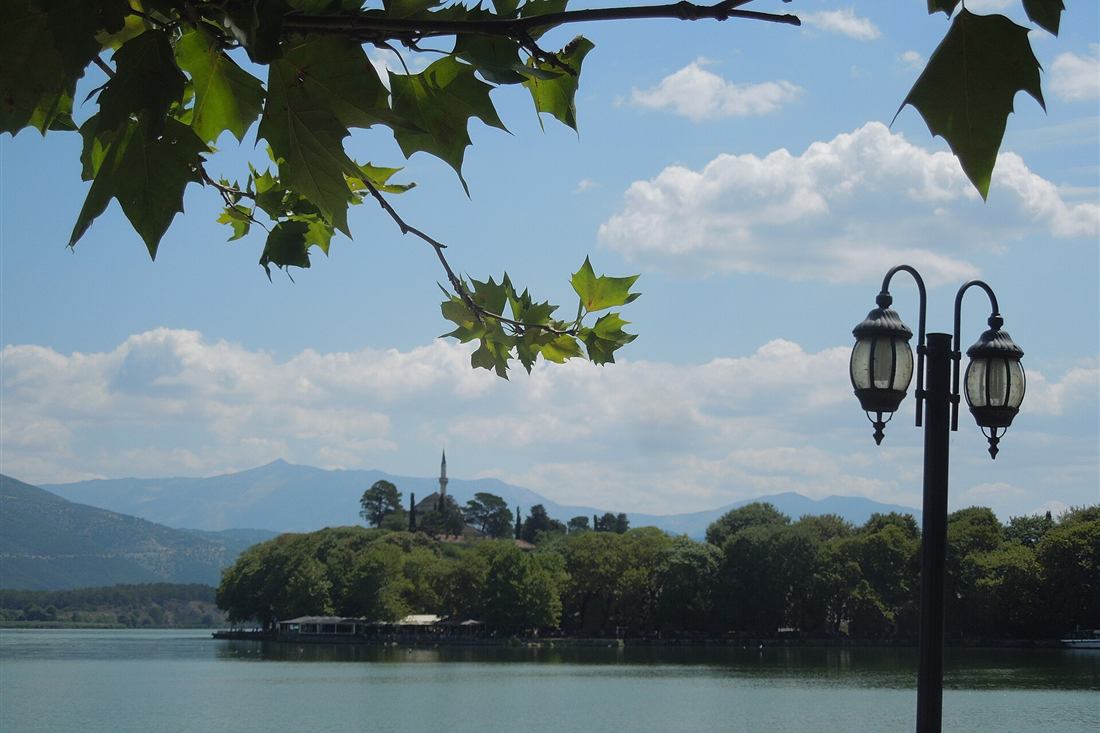
An Ioannina food tour walks the capital of Epirus on the shore of Lake Pamvotida, from a morning bougatsa and a platter of local feta with tsipouro to charcoal souvlaki, siropiasta syrup sweets and baklava, with the castle, the silversmiths and the Island on the way. Plan the rest of the trip with Greece Tours.
This page covers the Ioannina food tour and its route: the city tastings, the castle and the crafts, the Island and its lake dishes, the pies and the Zitsa wine, and how to plan a day of eating in Ioannina.
What does an Ioannina food tour taste?
An Ioannina food tour tastes of bougatsa in the morning, local cheeses with tsipouro, charcoal-grilled souvlaki and gyros, and syrup sweets called siropiasta; the same city route runs from street food to fine dining in Ioannina.
Ioannina is the capital and largest city of Epirus in north-west Greece, on the western shore of Lake Pamvotida at about 500 metres above sea level, with the Pindus Mountains around it.
The city was the centre of a remote region and a commercial hub of the Balkans. Its food culture grew to serve mountain villagers and high officials alike.
Across the water, the Island in Lake Pamvotida is famous for frog and eel dishes. Travellers can cross the lake to taste them.
Where does the Ioannina food tour start and what does it include?
The Ioannina food tour is the Culinary City Tour, bookable on GetYourGuide, starting at the Clock Tower in the city centre. It runs four hours entirely on foot, with six guided tastings, a personal guide sharing city history at each stop, and bottled water.
The start point stands in the old administrative heart of the city. The walking route passes a view over the south-east part of the city.
The tour is family-friendly, for ages 4 and up. Guests tell the tour about food allergies or dietary needs when booking. Other guided walks and day trips from the city are listed on our Ioannina tours page.
Why does an Ioannina food tour begin with bougatsa and coffee?
An Ioannina food tour begins with bougatsa and coffee because bougatsa is the morning pick-me-up in Ioannina, and one walking tour starts with a grandmother’s family bougatsa recipe before moving on to a traditional coffee house.
Bougatsa is a Greek breakfast or mid-morning snack. It can be sweet or savoury: hand-made phyllo is wrapped around a filling, baked, cut into small pieces and served hot on a small plate. The cream version holds semolina custard and is topped with icing sugar or cinnamon.
After the bougatsa, one food walk goes through the old lanes to an old hangout of the city. The hangout is a traditional coffee house, and the walk stops there for freshly roasted coffee.
How does Ioannina bougatsa differ from bougatsa elsewhere in Greece?
Ioannina bougatsa is the city’s own morning version, not Veria’s very sweet and full-of-cream bougatsa, Thessaloniki’s crunchy and less sweet one, or Chania’s cheese version with local mizithra on Crete sprinkled with sugar and cinnamon.
The name bougatsa comes from the Byzantine word pogatsa, which goes back to the Roman hearth bread, a relative of Italian focaccia. Bougatsa was a staple of the Cappadocian Greeks in the Byzantine Empire, and its modern version grew up in northern Greece, in Serres and Thessaloniki.
Shops that sell only bougatsa are called bougatsadika. Bougatsa is a popular breakfast among Greek Jews, and Ioannina had a Jewish community inside the castle walls.
An Ioannina food tour can pass those castle walls and a bougatsadiko.
What is feta and why is the Ioannina region known for it?
Feta is a Greek white brined cheese made from sheep’s milk, or from sheep’s milk with up to 30 percent goat’s milk from the same area, and the Ioannina region is well known for producing it.
Its texture is soft, with small or no holes and no skin, crumbly and slightly grainy; it is formed into large blocks and aged in brine. Its taste is tangy and salty, ranging from mild to sharp.
Feta has protected designation of origin in the European Union: the name belongs only to cheese made the traditional way in mainland Greece and Lesbos. It is served with olive oil or olives and sprinkled with oregano, and it is also grilled.
Epirus dairy comes from milk enriched by the wild herbs of the Epirus countryside. The culinary walk on the Ioannina food tour includes a platter of local cheeses as one of the tastings.
What is tsipouro and what comes with it on an Ioannina food tour?
Tsipouro is an un-aged brandy of Thessaly, Epirus and Macedonia, 40–45 percent alcohol, from grape pomace or wine. It comes pure by default, anise-flavoured (the newer style), or barrel-aged; on an Ioannina food tour it is the traditional aperitif with a platter of local cheeses.
Tsipouro is close to the tsikoudia of Crete, but tsipouro is double-distilled while tsikoudia is single-distilled with no flavourings. Platters of grilled sheep are the classic food of a tsipouro gathering in Ioannina. A traveller can tell them apart by distillation and flavourings.
One tsipouro restaurant in the city cooks everything fresh each day without a freezer and buys from the butchers next door. It serves home-style dishes such as cabbage rolls and chickpeas with sausage and feta, with a long list of tsipouro. A traveller can order either dish and know it was cooked the same day.
Spring water from Zagori, the mountain area north of the city, is sold throughout Greece. A traveller does not need to visit Zagori to find it.
Which street foods and sweets does an Ioannina food tour include?
An Ioannina food tour includes Greek street food such as lamb souvlaki marinated and cooked over charcoal and gyros with tzatziki, and ends with siropiasta. The last stop combines local ingredients in new forms, and the city is also famous for its baklava.
Sheep souvlaki is the Ioannina speciality. The best-known souvlaki shop, on Anexartisias Street, grills marinated sheep souvlaki and serves it with hand-cut fries, and also makes handmade chicken and pork souvlaki.
One city restaurant cooks everything over an open fire. Its dishes run from slow-cooked sheep with sourdough bread to charred kale with smoked trout.
These syrup sweets are made with thin pastry leaves and nuts and drizzled with lemon-water syrup. They are a staple of the city’s dessert tradition.
How is the Ioannina food scene changing?
Ioannina’s culinary scene has grown more diverse, and English and French are now heard in its cafés and bars. Since the first major tech company arrived from Germany, the city has drawn professionals from abroad, locals returning home and newcomers from other countries.
Ioannina was known mainly for medical conferences; the completion of the national highway network and faster links to Athens and Thessaloniki turned it into a popular tourist destination. The city has become a centre for technology and the digital economy. Boutique lodgings keep multiplying, and QR-code menus are common.
Near the central bus station, a multicultural café-meze spot run by a cook from Konitsa and a cook from Guinea serves five dishes that change daily, from Turkish breakfast and Indian sweet rice pudding to spiced rice with fried chicken from Ghana. For an Ioannina food tour, it is an alternative to the classic tsipouro gatherings and platters of grilled sheep. The open-fire restaurant in the city introduced Ioannina to open-fire cooking.
What does the castle walk add to an Ioannina food tour?
The castle walk adds the fortified old town of Ioannina, set on a peninsula that juts into Lake Pamvotida, with cobbled lanes running inside it. The walk also passes a boutique hotel inside the walls.
Tradition says Emperor Justinian I founded and fortified the city, but excavations found walls from the Hellenistic period. Later Byzantine and Ottoman walls follow their course. The south-eastern citadel is traditionally credited to the Normans under Bohemond of Taranto, who held the city for a short time.
The present walls date largely from the rebuilding under Ali Pasha, who governed Epirus and much of western Greece from Ioannina. One food walk enters the castle after a delicatessen stop, wanders its narrow alleys and tells the story of Ali Pasha and Kyra Frosini.
What stands inside Its Kale on an Ioannina food tour?
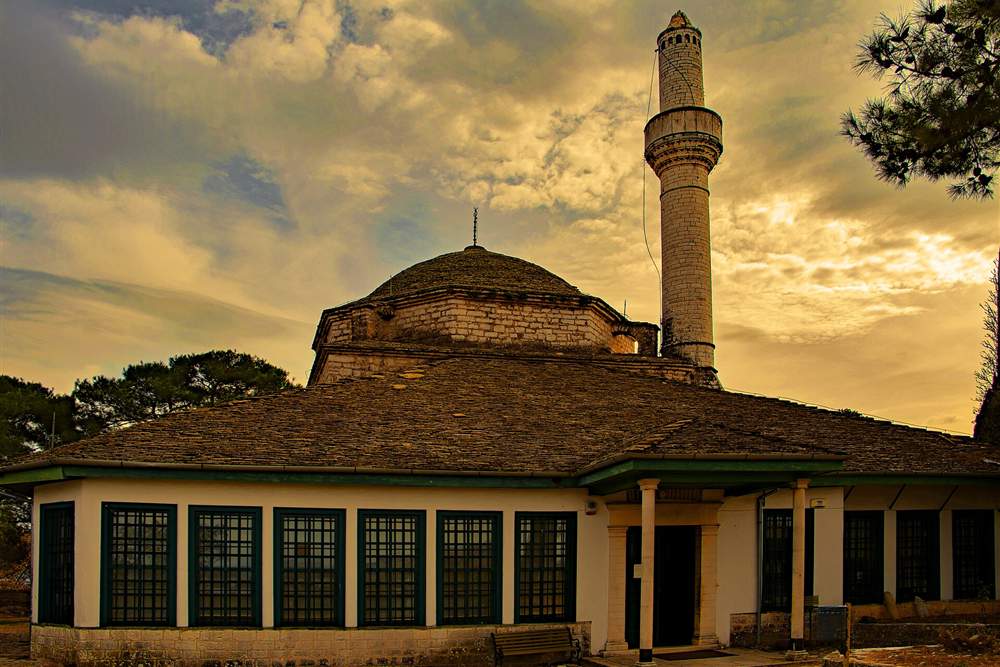
Its Kale, the inner citadel, holds the Aslan Pasha Mosque, Ali Pasha’s tomb, palace ruins, Ottoman baths, Fethiye Mosque, Jewish Synagogue and Silversmithing Museum, all joined by cobbled lanes.
The tomb of Ali Pasha contains only his body; his head was taken to Constantinople. Near the tomb stand the ruins of his palace and the Ottoman baths, while the Fethiye Mosque and the Jewish Synagogue sit inside the same walled area.
The Municipal Ethnographic Museum fills the Aslan Pasha Mosque. Its three departments represent the Greek, Muslim and Jewish communities that lived in the city, each with its own material record.
The Byzantine Museum stands in the south-eastern citadel. A visitor can move from the ethnographic rooms to the Byzantine collection without leaving the inner citadel.
A legend tells of Kyra Frosini, drowned in the lake on the orders of Ali Pasha. Locals say her spirit wanders the lake on misty nights, a tale that follows an Ioannina food tour along the water.
How do the silversmiths fit into an Ioannina food tour?
Silversmithing, the historic craft of Ioannina practised since the Ottoman period, fits into a food walk through the historic centre where city craftsmen worked. A silversmith presents the old folk art and its history since Ottoman times; Ioannina is called the city of master silversmiths.
The Silversmithing Museum stands in the western bastion of the south-eastern citadel of the castle and is run by the Piraeus Bank Cultural Foundation. Its lower level explains the techniques through documentary films and multimedia displays; its upper level shows silverwork of the late Ottoman and modern periods.
On Kaniggos Street an antique shop sells pieces from the Ottoman past of the city. Weapons, snuffboxes, copper trays, traditional Ioannina costumes and ornate silver buckles and belts are among its stock.
What does the Metsovo delicatessen stop serve on an Ioannina food tour?
Before the castle, one food walk stops at a family delicatessen run by people from Metsovo, with traditional cheeses, cold cuts and wine the family has produced for 40 years.
Metsovo is a mountain town of the Pindus between Ioannina and Meteora. It is the largest centre of Aromanian (Vlach) life in Greece, and the delicatessen brings that town’s produce into the city.
Metsovone is a semi-hard smoked cheese with protected designation of origin. It is made from cow’s milk or cow’s milk mixed with sheep or goat milk at the Tositsa Foundation Cheese Factory.
Metsovela is the other famous Metsovo cheese beside it on the counter. Visitors who want to see the mountain source of these foods can follow Metsovo tours.
The shop’s cold cuts and wine come from the same family production as the cheeses. This part of an Ioannina food tour gives the highland produce a place before the castle.
How do you cross to the Island on an Ioannina food tour?
You cross from the Molo, the lake front of the city, on a regular small boat to the Island in Lake Pamvotida. The Island is one of the very few inhabited lake islands in the world.
One walking tour explores both the alleys of the city and the Island. Ali Pasha hid on the Island in the last days of his rule.
The Island holds the monasteries of Filanthropinon, Eleousa and Stratigopoulou. The Ali Pasha and Revolutionary Period Museum on the Island shows his 1.5-metre rifle and Epirus silverwork. It also shows a reconstruction of the drowning of Kyra Frosini.
What lake foods and natural stops complete an Ioannina food tour?
Frog and eel dishes are the famous food of the Island, joined by tsoumbeki, a grape-must sweet with walnuts, and traditional baklava from a pastry shop whose name means “A Thousand Quintals of Sugar”.
Lake Pamvotida is the largest lake in Epirus at 470 metres, south of the Mitsikeli mountains, with small fishing ports. It is one of the oldest lakes in Europe, about seven million years old.
The lake is home to nearly two hundred bird species, including the rare ferruginous duck, and to the tsima, a fish found only in this lake. A lake information centre on the Island shows a reed-weaving loom and traditional fishing tools.
An outdoor telescope at the centre is for birdwatching. Rowing is popular, and the lake hosts part of the Greek Rowing Championships.
A day tour of Ioannina, the lake and the Island is bookable on GetYourGuide. Booking that route extends an Ioannina food tour from the plate to the water and the bird habitats.
Where can you cook Epirus pies and other local dishes near Ioannina?
An Ioannina food tour can include cooking Epirus pies and other local dishes at a small restaurant, in a local cooking class, on a Valia Calda off-road tour from Ioannina, and on a truffle hunt in East Zagori.
Epirus is known for its pies: filo pastry filled with greens, cheese or meat. Feta goes into the filo pies spanakopita (spinach pie) and tyropita (cheese pie).
One Ioannina walking tour ends in a small restaurant where the group cooks a traditional pie and tastes the local flavours of Epirus. A cooking class with a local host and a traditional home dinner with a local cook are offered in Ioannina.
A Valia Calda off-road tour with a cooking lesson is bookable on GetYourGuide from Ioannina; Valia Calda is a mountain area of the Pindus. In East Zagori a truffle hunt ends with a cooking session. The Zagori villages are reached on our Zagori jeep tour.
Why does Zitsa wine belong on an Ioannina food tour?
Zitsa wine belongs on an Ioannina food tour because Zitsa is a village near Ioannina, and the local white Debina grape grown in the Zitsa area of Epirus has high acidity that suits sparkling wine.
Zitsa was first named in the Chronicle of Ioannina and grew rich in the Ottoman era as a centre of wine production; the village is still known for its wine. The grape is also called Zitsa and grows in the Permet region of Albania. Wine production and tourism are the two main activities of Zitsa today, and a winery and a bakery there welcome visitors. A visitor can stop at both in one trip.
Lord Byron spent two nights in the Zitsa monastery and wrote a stanza about the village in Childe Harold’s Pilgrimage. Ioannina food walks pour local wines made by local producers. Travellers who prefer sparkling wine can ask for Zitsa.
Which ancient sites pair with an Ioannina food tour?
You can see the oldest oracle of the Greeks at Dodona, near Ioannina, and the Archaeological Museum of Ioannina in the Litharitsia area, with its 3,000 finds from prehistory to the late Roman period and hall on the sanctuary of Dodona.
Homer describes Dodona as an oracle of Zeus, and it was second only to Delphi in prestige. Priests and priestesses in the sacred grove read the rustling of the oak leaves. A newer reading holds that the sound came from bronze objects hanging from the oak branches, ringing in the wind. An earlier mother goddess, Dione, was worshipped there before Zeus joined and partly replaced her.
The Archaeological Museum of Ioannina stands in a building by the architect Aris Konstantinidis that joins modern design with Epirus architecture. Litharitsia is a fortress on a low rocky hill south of the castle, built by Ali Pasha as an outwork of the castle. Today it is a green park with a playground.
The city emblem shows Emperor Justinian crowned by the ancient theatre of Dodona. A tour of the Oracle of Dodona with the Archaeological Museum is bookable on GetYourGuide before an Ioannina food tour.
What else can you do around Ioannina after an Ioannina food tour?
After the food tour, four nearby options around Ioannina city are the Perama Cave, the Pavlos Vrellis Wax Museum at Bizani, a tandem paragliding flight over Lake Pamvotida from Ligiades, and the Municipal Art Gallery of Ioannina.
Perama Cave lies at Perama, the town on the north side of the lake. Villagers found it while sheltering from bombing in the Second World War. The route inside the cave runs 1.1 km with steps and humidity, and the 45-minute visit passes 19 types of stalactites and stalagmites, each with its own colouring.
The Pavlos Vrellis Wax Museum at Bizani shows about 150 wax figures by the artist Pavlos Vrellis. They include heroes of the Greek Revolution and other figures of Greek history. The Municipal Art Gallery of Ioannina fills the neoclassical Pyrsinella building and shows modern works by Greek painters and sculptors.
Paragliding flights over Lake Pamvotida need no experience, because beginners fly tandem with an instructor. The meeting point is the village of Ligiades, take-off is at 1,300 metres, and flights last about 15 minutes, landing near the lake shore.
Where do you spend the evening after an Ioannina food tour?
Spend the evening after a food tour around Kaniggos Street, Kritharopazaro and the Liampeis Arcade. Begin on Kaniggos Street, a stone-paved old-town street running from Anexartisias to Averof Street through the old wheat market, then explore the arcade.
Kritharopazaro fell into decline and was almost abandoned. Today it holds a café-bar open from morning to midnight, where students mix with company staff. It also has a workspace for digital nomads and shops.
The Liampeis Arcade is one of the liveliest night-time spots of the city, with long-standing bars. One rock bar there keeps more than 200 whisky labels.
A small speakeasy-style bar nearby is one of the top cocktail places of the city. The University of Ioannina, five kilometres south-west of the city, has about 25,000 students. Students make up about one in ten residents of the city.
How do you reach Ioannina and what weather do you plan an Ioannina food tour around?
Reach Ioannina via Ioannina National Airport, KTEL long-distance buses, and A2 Egnatia Odos motorway passing Ioannina and linking the west-coast port of Igoumenitsa with the borders. Plan an Ioannina food tour around hot, moderately dry summers and wet winters colder than the coast, with frosts.
KTEL long-distance buses run daily to Athens (6 to 6.5 hours) and Thessaloniki (3 hours). Ioannina is the wettest city in mainland Greece of its size. On winter mornings a thick fog hides the city for a few hours.
The food walk is on foot, so wear comfortable walking shoes suited to the season and bring sunscreen, sunglasses and a hat. A private walking tour of Ioannina with a local and a one-day tour of the top sites of Ioannina are bookable on GetYourGuide.
Frequently Asked Questions
How long does the Ioannina food tour last?
The Culinary City Tour runs 4 hours on foot, with 6 guided tastings, starting at the Clock Tower.
What is Ioannina famous for eating?
Bougatsa, feta, sheep souvlaki, siropiasta and baklava in the city, and frog and eel on the Island.
Which wine comes from near Ioannina?
Zitsa wine, made from the white Debina grape, whose high acidity suits sparkling wine.
Is the Ioannina food tour suitable for children?
Yes. The Culinary City Tour is family-friendly and open to ages 4 and up.
How do you reach the Island in Lake Pamvotida?
A regular small boat crosses from the Molo, the lake front of the city.