
The Palace of Phaistos is the second-largest Minoan palace on Crete, a sprawling Bronze Age complex set on a low ridge above the fertile Messara plain in south-central Crete. Its grand staircases, paved courts and sweeping views over the Geropotamos valley toward Mount Ida make it one of the island’s most atmospheric ancient sites. Plan tickets and tours through My Greece Tours.
Phaistos is best understood alongside its larger and more famous cousin, the Palace of Knossos, which sets the standard for Minoan palace architecture across the island. The sections below cover what the palace was, where it lies and how to reach it, what survives to see, how it dates, how it compares with Knossos, and the practicalities of visiting today.
What is the Palace of Phaistos?
The Palace of Phaistos is the second-largest Minoan palace on Crete, a Bronze Age administrative, religious and economic centre built around a central court. It commanded the rich Messara plain and ranks among the defining monuments of Minoan civilisation, alongside Knossos and Malia.
Phaistos was a hub of Minoan power in the southern half of Crete, controlling the agricultural wealth of the Messara plain and the trade routes that ran toward the Libyan Sea. Like the other Minoan palaces it was organised around a large central court, with surrounding wings holding storerooms, workshops, residential quarters and spaces for ceremony and administration. The plan reflects a society that concentrated ritual, craft and the storage of farm surplus in a single monumental building.
The palace also carried real political weight. Legend linked it to Rhadamanthys, brother of King Minos and a just lawgiver of the Greek myths, and the archaeology shows a centre wealthy enough to rival Knossos in its southern sphere. Whoever ruled Phaistos governed the produce and movement of the largest plain on the island, which helps explain the scale, the fine masonry and the long life of the complex.
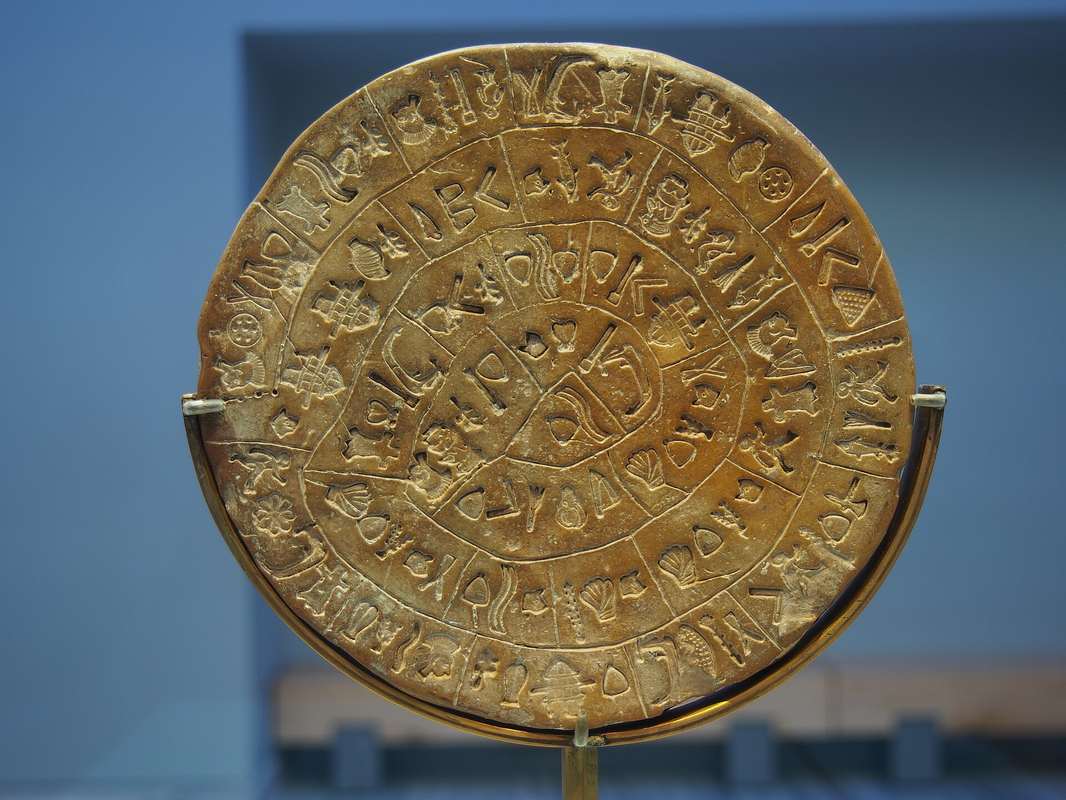
Beyond specialist circles the site is best known for the Phaistos Disc, a fired clay disc stamped with spiralling symbols that remain undeciphered, unearthed here and now a star object of the island’s archaeology. Phaistos forms part of a wider network of Minoan centres, and our guide to the Minoan palaces of Crete covers how these sites related to one another.
The palace also anchored a small cluster of Minoan settlement in the Messara. The nearby royal villa of Agia Triada, a short walk to the west, served as a secondary residence and administrative annexe, while satellite farms and shrines dotted the surrounding plain. Reading Phaistos as the centre of this network, rather than a single isolated building, explains why it held such wealth and why its finds range from fine palace ceramics to the everyday tools of the countryside.
Where is Phaistos and how do you get there?
Phaistos sits on a ridge in the Messara plain of south-central Crete, roughly 55 km south-west of Heraklion. Most visitors drive or join a tour from Heraklion, about an hour toward Mires and the southern coast through olive groves and farmland.
The palace occupies a commanding position on a low hill at the western edge of the Messara, the largest plain on Crete and historically its agricultural heartland. From the ridge the view stretches across cultivated fields toward the bulk of Mount Ida, or Psiloritis, the island’s highest peak, while to the south the land rolls toward the Libyan Sea. The dominating setting was no accident: whoever held Phaistos controlled the produce and movement of the entire plain.
Reaching Phaistos is straightforward from the north coast. The road from Heraklion runs south-west through the town of Mires before climbing to the site, and a hire car gives the most flexibility for combining the visit with nearby attractions such as Gortyna and Agia Triada. Guided day trips also run from Heraklion and the resort towns, and public buses reach Mires, from where a short taxi ride completes the journey.
The southern location shapes how the palace fits into a trip. It lies too far from the north coast for a casual afternoon, so most travellers give it a dedicated half-day or pair it with the Messara’s other ancient sites. Many also combine it with the capital’s museum, where the finds are displayed. Our guide to the Heraklion Archaeological Museum covers the objects from the site now kept in the city.
The drive itself forms part of the appeal. The road south from Heraklion climbs over the low hills that divide the north coast from the Messara before dropping into a broad basin of olive groves, vineyards and vegetable fields that has fed Crete since Minoan times. Approaching Phaistos across this cultivated plain, with Mount Ida rising behind, gives an immediate sense of why the palace was built where it was, at the meeting point of farmland, mountains and the sea route south.
What can you see at the Palace of Phaistos?
At Phaistos you see the great theatral staircase and west court, the central court, storerooms, residential quarters and the foundations of both the first and second palaces across the ridge. The layered remains and panoramic views make it a rewarding archaeological walk.
The most striking feature is the monumental theatral staircase rising from the broad west court, a flight of wide stone steps thought to have served as seating for spectators at ceremonies held in the open space below. Beyond it lies the great central court, the organising heart of the palace, around which the wings were arranged. Walking the site you trace storerooms that once held the great pithoi for oil and grain, along with corridors, light wells and finely built residential rooms.
The grand propylon, or monumental gateway, and the paved processional ways show how Minoan builders staged movement and arrival. The royal apartments preserve gypsum-slab flooring, a lightwell and traces of the fresco decoration that once brightened the walls, giving a sense of the colour and refinement of palatial life. A peristyle court and a Minoan kiln round out the picture of a working, living complex rather than a bare ruin.
The west court repays close attention. Its raised walkways, cut across the paving at an angle, mark the ceremonial routes trodden during festivals, and the tiers of the theatral staircase rising beside it turned the whole court into an arena for public ritual. Standing at the foot of the steps, you look across the same open space where Minoan crowds once gathered, a rare survival of a Bronze Age performance setting.
The rebuilding of Phaistos means parts of the earlier palace remain visible beneath and beside the later structure, giving visitors an unusually clear sense of the site’s long history. The setting is left largely open, with far fewer reconstructions than at Knossos, so the ruins read as authentic foundations against the dramatic backdrop of the plain and the mountains. Our guide to the Phaistos Disc covers the object and its mysterious symbols.
What is the Phaistos Disc and what was found here?
The Phaistos Disc is a fired clay disc about 15 cm across, stamped on both faces with spiralling pictographic signs that remain undeciphered. Found here and now in the Heraklion museum, it is the site’s most famous discovery, alongside pottery and Linear A tablets.
The disc carries around two hundred and forty impressed signs, of which roughly forty-five are distinct, arranged in a spiral running inward from the rim. The signs were pressed into the wet clay with individual stamps, an early form of movable-type printing that makes the object unique in the Bronze Age world. No secure translation exists, and scholars debate whether it records a prayer, a hymn, an inventory or something else entirely.
Phaistos yielded far more than its celebrated disc. Excavators recovered elegant Kamares-ware pottery, the fine polychrome ceramics named after the cave sanctuary on nearby Mount Ida, along with clay sealings, stone vessels and inscribed Linear A tablets that document the palace’s administration. Together these finds show a centre engaged in fine craft, record-keeping and long-distance exchange across the eastern Mediterranean.
The sealings deserve particular note. Small lumps of clay pressed with engraved seal-stones once secured jars, boxes and storeroom doors, and the impressions they carry record the flow of goods through the palace. Read together with the Linear A tablets, they reveal an administration that tracked oil, grain and produce with care, the bureaucratic backbone that let a single building govern the wealth of the whole Messara plain.
The objects now live mainly in the capital, so the fullest experience pairs the ruins with the museum. Seeing the disc, the Kamares pottery and the sealings in one gallery, then walking the courts where they were used, connects the abstract plan of the palace with the tangible life once lived inside it. Our guide to the Heraklion Archaeological Museum covers that collection in depth.
How does Phaistos compare to Knossos?
Phaistos is the second-largest Minoan palace after Knossos and shares its plan of wings around a central court, but it feels different. Knossos is larger, partly reconstructed and far busier, while Phaistos stays open, quiet and unrestored, prized for its setting.
Both palaces follow the classic Minoan template of storerooms, workshops, residential quarters and ceremonial spaces grouped around a great rectangular central court, and both were destroyed and rebuilt over the long Bronze Age. The key difference for visitors lies in presentation. At Knossos the early excavators carried out extensive concrete reconstruction and repainting that brings the architecture vividly to life but divides opinion; at Phaistos almost nothing has been rebuilt, so what you see are genuine foundations and steps.
The contrast extends to atmosphere and setting. Knossos draws large crowds and sits close to Heraklion in the north, while Phaistos, further south and less reconstructed, is usually calmer and rewards visitors who enjoy reading a site from its plan and its landscape. Where Knossos overwhelms with restored frescoes and rebuilt wings, Phaistos speaks through its masonry, its staircase and the vast view across the Messara.
Scale sharpens the comparison. Knossos covers a larger footprint with more storerooms, more elaborate residential wings and a denser warren of corridors, while Phaistos, though smaller, uses finer ashlar masonry in places and a more commanding hilltop position. The southern palace often strikes visitors as the more elegant piece of siting, the northern one as the more overwhelming piece of architecture.
Many travellers visit both to appreciate the range of Minoan building, seeing how a shared plan was expressed in two very different places. The hilltop grandeur of Phaistos and the labyrinthine density of Knossos are two faces of the same civilisation. Our guide to Knossos versus Phaistos covers the comparison in detail.
How do you visit the Palace of Phaistos today?
You visit Phaistos as a managed archaeological site with a ticket, opening hours, parking and a small visitor area. Most people come by hire car or guided day trip from Heraklion, allowing one to two hours, ideally early or late to avoid the midday heat.
The site operates seasonal opening hours, with longer days in summer, and a single ticket admits you to the whole palace. There is a car park near the entrance and a modest building with refreshments and shade, but the ruins themselves are open and exposed, so sturdy shoes, sun protection and water are essential, especially in high summer when the Messara plain bakes under a fierce sun.
Allowing one to two hours lets you take in the staircase, courts and storerooms without rushing, and the views reward a slower pace. Early morning and late afternoon bring softer light, thinner crowds and far more comfortable walking, so timing the visit to avoid the middle of the day pays off. The paths cross uneven ground, so steady footwear matters more here than at more manicured sites.
Guided tours add depth for first-time visitors, since the open, unlabelled foundations can be hard to read without help. A guide explains which steps formed the theatral area, how the storerooms worked and where the royal apartments lay, turning a field of stone into a legible palace. Independent travellers with a good plan or audio guide can achieve the same, but the layered phases of Phaistos reward some background before you arrive.
Phaistos pairs naturally with other sites in the area, including the Roman remains at Gortyna and the smaller villa at Agia Triada, making a satisfying full day in the south. Many visitors combine it with the museum in the capital, where the most important finds are kept, to see the objects and the architecture together. Plan your visit and tours through our Palace of Knossos guide.
How old is the Palace of Phaistos and how did it end?
The first palace rose near the end of the third millennium BC and was destroyed by earthquake, then rebuilt as a grander second palace. That later palace fell around the mid-fifteenth century BC in the wave of destructions that ended the Minoan palatial system.
Phaistos followed the same broad rhythm as Knossos and Malia. The Protopalatial, or Old Palace, phase began at the close of the third millennium BC, and that first complex suffered serious damage, most likely from the earthquakes that periodically shook Crete. Builders then raised a larger Neopalatial palace on the same ridge, incorporating and levelling parts of the old plan, which is why both phases remain legible on the ground today.
The second palace marked the height of Phaistos, with its grand staircase, propylon and richly decorated apartments. Its end came in the general collapse of the Minoan centres around the mid-fifteenth century BC, a horizon of destruction linked variously to earthquakes, the aftermath of the Thera eruption and the rise of Mycenaean power. Unlike Knossos, Phaistos was not strongly reoccupied afterwards, so it preserves the Minoan plan with little later overbuilding.
The two palace phases sit within the standard Minoan chronology that scholars divide into Prepalatial, Protopalatial and Neopalatial periods. Phaistos spans all three, from the early settlement on the hill through the first and second palaces, which makes the site a compact timeline of Minoan development. Walking from the older western foundations to the later grand staircase, a visitor crosses several centuries of Bronze Age building in a few paces.
The long life and relatively clean ending give Phaistos its clarity. Where later Greek and Roman building blurred other sites, here the ridge holds mainly Bronze Age foundations, letting visitors read a Minoan palace with unusual directness. Our guide to the Palace of Knossos covers how that northern centre outlived Phaistos into the Mycenaean age.
A Classical Greek town later grew on and around the ridge, and Phaistos minted its own coins and warred with neighbouring Gortyna before that rival absorbed it. These later chapters left only light traces over the Minoan palace, so the Bronze Age plan still dominates what visitors see. The layering nonetheless reminds you that the hill drew settlement for many centuries, prized in every age for the same command of the plain that first raised the palace.
Frequently Asked Questions
Is the Phaistos Disc still kept at the palace?
No. The Phaistos Disc was discovered at the palace but is not displayed on site. The fired clay disc, stamped on both faces with spiralling lines of pictographic symbols that have never been securely deciphered, is one of the most celebrated objects of Aegean archaeology and is kept in the capital rather than at the ruins.
Visitors who want to see the disc should plan a separate stop at the Heraklion Archaeological Museum, where it sits among the richest collection of Minoan finds anywhere. Seeing the disc in the museum and then walking the palace where it was found, or the reverse, gives a fuller picture of Phaistos than either visit alone, and the two easily fit into a single day on Crete.
How long should I spend at the Palace of Phaistos?
One to two hours suits most visitors to the Palace of Phaistos. That is enough time to climb the grand theatral staircase, cross the west and central courts, trace the storerooms and residential wings, and take in the sweeping views over the Messara plain toward Mount Ida.
Slow readers of a site, and visitors who come in the cooler parts of the day, tend to linger longer; the open ridge is exposed, so a brief visit in fierce midday heat is understandable. The southern location means many people build the palace into a longer day that also takes in the Roman ruins at Gortyna and the villa at Agia Triada nearby.
Can I visit Phaistos and Knossos on the same trip?
Yes, and many visitors do exactly that to appreciate the full range of Minoan palace architecture. Knossos sits just outside Heraklion in the north, while Phaistos lies roughly 55 km south-west on the Messara plain, so the two are not close enough for a relaxed single afternoon but fit comfortably into separate days of a Crete itinerary.
A common approach is to see Knossos, with its bold reconstructions and crowds, on one day, then drive south to Phaistos on another for a quieter, unrestored counterpart set in dramatic open countryside. Pairing each palace with a visit to the archaeological museum in the capital, where finds from both sites are displayed, ties the architecture and the objects together.
Who excavated the Palace of Phaistos?
The Italian Archaeological School of Athens carried out the main excavations at Phaistos, beginning under Federico Halbherr and Luigi Pernier around the turn of the twentieth century and continuing under later Italian scholars such as Doro Levi. Their work uncovered both the first and second palaces and, famously, the Phaistos Disc, found in a basement room of the north-eastern wing.
The Italian involvement gives Phaistos a different research tradition from Knossos, which the British archaeologist Arthur Evans reconstructed. The comparatively restrained Italian approach, favouring conservation over rebuilding, is one reason Phaistos survives as open, unrestored foundations rather than the coloured reconstructions seen at its northern rival.
What is Kamares ware and why is it linked to Phaistos?
Kamares ware is a class of fine Minoan pottery famous for its thin walls and bold polychrome decoration in white, red and orange on a dark ground. It takes its name from the Kamares Cave, a peak sanctuary high on the slopes of Mount Ida, where many examples were first found as offerings, and it reached its finest expression during the Old Palace period.
Phaistos is closely tied to this pottery because the palace lay on the route to the Kamares Cave and produced and used the ware in quantity. Excavations of the first palace yielded rich deposits of Kamares vessels, from delicate cups to large storage jars, and many are now displayed in the Heraklion museum. Seeing this pottery helps visitors picture the colour and craftsmanship of Phaistos at its height.
The eggshell-thin walls of the finest cups show the technical mastery of Minoan potters, achieved on the fast wheel and fired to a hard, ringing finish. Their swirling spirals and stylised plants echo the same love of natural motion seen in Minoan frescoes, so the pottery is not just tableware but a window on the aesthetic of the whole civilisation, most vividly preserved at the palace that helped make it.