
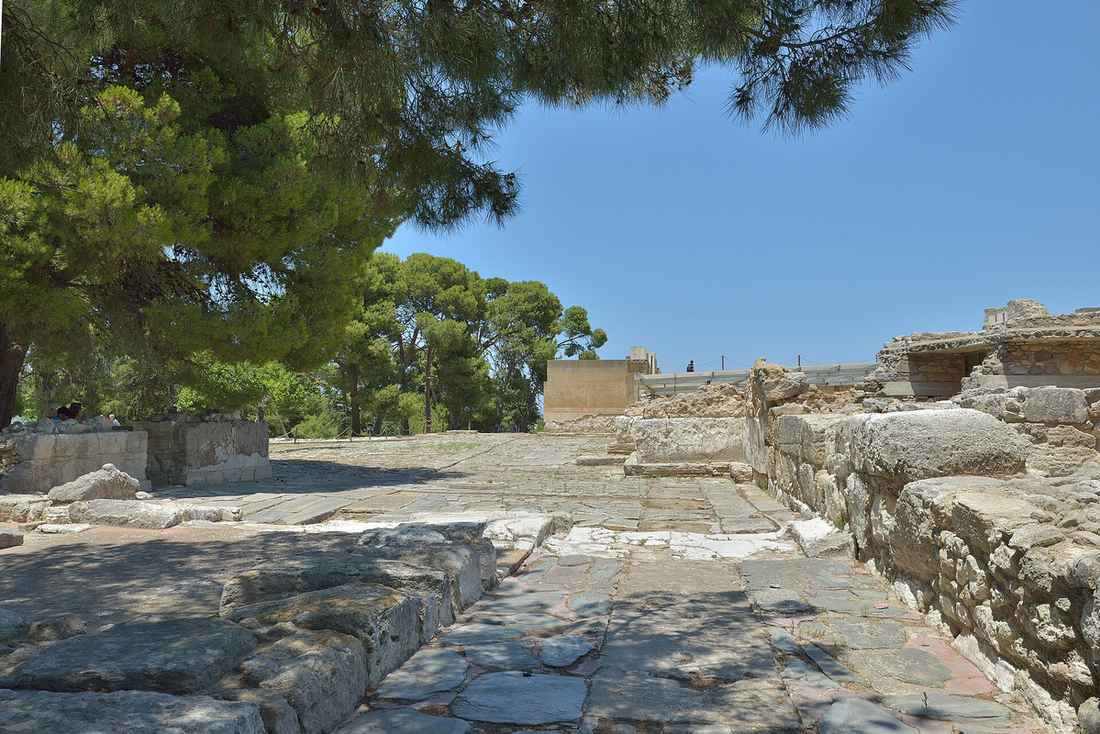
A pillar crypt at Knossos is a ground-floor room with a central pillar carved with the sacred double axe, used for Minoan religious ritual. Plan tickets and tours through My Greece Tours.
The pillar crypts are among the most atmospheric sacred spaces of the Palace of Knossos. The sections below cover what they are, how many there are, their religious use and the double-axe signs. They also cover the lustral basins beside them, other Minoan sites, the link to sacred caves, where the crypts are and how to see them.
What is a pillar crypt at Knossos?
A pillar crypt at Knossos is a windowless ground-floor room with square stone pillars at its centre, read as a Minoan cult room rather than an ordinary basement.
A pillar crypt is a room type found at Knossos and other Minoan sites. It is a ground-floor, basement-like chamber, usually windowless and dim, with square-built stone pillars standing at its centre. At Knossos a pair of these rooms, known as the pillar crypts, lies in the west wing of the palace. That wing was the main religious quarter, and the crypts rank among the most distinctive sacred spaces of the whole building. The rooms are small and low. Their heavy stone construction sets them apart from the airy halls and light-wells that define the residential quarters east of the Central Court.
The central pillars are partly structural, since they help carry the upper storeys. Even so, the crypts are read as cult rooms rather than plain basements. That reading rests on their place among the religious rooms, their dim and secluded character, and above all the sacred symbols carved on the pillars. Channels, basins and vessel-stands recovered in the crypts point to offerings or libations made there. Together these traces give a strong sense of the more secret, underground side of Minoan religion at Knossos. Our guide to Minoan religion covers the beliefs, and the next section covers how many crypts survive.
How many pillar crypts are at Knossos?
Knossos has a pair of linked pillar crypts, an east and a west crypt, set side by side in the west wing behind the Central Court, sharing one small connected group of rooms.
The best-known pillar crypts at Knossos form a pair. An east and a west crypt stand next to one another within the same small suite of rooms in the west wing. They are usually described together as the pillar crypts of Knossos, because they were laid out and used as a connected group rather than as isolated chambers. Each holds a squat, square-built stone pillar at its heart. The two rooms sit close behind the western edge of the Central Court, among the storerooms and shrines of the palace’s religious quarter.
Grouping the crypts in a pair matters for how we read them. A single dim basement might be dismissed as storage. A deliberate arrangement of two matching pillared rooms is harder to dismiss. Placed together in the most sacred wing and marked with carved symbols, the pair points instead to planned ritual space. The east and west crypts differ in detail, and the western room is the more heavily marked of the two. Yet both belong to the same religious idea. The next section covers what these paired rooms were used for.
What were the pillar crypts used for?
The pillar crypts are thought to have been used for Minoan religious ritual, with the central pillar itself serving as the sacred focus, honoured through libations and offerings.
The pillar crypts are read as cult rooms used for Minoan religious ritual. The central pillar itself served as the sacred focus of the room. The idea is that the pillar was venerated as a holy object, or as the dwelling or embodiment of a deity or sacred power. This is a form of worship in which a column or pillar stands for the divine. That kind of pillar and column cult is known from other evidence in Minoan religion, where sacred trees and stone pillars often mark the presence of a god rather than a carved human image.
Practical traces support a ritual use. Certain pillar crypts contain stone-lined channels, basins or vessel-stands set around the pillar. These are read as provision for pouring libations or making offerings of liquids, oil or other gifts that drained or collected there. One line of interpretation even connects deposits below the floor with the ash of sacrifices, though that reading is debated. The dim, secluded, underground setting would have suited solemn or hidden rites, set apart from the busy courts above. With the carved double axes, these features mark the crypts as important religious spaces. Our guide to the Minoan double axe covers the sacred symbol, and the next section covers the double-axe signs.
What are the double-axe signs in the pillar crypts?
The square pillars in the Knossos pillar crypts are carved with the sign of the double axe, or labrys, the most sacred symbol of Minoan religion.
Carved into the stone blocks of the central pillars are repeated signs of the double axe, or labrys. This was the most important and sacred symbol of Minoan religion. The double axe is a stylised axe with two opposed blades set on a single shaft. It appears throughout Knossos, on walls, on objects and among offerings. Its presence cut into the pillars is the strongest single piece of evidence that the crypts were sacred rather than ordinary basement rooms. No one would take the trouble to mark a plain cellar with the chief emblem of the cult.
These incised double-axe signs effectively dedicate the pillars, and the rooms around them, to the cult of the labrys. The double axe was so central to Knossos that certain scholars believe it lies behind the very name labyrinth. On that reading, labyrinth means the house of the double axe, used for the palace itself. The carved signs in the pillar crypts thus tie these secluded rooms directly to the great religious symbol of the Minoan world. They offer a vivid example of how the Minoans marked sacred space in stone. Our guide to the labyrinth legend covers the name, and the next section covers how many axes were carved here.
How many double axes are carved in the pillar crypts?
The pillars carry a large number of incised double-axe signs, and the West Pillar Crypt is notably marked, with the labrys cut repeatedly across its central pillar.
Rather than a single carved emblem, the pillars of the Knossos crypts carry a large number of incised double-axe signs. The labrys is cut repeatedly into the faces of the stone blocks. The West Pillar Crypt is the more heavily marked of the pair. It is often singled out for the notably large number of labrys signs scored across its central pillar. The marks are not decoration in any ordinary sense. They cluster on the pillar itself, the very object the room appears to have been built around and venerated.
The sheer repetition is part of the meaning. Cutting the labrys again and again into one pillar heaps sacred significance onto that stone. It reinforces the pillar’s role as the holy focus of the room. This also fits the wider pattern at Knossos, where the double axe recurs on masonry as a mason’s or votive mark tied to the cult. The signs are shallow and worn, so they can be hard to pick out today. For that reason the true count is best appreciated with a guide who knows exactly where to look. The next section covers the lustral basins that lie nearby.
What is a lustral basin, and how does it relate to the pillar crypts?
A lustral basin is a small sunken room reached by a short flight of steps, used for Minoan purification rites; examples stand in the same religious quarter as the crypts but form a different room type.
A lustral basin is another kind of Minoan ritual room. It is a small, sunken chamber reached by a short flight of steps. The steps lead down to a floor set below the surrounding level. These sunken rooms are widely read as places for purification or cleansing rites, where water or another substance may have played a part. Their exact use is still discussed. Examples survive at Knossos, including one beside the Throne Room, and they belong to the same world of Minoan cult architecture as the pillar crypts.
It helps to keep the two room types apart. A pillar crypt is a windowless ground-floor room built around a central marked pillar. Its focus is a solid stone object. A lustral basin is a stepped-down sunken room with no pillar. Its focus is the descent to a lower, set-apart floor. Both cluster in the religious quarter of the west wing, and both point to ritual rather than daily life, yet they served different rites. Seen side by side, they show the range of sacred spaces the Minoans built into the palace. The next section covers whether crypts like these appear beyond Knossos.
Were pillar crypts found only at Knossos?
No. Pillar crypts are a recurring feature of Minoan Crete, appearing at other palaces and sites and in grand houses such as the Little Palace and its villas, not only at Knossos.
Pillar crypts are not unique to Knossos. They are a recurring feature of Minoan architecture found at other Cretan palaces and settlements. That is why the type can be described in general terms at all. The pattern is a windowless ground-floor room built around a central pillar, at times marked with sacred signs. It appears widely enough that archaeologists treat the pillar crypt as a standard element of Minoan religious building rather than a one-off at the great palace.
The type also reaches beyond the palaces into grand private and secondary buildings. At Knossos itself, the Little Palace and its villas contain their own pillar rooms. This shows that the cult of the pillar was not confined to the main palace shrine. It spread through the wider elite architecture of the town. That spread strengthens the religious reading of the rooms. A form repeated across buildings, and attached to sacred symbols in more than one of them, is far more likely to answer a shared belief than mere structural convenience. Our guide to Minoan religion sets these rooms in their wider context, and the next section covers their link to sacred caves.
How does the pillar cult connect to sacred caves?
The crypt pillars are widely read as human-made echoes of the stalagmites and stalactites in Crete’s sacred caves, carrying cave worship indoors as a built version of an older natural cult.
One influential idea connects the pillar crypts with Crete’s sacred caves. Long before and alongside the palaces, the Minoans worshipped in caves across the island. In those caves great stalagmites and stalactites rise and hang like natural columns of stone. On this reading, the built pillar at the heart of a crypt is a human-made echo of those cave formations. It is a way of bringing the numinous power felt underground in a cave into a room within the palace itself.
The parallel fits the character of the crypts. Their dim, windowless, basement setting recreates something of the darkness and stillness of a cave. The solid central pillar stands where a cave’s stone column would rise. If the connection holds, the pillar crypt is essentially cave worship carried indoors. It becomes a built version of an older natural cult, with the venerated pillar taking the place of the sacred rock. This reading ties the secluded rooms of Knossos to one of the deepest strands of Minoan belief. The next section covers where in the palace the crypts stand.
Where are the pillar crypts at Knossos?
The pillar crypts at Knossos are in the west wing of the palace, the main religious and ceremonial quarter, close to the Throne Room and the tripartite shrine on the Central Court.
The pillar crypts at Knossos stand in the west wing of the palace. That wing served as the main religious and ceremonial quarter, set behind the western side of the great Central Court. The crypts lie close to the other sacred rooms of this wing. Their neighbours include the Throne Room with its griffin frescoes, the tripartite shrine that fronted the court, and the long storage magazines. Together these form a concentrated religious complex. The position of the crypts deep within this most solemn part of the palace is itself telling.
That location is an important clue to the crypts’ purpose. Their place among the most sacred rooms of the palace, rather than in the residential or service areas, supports the reading that they were cult rooms rather than storage basements. The arrangement pairs the open Central Court and its shrine above with the dim, secret pillar crypts below and behind. This reflects the different levels and moods of Minoan religious life at Knossos, from public ceremony in the light to secluded rite in the dark. Our guide to the Throne Room covers the west wing, and the next section covers how to see the crypts.
Can you see the pillar crypts at Knossos today?
Yes, you can see the pillar crypts at Knossos today in the west wing, where the square central pillars with their carved double-axe signs survive.
Yes, the pillar crypts are among the features you can see on a visit to Knossos, in the west wing of the palace. The square central pillars, built of stone blocks and carved with the sacred double-axe signs, still survive. Visitors can stand in these dim, secluded cult rooms and sense the more secret, underground side of Minoan religion. The contrast with the open ceremony of the nearby Central Court is part of what makes them memorable once you have found them.
The crypts are small, dim and tucked among the rooms of the west wing. They are easy to walk past without realising their significance, and the carved double axes can be hard to spot on the worn stone. For this reason they reward a good guide or audio guide who can lead you to them. Such a guide will point out the labrys signs and explain their religious meaning and their link to the cult of the double axe. Seeking out the pillar crypts rewards visitors interested in the deeper religious life of Knossos. Plan your visit and tours through our Palace of Knossos guide.
Frequently Asked Questions
What is a pillar crypt at Knossos?
A pillar crypt is a room type found at Knossos and other Minoan sites. It is a ground-floor, basement-like chamber, usually windowless and dim, with square-built stone pillars standing at its centre. At Knossos a pair of these rooms, known as the pillar crypts, lies in the west wing of the palace. That wing was the main religious quarter, and the crypts are among the most distinctive sacred spaces of the building.
The central pillars are partly structural, since they help support the upper storeys. Even so, the crypts are read as cult rooms rather than mere basements. That reading follows from their place among the religious rooms and their dim, secluded character. Above all it rests on the sacred double-axe symbols carved on the pillars, together with the channels and stands that point to offerings made there.
What are the double-axe signs in the pillar crypts?
Carved into the stone blocks of the central pillars are repeated signs of the double axe, or labrys. This was the most important and sacred symbol of Minoan religion. The double axe is a stylised axe with two opposed blades on a single shaft. It appears throughout Knossos, on walls, objects and offerings. Its presence cut into the pillars is the strongest single piece of evidence that the crypts were sacred rather than ordinary basement rooms.
These incised signs effectively mark the pillars, and the rooms around them, as holy. They dedicate the space to the cult of the labrys. The West Pillar Crypt is the more heavily marked of the pair, carrying a notably large number of these signs. The symbol was so central that certain scholars even connect it with the name labyrinth, read as the house of the double axe.
What were the pillar crypts used for?
The pillar crypts are read as cult rooms used for Minoan religious ritual. The central pillar itself served as the sacred focus of the room. The idea is that the pillar was venerated as a holy object, or as the dwelling or embodiment of a deity or sacred power. This is a form of worship in which a column or pillar stands for the divine, known from other evidence in Minoan religion.
Practical traces support the reading. Certain pillar crypts contain stone-lined channels, basins or vessel-stands set around the pillar. These are understood as provision for pouring libations or making offerings that drained or collected there. The dim, secluded, underground setting would have suited solemn or hidden rites, set apart from the busy courts above. All of this marks the crypts as some of the most important religious rooms in the west wing of Knossos.
How do the pillar crypts differ from the lustral basins at Knossos?
The pillar crypts and the lustral basins are two different kinds of Minoan ritual room, though both cluster in the religious quarter of the west wing. A pillar crypt is a windowless ground-floor room built around square central pillars. Its focus is that solid marked stone, thought to have been venerated in a pillar cult. A lustral basin, by contrast, is a small sunken chamber reached by a short flight of steps.
The steps of a lustral basin lead down to a floor set below the surrounding level. The basin is widely read as a place for purification or cleansing rites rather than pillar worship. So the crypts centre on a raised sacred object, while the basins centre on a descent to a set-apart lower floor. Recognising the difference helps visitors read the west wing as a whole quarter given over to varied forms of Minoan religious life.