
The Throne Room at Knossos holds the oldest throne in Europe, a carved alabaster seat flanked by painted griffins. Plan tickets and tours through My Greece Tours.
The Throne Room is one of the most evocative spaces in the Palace of Knossos. The sections below cover what it is, the throne itself, the griffin frescoes, its likely purpose and whether you can go inside.
What is the Throne Room at Knossos?
The Throne Room at Knossos is a small Minoan chamber containing a carved stone throne set against the wall, flanked by benches and griffin frescoes, with a sunken lustral basin opposite.
The Throne Room is a compact chamber built around a single carved stone seat that stands against one wall. Gypsum benches run alongside the throne, offering places for others to sit during whatever gatherings the room hosted. The walls carry painted griffins that frame the seat, and the whole space feels close and deliberately intimate. Nothing about the layout suggests a large audience; the room reads instead as a focused setting for a small circle of people.
Opposite the throne lies a sunken area reached by a short flight of steps, a feature that archaeologists call a lustral basin. Many scholars link such basins to ritual purification, which reinforces the ceremonial character of the room. The chamber is often described as the oldest throne room in Europe, and it survives from the Late Bronze Age palace. Stepping up to it gives a strong sense of standing at the heart of Minoan ceremonial life.
The room also sits within a wider suite of connected spaces rather than standing alone. An anteroom screens it from the central court, and storerooms and shrine-like areas lie close by in the same wing. This clustering of ceremonial and sacred rooms shapes how scholars read the Throne Room, since the neighbours point toward religion and ritual rather than ordinary living quarters. The Throne Room therefore feels less like a private study and more like the focal point of a ceremonial complex. Our guide to the key features of Knossos Palace covers the wider site, and the next section covers the throne itself.
What does the Knossos throne look like?
The Knossos throne is a seat carved from a single block of gypsum alabaster, set against the wall with a high, wavy-edged back and a gently moulded form.
The throne is cut from a single block of gypsum, a pale and smooth form of alabaster, and it stands directly against the wall of the chamber. Its back rises high and carries a distinctive wavy, undulating upper edge, while the seat itself curves in a gently contoured shape. The stone gleams softly in the light and gives the piece an elegant yet austere presence. There is no gold, no inlay and no precious decoration; the impact comes entirely from the form of the stone.
The choice of gypsum is telling in itself, since the same pale stone appears in benches, floors and other fittings across the palace. Carving the throne from one block gives it a unity that a jointed wooden or stone seat would lack. The wavy back seems to echo natural forms, and some observers read it as a stylised suggestion of mountains or water. Whatever the intent, the shape marks the seat out from a plain bench and signals that it was made for a person of special standing.
What sets the throne apart above all is its great age, since it is widely regarded as the oldest throne in Europe, surviving from the Bronze Age palace of Knossos. Standing before it, visitors can picture the figure of authority who once occupied the seat at the centre of Minoan ceremonial life. The seat you see in the chamber is the original, not a copy, which makes it one of the genuine highlights of any visit. Our Knossos guided tours guide covers seeing it with a guide, and the next section covers the griffin frescoes.
What are the griffin frescoes in the Throne Room?
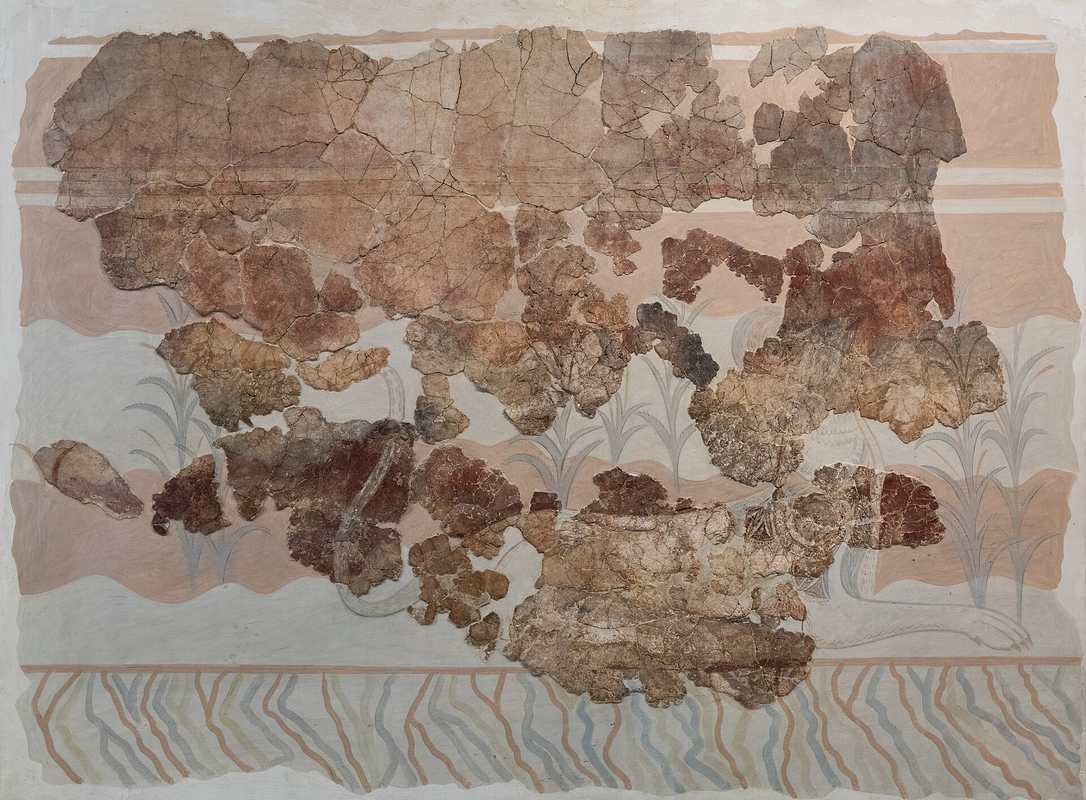
The griffin frescoes flank the throne in the Knossos Throne Room, showing mythical creatures with the body of a lion and the head of an eagle, set among stylised lilies and papyrus.
Flanking the throne on either side are frescoes of griffins, mythical creatures that combine the body of a lion with the head and wings of an eagle. The painted beasts recline amid stylised lilies and papyrus, their calm poses turning them into guardians rather than attackers. These are among the most evocative images anywhere in the palace, and the replicas on the walls today recreate how the original decoration once framed the throne in vivid colour. The plants around them add a formal, garden-like setting that heightens the sense of ceremony.
The griffin carried real weight as a symbol in the ancient world, standing for royalty, protection and the divine, and often serving as a guardian figure. Placing a griffin on each side of the throne strongly suggests that whoever sat there held an authority that was royal, religious or both. The creatures lend the seat an aura of sacred or kingly power, and their presence is one of the clearest clues in the debate about the room’s role.
The colours and setting matter as much as the creatures themselves. The frescoes place the griffins against warm reds and softer tones, with the lilies and papyrus adding a lush, formal border. Painting rather than sculpture was the Minoan medium of choice for such scenes, and the wall itself became the guardian rather than a freestanding statue. The griffins also link the Throne Room to a wider Minoan artistic language, since related creatures and plants appear in frescoes elsewhere on Crete and across the Aegean. Our guide to the Knossos frescoes covers the palace’s wall paintings, and the next section covers the room’s purpose.
What was the Throne Room used for?
The exact use of the Knossos Throne Room is debated, but it was most likely a place of ceremony and ritual rather than everyday rule.
The precise function of the Throne Room remains a matter of scholarly debate, yet most researchers agree it served ceremony and ritual rather than the routine business of government. The small size of the chamber, the formal arrangement of throne and benches, the protective griffins and the sunken lustral basin opposite all point to religious or ceremonial occasions. A room this intimate could never have held a crowd, so any gathering here would have been small and carefully staged. The setting reads as a stage for rites rather than a hall for daily decisions.
One leading idea holds that the throne was occupied by a priest-king, and some interpretations favour a high priestess instead, a figure who combined political and religious authority in Minoan society. Such a person may have presided over rites in which the lustral basin played a part, perhaps purification before or after a ceremony. The Minoans left no readable historical records of these matters, so the room’s exact use can only be inferred from its design and decoration. That gap is part of the room’s enduring fascination.
The excavator who uncovered the room favoured the priest-king reading, and that view long shaped popular accounts of Knossos. Later scholars questioned it and pointed to the strong female presence in Minoan religion, which opened the door to the high-priestess interpretation. Others suggest the seat may have stood empty for much of the time, reserved for a deity rather than a living ruler, with the room serving as a place of epiphany or divine appearance. These competing readings all draw on the same evidence, the throne, the griffins, the benches and the basin, yet they reach different conclusions. Our guide to the mysteries of the Palace of Knossos explores the debates, and the next section covers when the Throne Room was built.
When was the Throne Room at Knossos built?
The Throne Room at Knossos took its final form in the Neopalatial period of the Late Bronze Age, roughly the fifteenth century before the common era, within the last great phase of the palace.
The Throne Room belongs to the Neopalatial period, the era of the second, grander palace at Knossos that followed the destruction of the earlier structure. Scholars place its final surviving form in the Late Bronze Age, within the last century or so of the palace’s active life. The chamber as visitors see it today, with its throne, benches, basin and painted griffins, reflects that late phase rather than the palace’s earliest years. Earlier building on the site was extensive, but the Throne Room’s known decoration and layout date from this later stage.
Dating the room rests on the style of its frescoes, the pottery found across the palace and the wider sequence of Minoan building phases worked out by archaeologists. These strands place the surviving Throne Room among the final flourishes of Minoan Knossos, shortly before the palace fell into decline. Because no written date survives, the chronology comes from comparing the room with securely dated material elsewhere on Crete. That careful cross-checking gives the room its firm place near the close of the Bronze Age.
The late date carries real meaning for how the room is understood. By the time the Throne Room reached its final form, the Minoan world was entering its last chapter, and some scholars connect the room’s design to the changes of that turbulent age. A few argue that its formal, almost throne-hall character reflects new influences on Crete rather than a purely Minoan tradition. Whatever the cause, the room stands as a late and highly developed expression of Minoan ceremonial architecture. Its position at the end of the palace’s long life makes it a valuable window on the culture in its final phase, and the next section covers exactly where it sits within the palace.
Where is the Throne Room at Knossos?
The Throne Room sits in the west wing of the palace at Knossos, beside the central court, reached down a short flight of steps through an anteroom, with a lustral basin opposite the throne.
The Throne Room lies in the west wing of the palace, one of the ceremonial quarters that flanks the great central court. Visitors reach it by moving off the court and stepping down a short flight of steps into the complex. An anteroom comes first, a small waiting space that screens the throne itself from the open court beyond. This sequence of court, steps and anteroom builds a sense of approach, so the throne is not seen at once but revealed only after passing through the outer space.
Inside the main chamber the throne stands against the north wall, with the gypsum benches running along the sides for others to sit. The sunken lustral basin faces the throne from across the room, set below floor level and reached by its own short steps. This arrangement, throne on one side and basin opposite, gives the room a clear axis and a strong ceremonial focus. Its position within the west wing, close to storerooms and shrine areas, further supports the idea of a religious and ceremonial heart to the palace.
The west wing itself was one of the busiest and most important quarters of the palace, holding not only shrines but also the long magazines where goods and treasures were stored. Setting the Throne Room among these rooms places it at the meeting point of religion, administration and storage. Visitors following the modern route usually reach the room after crossing the central court, so the sequence of open court, steps, anteroom and chamber can be traced on the ground today. Understanding this layout helps make sense of what you see when you finally look through the doorway, and the next section covers whether you can go inside.
Can you go inside the Throne Room at Knossos?
You generally cannot walk into the Throne Room at Knossos, as it is roped off to protect the original throne and frescoes.
For conservation reasons, visitors generally cannot walk into the Throne Room itself. The chamber is roped off, and you view it from the doorway or a designated viewing point. This measure protects the original alabaster throne, the genuine surviving features and the fresco-decorated walls from the wear of thousands of visitors each day. Even from behind the barrier, the vantage point gives a clear and close view of the throne against the wall, the flanking benches and the griffin frescoes on either side.
The Throne Room is one of the most popular spots in the palace, so it can grow congested in the middle of the day when tour groups gather. Arriving early in the morning gives a calmer, less crowded look at the chamber and its throne. A guide will explain what you are seeing and set out the theories about the room, which enriches the experience even from the threshold. The space remains one of the unmissable highlights of a visit to Knossos. Plan your visit and tours through our Palace of Knossos guide.
Of all the spaces at Knossos, the Throne Room lingers longest in the memory. Small, shadowy and charged with significance, it places you a few steps from the oldest throne in Europe, flanked by its guardian griffins, in the very heart of Minoan ceremonial life. Even viewed from the threshold, it sparks the imagination, prompting questions about who sat here, what rites unfolded and what authority this modest stone seat once commanded. Visiting early, before the crowds gather at the doorway, and ideally with a guide, makes the encounter all the more powerful. It stands as a fitting symbol of Knossos itself.
Frequently Asked Questions
What is the Throne Room at Knossos?
The Throne Room at Knossos is a small Minoan chamber that contains a carved gypsum alabaster throne set against the wall, flanked by stone benches and frescoes of griffins, with a sunken lustral basin opposite reached by steps. Often called the oldest throne room in Europe, it dates from the Bronze Age and is one of the most famous and atmospheric spaces in the palace. The throne is widely regarded as the oldest in Europe. Its exact purpose is debated, but it was most likely used for religious or ceremonial occasions presided over by a priest-king or priestess rather than for everyday government.
Why are there griffins in the Knossos Throne Room?
Griffins flank the throne in the Knossos Throne Room because they were powerful symbols of royalty, protection and the divine in the ancient world. These mythical creatures, with the body of a lion and the head and wings of an eagle, are shown reclining amid stylised plants on either side of the throne, where they acted as guardians. Their placement strongly suggests that whoever sat on the throne held an authority that was royal, religious or both, lending the seat an aura of sacred or kingly power. The griffin frescoes are an important clue in the long debate about the room’s purpose and the nature of Minoan rule.
What is a lustral basin?
A lustral basin is a small sunken area set below floor level and reached by a short flight of steps, found in several important rooms at Knossos and other Minoan sites, including opposite the throne in the Throne Room. Many archaeologists connect these basins with ritual purification, where water or ceremony marked a threshold before an important act. The basin in the Throne Room faces the throne directly, which strengthens the reading of the chamber as a ceremonial and religious space. Because the Minoans left no explanatory records, the exact rites remain uncertain, yet the basin’s placement remains one of the strongest signs of ritual use.
Is the Knossos throne the oldest in Europe?
Yes, the throne in the Knossos Throne Room is widely regarded as the oldest throne in Europe. Carved from a single block of gypsum alabaster and surviving from the Late Bronze Age palace, it predates the thrones of later European monarchies by many centuries. Its great age is one of the main reasons the chamber draws so much attention and is protected so carefully behind a barrier. Standing before it, visitors are looking at an original Bronze Age seat rather than a reconstruction, which makes it one of the most remarkable survivals anywhere in the ancient Aegean world.