
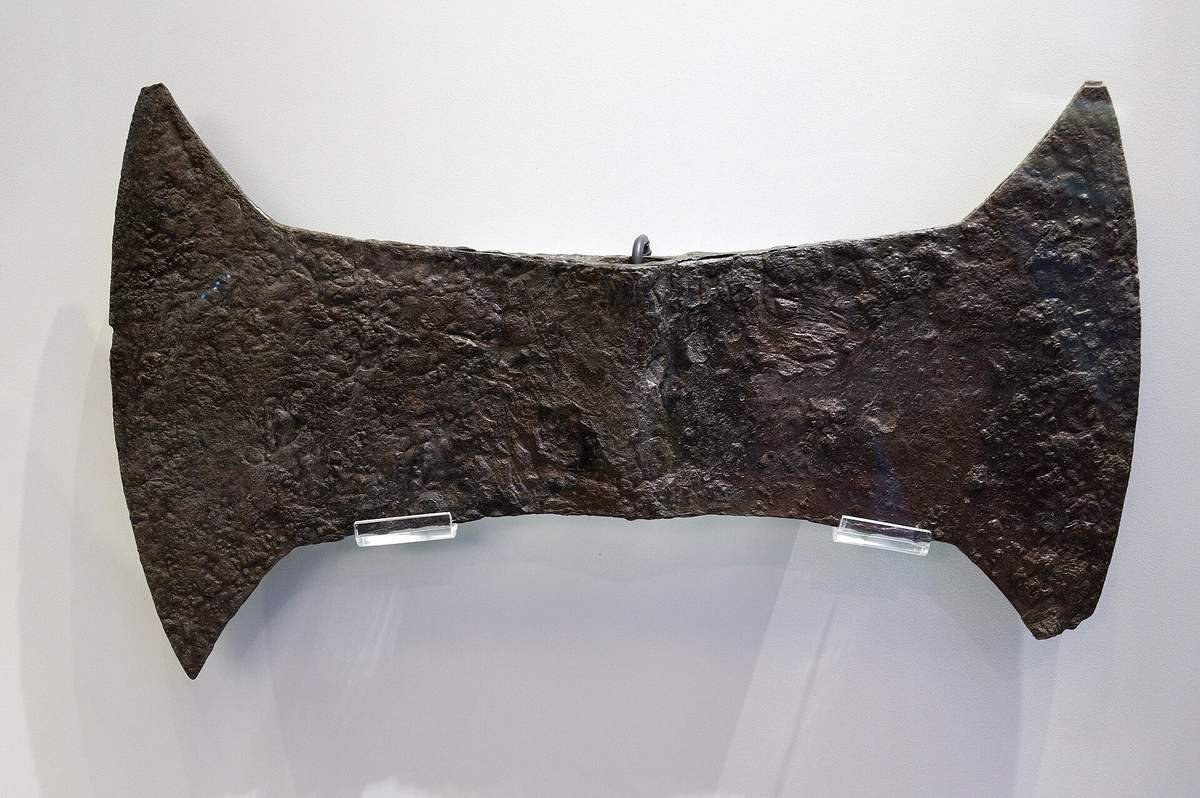
The labrys, the Minoan double axe, was a sacred symbol found throughout Knossos, carved on walls and offered in shrines. Plan tickets and tours through My Greece Tours.
The double axe is one of the defining symbols of the Palace of Knossos. The sections below cover what the labrys is, its religious meaning, the Hall of the Double Axes, its link to the word labyrinth and where to see it.
What is the labrys, the Minoan double axe?
The labrys is the double-headed axe, a sacred symbol of the Minoans found throughout Knossos on walls, pillars and votive offerings, prized for its religious meaning rather than any use as a weapon.
The labrys is a double-bitted axe. A single haft joins two symmetrical blades that face in opposite directions from a central shaft. That mirrored form gives the emblem its balanced, unmistakable outline. The name itself is pre-Greek, thought to derive from an old word for the double axe. The symbol recurs across Minoan art, architecture and ritual objects. It ranks among the signatures of the whole civilisation, beside the sacred bull and the horns of consecration.
The labrys was not a working weapon or tool. It served as a religious emblem, charged with sacred meaning. Masons incised it into the stone walls and pillars of the palace. Painters set it in frescoes, and potters moulded it onto vessels. Above all, worshippers cast it as votive offerings in gold, bronze, silver and lead. They dedicated these axes at shrines and sacred caves. Some votive pieces are large and thin, far too delicate to cut anything, which confirms that they were made to be offered rather than swung.
The double axe also has a long history before and after the palace period. Its form goes back to real working axes of the Neolithic and Early Bronze Age. Over time the shape lost its practical edge and gained sacred weight. The Minoans then made it a religious sign above all else. Later Greeks kept the word labrys for the double axe, and the emblem survived in the cult of Zeus Labraundos in Caria, in Asia Minor. That long afterlife shows how firmly the symbol had lodged in the Aegean imagination.
Its constant presence at Knossos marks it as a central symbol of Minoan religion. The emblem runs through the palace at every scale, from a mason’s mark to a golden dedication. It also spread beyond Crete into the wider Aegean. Copies turn up on the mainland and the islands wherever Minoan religious influence reached. Our guide to Minoan religion covers the wider faith, and the next section covers its meaning.
What did the double axe mean in Minoan religion?
The double axe was a powerful sacred symbol in Minoan religion, closely associated with the central goddess and with ritual and sacrifice, though no Minoan text survives to fix its precise meaning.
The double axe marked out the sacred and signalled the presence of the divine. It graced shrines, blessed rites and attended ceremonies. It also served as a focus of worship in its own right. Scholars read it above all as an emblem of the central Minoan goddess. The axe frequently appears beside female religious figures, held by them or set between the horns of consecration. That recurring pairing suggests it stood for divine authority and sacred power channelled through her.
The labrys also carried a ritual role tied to sacrifice. Many scholars connect it with the killing of sacrificial bulls. That reading fits the towering importance of the bull in Minoan religion. Votive axes offered at peak sanctuaries and cave shrines show that the object itself drew devotion. Priestesses appear to have wielded the axe in ceremony. That points to women holding real religious authority within Minoan society, not a purely decorative role.
The emblem also travelled with other Minoan sacred signs. It appears set between the horns of consecration, the stylised bull’s horns that crowned shrines and palace rooftops. It stands beside sacred knots, rosettes and the figure-of-eight shield in the shared vocabulary of Minoan cult. Doves sometimes perch on the double axes in shrine models, a bird linked to the goddess. This clustering of symbols tells us the labrys was not an isolated motif. It belonged to a whole system of religious imagery centred on the goddess and the bull.
Certainty stays out of reach. The Minoans left no explanatory texts, and their own Linear A script remains undeciphered. Every reading therefore rests on images and archaeology rather than words. That silence keeps interpretations open. Even so, the sheer frequency of the emblem settles one point beyond doubt. The labrys was among the most potent religious symbols of the Minoan world. Our guide to the mysteries of the Palace of Knossos explores such symbols, and the next section covers the Hall of the Double Axes.
What is the Hall of the Double Axes at Knossos?
The Hall of the Double Axes is a grand room in the royal apartments of Knossos, named after the labrys symbols masons carved into its stone walls and pillars in the east wing of the palace.
The hall lies in the east wing of the palace, among the king’s quarters reached by the grand staircase. It takes its name from the double-axe marks cut repeatedly into its masonry. These marks were mason’s signs and sacred emblems at once. The room therefore announces the importance of the labrys through the very stones that build it. The naming has stuck since the excavations of the early twentieth century. Visitors still pass through the space today.
The hall was a fine, spacious apartment. Builders fitted it with the light wells, columns and pier-and-door partitions typical of high-status Minoan architecture. Those partitions are rows of double doors set between piers. Opened, they turned the room into one airy hall; closed, they made smaller, private chambers. That gave the space a flexibility unusual in the ancient world. A light well drew sunshine and fresh air deep into the interior. Painted columns in the Minoan style, wider at the top than the base, framed the openings.
The hall sat within the residential quarter that Evans called the Domestic Quarter. It lay below the main court level, cut into the slope of the hill, so the grand staircase dropped down to reach it. That position gave the rooms shade and cool air in the Cretan summer. A colonnaded light well, the Hall of the Colonnades, stood beside it and lit the stairwell. The double-axe hall opened onto a portico and, beyond it, a smaller private room. This layered plan of open and closed spaces is Minoan design at its most refined.
These religious marks sit in a grand domestic and ceremonial space. Their presence shows how closely Minoan religion was bound up with the daily life of the palace and its rulers. Faith did not sit apart in a separate temple. The sacred axe ran through the living quarters themselves. Our guide to the queen’s megaron covers the neighbouring royal quarters, and the next section covers the link to the labyrinth.
Is the labrys linked to the word labyrinth?
Yes, the word labyrinth may derive from the labrys, according to a long-standing theory that reads labyrinth as the place or house of the double axe, given how thoroughly the emblem marked Knossos.
The theory proposes that labyrinth originally meant the house of the double axe. It builds the word from labrys and a suffix denoting a place. Sir Arthur Evans, who excavated Knossos, championed this reading. He pointed to how thoroughly the double-axe symbol marked the palace on its walls, pillars and ritual objects. On that view the maze-like palace, saturated with the labrys, became known as the place of the axe. The name later attached to the legendary maze of Greek myth.
A correct etymology would tie the sacred Minoan double axe directly to the labyrinth of the Minotaur and to Knossos itself. It would bind together a religious emblem, a real building and one of the most famous stories of the ancient world. The rambling, multi-storey plan of the palace holds corridors, staircases and light wells. That plan plausibly struck later Greeks as a maze. A name rooted in the axe that covered its walls therefore carries a certain logic.
The connection stays a theory rather than a proven fact. The derivation of labyrinth is still debated among linguists, and some trace the word to a different pre-Greek root. Even so, it is a compelling link. It adds a further layer of meaning to the labrys and to the palace. Our guide to the Minotaur and the labyrinth covers the legend, and the next section covers where to see the labrys.
Where can you see the labrys at Knossos?
You can see the labrys carved into the palace walls at Knossos, above all in the Hall of the Double Axes, while gold and bronze votive axes are displayed nearby in the Heraklion Archaeological Museum.
At the Knossos site the double-axe symbol survives incised into the stone walls and pillars of the palace. It shows most clearly in the Hall of the Double Axes, which takes its name from these marks, but it also appears elsewhere among the ruins. Spotting the emblem as you move through the rooms connects you directly to Minoan religion. It is the sacred meaning the builders cut into the fabric of the palace. A guide or a good plan helps, because the marks are shallow and easy to miss.
The finest physical examples of the labrys are the votive double axes. Craftsmen made them as offerings in gold, bronze, silver and lead, and worshippers dedicated them at shrines and sacred caves. These pieces are displayed in the Heraklion Archaeological Museum, a short distance from the site, where the greatest Minoan finds are kept. Among them are delicate golden axes from the cave sanctuary of Arkalochori and pieces set on tall bronze stands. Every one was made for the altar rather than the battlefield.
The museum sets the axes among the wider world they came from. Nearby cases hold the faience snake goddesses, the bull’s-head rhyton and the great frescoes lifted from Knossos. Seeing the labrys beside these treasures shows how it fitted the whole religious scene. The double axe was not a curiosity but part of a rich sacred art. A short guided route through the prehistoric galleries brings the connections into focus.
Seeing both halves of the story completes the picture. The emblem carved into the living palace at the site, and the precious votive axes in the museum, together show how central the labrys was to the Minoan world. A combined visit to site and museum is the standard way to take in Minoan Crete. Our guide to the Heraklion Archaeological Museum covers the collection. Plan your visit and tours through our Palace of Knossos guide.
What forms and materials did the Minoan labrys take?
The Minoan labrys took three main forms: carved marks on palace stone, votive axes in gold, bronze, silver and lead, and large ceremonial axes set upright on stands for shrine display.
The carved form is the humblest. Masons cut the double axe into wall blocks and pillars as a shallow relief or an incised sign. These marks are plain, small and repeated, and they double as builders’ signatures and sacred emblems. The Hall of the Double Axes carries the clearest set. Other marks, sometimes called mason’s marks, appear on dressed ashlar blocks across the palace, linking the labrys to the very act of building Knossos.
The votive form is the richest. Craftsmen hammered and cast axes in gold, bronze, silver and lead, then worshippers left them at peak sanctuaries and cave shrines. The gold axes from the Arkalochori cave are the most famous, thin sheets embossed with fine lines. That cave held hundreds of miniature bronze and gold axes, a hoard of pure dedication. Peak sanctuaries such as Petsofas and cave shrines such as the Diktaian and Idaean caves yielded more. Many pieces are tiny, made only to be left for the goddess, while others are broad and elaborate. Their delicacy proves the point that the labrys was a religious offering, never a battle weapon.
The ceremonial form is the grandest. Large bronze double axes stood upright, fixed to tall stands or bases, so they rose above an altar as a cult object. These display axes gave shrines a fixed sacred focus, much as a cross or a statue anchors later temples. Some carried elaborate openwork or extra pairs of blades, turning a simple axe into an ornate standard.
Beyond these three, the labrys crosses into other media. Painters set it in frescoes and on painted pottery. Sealstone cutters engraved it on rings and seals, small enough to press into clay. Ivory and faience workers shaped it as inlay and pendant. Even sarcophagi carry the emblem, most famously the painted Agia Triada sarcophagus, where double axes topped by birds frame a funeral scene. Together these forms show one emblem worked at every scale, from a scratch in stone to a gleaming altar-piece. Our guide to the fine crafts of Minoan Crete covers this metalwork in more depth.
Frequently Asked Questions
What is the labrys double axe?
The labrys is the double-headed axe, one of the most important sacred symbols of the Minoan civilisation, found throughout the palace of Knossos. It consists of an axe with two symmetrical blades facing in opposite directions from a central shaft. Crucially, it was not primarily a weapon or tool but a religious emblem, charged with sacred meaning. It appears carved into the stone walls and pillars of the palace, painted in frescoes, and was made as votive offerings in gold and bronze dedicated at shrines and sacred caves. Widely thought to be associated with the central Minoan goddess and with ritual, the labrys was a central symbol of Minoan religion, alongside the sacred bull, and its constant presence marks the deep religiosity of Knossos.
What did the double axe symbolise to the Minoans?
The double axe, or labrys, was a powerful sacred symbol in Minoan religion, though its precise meaning is uncertain because no Minoan texts explain it. It is widely thought to have been closely associated with the central Minoan goddess, sometimes appearing alongside female religious figures, and to have symbolised the divine, sacred power and religious authority. It also played a role in ritual, with some scholars connecting it to sacrifice, probably of bulls given their importance in Minoan religion. Votive double axes offered at shrines and caves show it was an object of devotion in its own right. Whatever its exact significance, the labrys was one of the most potent religious symbols of the Minoan world.
Is the word labyrinth related to the labrys?
Yes, the word labyrinth may be related to the labrys, the double axe, according to a long-standing and widely cited theory. This theory proposes that labyrinth originally meant something like the place or house of the double axe, deriving from labrys, given how thoroughly the double-axe symbol marked the palace of Knossos on its walls, pillars and ritual objects. If correct, it directly links the sacred Minoan double axe to the legendary labyrinth of the Minotaur and to Knossos itself, since the maze-like palace, so full of the labrys, could have become known as the place of the double axe. The etymology is debated and not certain, but it is a compelling connection between the symbol, the palace and the famous myth.
Was the labrys used by Minoan priestesses?
The evidence points to Minoan priestesses handling the labrys in ritual. That suggests women held real religious authority in Minoan society. In Minoan art the double axe appears in the hands of female figures. It sits between the horns of consecration beside goddesses, not carried by warriors into battle. The votive axes at peak sanctuaries and cave shrines fit the same picture. Together they indicate the emblem belonged to the sphere of the central goddess and her human servants. The Minoans left no readable texts, so the exact ceremonies stay unknown. Yet the recurring image of a woman holding the sacred axe is one of the clearest signs that priestesses led Minoan worship, in a religion where female figures dominate the surviving imagery.