
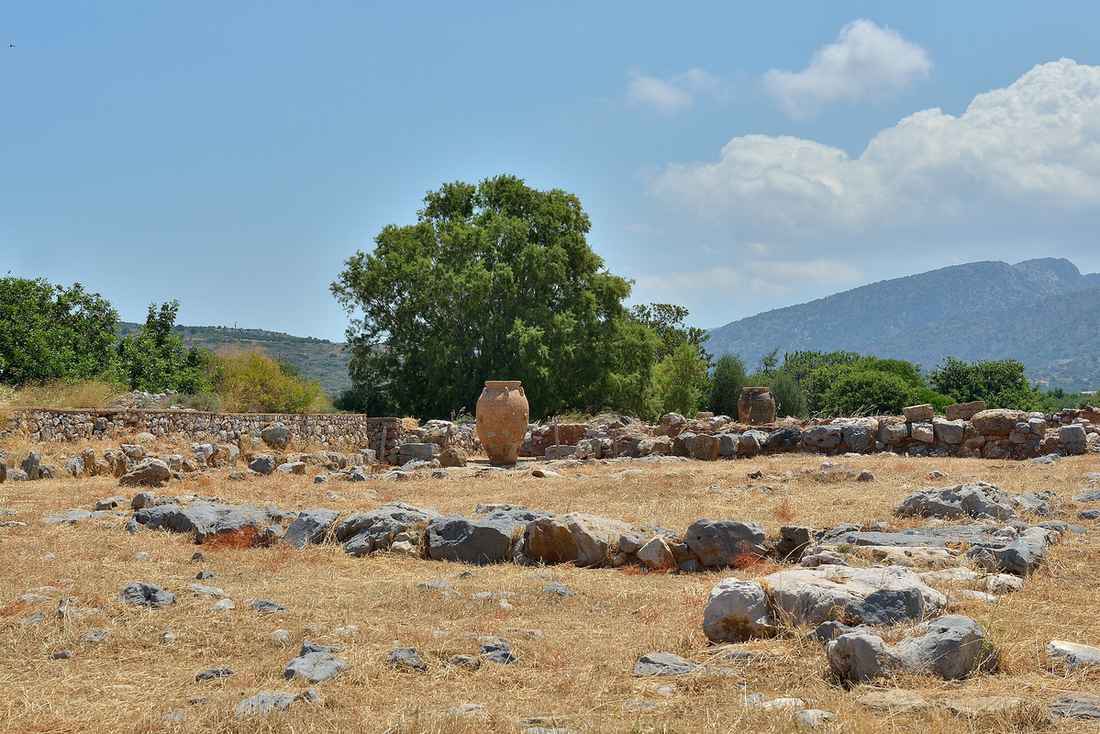
The Palace of Malia is a Minoan palace on the north coast of Crete, the third-largest of the island’s great palatial centres, set on a flat coastal plain near the modern resort town of Malia. It survives as an open archaeological site of courts, storerooms and ceremonial spaces that reveal how a Bronze Age Cretan court was organised. Plan tickets and tours through My Greece Tours.
Malia sits within the same Minoan world as the Palace of Knossos, sharing its layout logic of a central court ringed by ceremonial and storage wings. The sections below cover what the palace is, where Malia lies and how to reach it, what you can see on site, what was found there, how it dates and how to plan a visit today.
What is the Palace of Malia?
The Palace of Malia is a Minoan palatial complex on Crete’s north coast and the third-largest of the island’s palaces, after Knossos and Phaistos. It served as an administrative, ceremonial and storage centre, organised around a large rectangular central court.
The palace belongs to the network of Minoan palatial centres that governed Bronze Age Crete. Like its larger siblings, it follows the classic palatial template: a broad central court at the heart of the complex, with wings of rooms, corridors and storerooms wrapped around it. The plan reflects a society that combined ceremony, craft production and the storage of agricultural surplus under one roof, with the court acting as the social and ritual focus where the community gathered.
Malia is smaller and plainer than Knossos, which makes its structure easier to read on the ground. Visitors trace the central court, the lines of storage magazines and the ceremonial features without the dense reconstruction found elsewhere, so the site reads almost as a clear ground plan of how a Minoan palace worked. Our guide to the Minoan palaces of Crete covers how the four great centres compare.
The palace also marks Malia as a distinct political centre rather than a satellite of Knossos. Its own royal quarters, its own storage economy and its own workshops point to an independent Minoan polity that controlled the surrounding plain. Reading Malia alongside Knossos and Phaistos shows that Bronze Age Crete was a patchwork of palace-states rather than a single kingdom, and the next section covers where Malia lies and how to reach it.
Where is Malia and how do you get there?
Malia lies on the north coast of Crete, roughly 37 km east of Heraklion, beside the modern resort town of the same name. The archaeological site sits on a flat coastal plain near the sea, reached by road along the northern coastal route.
The palace stands east of Heraklion, the island’s capital and the arrival point for most visitors coming by air or sea. The drive follows the main road along the north coast, passing through the resort belt before reaching the site, which lies a little inland of the modern town and its beaches. Public buses along the Heraklion–Agios Nikolaos line stop near the town, and the site is a short taxi ride or walk from there.
The flat coastal setting is part of the story. The palace controlled fertile land and a stretch of coastline, giving it access to farming, trade and the maritime routes that linked Minoan Crete to the wider Aegean. The plain grew grain, olives and vines, while the nearby shore opened onto shipping lanes toward the Cyclades and the eastern Mediterranean, feeding the surplus that the palace stored and redistributed.
The location also shapes how travellers fit Malia into a trip. It pairs naturally with other sites and towns along the same route, making it a practical stop on a longer Crete itinerary rather than an isolated detour. Many visitors combine it with the museums and palaces clustered around the centre of the island. Our guide to Knossos day trips covers how to combine northern-coast sites in one outing.
What can you see at the Palace of Malia?
At Malia you see the large rectangular central court, ranks of storage magazines, the raised ceremonial platform known as the loggia, and the round Kernos stone with its ring of small hollows. Together these features map the ceremonial and economic heart of the palace.
The central court is the defining space, a broad rectangle that anchored the whole complex and around which the wings were arranged. Off the court lie the storage magazines, long rooms that once held large jars and bulk goods, evidence of the palace’s role in gathering and redistributing agricultural produce. The loggia, a raised ceremonial platform, marks a space set apart for ritual or display, the formal stage that distinguished a palace from an ordinary settlement.
The most talked-about feature is the Kernos stone, a round stone set with a ring of small hollows and a larger central cavity, widely interpreted as a vessel for offerings, perhaps small quantities of grain, seeds or produce laid out in ritual. Its exact use remains debated, which is part of its appeal. Nearby, a broad flight of steps interpreted as a theatral area suggests the palace hosted gatherings and public ceremony for the surrounding community.
Beyond the palace proper, the excavated town district known as Quartier Mu rewards a closer look. This block of the Protopalatial settlement preserves workshops for seal-carving, metalwork and pottery, along with archive rooms, giving a rare picture of craft and administration outside the central court. Our guide to the Palace of Phaistos covers how ceremonial spaces differ between the palaces.
The north court and its pillar hall add another dimension to the visit. This paved forecourt, ringed by the stone bases of columns that once carried an upper storey, framed the entry of processions and produce from the plain. Standing there, you look across the whole complex toward the central court, reading the palace as a sequence of thresholds rather than a single room, exactly as a Minoan visitor bringing offerings or goods would have experienced it.
What was found at the Palace of Malia?
The Malia area produced some of the finest Minoan craftsmanship, most famously the gold Bee Pendant, which shows two bees curved around a honeycomb. A stone sceptre carved as an axe was also recovered, alongside storage and administrative material.
The Bee Pendant is the celebrated treasure associated with the Malia area, a gold ornament depicting two bees, or possibly wasps, facing each other around a central drop of honey. Its delicate granulation and symmetry place it among the masterpieces of Minoan goldwork and have made it an emblem of Cretan jewellery. It was recovered from the Chrysolakkos burial complex just north of the palace and is now displayed in the Heraklion Archaeological Museum.
Alongside such fine pieces, the site yielded a stone sceptre shaped like a leopard-headed axe, an object that hints at the symbols of authority and ritual power used by those who controlled the palace. Excavators also recovered inscribed tablets and sealings, and Malia is notable as one of the few sites where all three Cretan writing systems appear: Cretan Hieroglyphic, Linear A and, later, Linear B.
Beyond the showpieces, the palace and its magazines preserved the workaday traces of palatial life: storage vessels, loom weights and the residue of administration and craft. Together these finds let archaeologists reconstruct both the wealth and the daily economy of the centre. Our guide to Minoan jewellery covers the goldwork tradition the Bee Pendant belongs to.
How old is the Palace of Malia and who dug it?
The first palace rose in the early second millennium BC, was destroyed, then rebuilt as a second palace that fell around the mid-fifteenth century BC. Greek archaeologist Iosif Hatzidakis began excavation early in the twentieth century, and the French School of Athens continues it.
Malia followed the same rhythm as the other Cretan palaces. The Protopalatial, or Old Palace, phase began around nineteen hundred BC on the site of an older settlement, and that first complex was destroyed near seventeen hundred BC. A grander Neopalatial palace rose in its place, and Malia flourished until the wave of destructions around fourteen fifty BC that ended the palatial system across Crete during the rise of Mycenaean power.
The excavation history explains why so much survives to read. Iosif Hatzidakis opened the site in nineteen fifteen, and the French School of Athens later took over the long-running campaigns that continue today. Their work uncovered not only the palace but the surrounding town, the Chrysolakkos cemetery and Quartier Mu, giving Malia one of the fullest settlement records of any Minoan centre.
The layered dating matters for visitors, because the ruins you walk are mostly the second palace, with fragments of the first beneath. Recognising the two building phases helps make sense of overlapping walls and shifting floor levels. Our guide to the fall of Knossos covers the wider collapse that ended Malia’s palatial life.
How do you visit the Palace of Malia today?
Malia is an open archaeological site you visit on foot, walking among the excavated courts, magazines and ceremonial features. It is reached by road from Heraklion along the north coast, and pairs well with the city’s archaeological museum and the larger palaces.
A visit to Malia means walking the ground plan of the palace itself, following the central court, the lines of storage rooms and the ceremonial features as you move through the complex. The site is comparatively plain and uncrowded, so it offers a calmer, more contemplative experience than the busiest Minoan attractions, and the flat terrain makes it straightforward to explore. A modern shelter now protects part of the excavations from sun and rain.
Practical planning is simple. The site opens through the day in the tourist season with a modest entrance fee, and a visit typically takes about an hour, a little longer if you add Quartier Mu. Sensible footwear, sun protection and water are worth bringing, as the coastal plain offers little shade and the surfaces are uneven in places. Early morning and late afternoon give the best light and the coolest walking.
Many of the finest objects connected with the palace, including celebrated goldwork, are displayed off site, so a visit gains depth when paired with a museum stop. Our guide to the Heraklion Archaeological Museum covers the collections that bring the palatial finds together. Plan your visit and tours through our Palace of Knossos guide.
How was the Palace of Malia laid out?
Malia is organised around a rectangular central court aligned roughly north to south, with residential and ceremonial rooms to the west, storage magazines and workshops to the east, and a paved north court and pillar hall that handled processions and produce entering the complex.
The west wing held the ceremonial and formal heart of the palace. Here lie the loggia and a broad staircase, the rooms interpreted as cult or reception spaces, and the corridors that channelled movement toward the court. A pillar crypt with double-axe marks cut into its supports points to religious use, echoing similar spaces at Knossos and Phaistos and confirming that ritual was woven into the fabric of the building.
The east and north ranges carried the working economy of the palace. Rows of long, narrow magazines held the tall storage jars, or pithoi, that gathered oil, grain and wine, while channels in the floors show how liquids were collected. A hypostyle hall of stone pillars near the north court and a paved processional area handled goods and gatherings, so the plan reads as two halves: display and cult to the west, storage and supply to the east.
Water management ties the plan together. Drains and channels thread beneath the floors, carrying rainwater from the flat rooftops and courts away from the storerooms, a practical answer to the coastal plain’s winter downpours. Reading the wings, the court and the drainage as one system shows a building designed for both ceremony and the steady business of feeding and governing a region.
How does Malia compare with the other Minoan palaces?
Malia is the third-largest Minoan palace after Knossos and Phaistos and ahead of Zakros. It shares their central-court plan but stands out for its plainer construction, its intact town quarter and the goldwork of the nearby Chrysolakkos cemetery.
In scale and grandeur Malia sits below Knossos, whose restored frescoes and multi-storey wings make it the most elaborate of the palaces. Compared with Phaistos, set on a hilltop in the fertile Messara plain, Malia lies low on the coast and uses simpler local stone rather than the fine ashlar masonry of its southern rival. This plainness is an advantage for readers of architecture, because the bones of the palace show clearly without heavy reconstruction.
Where Malia leads is context. The palace survives with an unusually complete surrounding town, including Quartier Mu and the Chrysolakkos burial complex, so it documents not just a royal court but a whole Minoan community. The Bee Pendant and the leopard axe place its craftsmanship among the finest on the island, matching the treasures of the grander centres despite the palace’s modest walls.
The writing evidence sharpens the comparison further. Malia is one of the very few Cretan sites where all three of the island’s scripts appear, from early Cretan Hieroglyphic on seals and clay bars to Linear A in the palace archives and Linear B in the final phase. That span makes the site a small window on the whole history of Aegean writing, from the picture-signs of the old palaces to the Greek administrative tablets that arrived with Mycenaean control.
Set beside Zakros in the far east, Malia looks large and central rather than remote and trade-focused. Read together, the four palaces show a shared Minoan template expressed through local materials, settings and economies. Our guide to the Minoan palaces of Crete sets Malia within that full comparison.
What is the Chrysolakkos cemetery at Malia?
Chrysolakkos is a large rectangular funerary complex north of the palace, used as a communal burial and cult building for Malia’s elite. Its name means “pit of gold,” a reference to the rich grave goods found there, including the celebrated gold Bee Pendant.
The building is a walled enclosure divided into many small compartments, with an external portico and an altar area that point to rituals held for the dead. It served generations of the Malia community rather than a single family, and its scale and careful masonry mark it as a monument to the same social order that ran the palace. The burials had been disturbed in antiquity, yet enough survived to show the wealth once laid inside.
For visitors, Chrysolakkos completes the picture of Malia as a whole society. The palace shows how the living governed and stored; the cemetery shows how they honoured their dead and displayed their status in gold. Walking from one to the other along the coast connects the ceremonial court with the treasure now in the museum, and grounds the abstract idea of a Minoan elite in a real place on the shore.
Frequently Asked Questions
Is the Palace of Malia worth visiting compared with Knossos?
Malia is well worth visiting for travellers who want to understand how a Minoan palace was laid out without the crowds and heavy reconstruction found at Knossos. Where Knossos overwhelms with its scale, restored frescoes and partial rebuilding, Malia presents a clearer, flatter ground plan that reads almost like an architectural diagram on the earth. You can walk the central court, follow the storage magazines and study ceremonial features such as the loggia and the Kernos stone at your own pace.
For visitors with time for more than one site, Malia and Knossos complement each other well. Knossos shows the grandeur and ambition of the largest palace, while Malia reveals the underlying template more plainly. Its position on the north coast near Heraklion makes it an easy addition to a Crete itinerary rather than a difficult detour, and the quieter atmosphere is part of its appeal.
What is the Kernos stone at Malia?
The Kernos stone is one of the most distinctive and debated features at Malia. It is a round stone set with a ring of small hollows around a larger central cavity, sitting near the edge of the palace’s ceremonial area. The most common interpretation is that it functioned as a vessel for offerings, with the small hollows holding modest quantities of produce such as grain or seeds presented in ritual, perhaps a gesture tied to harvest and fertility.
No written explanation survives, so its precise purpose stays uncertain, and scholars continue to discuss exactly how it was used. That ambiguity is part of what makes it memorable for visitors: a tangible, puzzling object that connects directly to the ritual life of the palace and invites you to imagine the small acts of offering that once took place around it.
How do you get to the Palace of Malia from Heraklion?
The Palace of Malia is reached by travelling east from Heraklion along the main road that runs the length of Crete’s north coast, a journey of roughly 37 km. Heraklion is the island’s capital and main arrival point, with its airport and port making it the natural base for visiting the Minoan sites. The route passes through the developed coastal strip before reaching the archaeological site, which lies just inland of the modern resort town.
Many visitors drive themselves, while others reach the area by intercity bus or organised tour, since the northern coastal corridor is well served by transport. The busy route means Malia combines easily with other stops, including the central palaces and the archaeological museum in Heraklion. Treating it as one element of a wider north-coast itinerary is usually the most rewarding way to fit it into a visit.
What is Quartier Mu at Malia?
Quartier Mu is a block of the Protopalatial town excavated a short distance from the palace, and one of the best-preserved settlement complexes on Crete. It contained workshops for seal-cutting, metalworking and pottery, along with storerooms and archive rooms that held sealings and inscribed documents. The quarter shows how craft production and record-keeping operated in the town around the palace, not only inside the central court.
For visitors, Quartier Mu adds a layer of daily life to the ceremonial story of the main site. Walking its rooms alongside the palace gives a fuller sense of a working Minoan community, where artisans, administrators and traders lived and worked in the shadow of the central court.
What is the Bee Pendant from Malia?
The Bee Pendant, sometimes called the Malia Pendant, is a gold ornament showing two insects, read as bees or wasps, curved symmetrically around a small golden ball interpreted as a drop of honey or a honeycomb. Fine granulation, filigree and tiny hanging discs make it one of the masterpieces of Minoan goldsmithing, and it has become an emblem of the whole civilisation’s craftsmanship.
It was found not in the palace itself but in the Chrysolakkos funerary complex just to the north, a communal burial building for the local elite. The pendant now sits in the Heraklion Archaeological Museum, so pairing a visit to the site with the museum lets you connect the empty tombs on the coast with the treasure they once held.
How long does a visit to the Palace of Malia take?
A focused visit to the palace itself takes about an hour, enough time to walk the central court, follow the storage magazines and study the loggia and the Kernos stone. Adding the town district of Quartier Mu and the Chrysolakkos cemetery extends the visit to around ninety minutes or a little more, depending on how closely you read the information panels along the paths.
The flat terrain and modern walkways make Malia one of the easier Minoan sites to cover, with no steep climbs. Combining it with the Heraklion Archaeological Museum on the same day gives the fullest picture, since the finest objects from the palace and its cemetery are displayed there rather than on site.