
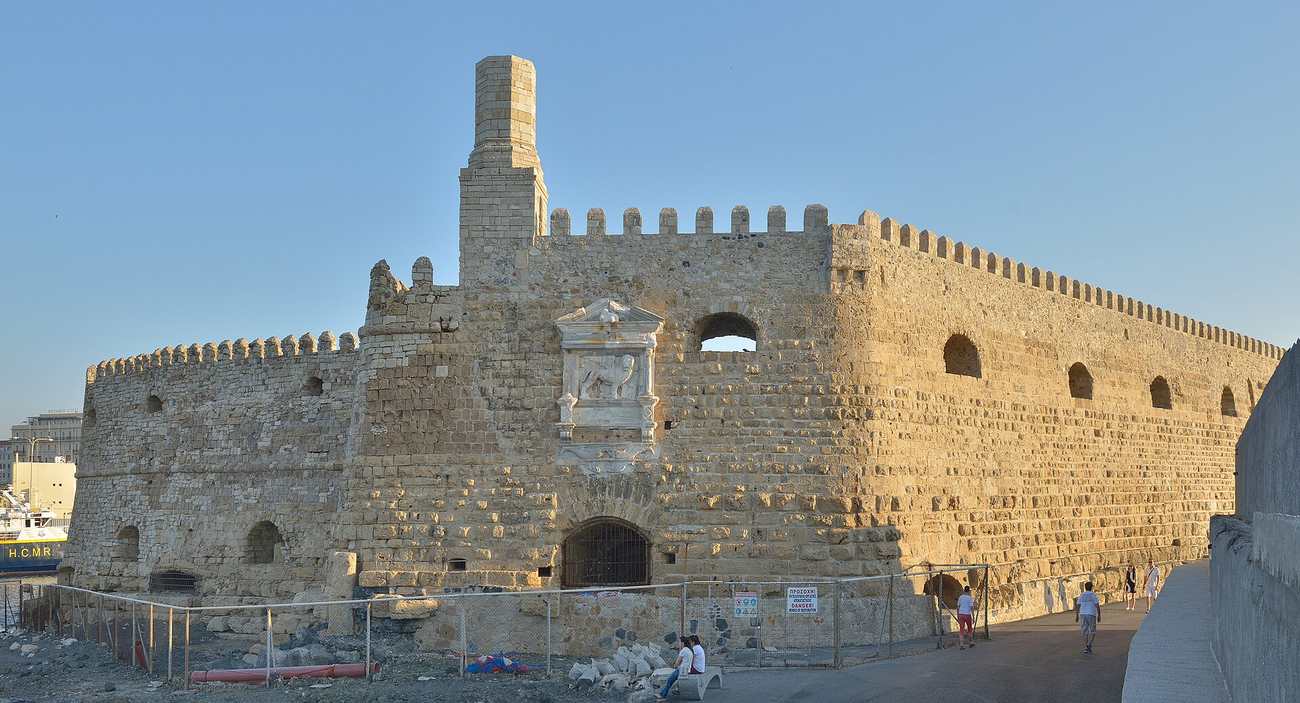
The Koules fortress is a squat stone sea fort guarding the entrance to the old Venetian harbour of Heraklion, the capital of Crete. The Venetians knew it as Rocca a Mare and Greeks call it Koules. It stands beside the old Venetian arsenali shipyards, a low block of thick walls that has become the emblem of Heraklion. The fort holds two floors of vaulted halls, cannon and exhibitions, and its roof gives wide views over the harbour, the fishing boats and the city. Plan your Heraklion waterfront walk and the wider island with My Greece Tours.
The Venetians built the surviving fortress in the sixteenth century over an earlier fort to protect the port of Candia. The sections below cover the fort’s history, its Lion of Saint Mark reliefs, the long Ottoman siege it endured, what waits inside its vaulted halls, and how it fits into a Heraklion visit. Read this guide alongside the wider Crete travel guide to place the sea fort within the capital and the north coast. The fort sits at the harbour mouth, an easy stop on any walk around the Heraklion waterfront.
What is the Koules fortress in Crete?
Koules is a squat stone sea fort guarding the entrance to the old Venetian harbour of Heraklion, the capital of Crete. The Venetians called it Rocca a Mare. Its thick, sloping walls close off the harbour mouth beside the old shipyards.
The Koules fortress sits at the tip of the mole that closes the old Venetian harbour of Heraklion. The Venetians named it Rocca a Mare, the rock in the sea, and the Greek name Koules carries the same sense of a harbour castle. The building is a low, broad block rather than a tall tower, with thick, sloping walls that meet cannon fire at an angle. It guards the narrow entrance where fishing boats still pass in and out today. The fort stands beside the old Venetian arsenali shipyards, the vaulted sheds where the port once built and repaired its galleys.
Together the fort and the arsenali form the surviving core of the working port that the Venetians called Candia. You can reach the fort along the harbour mole on foot.
The fort you see rose in the sixteenth century, built over an earlier fortification on the same rock. Its purpose was plain defence: to protect the port of Candia, the main harbour of Venetian Crete, from raiders and rival fleets. The thick masonry carries three carved reliefs of the Lion of Saint Mark, the badge of Venice, set into the outer walls. Inside, two floors of vaulted halls held the garrison, its cannon and its stores. The lower level kept ammunition and supplies while the upper level mounted the guns that swept the harbour approach. Heraklion grew around this port, and the fort remains its clearest link to the Venetian centuries.
A walk from the town centre to Koules crosses the whole old harbour front, tracing that history along the water. The mole makes the approach direct.
When did the Venetians build the Koules sea fort?
The Venetians built the surviving Koules fortress in the sixteenth century, raising it over an earlier fort on the same rock. Its role was to protect the port of Candia, the main harbour of Venetian Crete, from attack.
The current fortress dates from the sixteenth century, the height of Venetian rule over the island. An older fort already stood on the rock, and the Venetians replaced it with the heavier structure that survives, matching the military engineering of the age. Cannon had changed how forts were built, so the walls were made thick and sloped to deflect shot rather than tall and thin. The result is the squat, powerful outline that still closes the harbour mouth. The port it defended, Candia, gave its name to the whole island in that period and ranked among the busiest harbours of the eastern Mediterranean.
Control of the sea fort meant control of the port, and the port was the key to Crete. The sixteenth-century masons built for a long fight, and the walls proved it.
The fort was one link in a wider Venetian defence of the north coast. The Fortezza above the town of Rethymno, raised in the same century as a walled refuge for its people, guarded the harbour further west, while inland monasteries later played their own part in Cretan history. Reading Koules beside those sites shows how the Venetians ringed their island with stone. A trip that takes in the sea fort of Heraklion pairs well with a Crete 3-day itinerary that reaches west along the coast to the other Venetian towns.
The best light for photographing the low walls and the harbour comes early or late, so plan the visit into your day; a quick check of the best time to visit Crete helps you match crowds and weather to the season you choose.
What are the Lion of Saint Mark reliefs on Koules?
Three carved reliefs of the Lion of Saint Mark, the winged lion that served as the emblem of Venice, are set into the outer walls of Koules. They mark the fort as Venetian work and stamp the republic’s authority on the harbour.
The Lion of Saint Mark is the winged lion that stood as the emblem of the Venetian republic, and three of these reliefs are carved into the thick outer walls of Koules. The Venetians placed the lion on the buildings and gates of their overseas territories to mark the reach of the state, so the fort at the harbour mouth of Heraklion wore the badge for every arriving ship to read. Each relief shows the lion in its usual form, one paw resting on an open book. The carvings face the sea and the port, the two directions from which the fort was meant to be seen.
Weather and centuries have worn the stone, yet the shapes still read clearly on the walls. They are the surest sign of who built and held this fort.
The reliefs tie Koules to the capital that grew behind it. A walk around Heraklion old town turns up the same winged lion on fountains, gates and the walls of other Venetian buildings, so the fort’s carvings sit within a wider set across the city. Tracing the lion from the sea fort into the streets shows how deeply the republic marked its Cretan capital. The fort is one of the headline things to do in Crete for anyone drawn to the island’s layered history, and the reliefs make a clear starting point.
Look for the lion first on the outer walls as you approach along the mole, then again inside as you climb to the roof for the view over the harbour and the city.
What role did Koules play in the Ottoman siege of Heraklion?
Koules held out through the long Ottoman siege of Heraklion, one of the longest sieges in history. The sea fort helped keep the harbour open to relief and supply while Ottoman forces pressed the walled city from the land.
The fort was tested in the great Ottoman siege of the city, ranked among the longest sieges in history. Ottoman forces pressed the walled capital from the land for years while the defenders held on, and control of the harbour decided whether relief and supply reached the town. Koules, closing the harbour mouth, was central to that fight for the port. Its cannon and thick walls covered the entrance through which help arrived by sea. The siege drew in the wider Mediterranean powers of the day and became one of the defining episodes of Venetian Crete.
The fall of the city ended Venetian rule over the island, yet the sea fort itself endured, its masonry outlasting the empire that raised it. The walls that had deflected cannon still stand at the harbour mouth today.
That long defence sits within the island’s wider record of resistance. The same theme runs through later Cretan history, as at Arkadi Monastery, whose stand against Ottoman forces became a national symbol in the nineteenth century. Reading Koules and the monastery together traces the island’s long struggle across the centuries, from the Venetian port to the later fight for freedom. The sea fort makes the harbour side of that story concrete and visible. Standing on the roof and looking back at the land walls of Heraklion, you can picture the two lines of the siege, the sea entrance the fort guarded and the ramparts the Ottoman army faced.
The setting turns the written history into something you can trace with your own eyes across the harbour and the old town.
What can you see inside Crete’s restored Koules fortress?
The restored fort holds two floors of vaulted halls with cannon and exhibitions, and its roof gives wide views over the harbour, the fishing boats and the city of Heraklion. It stands beside the old Venetian arsenali shipyards.
The fort has been restored and opened to visitors, and a route leads through two floors of vaulted halls. The lower level holds cannon and displays that set out the history of the fort and the port, while the vaulted ceilings show the heavy construction that let the walls carry guns and take fire. Stairs climb to the roof, where a broad terrace gives wide views over the harbour, the fishing boats moored below and the city of Heraklion spreading behind. The old Venetian arsenali shipyards stand just beside the fort, their long vaulted sheds framing the inner harbour. Exhibitions inside explain how the sea fort worked and how it fits the story of Candia.
The visit is short but rewards anyone who wants to understand the port at the heart of the capital.
Koules works best as one stop on a wider stay in the capital. The harbour front runs from the fort into the streets and squares of the old town, so the sea fort pairs naturally with the museums, fountains and Venetian buildings inland. Basing yourself near the water makes the fort and the arsenali an easy evening stroll; the guide to where to stay in Crete sets out how Heraklion compares with the coastal resorts and the western towns as a base. From the roof you can pick out the line of the old harbour and the modern port beyond, seeing at a glance how the Venetian core still shapes the working waterfront.
The fort turns a walk along the sea into a walk through the history of the city.
Frequently Asked Questions
Is the Koules fortress open to visitors?
The Koules fortress has been restored and opens to visitors at the mouth of the old Venetian harbour of Heraklion, the capital of Crete. A route runs through two floors of vaulted halls holding cannon and exhibitions that set out the history of the sea fort and the port of Candia. Stairs lead up to the roof, where a broad terrace gives wide views over the harbour, the fishing boats and the city behind. The fort stands beside the old Venetian arsenali shipyards, whose long vaulted sheds framed the inner harbour. Reaching it means a walk along the harbour mole from the town centre, which crosses the whole old waterfront on the way.
The three Lion of Saint Mark reliefs on the outer walls reward a close look as you approach. The visit is a short, self-contained stop within a wider day in the city, and it suits travellers drawn to the island’s Venetian past.
Why is Koules important to the city of Heraklion?
Koules is the emblem of Heraklion and the clearest surviving link between the modern capital and its Venetian past. The sea fort closed the harbour that the Venetians called Candia, the port that gave the island its name in that period and ranked among the busiest in the eastern Mediterranean. The fort protected that port, carried three reliefs of the Lion of Saint Mark and held out through the long Ottoman siege of the city, one of the longest sieges in history. The city grew around this harbour, so the fort stands at the root of its story.
It appears on postcards, logos and photographs of the capital, the single image most people carry away from the north coast. The old Venetian arsenali shipyards beside the fort round out that working core of the port. A walk from the town centre out along the mole to the fort traces the history step by step across the old harbour front to the sea, ending at the walls that guarded the entrance.
How does Koules fit into a wider Crete trip?
Koules fits neatly into a stay in Heraklion, sitting at the harbour mouth an easy walk from the old town, its museums and its Venetian squares. The sea fort pairs with the wider record of the island’s history, from the Venetian towns of the north coast to the later fight for freedom. A route west along the coast reaches the Fortezza above Rethymno, raised in the same century as a walled refuge, and the stand at Arkadi Monastery, tying the harbour fort into the broader story. The two floors of vaulted halls, the cannon and the rooftop views make the fort a rewarding stop in its own right, not just a photograph.
Timing matters for the light on the low walls and the crowds along the mole, so set the season with care before you travel. The fort makes a strong first or last stop on any trip that centres on the capital and its working waterfront.