
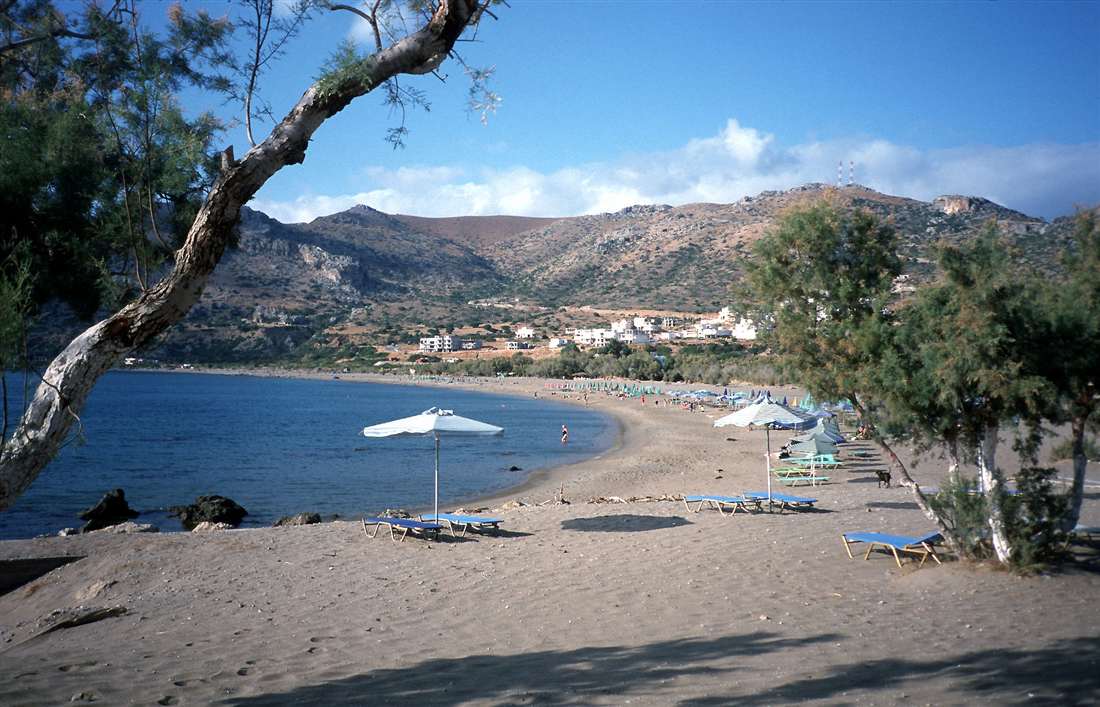
Paleochora is a laid-back beach town on the south-west coast of the Chania region of Crete, about 70 kilometres from Chania on a peninsula between a long sandy beach and a pebbly one, the “bride of the Libyan Sea”. Plan the whole trip with Greece Tours.
This guide covers Paleochora in full: what and where it is, the sandy Pachia Ammos and pebbly Halikia beaches, the Venetian castle, the car-free evening town, the history, the boat trips to Elafonisi, Sougia and Gavdos, the E4 and Anydri Gorge hikes, the watersports, the tavernas and low-key nightlife, where to stay, how to reach it from Chania, the best time, and whether Paleochora is worth visiting.
What is Paleochora in Crete?
Paleochora is a laid-back beach town on the south-west coast of Crete, in the Chania region. Locals name it the “bride of the Libyan Sea” because it sits on a narrow peninsula that carries a long sandy beach on one flank and a pebbly beach on the other.
Paleochora occupies the tip of a low peninsula that pushes south into the Libyan Sea, the stretch of the Mediterranean that separates Crete from the coast of North Africa. The peninsula measures roughly 400 metres across at its widest and tapers to a rocky headland crowned by a ruined Venetian fort. That single strip of land holds the entire settlement, so a visitor walks from the sandy west shore to the pebbly east shore in five minutes, crossing the main street on the way. This twin-coast geometry defines the town and explains its nickname: two seas embrace one strip of houses, tavernas and gardens.
The town belongs to the Selino district, the far south-western corner of the Chania regional unit, and it faces open water with no island to break the horizon. The nearest land across the water is Gavdos, the southernmost point of Europe, which floats on the horizon on a clear day. Paleochora functions as the departure port for the ferry that links this coast with Gavdos, Sougia, Agia Roumeli at the mouth of the Samaria Gorge, and Loutro. That ferry role turns the town into the hinge of the whole south-west coastline, a place where hikers, beach-seekers and island-hoppers converge.
The name Paleochora translates as “old town”, a reference to the medieval settlement that grew beneath the fortress. Today the modern town spreads across the peninsula in a compact grid of two-storey buildings, flat-roofed houses and gardens heavy with bougainvillea, jasmine and citrus. The population stays small through the year and swells in the warm months, yet the town never loses its unhurried rhythm. Paleochora draws travellers who want a beach holiday without the scale, traffic and neon of the north-coast resorts, and it rewards them with warm south-facing water, mountain backdrops and a horizon that turns copper at sunset.
The peninsula’s low relief and open aspect give Paleochora a light-filled quality through the day. The morning sun rises over the pebbly east shore and the harbour, tracks across the town, and drops into the sea beyond the sandy west beach at dusk, so the town owns both a sunrise and a sunset over water. The White Mountains stand behind the coast to the north, their peaks holding snow into late spring, and their foothills fold down to the shore in ravines and gorges that feed the beaches with cold, clear streams. This meeting of high mountain and warm southern sea shapes the whole character of the place. For a wider picture of the region, the Chania hub maps the towns, gorges and beaches that ring this corner of Crete.
Where is Paleochora and how far is it from Chania?
Paleochora lies on the south-west coast of Crete, roughly 70 kilometres south-west of Chania town. The drive crosses the White Mountains foothills on a winding mountain road and takes around one hour and thirty minutes by car, or two hours by the public bus.
The route from Chania climbs south through the Selino highlands, threading past the Topolia Gorge, the plane-shaded village of Kandanos and terraced olive groves that step down the slopes. The road narrows and twists as it crosses the spine of the peninsula, so the 70-kilometre distance translates into far more driving time than a flat coastal run of the same length. Drivers gain sweeping views over ravines and distant sea as the tarmac coils toward the Libyan coast, and the final descent opens onto the sandy sweep of Pachia Ammos with the town beyond. Hire a car in Chania for the freedom to stop at villages and viewpoints along the way; the mountain road demands unhurried, attentive driving rather than speed.
The KTEL bus network connects Chania bus station with Paleochora through the day in the warm season, with a reduced timetable in winter. The journey by bus runs close to two hours because the coach halts at villages along the mountain road, yet it removes the stress of the hairpins and delivers passengers to the edge of the town, a short walk from both beaches. From Chania, the bus is the simplest car-free link to the south-west coast.
Chania International Airport on the Akrotiri peninsula sits around 85 kilometres from Paleochora, and Heraklion airport lies roughly 220 kilometres east. Most travellers land at Chania, collect a hire car or ride the bus, and reach the town in an afternoon. Paleochora’s isolation is the point: the long transfer filters out the crowds, so the town keeps its calm even in high summer. The ferry adds a second axis of arrival, since walkers finishing the Samaria Gorge at Agia Roumeli ride the boat west to Paleochora rather than backtrack over the mountains. The long transfer over the mountains sets Paleochora apart from its south-coast neighbours and keeps its shore uncrowded.
What is Pachia Ammos, the sandy beach at Paleochora?
Pachia Ammos is the long sandy beach on the west side of the Paleochora peninsula. It stretches for roughly 1.2 kilometres of soft golden sand backed by a line of tamarisk trees, holds a Blue Flag award, and faces the open Libyan Sea with shallow, warm water.
The name Pachia Ammos means “thick sand”, and the beach earns it: the shore is a broad band of fine, deep sand that runs the full western flank of the town. A row of mature tamarisk trees traces the back of the beach, throwing pools of shade over the sand through the hottest hours, so families claim a spot beneath the branches rather than pay for every parasol. Sunbeds and umbrellas line the central stretch in front of the tavernas and caf\u00e9s, while the outer ends stay open and quiet for those who carry their own towel and shade. The gradient is gentle, the seabed sandy and free of rocks, and the water shallow for a long way out, which makes the shallows safe for small children and easy for weak swimmers.
Because Pachia Ammos faces west and south into open water, it catches the afternoon wind. On breezy days the surf builds into rolling waves and the shore becomes a playground for windsurfers, kitesurfers and bodyboarders, while calmer mornings suit swimming and paddling. Windsurf and watersport operators set up on the sand through the summer, renting boards and running lessons. The same exposure delivers the town’s headline sunset: the sun drops straight into the Libyan Sea off Pachia Ammos, and the crowd drifts to the water’s edge each evening to watch the sky burn orange and pink.
The Blue Flag award marks the beach’s clean water, safe access and lifeguard cover through the peak season. Facilities line the promenade behind the sand \u2014 showers, changing points, beach bars, tavernas and a footpath into the town centre, all within a two-minute walk. Because the beach abuts the town, a swimmer strolls from the sea to a taverna table or an ice-cream counter without moving the car. This blend of length, soft sand, shade, watersports and immediate town services makes Pachia Ammos the beach most visitors picture when they think of Paleochora.
The beach fills through the day with a gentle, mixed crowd \u2014 families beneath the tamarisks, swimmers along the shoreline, windsurfers on the outer water and walkers tracing the sand toward the open dunes at the northern end. Beyond the developed strip the beach runs wild, with low dunes, sea daffodils and a quieter shore where nudity is tolerated by long habit. A coastal footpath continues north from Pachia Ammos toward the mouth of a river and the beaches beyond, so a morning walk along the sand extends into a genuine coastal hike. The full sweep of the region’s shoreline, from these south-coast sands to the north-coast bays, appears in the guide to the beaches of Chania.
What is Halikia, the pebble beach at Paleochora?
Halikia is the pebbly beach on the east side of the Paleochora peninsula, the sheltered opposite of the sandy west shore. It runs beside the harbour, holds calmer water on windy days, and offers clear sea over smooth grey pebbles and slabs of rock.
The name Halikia derives from the Greek word for pebbles, and the beach is a shore of smooth stones and rock terraces rather than sand. It faces east, so it turns its back on the prevailing afternoon wind that whips up Pachia Ammos across the peninsula. When the sandy beach churns with surf, families and swimmers cross the strip of town to Halikia and find flat, glassy water on the leeward side. This wind-shelter role is Halikia’s whole point: the town gives a swimmer two seas and two moods, and a five-minute walk swaps a windy shore for a calm one.
The water off Halikia runs deep and startlingly clear, and the rocky seabed draws snorkellers who want to watch fish among the stones rather than dig their toes into sand. Flat rock ledges and concrete platforms give sunbathers a place to spread a towel and slip straight into deep water, so strong swimmers gravitate here. Water shoes ease the walk over the pebbles at the shoreline, and the deep entry suits confident swimmers more than toddlers. A morning swim off Halikia catches the sunrise over the sea, the mirror image of the sunset that ends the day on Pachia Ammos.
Halikia curves around toward the small fishing and ferry harbour at the south-east foot of the peninsula. Fishing boats and the Libyan Sea ferry berth here, and a cluster of fish tavernas lines the quay, serving the morning catch a few steps from where it lands. The harbour anchors the eastern edge of town and gives Halikia a working, lived-in character that the resort strip on the sandy side lacks. Between the two shores, Paleochora hands its visitors a rare choice: sand or pebbles, sunset or sunrise, surf or calm, all within one short peninsula.
What is the Venetian castle (Kastelli) at Paleochora?
Kastelli is the ruined Venetian fortress on the rocky headland at the southern tip of the Paleochora peninsula. The Venetians raised it to guard the south-west coast, and its surviving walls now form a free open-air viewpoint over both beaches, the harbour and the Libyan Sea.
The Venetians, who ruled Crete for centuries, built the castle on the highest rock of the peninsula to command the sea approaches and the anchorage below. They named the stronghold Selino, and the surrounding district still carries that name today. From this height the garrison watched for raiders sweeping in from the Libyan Sea and controlled the fertile Selino hinterland behind the coast. The fort changed hands and fell into ruin through cycles of raids, sieges and demolition, so what stands now is a shell \u2014 sections of curtain wall, corner bastions and the footprint of interior chambers, weathered to the colour of the rock they rise from.
A short, steep path climbs to the ruins from the town below, and entry is free with no gate or ticket. The reward at the top is the finest panorama in Paleochora. On one side the long golden ribbon of Pachia Ammos runs north; on the other the pebbles of Halikia and the harbour curve away; ahead the open Libyan Sea fills the horizon with Gavdos on the skyline. The height reveals the town’s whole peninsular geometry at a glance \u2014 two seas, one strip of houses, the mountains rising inland \u2014 in a way no street-level view delivers.
Sunset draws visitors up to the walls, where the low sun sets the ruined stone and the western beach aglow. The site stays open around the clock because it has no barrier, so an early riser climbs for the dawn over Halikia and the harbour just as readily. The castle grounds hold wildflowers in spring and the scent of thyme and sage on the breeze, and the crumbling walls carry the weight of the coast’s turbulent past. Kastelli is the historical anchor of Paleochora and its single best free attraction.
The headland around the ruins doubles as a wild coastal park. Paths thread between the walls and the rocks down to the water, where flat ledges give swimmers a place to slip into deep, clear sea away from the beaches. Goats graze the thyme and the ruined masonry, seabirds ride the wind off the point, and the scent of wild herbs carries on the breeze. The rock underfoot preserves the marks of the fortress it once carried \u2014 cut blocks, cistern hollows and the line of the curtain wall \u2014 so the walk reads the town’s defensive past straight from the ground. From the tip of the headland the eye follows the Libyan Sea south with nothing but open water and the far outline of Gavdos between Crete and the coast of Africa.
What is Paleochora town like?
Paleochora town is a low-key, low-rise grid of tavernas, caf\u00e9s and family-run rooms spread across a narrow peninsula between two beaches. The main street closes to traffic each evening and fills with diners, strollers and street life under the tamarisks and bougainvillea.
The town keeps a human scale. Buildings rise two storeys at most, painted white and washed with the ochre and terracotta of the older houses, and gardens spill jasmine, geraniums and citrus over the walls. Streets run in a loose grid across the flat peninsula, so orientation is effortless: the sea lies on both sides, the fortress marks south, and the mountains rise to the north. No high-rise hotel block, no motorway of neon, no cruise-ship crush intrudes on the skyline. The pace is deliberately slow, a rhythm set by the heat, the sea and the long lunch.
Each evening the main street, Odos Venizelou, closes to cars and turns into a pedestrian promenade. Taverna tables spread across the tarmac, string lights come on in the tamarisk branches, and the whole town walks the street end to end. Grills smoke with fresh fish and lamb, ouzo and raki arrive with small dishes, and musicians play in the doorways of the bars. This nightly car-free ritual is the heart of Paleochora’s character \u2014 a communal, open-air dinner that stretches from the beach caf\u00e9s to the harbour tavernas. Children chase one another between the tables, elders sit on doorsteps, and the meal runs late into the warm night.
By day the town settles into an easy loop between the two shores. Bakeries and kafeneia serve strong Greek coffee and bougatsa in the morning, small supermarkets and gift shops trade through the afternoon, and the tavernas reopen as the heat breaks. Beyond the food, the town offers watersport rental, dive operators, a scattering of bars, and the ferry quay where boats leave for Sougia, Agia Roumeli, Loutro and Gavdos. A short walk clears the town on any side and lands the walker on a footpath into the hills or along the coast. Paleochora suits the traveller who prizes calm, sea, sun and honest food over polish and scale.
The town also serves as a base rather than a dead end. The ferry quay on the harbour side links Paleochora to Sougia, Agia Roumeli, Loutro and the island of Gavdos, turning day trips into short sea voyages along a coast with no through-road. Walkers use the town as the western terminus of the E4 European long-distance path, which traces the south coast between the gorges. Dive centres run boats out to the reefs and drop-offs of the Libyan Sea, and rental scooters and cars open the mountain villages, the chestnut groves of the Selino interior and the pink sands further west. Paleochora keeps the visitor busy or idle at will.
Is Paleochora good for families?
Paleochora suits families well. The Blue Flag sandy beach at Pachia Ammos slopes gently into shallow, warm, lifeguarded water, the compact town stays free of heavy traffic, and the car-free evening street lets children roam and play safely while parents dine.
The sandy beach is the foundation of the town’s family appeal. Pachia Ammos runs long and soft with a gentle gradient, so the water stays shallow far from shore and the seabed holds no rocks to bruise small feet. The tamarisk trees behind the sand throw natural shade over the beach through the hot hours, a rare comfort that spares young children the full midday sun without hiring a parasol. Lifeguard cover through the peak season and clean, calm morning water add a layer of safety that reassures parents of paddlers and first-time swimmers. When the afternoon wind rises on the sandy side, the sheltered pebbles of Halikia give a calm-water alternative a five-minute walk away.
The town itself is built for small legs. Distances are short, the streets are flat, and the evening pedestrian zone removes cars from the heart of the action, so children walk, cycle and play in the open while families eat. Tavernas welcome children as a matter of course, high chairs and simple grilled dishes are standard, and the relaxed pace means no one hurries a family meal. Rooms and studios with kitchenettes outnumber large impersonal hotels, which suits families who cook a breakfast or a light supper for young children.
Beyond the beaches, the setting hands families gentle adventures. The climb to the Venetian castle is short enough for older children and rewards them with a fortress to explore and a huge view to name. The ferry turns a day out into a small voyage, carrying families along the coast to quieter coves and the sands of Gavdos. Boat trips, snorkelling over the rocks at Halikia and easy coastal walks fill the days between beach sessions. The combination of a safe shallow beach, a calm car-light town and low-key outdoor adventures makes Paleochora a dependable choice for a family holiday on Crete’s south coast.
Practical family logistics fall into place easily. The town packs supermarkets, bakeries, pharmacies and a medical centre within a few flat streets, so a family restocks nappies, sun cream and snacks on foot. Self-catering studios with kitchenettes and a garden or terrace outnumber large hotels, giving parents room to store milk, warm a bottle and settle a young child for an early night while the evening street hums a short walk away. The short distances mean a tired toddler is back at the room in minutes, and the two-sided peninsula guarantees a swimmable, sheltered shore whichever way the wind blows.
What is the history of Paleochora?
Paleochora grew beneath the Venetian fortress of Selino, built on the headland to guard the south-west coast. Pirate raids razed the medieval town, wartime hardship marked the twentieth century, and a wave of travellers turned the quiet fishing port into a low-key holiday town.
The recorded story of the peninsula begins with the Venetians, who controlled Crete for centuries and fortified this rock to command the Libyan Sea approaches and the Selino district behind it. The castle they named Selino gave the town and the whole surrounding region their identity. A settlement clustered under the walls for protection, farming the fertile hinterland and fishing the sheltered eastern shore. The exposed south coast made the town a target, and raiders sweeping in from the sea sacked and burned it in the turbulent years of the Venetian and Ottoman periods, so the fortress passed through destruction, repair and final ruin. The name Paleochora \u2014 “old town” \u2014 records that layered, broken past.
The twentieth century brought fresh hardship. Crete endured a brutal occupation during the Second World War, and the remote villages of the Selino district paid a heavy price in reprisals and privation. The south-west coast, cut off by mountains and poor roads, stayed poor and isolated through the decades that followed, its people living from fishing, olives and small-scale farming. That very isolation preserved the town from the concrete resort boom that reshaped the north coast, and Paleochora entered the modern era as a working port rather than a package destination.
The town’s holiday chapter opened when travellers of the counter-culture movement found the long empty sands of the south coast and settled for the summer, camping under the tamarisks and living cheaply by the sea. Paleochora gained a reputation as a relaxed, alternative retreat, and that free-spirited streak still colours the town’s easy, tolerant mood. Modest rooms, tavernas and beach caf\u00e9s grew to serve the arrivals, yet the town kept its scale and its calm. To reach further along this shoreline of gorges, coves and pink-tinted sand, the route west leads to the lagoon at Elafonisi beach, one of the south-west coast’s most celebrated stretches of sea. Paleochora today carries all of it at once \u2014 the ruined Venetian stronghold on the rock, the memory of raids and war, and the laid-back spirit of the travellers who made it a beach town.
What is there to do in Paleochora?
Paleochora fills a day with two contrasting beaches on one peninsula, boat trips west to Elafonisi and east to Sougia, coastal walks on the E4 path, windsurfing off the sandy bay, and long dinners at the harbour fish tavernas.
The town sits on a narrow finger of land that drops into the Libyan Sea on both sides. Pachia Ammos, the wide sandy beach, runs down the west flank and takes the afternoon sun and the wind. Halikia, the pebble shore on the east flank, stays calmer and warmer, so swimmers cross from one side to the other as the breeze turns. This double-beach layout gives Paleochora a rhythm no single-shore resort matches: morning on the sheltered pebbles, afternoon on the open sand.
Beyond the sand, the day divides into water and land. The harbour launches boats to the pink-sand lagoon at Elafonisi and to the roadless villages of Sougia and Agia Roumeli, the sea being the main road along this coast. On land, the E4 European long-distance path threads east over the headlands, and the Anydri Gorge cuts inland to a hidden beach. Watersports schools rig windsurf boards and sea kayaks on Pachia Ammos, and the tavernas that line the waterfront turn the evening into the town’s second act. A base here connects to the wider peninsula through Chania, the regional capital 70 km north.
The pace is deliberate and low. Cars stop on the main pedestrian street each evening, tables spill into the road, and the town moves at walking speed. Paleochora rewards travellers who treat it as a slow beach base for a week rather than a checklist stop for an afternoon.
What day trips run from Paleochora by boat?
Paleochora runs boats west to the Elafonisi lagoon, east to Sougia and Agia Roumeli, a connecting service that lands walkers finishing the Samaria Gorge, and a ferry south to Gavdos island. The Libyan Sea is the highway of Crete’s roadless south-west coast.
The eastbound coastal ferry is the backbone of the network. It leaves the harbour in the morning and calls at Sougia, then Agia Roumeli, hugging a shoreline that no road reaches. Agia Roumeli marks the sea exit of the Samaria Gorge, so the boat carries a steady flow of hikers who walked the 16 km down from the Omalos plateau and need the ferry out. Travellers ride the same boat purely for the crossing, stepping off at Sougia for lunch and a swim before the return sailing. The gorge itself starts inland and finishes at the water, and the route ties into the wider Samaria Gorge circuit that draws walkers from across Crete.
The westbound boat targets Elafonisi, the shallow pink-tinged lagoon at the south-west corner of Crete. It threads past cliffs and coves that the coast road avoids, delivering passengers straight onto the sand bar without the long mountain drive. Southbound, the Gavdos ferry crosses open water to Europe’s southernmost inhabited island, a longer voyage that turns a day trip into an overnight for most. Between them, these sailings make Paleochora a hub rather than a dead end, and a week here reaches four distinct landscapes without a hire car.
Schedules follow the season and the sea state. Sailings thicken through the warm months and thin at the shoulders, and a strong south wind holds boats in port, so travellers confirm the departure the evening before at the harbour ticket kiosk.
How do you visit Elafonisi from Paleochora?
Two routes reach Elafonisi from Paleochora: the seasonal boat west along the coast in around one hour, and a 40 km road north-west over the hills by car or bus. Both land at the shallow lagoon of pink-tinted sand and turquoise water.
The boat is the direct line. It leaves Paleochora harbour in the morning, tracks the cliffs of the south-west corner, and drops passengers at the lagoon for a long midday stop before the afternoon return. The crossing removes the winding drive and delivers the arrival most travellers want: stepping off the deck straight onto the sand bar. Space is finite and the boat fills in high season, so passengers buy the ticket the day before.
The road option suits drivers who want to stop along the way. From Paleochora the route climbs north and swings west through mountain villages before descending to the Elafonisi car park, a drive of roughly 40 km that takes over an hour on tight bends. The KTEL bus covers the same corridor in the warm months for travellers without a car. Either way, the reward is the same lagoon: a knee-deep channel of clear water separating the mainland shore from a low islet, with sand that carries a rose tint from crushed shell fragments. The water stays shallow far out, which makes Elafonisi a natural pairing with the family beaches back in Paleochora.
The lagoon is a protected Natura area, so visitors keep to the marked sand paths, take no sand or shells away, and leave the fenced dune vegetation untouched. Arriving early beats both the midday crowds and the afternoon wind that funnels across the flat bar.
What hikes start from Paleochora?
Three walks lead out of Paleochora: the E4 coastal path east to Sougia over five to six hours, the Anydri Gorge down to the quiet Gialiskari beach in around two hours, and a short shoreline stroll linking the town’s own beaches and coves.
The E4 European long-distance path is the headline route. It leaves the eastern edge of town and traces the clifftops and shingle coves toward Sougia, a full-day traverse of roughly 14 km with no shade and no shop between the two towns. Walkers carry water, start early, and time the finish to catch the afternoon ferry back from Sougia, turning a one-way hike into a loop by boat. The path rewards the effort with sea views the coast road never reaches and a string of empty pebble beaches for a mid-walk swim.
The Anydri Gorge offers a shorter, greener alternative. A short drive or a walk uphill reaches the village of Anydri, and from there the trail drops through a narrow limestone gorge to Gialiskari, a chain of small coves east of Pachia Ammos. The descent runs about two hours through oleander and plane trees, ending at clear water where the crowds thin. The final option needs no map at all: the flat shoreline walk that crosses the peninsula from the sandy west beach to the pebble east beach in minutes, past the Venetian castle headland. Together these three routes cover a full range, from a demanding coastal traverse to a gentle after-dinner stroll.
The terrain is exposed limestone and loose stone, so sturdy shoes, a hat and two litres of water per person are the baseline for the longer routes. The E4 markings are painted stripes and posts; walkers who lose the line return to the last marker rather than pressing on across open hillside.
What is Gavdos island and how do you reach it from Paleochora?
Gavdos is the southernmost point of Europe, a small, sparsely populated island in the Libyan Sea south of Crete, reached from Paleochora by a ferry that crosses the open channel in around two hours to the port of Karave.
The island is a fragment of wild coast: pine-backed sand beaches, a scatter of tavernas, and a population that numbers in the dozens through the quiet season and swells with campers in summer. Sarakiniko and Agios Ioannis are the best-known beaches, broad stretches of sand where free-camping under the cedars is a long tradition. At Tripiti, a wooden chair set at the cliff edge marks the symbolic southernmost tip of Europe, a walk of a couple of hours from the nearest road. Gavdos has no resort infrastructure, minimal grid power, and roads that turn to dirt track, and that stripped-back character is precisely its draw.
The ferry from Paleochora is the main link, running across the exposed channel to Karave on the island’s east side. The crossing depends entirely on the sea: a strong south wind cancels sailings and strands travellers on either side, so a Gavdos trip carries a buffer day. Most visitors treat it as an overnight or a multi-day stay rather than a return day trip, camping on the beaches or renting a simple room in the inland village of Kastri. From Paleochora it is the most committing of the boat trips and the one that feels furthest from the modern world.
Supplies on the island are limited, so travellers bring cash, sun cover and any specific food they need, and treat the posted ferry timetable as provisional against the wind.
What watersports are there in Paleochora?
Paleochora’s wide sandy beach at Pachia Ammos draws windsurfers to its afternoon thermal breeze, while schools on the shore rent sea kayaks for the calmer coves and dive operators run guided trips to the reefs and drop-offs of the Libyan Sea.
Windsurfing is the signature sport. The open west-facing bay catches a reliable afternoon wind that builds as the land heats, and the flat sand entry makes rigging and launching straightforward. Schools on Pachia Ammos rent boards and sails and teach beginners in the shallow inshore water before letting them out to the stronger breeze offshore. The same wind that drives the sails is the reason swimmers cross to the sheltered pebble beach in the afternoon, so the two shores serve two different crowds at once.
Sea kayaking opens the coastline that walkers and boats reach less easily. Paddlers launch from the calmer east side and trace the cliffs and coves toward Gialiskari, landing on pebble beaches with no road access for a private swim. Diving completes the trio: operators run guided descents to rocky reefs, walls and small caves in the clear, warm Libyan Sea, with visibility that holds through the summer. Snorkellers work the rocky margins of the pebble beach straight off the shore. For a town this size, the spread of water activity is broad, and the warm southern sea extends the season at both ends.
Conditions swing with the wind. The morning stays glassy and suits kayaking and diving, and the afternoon breeze suits the sailors, so travellers plan the water day around the forecast the town’s schools post each morning.
Where do you eat and drink in Paleochora?
Paleochora eats at the harbour fish tavernas for the day’s catch, at family kitchens on the pedestrian street for Cretan classics like dakos, lamb and cheese pies, and at relaxed seafront bars where the drinks arrive with a sea view and no rush.
The fish tavernas cluster along the harbour and the pebble-beach side, where the boats land the catch and the menu changes with what came in. Grilled fish by the kilo, fried small fish, octopus dried on the line and then charred, and sea urchins in season anchor the tables. The Cretan kitchen fills the rest of the plate: dakos rusks soaked and topped with tomato and mizithra cheese, wild greens dressed with lemon and oil, slow-cooked lamb, snails, and the island’s own graviera cheese. Portions run generous and prices stay honest, the town having escaped the mark-ups of the north-coast resorts.
The drinking follows the same unhurried key. Raki arrives free at the end of most meals, poured from the taverna’s own still, and the seafront bars serve it alongside cold beer, Cretan wine and the bitter-orange and honey flavours of the local spirits. Tables sit under tamarisk trees on the sand or spill onto the closed evening street, and the transition from dinner to a late drink needs no more than turning a chair to face the water. Eating in Paleochora is the reason travellers extend their stay, and the food scene draws directly on the produce of the surrounding hills and the sea on three sides.
Cash is welcome everywhere and cards are accepted at most kitchens. Travellers arrive hungry and stay late; the tavernas keep serving as long as the tables are full, and the pace never turns them out.
What is the nightlife in Paleochora like?
Paleochora’s nightlife is deliberately low-key: seafront bars with raki and live Cretan music, a beloved open-air summer cinema showing films under the stars, and a pedestrian main street that turns into one long, relaxed evening promenade rather than a club strip.
The town trades loud clubs for atmosphere. Bars line the sandy west beach and the pedestrian street, and the evening starts with a drink at a table on the sand as the sun drops into the Libyan Sea. Live music surfaces through the week, lyra and laouto playing Cretan tunes to a crowd that spans generations, and the volume stays at conversation level. The whole main street closes to cars after dark, so families, walkers and drinkers share the same lamplit stretch, and the mood is communal rather than frenetic.
The open-air cinema is the town’s cult institution. A screen set among trees and bougainvillea shows films on warm summer nights, drinks in hand, cicadas as the soundtrack, and it draws returning visitors year after year. Between the cinema, the beach bars and the slow street, a night in Paleochora is a gentle unwinding rather than a big night out. Travellers who want thumping clubs go elsewhere; those who want a cold drink, a sea breeze and a film under the stars find the town pitched exactly to them.
The nightlife tracks the season, filling through the warm months and quietening at the shoulders. Even at its busiest, the town keeps the low-key character that defines it, and the last bars empty at a civilised hour.
Where do you stay in Paleochora?
Paleochora stays across self-catering apartments and studios near the two beaches, a handful of small family-run hotels and pensions in and around the old town, and a shaded seafront campsite on the eastern edge for tents, vans and budget travellers.
Apartments and studios are the mainstay. Blocks of self-catering rooms sit within a short walk of both Pachia Ammos and the pebble beach, most with a kitchenette, a balcony and a sea or garden view, and they suit the week-long, slow-beach stay the town is built for. Small hotels and pensions, family-owned and modest in scale, fill the streets of the old town and the fringes, trading resort facilities for a personal welcome and a location in the thick of the tavernas. The town carries no large chain resorts, which keeps prices grounded and the atmosphere intimate.
The campsite on the east side, shaded by tamarisk and olive trees a step from the pebble beach, serves tents, campervans and travellers on a tight budget, and it feeds the mellow, outdoors crowd the town attracts. Booking ahead matters through the peak summer weeks, when the apartments fill and the ferries bring day-trippers who decide to stay. Travellers planning a wider Chania-region trip weigh Paleochora against the north-coast bases covered in the guide to where to stay in Chania, choosing the quiet south for a beach week and the north for touring.
Whatever the choice, staying in the town itself puts the beaches, the harbour and the tavernas within a few minutes on foot, and removes the need for a car in the evening. Paleochora rewards a stay measured in days rather than hours.
How do you get to Paleochora from Chania?
Paleochora sits about 70 km south-west of Chania, a mountain drive of around ninety minutes on winding roads. The KTEL bus runs the same route through the day in the warm season, and the town has no airport, so Chania Airport is the arrival point.
The drive is the direct option. The road leaves Chania, climbs into the White Mountains foothills, and descends through gorge country and stone villages to the south coast, covering roughly 70 km in about an hour and a half. The distance reads short on a map, but the tight bends and the mountain gradient set the pace, so travellers allow the full ninety minutes and drive in daylight the first time. A hire car frees up the Elafonisi road trip and the inland villages, though the town itself needs no car once you arrive.
The KTEL public bus is the car-free alternative. It runs from the Chania bus station to Paleochora through the day in the warm months, with a reduced timetable at the shoulders, and the journey mirrors the drive at a couple of hours with stops. From Chania Airport, travellers reach the bus station by taxi or airport bus first, then connect onward. Once in Paleochora, the local ferry network and the two beaches remove any further need for wheels. The town is the end of the road on this stretch of coast, which is part of why it stays quiet.
Fuel up before leaving the main road, as filling stations thin out on the mountain stretch. Booking a bus seat is unnecessary; travellers pay the driver or buy at the station, and the return timetable is posted at the Paleochora stop.
When is the best time to visit Paleochora?
Paleochora peaks from late spring to early autumn, with the warmest sea and the fullest ferry timetable in high summer. The shoulder months of May, June and September deliver hot swimming, thinner crowds and calmer conditions, while the afternoon wind runs strongest at midsummer.
The south coast holds heat longer than the north, so the Paleochora season stretches at both ends. Late spring brings warm days, a sea already fit for swimming, wildflowers on the E4 path and a town that has woken from winter without filling up. Early autumn repeats the trick in reverse: the Libyan Sea holds its summer warmth, the day-trip boats still run, and the crowds have gone home. These shoulder weeks are the sweet spot for walkers, who avoid the midsummer heat on the exposed coastal path, and for travellers who want the town at its relaxed best.
High summer delivers the fullest programme and the strongest sun. Every ferry runs, every taverna and bar is open, and the beaches and bars hit their peak buzz, at the cost of heat, crowds and the reliable afternoon wind that funnels down the west bay. That wind is a gift to windsurfers and a nuisance to sunbathers, which is why swimmers switch to the sheltered pebble side after lunch. Winter empties the town: businesses close, the ferries pause, and Paleochora returns to its resident core. The choice of month turns on the trade-off between a full timetable and an empty beach.
Travellers who prize swimming warmth over everything aim for the tail of summer; those who prize the walking aim for spring. Either way, the ferry and bus schedules run at full strength only in the warm half of the year, so a shoulder trip confirms the day-trip sailings before committing.
Is Paleochora worth visiting?
Yes. Paleochora is worth visiting as a relaxed south-coast beach base with a sandy and a pebble shore on one peninsula, a Venetian castle, honest fish tavernas, and a ferry network that reaches Elafonisi, Sougia, the Samaria Gorge coast and Gavdos without a car.
The case for the town is its combination of stillness and reach. Few beach bases pair a genuinely quiet, unspoilt atmosphere with this range of options a boat ride away. A week here fills with two beaches that suit two winds, a headland castle for the sunset, gorge and coastal walks that start at the door, watersports on the sand, and island-hopping to the pink lagoon and the wild south. The food is Cretan and unpretentious, the prices sit below the north-coast resorts, and the evenings run on raki, live lyra and an open-air cinema rather than clubs. That mix rewards travellers who want to slow down and stay put.
The town suits a specific traveller: one after a laid-back beach week with day trips, not a nightlife strip or a big-resort package. The trade-off is the ninety-minute mountain drive from Chania and the shoulder-season thinning of the ferry timetable, both easily planned around. For a slow south-west Crete base that opens onto Elafonisi, Gavdos and the Samaria Gorge coast, Paleochora earns the trip, and it stands among the most rewarding corners of the wider Chania region for travellers who value quiet over polish.
Set against the busier north coast, Paleochora asks a longer stay and gives back a deeper one. Travellers who arrive for two nights routinely extend, which is the surest sign the town is worth the journey.
Frequently Asked Questions
What is Paleochora in Crete?
Paleochora is a relaxed beach town on the south-west coast of Crete, about 70 kilometres from Chania, set on a small peninsula. A long sandy beach lines one side and a pebbly beach the other, below a ruined Venetian castle, earning it the name bride of the Libyan Sea.
How do you get to Paleochora from Chania?
Paleochora lies about 70 kilometres south-west of Chania, a 90-minute mountain drive or a KTEL coach from the Chania bus station. A hire car adds the freedom to reach Elafonisi and the beaches, while boats link the town along the south coast.
Is Paleochora worth visiting?
Paleochora rewards visitors after a relaxed south-coast base with two beaches, a car-free evening town, and boats to Elafonisi, Sougia and Gavdos. Its slow pace, sunsets and coastal walks suit travellers who want the quiet side of Crete.