
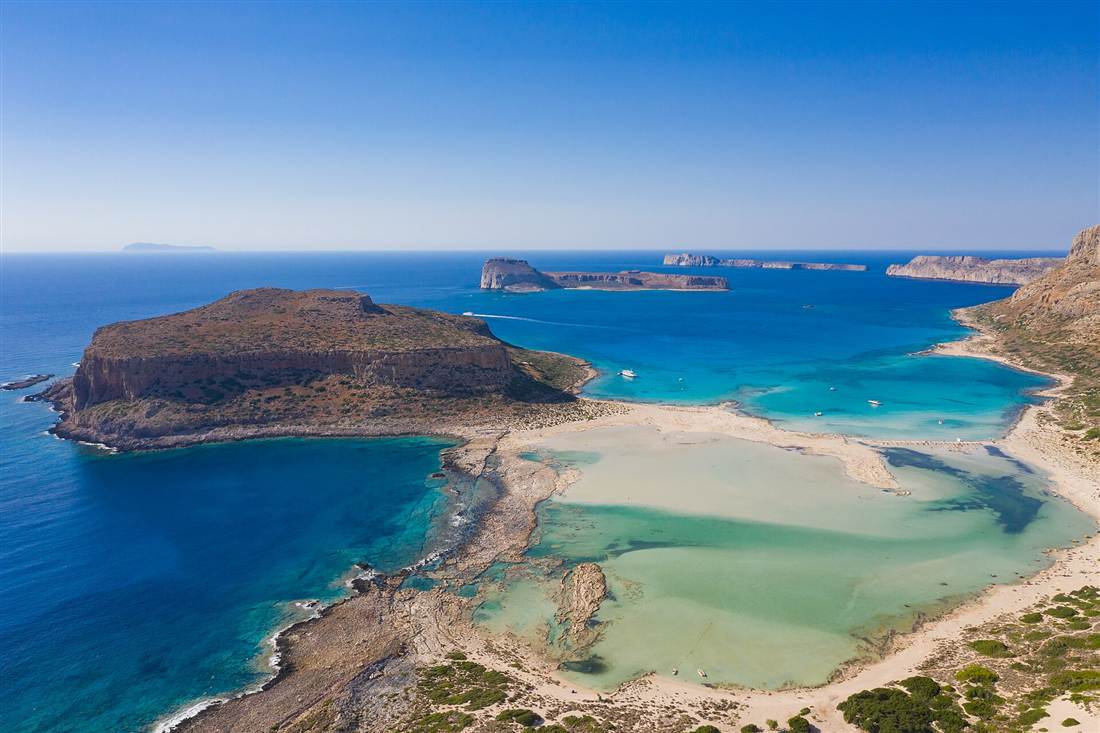
The best beaches near Chania in western Crete run from the turquoise Balos lagoon and the pink sand of Elafonisi to Falassarna, the fjord of Seitan Limania and the wild cedar shore of Kedrodasos. Plan the whole trip with Greece Tours.
This guide covers the beaches of Chania in full: the headline lagoons and sands, the beaches close to town, the Akrotiri and Sfakia coves, the family and the wild beaches, whether they are organised or remote, how to reach Balos and Elafonisi by boat and 4×4, the best time to go, and what to bring.
What are the best beaches near Chania?
The best beaches near Chania are Balos Lagoon, Elafonisi, Falassarna, Seitan Limania, Stavros, Kedrodasos and Glyka Nera. These icons range from turquoise lagoons and pink coral sand to fjord coves and freshwater springs, all inside a two-hour drive of the city.
Chania sits on the north-west coast of Crete, and its coastline delivers the widest spread of beach types in Greece. The Gramvousa peninsula holds Balos, a shallow lagoon of white sand and turquoise water reached by boat from Kissamos or by a rough dirt track. The far south-west corner holds Elafonisi, where crushed coral and shell tint the sand pink beside a wadable lagoon. The west coast runs into Falassarna, a kilometres-long strip of open sand famous for its sunsets over the Libyan-facing Cretan Sea.
The Akrotiri peninsula, minutes from Chania airport, guards two contrasting bays: Seitan Limania, a narrow emerald fjord cut deep between vertical cliffs, and Stavros, the round sheltered bay used as the backdrop for the finale of the film Zorba the Greek. Beside Elafonisi lies Kedrodasos, a wild undeveloped beach shaded by ancient junipers. On the rugged south coast near Sfakia, Glyka Nera pours cold freshwater springs straight out of the pebble shore into the sea. Each beach earns its place through a single defining feature no other stretch of Cretan coast repeats.
Distances from Chania town frame every plan. Akrotiri beaches sit 15 to 20 kilometres east. Balos and Falassarna lie roughly 55 kilometres west toward Kissamos. Elafonisi and Kedrodasos anchor the south-west corner at about 75 kilometres. Glyka Nera hides on the south coast near Loutro, reached through the Sfakia mountains. A hire car unlocks the lot; boats and buses reach the headline names for travellers without wheels.
The beaches divide cleanly by character. Balos and Elafonisi win on colour: the turquoise lagoon and the pink coral sand are the two images that define Cretan beaches worldwide. Falassarna and Stavros win on ease, with parking, tavernas and gentle water minutes from the sand. Seitan Limania, Kedrodasos and Glyka Nera win on drama and solitude, each guarded by a footpath that filters out the casual crowd. Choosing among them is a choice of effort against reward, and a week in Chania has room for one of each type.
What is Balos Lagoon near Chania and why go?
Balos Lagoon is a shallow turquoise lagoon on the Gramvousa peninsula, about 55 kilometres west of Chania. White and pink-tinged sand rings warm knee-deep water, with the Venetian fortress islet of Gramvousa on the horizon. Reach it by boat from Kissamos or a rough 4×4 track and a downhill walk.
Balos forms where the tip of the Gramvousa peninsula splits the sea into a sheltered pool of pale, near-still water and the open blue of the Cretan Sea. The lagoon floor is bright sand, so sunlight bounces back through the shallows and paints the whole bay in bands of turquoise, emerald and white. Wading out fifty metres leaves the water at waist height, which makes Balos a favourite with families and photographers. The sand carries streaks of pink from crushed shell, echoing the coral tint of Elafonisi across the island.
Two routes deliver visitors. The daily cruise boats depart Kissamos port, sail past the fortified islet of Imeri Gramvousa with its Venetian castle and shipwreck, then anchor off the lagoon for a swim stop. The overland route follows a signposted dirt road from Kalyviani onto the peninsula, ending at a car park high on the ridge; from there a stone path descends about twenty minutes to the sand. The track is unpaved, narrow and steep, so drivers hire a sturdy vehicle and start early to beat the midday crowds and heat.
There is no resort at Balos. A single seasonal canteen sells drinks and snacks, sunbeds and umbrellas line the busiest stretch, and the rest is bare peninsula. The lack of development is the point: the lagoon looks the way the north-west coast looked for centuries. Bring water, sun protection and sturdy footwear for the path, and time the visit for the first boats or the late afternoon when the cruise groups clear and the colour deepens.
The wider setting rewards a longer look. The islet of Imeri Gramvousa on the horizon carries a Venetian fortress built high on its rock, and a beached rusting freighter sits in its bay, a stop on every cruise itinerary. Wild goats roam the peninsula, sea birds nest on the cliffs, and the water changes tone hour by hour as the sun moves across the shallows. Strong winds funnel through the channel on exposed days, so the boat operators check the forecast and the overland drivers plan around the gusts that sweep the open ridge.
What is Elafonisi near Chania and why go?
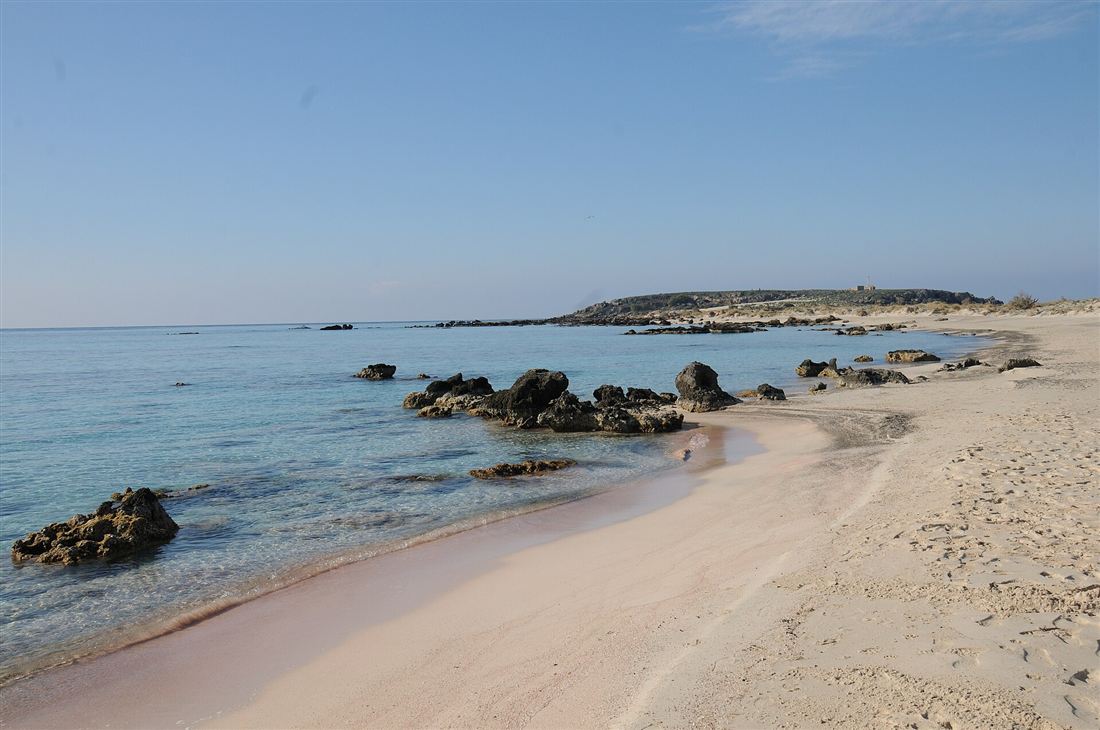
Elafonisi is a pink-sand beach and shallow lagoon in Crete’s south-west corner, about 75 kilometres from Chania. Crushed coral and shell colour the sand rose-pink, and a warm wadable channel separates the mainland from the offshore islet of Elafonisi, a European-protected nature reserve.
The pink tint at Elafonisi comes from Foraminifera, tiny red-shelled marine organisms whose crushed remains mix into the white quartz sand. The colour shows strongest where the surf concentrates the fragments, so patches of the beach glow deep rose while others stay pale. The water offshore is a shallow, transparent lagoon: a sandbar links the beach to the low islet of Elafonisi, and the channel between rarely rises above the waist, so walkers cross barefoot to the dunes, coves and tiny chapel on the far side.
Elafonisi is a protected reserve inside the European conservation network, home to nesting loggerhead turtles, rare sea daffodils and dune vegetation. Signs mark the fenced dunes and ask visitors to keep off the fragile plants and out of the roped nesting zones. The protection keeps the setting wild despite the crowds, so the beach reads as a nature sanctuary rather than a resort. Facilities stay minimal: a few canteens, sunbeds on the near stretch, and a car park behind the dunes.
The drive from Chania climbs through the mountain villages and gorges of the south-west, past the monastery of Chrysoskalitissa perched on its rock two kilometres before the beach. The road is paved but winding, and the journey takes roughly ninety minutes each way, so most visitors combine Elafonisi with the monastery and neighbouring Kedrodasos in a single day. Arrive early: by late morning the car park fills and the near beach crowds, while the islet side stays quieter for those willing to wade across.
Elafonisi faces the Libyan-influenced south-west, so the water warms early in the season and the shallow lagoon heats through the day, turning the wading channel into a bath by afternoon. Boats also run to Elafonisi from Paleochora along the south coast, an alternative to the mountain road that spares travellers the winding drive. The islet itself carries a small chapel and a memorial to shipwrecked sailors, and its far coves face the open sea with stronger surf, a contrast to the millpond calm of the lagoon on the landward side.
What is Falassarna near Chania and why go?
Falassarna is a long open sand beach on the west coast of Crete, about 55 kilometres from Chania. Its wide golden strand faces due west across the Cretan Sea, which makes it the island’s headline sunset beach. Ancient Falassarna, a Greek harbour city, sits at the northern end.
Falassarna stretches for kilometres along a broad west-facing bay backed by dunes and low hills. The sand is fine and pale, the seabed slopes gently, and the open aspect brings rolling surf on breezy days, so the beach draws swimmers, families and bodyboarders alike. The exposure that stirs the waves also delivers the sunset: with nothing between the shore and the horizon, the sun drops straight into the sea and floods the whole bay in gold and rose, drawing crowds to the sand every clear evening.
The main beach divides into named sections, Pachia Ammos among them, linked by the coast road and served by tavernas, beach bars, sunbeds and car parks. Behind the sand, greenhouses and tomato fields climb the slopes, and the northern headland holds the archaeological site of ancient Falassarna, a Hellenistic port city whose stone harbour now sits stranded inland after the coastline rose. The ruins, including a carved stone throne, add a layer of history to a day at the beach.
The drive from Chania runs west toward Kissamos, then climbs over a ridge with a panoramic viewpoint before dropping to the coast, about a seventy-minute trip. Falassarna pairs naturally with Balos, since both sit on the same western tip of the island, and a two-day base in Kissamos puts the pair within easy reach. Bring shade: the dunes give little cover, and the west-coast sun stays fierce until it sets.
The scale of Falassarna sets it apart from the coves and lagoons elsewhere around Chania. Where Seitan Limania and Glyka Nera pack their drama into a sliver of shore, Falassarna spreads across a full bay with room to walk far from the beach bars into empty sand. The open water suits swimmers who want a proper swim rather than a wade, and on windy afternoons the surf and the flat firm sand draw kitesurfers and bodyboarders to the northern sections while families keep to the sheltered pockets behind the rocks.
What is Seitan Limania near Chania and why go?
Seitan Limania is a dramatic narrow fjord cove on the Akrotiri peninsula, about 20 kilometres east of Chania. Emerald water threads deep between sheer grey cliffs to a short strip of pale pebbles. A steep footpath down the rock face is the only way in, and the reward is astonishing colour.
Seitan Limania, whose name means “devil’s harbours”, is a knife-thin inlet where the sea cuts far inland between towering vertical walls of rock. The confined channel concentrates the water into a vivid emerald-turquoise that glows against the bare grey stone and white pebbles. The cove is tiny, barely wide enough for the crowd it draws, and the drama comes entirely from the scale of the cliffs pressing in on either side and the intensity of the trapped colour.
Access is the challenge and the filter. Cars park on the clifftop above, and a rough, steep path drops down the rock to the pebbles, a scramble that demands proper footwear and a steady head; loose stones and exposed sections make flip-flops a mistake. The descent takes ten to fifteen minutes, the climb back longer in the heat. There are no facilities at the bottom, so visitors carry their own water, food and shade for the day.
Seitan Limania sits on the north-east side of the Akrotiri peninsula, past the airport and the villages of Chordaki, on a network of narrow roads that end at the clifftop car park. The proximity to Chania and the airport makes it an easy half-day, and its position pairs with Stavros a short drive west along the same peninsula. Go early: the small cove fills fast, the afternoon sun leaves the water in shadow, and the car park overflows by midday.
The clifftop above the cove doubles as a viewpoint, and the sight of the emerald ribbon of water threading between the rock walls is the shot that carries Seitan Limania across social media. Goats pick their way across the near-vertical slopes, and the deep channel draws snorkellers and cliff-jumpers to its clear, cold water once they reach the pebbles. The exposure that makes the descent thrilling also makes it hazardous in strong swell, when waves push into the narrow mouth and the pebble strip shrinks, so calm conditions matter as much as an early start.
What is Stavros near Chania and why go?
Stavros is a round, sheltered bay on the northern tip of the Akrotiri peninsula, about 17 kilometres from Chania. A near-perfect circle of calm shallow water sits beneath a bare pyramid-shaped mountain, the setting of the final beach scene in the film Zorba the Greek.
Stavros is defined by its geometry: a smooth arc of sand and shingle wraps a lagoon-like bay so enclosed that the water stays flat, warm and shallow whatever the weather offshore. The still, protected pool makes it one of the safest swimming spots near Chania for young children. Rising straight behind the sand is the distinctive bare rock mountain that frames every photograph and anchors the bay in film history.
This is the beach where Anthony Quinn danced the sirtaki in the closing scene of Zorba the Greek, and the unmistakable pyramid mountain in the background makes the location instantly recognisable to anyone who knows the film. The cinematic backdrop draws visitors who come as much for the setting as the swim. Unlike the wild coves of Akrotiri, Stavros carries tavernas, sunbeds and a car park right behind the sand, so a shaded lunch and a cold drink are steps from the water.
Stavros lies at the very end of the Akrotiri peninsula, a straightforward paved drive from Chania past the airport and the villages, roughly twenty-five minutes by car. The calm bay, easy parking and on-site tavernas make it a low-effort family day, in deliberate contrast to the cliff scramble at nearby Seitan Limania. A second, more open beach next to the main bay catches the breeze for those who want livelier water.
The sheltered geometry that makes Stavros safe also makes it warm and shallow far from shore, so children paddle out a long way with the sand still underfoot. Snorkellers work the rocky edges of the bay beneath the mountain, where the still water stays clear, and walkers climb the lower slopes of the pyramid rock for a view down onto the perfect circle of the beach. Caves in the base of the mountain and the film-set history give the bay a draw beyond the swim, turning a family beach day into a small pilgrimage for admirers of Zorba the Greek.
What is Kedrodasos near Chania and why go?
Kedrodasos is a wild, undeveloped beach beside Elafonisi in Crete’s south-west corner, about 73 kilometres from Chania. A forest of ancient junipers grows right down to pale sand and clear turquoise coves. There are no sunbeds, no bar and no road to the sand, only a footpath.
Kedrodasos, whose name means “cedar forest”, takes its character from the grove of centuries-old juniper trees that spreads across low dunes to the water’s edge. Their twisted roots and low canopy provide the only natural shade, and campers and day-trippers spread out beneath them. The shoreline breaks into small sandy coves and shallow turquoise pools between flat rock shelves, so the beach feels like a scatter of private bays rather than one continuous strand.
The defining trait of Kedrodasos is its wildness. There is no development at all: no loungers, no canteen, no lifeguard, no facilities of any kind, and no vehicle access to the sand. Reaching it means parking near Elafonisi and walking a rough ten-to-fifteen-minute path over the rocks and dunes, which keeps the crowds thin and the atmosphere quiet. Visitors carry everything in and everything out, and the juniper grove stays protected, so the shade and dunes remain intact for the next arrivals.
Kedrodasos lies immediately east of Elafonisi, sharing the same protected south-west coastline and the same rose-tinted, coral-flecked sand. The pairing is natural: a single drive delivers the busy pink lagoon of Elafonisi and, a short walk on, the empty cedar coves of Kedrodasos for those who want solitude and clear water. Bring water, food, shade and sturdy shoes, because the path and the total lack of services leave no room for improvisation.
What is Glyka Nera / Sweet Water near Chania and why go?
Glyka Nera, or Sweet Water, is a remote pebble beach on Crete’s south coast near Sfakia, reached from Chania through the mountains. Freshwater springs bubble up cold through the shingle at the shoreline, chilling the sea. A cliff footpath or a boat from Loutro or Chora Sfakion is the only way in.
Glyka Nera earns its name, “sweet water”, from the underground springs that seep up through the pebbles right at the waterline. Dig a shallow hole in the shingle near the sea and it fills with cold, drinkable fresh water, and the springs cool the shallows so that swimmers feel bands of chill against the warm Libyan Sea. The beach itself is a long strip of grey pebbles under steep cliffs, backed by deep, clear, fast-shelving water prized for its clarity.
Remoteness defines Glyka Nera. It sits on the wild south coast between Loutro and Chora Sfakion, with no road to the sand. Walkers reach it on a narrow, exposed cliff path carved into the mountainside, a demanding thirty-to-forty-minute route with sheer drops that rewards the effort with isolation. The gentler option is the small boat that runs along the coast from Chora Sfakion and Loutro, dropping visitors at the pebbles. A single seasonal taverna clings to the cliff above the beach, reachable by its own steep steps.
The journey from Chania crosses the White Mountains to the south coast, a scenic mountain drive of about ninety minutes to Chora Sfakion or the Anopoli approach, followed by the boat or the cliff walk. The commitment keeps Glyka Nera quiet and unspoilt, a fitting contrast to the accessible north-coast bays. It pairs with the wider Sfakia region, Loutro’s car-free harbour and the mouth of the Samaria and Aradena gorges, for travellers building a rugged south-coast day around cold springs and clear deep water.
The Libyan Sea off Glyka Nera runs deep and blue right up to the shore, so the water drops away fast from the pebbles into cool, glass-clear depths that reward strong swimmers and snorkellers. The freshwater springs create a shifting mosaic of temperatures and a faint blur where the fresh and salt water mix, a curiosity swimmers chase along the shoreline. The beach carries a long history as a free-camping haunt, and the driftwood shelters built along the shingle add to its off-grid, end-of-the-road character on the very edge of the White Mountains.
What beaches are close to Chania town?
Nea Chora sits a five-minute walk west of the Venetian harbour, and Agioi Apostoloi, Kalamaki and Golden Beach line the coast road within four kilometres, delivering organised sand, tavernas and shallow water at the edge of the old town.
Nea Chora is the town beach of Chania. The strip of grey-gold sand runs directly below the seafront tavernas, and the fish restaurants there serve the day’s catch a few metres from the water. Sunbeds fill the front row, showers stand at the back, and the shallow entry suits a quick swim between sightseeing stops. The Old Venetian Harbour and the Maritime Museum stand ten minutes away on foot.
West of Nea Chora the coast road threads past a run of connected bays. Agioi Apostoloi holds three small coves protected by low rocky headlands, which flatten the water into a warm, sheltered pool. Kalamaki and Golden Beach (Chrissi Akti) extend the sand toward Kato Galatas, backed by a promenade, car parks and bus stops on the number 21 line from the town market. These city-edge sands trade the wild scenery of the west for tap-water showers, lifeguards in peak weeks and a taverna every fifty metres.
The whole 4-kilometre run links to the town by the coastal cycle-and-walk path, so a beach morning folds into an afternoon in the harbour without a car. For the wilder capes and lagoons, base yourself in Chania and drive out from this urban core.
What are the Akrotiri and Kalathas beaches?
The Akrotiri peninsula east of Chania holds Kalathas, Marathi and Loutraki bay, three sheltered north-facing coves 12 to 18 kilometres from the town centre, each with fine pale sand, calm shallow water and organised sunbed-and-taverna service.
Kalathas is the headline beach of Akrotiri. A crescent of soft sand wraps around a bay with a rocky islet a short swim offshore, and the water stays waist-deep well out from the shore. The village above the beach supplies tavernas, a bakery and parking, and the drive from Chania town runs 12 kilometres past the Venizelos Graves viewpoint. Families settle here for the gentle gradient and the snorkelling around the islet.
Marathi lies further along the cape, split into two adjacent sandy coves divided by a jetty. The water is glassy and clear, the depth builds slowly, and beach tavernas serve grilled fish across the road from the sand. Loutraki bay, tucked below Stavros on the same peninsula, adds a third sheltered anchorage prized for flat morning water. Stavros itself, 18 kilometres from town, holds the round lagoon-like bay under the mountain used as a film location, ringed by shallow warm water and a line of sunbeds.
Akrotiri suits travellers flying in or out, because Chania airport sits on the same peninsula. A swim at Kalathas or Marathi bookends a flight without a long transfer, and the paved roads reach every cove in an ordinary hire car.
What is Frangokastello beach?
Frangokastello beach is a broad strip of pale sand on the Libyan Sea coast of south Chania, spread beneath a rectangular Venetian fortress. The shallow, bath-warm water and the castle backdrop mark it out 80 kilometres south of Chania town.
The Venetian castle gives the beach its name and its silhouette. The fort stands square and intact just behind the sand, its corner towers rising straight from the coastal scrub, and the main beach unrolls in front of it with fine grains and a sea floor that stays ankle-to-knee deep for a long way out. That shallow shelf warms the water early in the season and holds children safely close to shore.
Frangokastello faces the Libyan Sea, so it escapes the meltemi wind that rakes the north coast in high summer. The south-facing position keeps the water calm on the days when Balos and Falassarna churn with whitecaps. A cluster of tavernas, rooms and a handful of sunbeds serve the main beach, while quieter sand stretches east toward Orthi Ammos, where wind-sculpted dunes rise behind the shore. The drive from Chania crosses the White Mountains through Vryses and Sfakia, a 90-minute route that rewards the effort with warm, protected swimming.
What are the beaches near Sfakia and Loutro?
Marmara and Glyka Nera sit on the roadless coast west of Chora Sfakion, reached by boat or on foot. Loutro, a car-free fishing village, anchors this stretch, where clear deep water meets pebble and rock coves under the gorge walls.
Glyka Nera (Sweet Water) beach takes its name from the fresh springs that bubble up through the pebbles at the waterline, mixing cold spring water into the sea. The beach lies on the trail between Chora Sfakion and Loutro, a 40-minute clifftop walk from the port, or a ten-minute hop on the local passenger boat. Steep grey pebbles drop into deep, gin-clear water, and the coast has no road, so the crowds stay thin.
Marmara beach marks the mouth of the Aradena Gorge, west of Loutro. Water-smoothed marble slabs and a sea cave frame a small pebble cove where hikers finishing the gorge cool off before the boat back. Loutro village itself, wedged between the sea and the mountain with no road access, serves as the base for the whole coast: passenger ferries link it to Chora Sfakion, Agia Roumeli and the coves, and its own small pebble beach and swimming platforms edge the harbour. Boat timetables run daily through the warm months from Chora Sfakion, the road-end port south of the Imbros Gorge.
Which Chania beaches are best for families?
Kalathas, Marathi, Agioi Apostoloi and Frangokastello rank highest for families, because each pairs shallow, slow-shelving water with organised sunbeds, showers, shade and tavernas within steps of the sand, plus parking and easy paved access.
Shallow water drives the choice. At Agioi Apostoloi the three rocky-rimmed coves hold the sea flat and warm, so toddlers paddle in a sheltered pool a few metres from the towels. Kalathas and Marathi on Akrotiri build depth so slowly that a child walks out chest-deep only after twenty metres, and both have a bakery or taverna at the back of the sand for lunch and shade. Frangokastello’s long shallow shelf on the calm south coast adds a castle to explore between swims.
Facilities seal the pick. Nea Chora, minutes from the town centre, puts sunbeds, fresh-water showers, toilets and a promenade of restaurants beside the sand, with pushchair-friendly paving all the way from the harbour. These organised beaches supply umbrellas for shade through midday, lifeguards on the busiest weeks, and firm parking, which removes the long walk-in that the wild west-coast beaches demand. For a lagoon that thrills children with warm knee-deep water over pink-tinged sand, the day trip to Elafonisi beach rewards the early start.
Which Chania beaches are quiet and remote?
The unorganised west and south-coast beaches stay quiet: Glyka Nera and Marmara near Loutro, the dune-backed Orthi Ammos at Frangokastello, and the long empty flanks of Falassarna beyond the main bay all trade facilities for solitude and raw scenery.
Roadless access keeps a beach empty. Glyka Nera and Marmara reach only by boat or by a clifftop footpath, which filters out the day-tripper coaches and leaves clear deep water and grey pebbles to walkers and boat passengers. On the south coast east of Frangokastello, Orthi Ammos rises into wind-carved sand dunes with no sunbed line and no taverna at the water, a wild flank where the wind shapes the shore.
The far west holds the widest empty sand. Falassarna beach spreads across five kilometres of coast, and the central organised section draws the crowd while the northern and southern ends stay open and unmanned, backed by dunes and the ruins of the ancient city. These remote beaches ask for self-sufficiency: pack water, food, shade and sturdy footwear, because no shop, shower or rescue post stands at the sand. The reward is a stretch of Cretan coast with nothing on it but the sea, the wind and the mountains behind.
How do you get to Balos and Elafonisi from Chania?
Balos reaches by the Kissamos cruise boat or a 4×4-and-hike track on the Gramvousa peninsula, 56 kilometres west of Chania. Elafonisi reaches by direct daily bus, by hire car on a paved 76-kilometre road, or by organised day tour.
Balos lagoon has two routes. The daily cruise boat sails from Kissamos port, 42 kilometres west of Chania, loops around Imeri Gramvousa island with its pirate fortress and shipwreck, and anchors off the lagoon for a long swim stop; the boat removes the rough track entirely. The self-drive route runs to the end of the Gramvousa dirt road, a rutted 8-kilometre track best driven in a high-clearance 4×4, followed by a 20-minute downhill walk to the sand. A car park at the trailhead charges a small entry fee.
Elafonisi is simpler. KTEL runs a direct daily bus from Chania central bus station through the warm season, a two-hour ride to the beach car park. Drivers take the paved road through Elos and the Topolia Gorge, 76 kilometres that end at a large pay car park beside the pink-tinged lagoon. Organised day tours bundle transfers, and pairing the two icons demands two separate days, because Balos and Elafonisi sit on opposite sides of the western tip. Start either trip at dawn to beat the midday coaches.
Are Chania beaches organised or wild?
Chania holds both. The town and Akrotiri beaches run fully organised with sunbeds, showers, lifeguards and tavernas, while the western capes and south-coast coves stay wild and unmanned. Balos, Falassarna and Elafonisi mix a serviced core with open, empty flanks.
The organised beaches cluster near the town and the airport. Nea Chora, Agioi Apostoloi, Kalathas and Marathi supply the full kit: paid sunbed-and-umbrella rows, fresh-water showers, toilets, beach bars, parking and, in the peak weeks, lifeguard posts. These are the beaches for a hassle-free day where lunch, shade and a cold drink stand a few steps from the towel, and the paved car park sits behind the sand.
The wild beaches lie west and south. Glyka Nera, Marmara, Orthi Ammos and the outer reaches of Falassarna have no service at the water, so a visit demands packed water, food and shade. The famous lagoons split the difference: Balos and Elafonisi each run a small organised section with a canteen and a sunbed cluster at the main access point, then open into vast protected sand where nothing but the dunes breaks the view. The island rewards travellers who match the beach to the day, a serviced town cove for an easy morning and a roadless coast for an adventure.
When is the best time for Chania beaches?
The swimming season runs May to October. June and September deliver warm sea, long days and thinner crowds. July and August bring peak heat and the meltemi, a north wind that whips up the north-coast beaches while the south coast stays calm.
The shoulder months earn the top marks. By late May the sea has warmed enough for a full swim, the light stretches into long evenings, and the beaches hold room to spread out. September repeats the pattern in reverse, with the sea at its warmest after a summer of heating and the peak crowds already gone home. Both months keep the tavernas open and the boats running while the roads stay quiet.
The meltemi shapes the summer choice. Through July and August this dry north wind funnels down the Aegean and hits the north coast, turning Balos, Falassarna and the Gramvousa lagoon into a churn of whitecaps and blown sand on its strongest days. The answer is the south: Frangokastello, Glyka Nera and the Sfakia coves face the Libyan Sea and stay flat and clear when the north is blown out. Check the wind forecast the night before and swap coasts to match it. Water temperature climbs from the high teens in May to the mid-twenties Celsius by August and September.
What to bring to a Chania beach?
Pack water shoes for the pebble beaches, a shade umbrella or tent for the unorganised sand, at least two litres of water per person, high-factor sun cream, and cash, because the wild coves have no shop, shower or card machine.
Footwear tops the list. Glyka Nera, Marmara, Loutro and the Sfakia coast are pebble and rock, not sand, and hot smooth stones underfoot make water shoes essential for wading and for the walk across the shingle. The same shoes protect against sea urchins on the rocky entries around Akrotiri and the west. On the boat-and-hike beaches, sturdy sandals handle the trail down to the water.
Self-sufficiency covers the rest. The remote west and south beaches sell nothing at the sand, so carry drinking water, food, and a shade umbrella or a pop-up tent, because the natural shade is thin to none. High-factor sun cream, a hat and sunglasses fend off the strong Cretan sun that reflects off the pale sand and water. Bring cash in small notes for the car-park fees at Balos and Elafonisi and for the coastal boats at Sfakia, where card payment reaches no further than the port. A dry-bag guards phones and keys on the boat crossings, and a rubbish bag carries out everything you bring in, because these wild beaches run on leave-no-trace.
Which Chania beach has the best sunset?
Falassarna on the far west coast delivers the finest Chania sunset. Its wide sand faces due west across open sea, so the sun drops straight into the horizon with no headland in the way, painting the bay gold then deep crimson.
Falassarna sits at the north-western tip of the Gramvousa peninsula, an hour and a quarter from Chania town by road. The beach runs north to south along a shallow, sand-floored bay that opens onto the Ionian Sea, and that westward orientation is the reason photographers drive out for the final hour of daylight. In the last thirty minutes before the sun touches the water, the flat sand mirrors the sky and the whole bay turns amber.
Kissamos bay, twenty minutes north-east of Falassarna, gives a second front-row seat. The shoreline curves around the Gulf of Kissamos and looks west toward the twin peninsulas of Gramvousa and Rodopos, so the sun sets behind the ridgelines and throws long silhouettes across the water. Tavernas line the Kissamos waterfront, which turns the evening into a slow dinner with the colour show framed by the headlands.
Timing follows the season. In high summer the sun meets the horizon close to half past eight in the evening, and the afterglow holds the sky pink for a further twenty minutes. The west coast catches the last light later than Chania town because nothing blocks the sightline out to sea, so the golden hour stretches longer here than on the north-facing beaches near the city.
What water sports and activities are on Chania beaches?
Chania beaches carry windsurfing and kitesurfing on the breezy north coast, scuba diving off the town reefs, boat trips to Gramvousa and the coves, and snorkelling in the clear shallows. The steady afternoon meltemi wind drives the sailing scene.
The north coast between Chania town and Kissamos catches the meltemi, the dry summer wind that funnels down the Aegean and builds through the afternoon. Windsurf and kitesurf stations set up on the flat, sandy bays where the wind blows side-shore, renting boards and running lessons for first-timers on the beginner shallows. The consistent breeze is the draw: riders reach the water by early afternoon when the meltemi fills in and hold the wind until dusk.
Diving centres in Chania and Kalives run guided dives out to the reefs, wall drops and small wrecks off the coast, with try-dives in sheltered water for newcomers and certification courses for divers who want a licence. The visibility in the clear Cretan water reaches far below the surface, which opens the deeper reefs to sightings of grouper, octopus and moray.
Boat trips leave Kissamos harbour daily for the pink sands of Balos lagoon and the fort island of Gramvousa, and smaller RIBs run charters along the coast to reach coves that the road never touches. Snorkellers stay closer in, drifting over the rocky edges of the bays where the shallows stay glass-clear and the seagrass beds shelter fish a metre from the sand.
Frequently Asked Questions
What is the best beach near Chania?
Balos lagoon and Elafonisi rank as the best beaches near Chania, both turquoise shallows with pale-to-pink sand. Falassarna suits sunset lovers, Seitan Limania the adventurous, and Nea Chora and Agioi Apostoloi the visitors who want sand a walk from the old town.
How do you get to Balos and Elafonisi from Chania?
Reach Balos by the daily boat from Kissamos or the rough 4×4 track over the Gramvousa peninsula, and Elafonisi by the 75-kilometre mountain drive, the seasonal bus or a day tour. Both take a full day from Chania.
Are the beaches near Chania organised or wild?
Chania has both: organised sands with sunbeds and tavernas at Nea Chora, Agioi Apostoloi and Stavros, and wild unmanaged beaches at Kedrodasos, Glyka Nera and much of the west and south coast where you bring your own shade and water.