
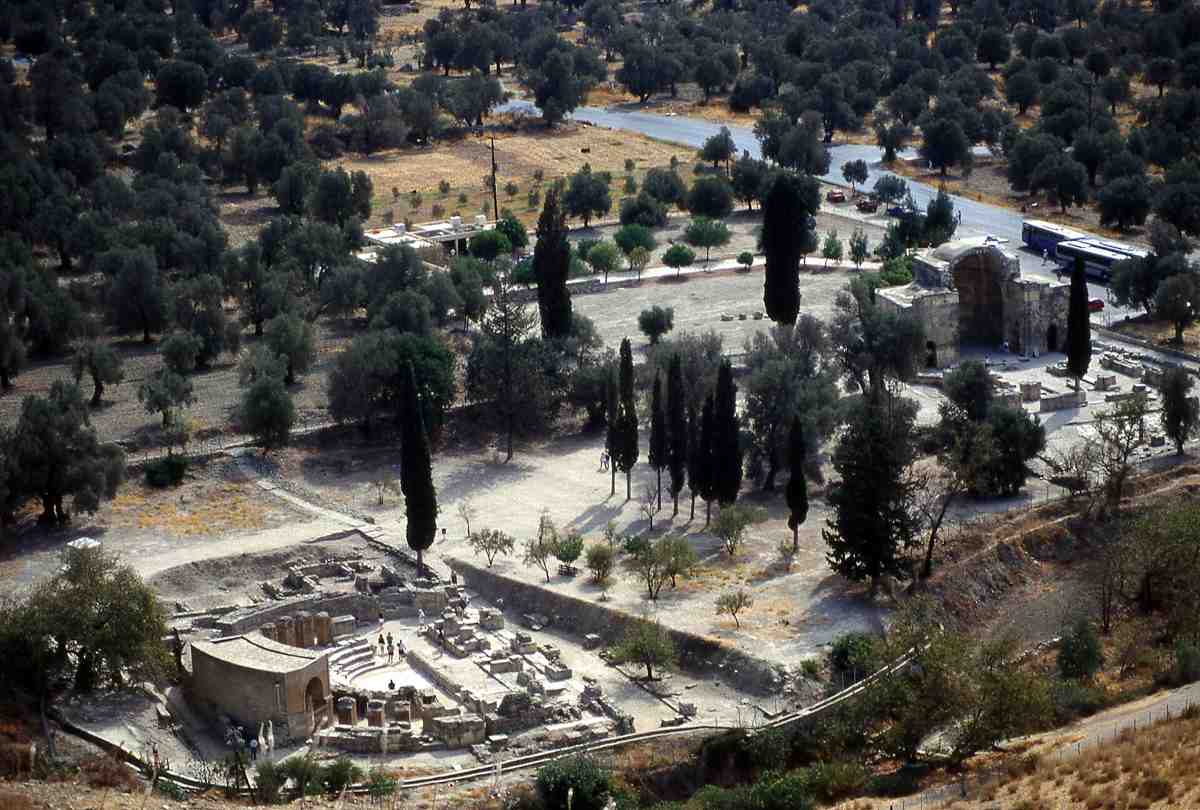
Gortyn stands as one of the most significant archaeological sites in central Crete, spreading its ancient ruins across the fertile Messara plain between Heraklion and the southern coast. This vast city-site served as the Roman capital of Crete and Cyrenaica, preserving layers of history from archaic Greek inscriptions to Byzantine churches. Visitors encounter Europe’s oldest surviving law code carved in stone, a Roman odeon, the ruined Basilica of Saint Titus, and the legendary plane tree where Zeus brought Europa. The sprawling remains extend through olive groves and fields, offering a rare glimpse into Cretan civilization long after the Bronze Age palaces fell silent. Explore this remarkable heritage with My Greece Tours.
The Messara plain holds treasures beyond the famous Minoan palaces, and Gortyn reveals Crete’s importance during Roman and early Christian times. The site rewards exploration with its combination of monumental inscriptions, religious architecture, and mythological associations scattered across an accessible landscape. The sections below cover the law code that shaped European legal tradition, the monuments that defined a provincial capital, the myths woven into the landscape, and practical guidance for visiting this expansive archaeological zone. For broader context on the island’s heritage, consult our comprehensive Crete travel guide.
What Makes the Gortyn Law Code Significant in Crete and Europe?
The Gortyn Law Code represents Europe’s oldest surviving complete law code, inscribed in an early Doric dialect on a curved stone wall. Dating to the fifth century BCE, it addresses property, family relations, and civil procedures, offering invaluable insight into archaic Greek society.
The Law Code wall at Gortyn consists of twelve columns of text carved in boustrophedon style, alternating direction like an ox plowing a field. This inscription technique requires readers to follow lines from left to right, then right to left in succession. The text covers marriage, divorce, inheritance, adoption, property rights, and the treatment of slaves with remarkable specificity. Legal historians value the code for its detailed provisions on women’s property rights, which were surprisingly progressive for the era. The stone wall curves behind the Roman odeon, protected by a modern shelter that allows visitors to examine the ancient letters up close.
The dialect and alphabet differ noticeably from classical Attic Greek, reflecting Crete’s distinct linguistic development during the archaic period.
Gortyn’s legal tradition extended well beyond this famous inscription, and archaeologists have discovered additional legal texts across the site. The city maintained its reputation as a center of jurisprudence throughout antiquity, influencing legal practices across the eastern Mediterranean. Visitors exploring things to do in Crete often prioritize this monument for its historical importance. The code’s preservation owes much to its incorporation into later Roman structures, which protected the stones from reuse as building material. Modern scholars continue to study the text for insights into pre-classical Greek society, property law, and the status of women in ancient communities. The inscription stands as tangible evidence of sophisticated legal thinking centuries before the Roman Empire.
What Roman and Byzantine Monuments Define Gortyn in Crete?
Gortyn preserves a Roman odeon adjacent to the Law Code, the extensive ruins of the Basilica of Saint Titus, a theatre, temples, and bath complexes scattered across the plain. These structures reflect the city’s status as provincial capital of Crete and Cyrenaica.
The Roman odeon served as a covered theatre for musical performances and civic gatherings, with semicircular seating facing a small stage. The structure incorporated the earlier Law Code wall into its rear facade, inadvertently preserving the inscription for posterity. Nearby, the Basilica of Saint Titus commemorates the island’s first Christian bishop, appointed by Saint Paul to lead the Cretan church. The basilica’s three aisles, apse, and baptistery represent one of the earliest Christian monuments on the island, dating to the sixth century of the common era. The ruins reveal column bases, floor mosaics, and architectural fragments that hint at the building’s original grandeur.
The combination of pagan and Christian monuments illustrates Gortyn’s transition from classical polytheism to Byzantine Christianity.
Beyond the fenced archaeological park, additional ruins extend across private olive groves and agricultural fields throughout the Messara plain. The theatre lies northwest of the main site, its cavea carved into a hillside with stone seating still visible. Temple foundations, bath complexes with hypocaust heating systems, and sections of Roman road network emerge from the landscape. The praetorium, or governor’s palace, occupied a prominent position befitting the administrative center of the province. Visitors interested in hidden gems in Crete appreciate the scattered nature of these remains, which require exploration beyond the ticketed area. The sheer scale of the ancient city becomes apparent only when walking the surrounding countryside, where fragments of the Roman capital surface amid modern agriculture.
What Mythological Significance Does Gortyn Hold?
Gortyn marks the legendary site where Zeus, transformed into a bull, brought the Phoenician princess Europa to Crete. A giant plane tree beside a spring identifies the spot where their union produced Minos, Rhadamanthys, and Sarpedon, founders of Cretan civilization.
The Europa myth connects Gortyn to the very foundation of Cretan identity and the Minoan civilization that preceded the classical city. According to tradition, Zeus spotted Europa gathering flowers on the Phoenician coast and, smitten, transformed himself into a magnificent white bull. The princess climbed onto his back, and the god swam across the Mediterranean to Crete, landing near Gortyn. The plane tree that witnessed their union became sacred, its evergreen leaves a divine gift ensuring the tree never shed its foliage. Their three sons went on to become kings and lawgivers, with Minos establishing the thalassocracy that dominated the Bronze Age Aegean. The myth provided Gortyn with prestigious mythological credentials that enhanced its status among Cretan cities.
The ancient plane tree still stands beside a spring in the archaeological zone, though modern botanists note that plane trees naturally shed their leaves seasonally. The site became a place of veneration in antiquity, with votive offerings and ritual activities continuing into the Roman period. The myth also explains the name Europa for the continent, as the princess gave her name to the lands west of Asia. Travelers combining Gortyn with coastal destinations like Matala encounter the mythological landscape where divine and human history intertwine. The story resonates throughout Cretan culture, appearing in art, literature, and local traditions that celebrate the island’s role in Greek mythology. The tree and spring remain evocative symbols of Crete’s deep mythological roots.
How Did Gortyn Rise to Become the Capital of Roman Crete?
Gortyn allied with Rome during the conquest of Crete in the first century BCE, earning favorable treatment as the provincial capital. Its strategic location on the Messara plain, agricultural wealth, and established infrastructure made it ideal for Roman administration.
The Roman conquest of Crete occurred in the late first century BCE when the general Quintus Caecilius Metellus subdued the island after a three-year campaign. Gortyn’s decision to support Rome rather than resist proved strategically wise, positioning the city to receive the rewards of collaboration. The Romans appreciated Gortyn’s central location on the fertile Messara plain, which provided agricultural surplus to support a provincial capital. The city already possessed substantial infrastructure, legal traditions, and urban amenities that required less investment than developing a new administrative center. Rome combined Crete with Cyrenaica in North Africa as a single province, and Gortyn governed this far-flung territory for centuries.
The city minted coins, hosted the provincial governor, and served as the judicial and administrative hub for the entire province. The nearby market town of Moires now serves as the commercial hub of the Messara plain.
The Roman period brought monumental building projects that transformed Gortyn into a showcase of imperial architecture and urban planning. The odeon, praetorium, baths, and expanded theatre demonstrated Roman engineering and aesthetic preferences while incorporating local traditions. The city’s prosperity rested on olive oil production, wine exports, and the agricultural productivity of the surrounding plain. Gortyn maintained its prominence through the early Byzantine period until Arab raids in the ninth century prompted the island’s administrative center to shift northward. Visitors traveling from Heraklion can trace this historical arc from Roman capital to abandoned ruin.
The extensive remains testify to Gortyn’s centuries as the political heart of Crete, a status unmatched by any other city on the island during the Roman era.
What Practical Information Helps Visitors Explore Gortyn?
Gortyn lies on the main road between Heraklion and the Messara coast, easily accessible by car or bus. The fenced archaeological site contains the Law Code, odeon, and basilica, while additional ruins spread across surrounding olive groves and fields.
The main archaeological park charges a modest entrance fee and provides access to the most significant monuments, including the sheltered Law Code inscription, the Roman odeon, and the Basilica of Saint Titus. Informational panels in Greek and English explain the historical context and architectural features, though a guidebook or knowledgeable guide enhances understanding considerably. The site remains open year-round with seasonal hour variations, and summer visits benefit from early morning or late afternoon timing to avoid midday heat on the exposed plain. The ticket office sells basic refreshments, but no restaurant operates on-site. Visitors should wear sturdy walking shoes, bring sun protection, and carry water for exploring the extensive grounds.
The plane tree associated with the Europa myth stands within the fenced area, clearly marked for visitors seeking the mythological landmark.
Beyond the ticketed zone, adventurous explorers can walk through olive groves to discover the theatre, additional temple foundations, and scattered architectural fragments across the Messara plain. Landowners generally permit respectful access, though visitors should stay on paths and avoid damaging crops or disturbing agricultural operations. Combining Gortyn with nearby coastal villages like Lentas or natural sites such as Agiofarango Gorge creates a full-day itinerary exploring southern Crete. Photography is permitted throughout the site without restrictions, and the golden light of late afternoon illuminates the ancient stones beautifully. The site receives far fewer visitors than the Minoan palaces, offering a quieter, more contemplative archaeological experience.
Allocate at least two hours for a thorough visit, longer if exploring the wider landscape beyond the main enclosure.
Frequently Asked Questions
How does Gortyn compare to the Minoan palaces like Knossos or Phaistos?
Gortyn represents a completely different historical period and cultural context compared to the Bronze Age Minoan palaces. The Minoan sites date to the second millennium BCE and showcase the distinctive palatial architecture, frescoes, and administrative systems of that civilization. Gortyn’s visible remains come primarily from the Roman and early Byzantine periods, roughly a thousand years after the Minoan collapse. The Law Code inscription dates to the archaic Greek period, still centuries after the palaces fell. Visitors seeking Minoan culture should prioritize Knossos, Phaistos, or Malia, while those interested in classical Greek law, Roman provincial administration, or early Christianity will find Gortyn more rewarding.
The site fills a crucial gap in understanding Crete’s long history beyond the Bronze Age, demonstrating the island’s continued importance through antiquity. The combination of legal inscriptions, mythological associations, and monumental architecture offers insights unavailable at the Minoan sites, making Gortyn essential for comprehending Crete’s full historical trajectory from prehistory through the Byzantine era.
Can visitors access all of Gortyn’s ruins or are portions restricted?
The main archaeological park with ticketed entry contains the most famous monuments, including the Law Code, odeon, Basilica of Saint Titus, and the sacred plane tree. This fenced area represents only a fraction of the ancient city, which sprawled across the Messara plain for considerable distances. Additional ruins lie scattered through olive groves, agricultural fields, and private property surrounding the official site. The theatre, certain temple foundations, bath complexes, and sections of the ancient street grid exist outside the fenced zone. Visitors can explore these outlying areas on foot, though access depends on landowner tolerance and agricultural activities. No formal trails or signage guide exploration beyond the ticketed site, and ruins appear intermittently amid modern farming.
Respectful behavior, staying on established paths, and avoiding crop damage generally ensure peaceful coexistence with property owners. The dispersed nature of the ruins means a complete understanding of Gortyn’s scale requires both visiting the official park and walking the surrounding landscape. Enthusiasts willing to explore beyond the main enclosure discover a vast archaeological landscape where ancient and modern land use overlap across the fertile plain.
What is the best time of year to visit Gortyn?
Spring months from March through May offer ideal conditions for visiting Gortyn, with mild temperatures, blooming wildflowers across the Messara plain, and comfortable weather for extended outdoor exploration. The site lacks shade in most areas, making the intense summer heat of July and August challenging for thorough visits. Autumn months from September through November provide another excellent window, with harvest activities adding agricultural context to the landscape and temperatures moderating after the summer peak. Winter visits remain possible and the site stays open, though occasional rain can make walking the unpaved areas muddy and less pleasant. Early morning or late afternoon visits during summer months allow dedicated travelers to experience the site while avoiding midday heat.
The archaeological park receives fewer visitors than major Minoan sites regardless of season, offering a relatively uncrowded experience even during peak tourist months. Photographers particularly appreciate the golden light of spring and autumn, which illuminates the ancient stones and surrounding olive groves beautifully. Consider coordinating your visit with exploration of the southern Messara coast to maximize the journey from Heraklion.