
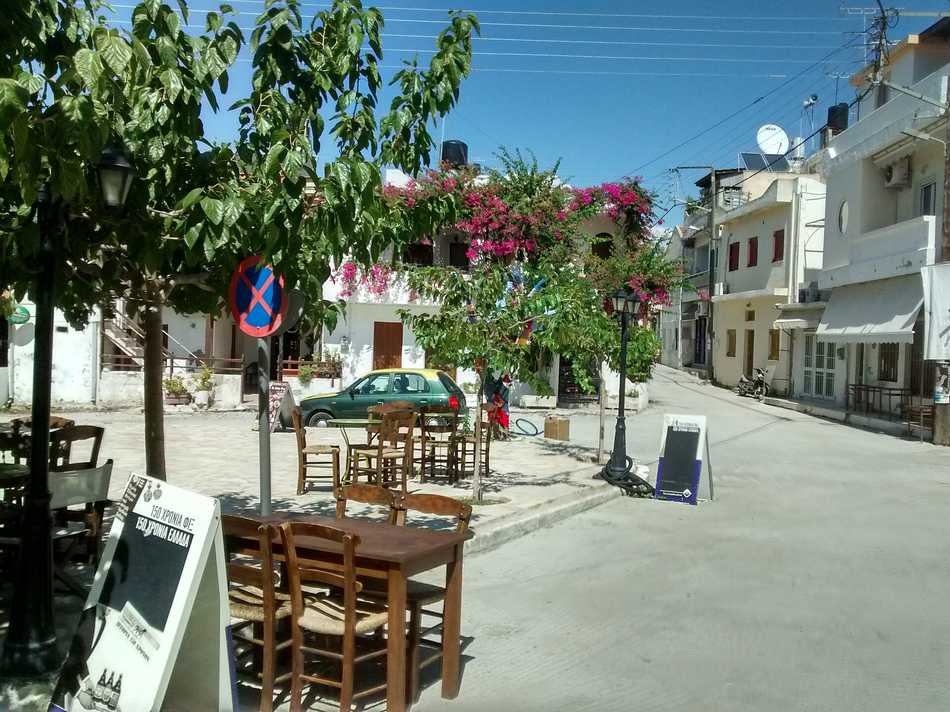
Moires stands as the bustling commercial centre of the Messara plain in southern Heraklion, Crete, far removed from the polished tourist resorts that line the island’s northern coast. This working market town serves the fertile agricultural region with banks, shops, tavernas, and the practical services that keep rural Cretan life running. Every Saturday, one of Crete’s largest street markets transforms the town into a vibrant trading hub where farmers sell fresh produce, local cheese, olive oil, plants, and household goods. Travellers seeking an authentic base near major archaeological sites and south-coast beaches discover Moires offers genuine Cretan character and everyday amenities. Explore the Messara region’s rich history and landscapes with My Greece Tours.
The town sits within easy reach of the Minoan palace of Phaistos, the extensive Roman ruins at Gortyn, the remote harbour of Kaloi Limenes, and the bohemian beach resort of Matala. The surrounding plain produces olives, vegetables, and citrus under both open skies and greenhouse cultivation. Moires appeals to independent travellers who prioritize location, authenticity, and convenience over tourist infrastructure. The sections below cover the town’s role as a market centre, its position within the Messara, nearby attractions, and practical considerations for using it as a touring base. Our Crete travel guide provides comprehensive information for planning your southern Crete exploration.
What makes Moires a significant market town in Crete?
Moires hosts one of Crete’s largest weekly street markets every Saturday, drawing farmers and shoppers from across the Messara plain. The town functions as the commercial hub for the region’s agricultural economy.
The Saturday market stretches through the town centre, creating a lively tableau of rural Cretan commerce that has sustained the Messara for generations. Farmers arrive early to display seasonal produce, aromatic herbs, fresh vegetables, and citrus from the surrounding plain. Stalls overflow with local cheeses, golden olive oil pressed from nearby groves, potted plants, clothing, and household essentials. The market serves as both economic engine and social gathering, where transactions happen alongside conversations in rapid Cretan dialect. Visitors experience authentic island life far from the curated experiences of tourist zones, witnessing the agricultural rhythms that define this fertile region. The atmosphere pulses with genuine energy, offering insight into how working Crete sustains itself through trade and community connection.
Beyond market day, Moires maintains its role as the Messara’s service centre throughout the week. Banks, pharmacies, supermarkets, bakeries, and hardware stores line the streets, providing everything residents and visitors need for daily life. Tavernas serve straightforward Cretan meals to locals rather than adapting menus for tourist palates. The town’s utilitarian character might disappoint those seeking picturesque charm, yet this authenticity represents precisely what draws travellers tired of manufactured experiences. Moires functions as a real place where real people work, shop, and gather, offering a grounding counterpoint to the archaeological grandeur and coastal beauty nearby.
The town proves that things to do in Crete extend beyond ancient ruins and beaches to include observing contemporary island life in its unvarnished form.
Where is Moires located on the Messara plain?
Moires occupies the central Messara plain in southern Heraklion district, surrounded by olive groves, vegetable fields, and greenhouse cultivation. The town sits roughly equidistant from major archaeological sites and south-coast destinations, making it strategically positioned.
The Messara plain spreads between the Psiloritis and Asterousia mountain ranges, creating Crete’s largest lowland agricultural zone. This fertile expanse has supported intensive cultivation since Minoan times, with the rich soil and favourable climate producing abundant crops across millennia. Moires developed at the plain’s commercial heart, where roads converge from mountain villages, coastal settlements, and archaeological sites. The surrounding landscape displays the agricultural wealth that sustains the town: endless olive groves silvering in the wind, orderly rows of vegetables, and the geometric patterns of greenhouse tunnels protecting citrus and early crops. The Asterousia mountains rise to the south, their barren slopes contrasting sharply with the cultivated plain.
This geographic position places Moires within striking distance of the island’s most significant southern attractions while maintaining its agricultural identity. Nearby, the village of Vori holds the Museum of Cretan Ethnology among the olive groves.
The town lies approximately ten kilometres north of Matala and its famous caves, fifteen kilometres west of the Minoan palace at Phaistos, and a similar distance from the Roman capital at Gortyn. The remote harbour of Kali Limenes sits roughly twenty kilometres south across the Asterousia foothills. This central positioning makes Moires an efficient base for exploring the Messara’s archaeological treasures and southern coastline without changing accommodation. The drive to Heraklion takes under an hour via good roads, connecting the rural south to the island’s capital and airport. Geography blessed Moires with accessibility, transforming it into the natural gathering point for a region rich in history, agriculture, and rugged coastal beauty.
What archaeological sites and attractions lie near Moires in Crete?
The Minoan palace of Phaistos, Roman Gortyn, the south-coast resort of Matala, and the remote harbour of Kaloi Limenes all sit within short drives. The Messara plain itself showcases traditional Cretan agriculture and rural landscapes.
Phaistos ranks among Crete’s most important Minoan sites, its palace commanding spectacular views across the Messara to Mount Psiloritis. The ruins reveal sophisticated Bronze Age architecture, with the famous Phaistos Disc discovered here remaining one of archaeology’s enduring mysteries. Gortyn spreads across a vast area, its Roman ruins including a remarkably preserved law code inscribed on stone, a massive odeon, and the remains of the basilica of Agios Titos. The site documents the Roman period when Gortyn served as capital of Crete and Cyrenaica, its importance evident in the scale of surviving structures. Both sites reward exploration, offering tangible connections to civilizations that shaped Mediterranean history.
The proximity to Moires allows visitors to explore these ruins during morning hours, returning to town for lunch and supplies before afternoon beach visits.
Matala draws visitors to its caves carved into sandstone cliffs, once home to a famous hippie community and now a popular beach destination. The town balances tourism with character, its tavernas and cafes facing the distinctive cave-studded headland. Kaloi Limenes offers a quieter alternative, a small harbour settlement where tradition persists despite summer visitors. The remote beaches along this southern coast remain relatively undeveloped, their pebbled shores and clear waters attracting those seeking solitude. The Messara plain itself rewards slow exploration, with traditional villages, Byzantine churches, and agricultural landscapes providing insight into rural Cretan life.
Moires positions visitors to discover both celebrated attractions and the hidden gems in Crete that reveal themselves to patient travellers willing to venture beyond the obvious circuit.
What type of traveller suits Moires as a base?
Independent travellers exploring archaeological sites and southern beaches who value authenticity, central location, and practical amenities over resort facilities find Moires ideal. The town suits those comfortable in working environments without tourist polish or English signage.
Moires makes no concessions to tourism, operating instead as a functional market town serving local needs. Visitors arriving expecting quaint charm or tourist infrastructure will find neither; the town offers banks, supermarkets, petrol stations, and straightforward tavernas rather than boutique hotels or craft shops. This utilitarian character appeals precisely to travellers who seek genuine experiences over curated ones, who appreciate observing daily Cretan life rather than consuming packaged culture. The town provides reliable amenities, affordable accommodation options, and excellent access to major sites without the crowds or prices of coastal resorts. Budget-conscious travellers, archaeology enthusiasts, and those planning extended Messara exploration benefit from Moires’ practical advantages.
The lack of English signage and tourist services requires modest self-sufficiency and adaptability, qualities that independent travellers typically possess.
The town particularly suits visitors combining cultural exploration with beach time, using Moires as a central hub from which to radiate outward. Morning visits to Phaistos or Gortyn can precede afternoon swims at Matala or quieter coves, with evenings spent in town tavernas among locals. Photographers and culture seekers find the Saturday market alone worth the stay, its authentic atmosphere providing rich material. Families with rental cars appreciate the practical amenities and central location, though the lack of resort facilities means planning falls entirely to parents.
Deciding where to stay in Crete depends on priorities; Moires rewards those who value location, authenticity, and economy over beachfront views and tourist services, offering an honest base in the heart of the Messara.
What defines the agricultural landscape around Moires?
The Messara plain surrounding Moires produces olives, vegetables, and citrus through both traditional cultivation and modern greenhouse agriculture. The fertile soil and favourable climate have sustained intensive farming since ancient times, continuing today as the region’s economic foundation.
Olive groves dominate the landscape, their gnarled trunks and silver-green canopies stretching across the plain in patterns established over centuries. The Messara’s olives produce oil prized for its quality, pressed in local mills and sold at the Saturday market alongside table olives cured in traditional brines. Vegetable cultivation fills the spaces between olive groves, with seasonal crops rotating through fields tended by families who have worked this land for generations. Citrus orchards add splashes of green and gold, their fruit destined for local consumption and broader markets. The agricultural calendar governs life here, with planting, tending, and harvest dictating the rhythm of work and community gatherings.
This continuity connects contemporary farmers to their Minoan predecessors who first recognized the plain’s potential, creating an agricultural tradition spanning millennia.
Greenhouse tunnels increasingly characterize the modern Messara, their plastic coverings creating geometric patterns across the landscape. These structures allow year-round cultivation and early-season production, extending the growing season and increasing yields. Tomatoes, cucumbers, peppers, and other vegetables grow under controlled conditions, supplying markets across Crete and beyond. The greenhouses represent agricultural adaptation, balancing tradition with economic necessity in a competitive market. Some visitors find the plastic tunnels aesthetically jarring against the ancient landscape, yet they sustain the rural economy that keeps villages populated and traditions alive.
The agricultural diversity around Moires demonstrates how working landscapes evolve while maintaining their essential character, providing the produce that fills market stalls and the economic foundation that sustains communities across the fertile plain.
Frequently Asked Questions
Is Moires worth visiting if I’m staying elsewhere in Crete?
Moires merits a Saturday morning visit for its exceptional market even if you base yourself elsewhere on the island. The market ranks among Crete’s largest and most authentic, offering genuine insight into rural commerce and agricultural life that tourist-oriented markets cannot match. Arrive early to experience the market at its busiest, when farmers display their freshest produce and the town pulses with local energy. The experience takes two to three hours, allowing time to wander the stalls, sample local products, and observe transactions conducted in rapid Cretan dialect. Combining the market with visits to nearby Phaistos or Gortyn creates a full day exploring the Messara’s cultural and historical layers.
The town itself offers little beyond the market to detain tourists, but the Saturday gathering provides authentic cultural immersion that enriches any Crete itinerary, particularly for visitors interested in agriculture, food culture, or contemporary island life beyond the beaches and ruins.
What facilities and services does Moires offer to travellers?
Moires provides practical amenities rather than tourist facilities, functioning primarily as a service centre for the Messara region. The town has banks with ATMs, pharmacies, supermarkets, bakeries, petrol stations, and auto repair shops serving local needs. Accommodation options exist but remain limited, typically consisting of simple rooms or small hotels catering to business travellers and agricultural workers rather than tourists. Tavernas serve traditional Cretan food at local prices, with menus rarely translated and service straightforward rather than solicitous. The town lacks tourist information centres, souvenir shops, or English signage, requiring visitors to navigate with modest self-sufficiency. Mobile coverage and internet access function reliably, and the town’s central location ensures good road connections to all Messara destinations.
Moires suits travellers who need a functional base with everyday services rather than resort amenities, offering the practical infrastructure necessary for extended exploration of southern Heraklion without the costs or crowds of coastal tourist centres.
How does Moires compare to staying in Matala or coastal resorts?
Moires and Matala serve entirely different purposes, with the choice depending on whether you prioritize beach access and tourist amenities or central location and authenticity. Matala offers beachfront accommodation, tavernas with sea views, tourist infrastructure, and the famous caves, creating a relaxed coastal atmosphere with swimming steps from your door. The village caters specifically to visitors, with English widely spoken and services designed for tourist needs. Moires provides none of these comforts but offers superior access to archaeological sites, lower prices, and genuine immersion in working Cretan life. The town sits more centrally for exploring the entire Messara, reducing driving times to Phaistos, Gortyn, and mountain villages.
Coastal resorts provide holiday ease and beach convenience; Moires offers authenticity and practicality. Travellers focused on swimming and relaxation should choose the coast, while those prioritizing archaeology, culture, and budget-conscious exploration benefit from Moires’ unglamorous efficiency. The decision reflects travel style: resort comfort versus authentic immersion in rural Crete’s commercial heart.