
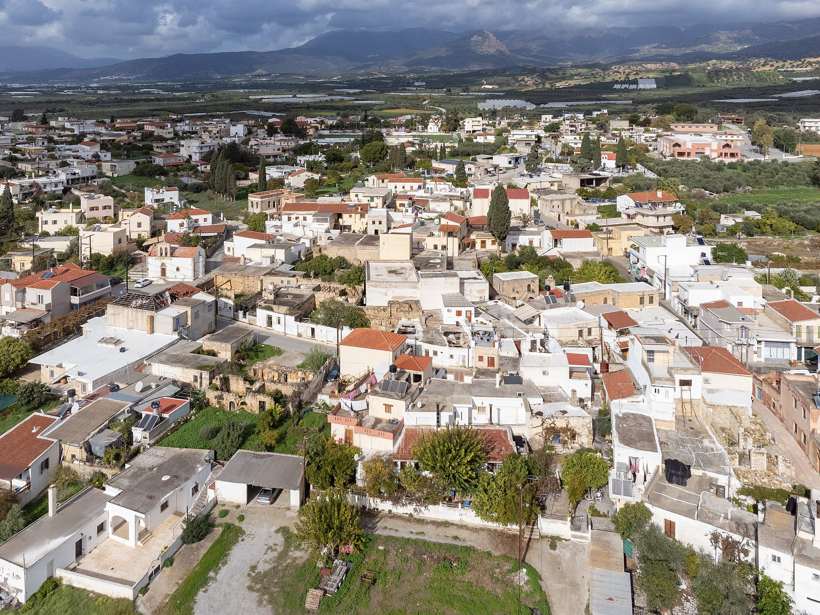
Vori is a traditional village on the Messara plain in the southern reaches of the Heraklion district, a quiet stop that reveals the everyday life behind Crete’s famous monuments. Whitewashed houses, shaded squares and old fountains line its lanes, while olive groves and vineyards fill the surrounding fields. The village sits near the ancient palace of Phaistos and the Roman ruins of Gortyn, yet its own draw is a fine folk museum devoted to rural craft and custom. Travellers curious about weaving, farming and food find a human counterpoint here to the grand archaeological sites nearby. Plan your slow wander through this corner of the Messara with My Greece Tours.
This guide gathers the practical detail that turns a name on the map into a real afternoon on the Messara plain. The sections below cover where Vori sits, what the Museum of Cretan Ethnology holds, how the village itself feels on foot, and which nearby beaches and towns pair well with a visit. You will find its place within the wider Crete travel guide, along with clear pointers toward the coast and the archaeological heart of the region. Read on to shape a midday or rainy-day stop that balances culture, quiet streets and the working landscape that surrounds this southern Cretan village.
Where is Vori located on Crete’s Messara plain?
Vori sits firmly on the Messara plain in the south of the Heraklion district of Crete, near the ancient palace of Phaistos and the Roman ruins of Gortyn. Olive groves and vineyards surround the whole village.
The Messara plain forms the broad agricultural heart of southern Crete, and Vori rests quietly among its olive groves and vineyards in the Heraklion district. The village lies within a short drive of the archaeological giants of the region, with the ancient palace of Phaistos and the Roman ruins of Gortyn both close at hand. This central position makes Vori a natural pause between the grand monuments, a place to slow down after walking long terraces of stone. The surrounding fields still work to the steady rhythm of the harvest, and the landscape carries the quiet order of long-cultivated land.
Travellers weaving a route across the south often reach Vori while planning their things to do in Crete, drawn by its rare blend of culture and calm.
Reaching Vori proves straightforward for anyone touring the south of the island by car, since the village connects easily to the main roads that cross the Messara. The nearby market town of Moires lies close and serves as a practical hub for supplies and onward routes across the plain. From Vori the beach at Kommos and the resort of Matala both sit within a short drive, so a museum visit folds neatly into a day that ends on the coast. The village keeps its own bearings among these larger names without ever losing its quiet character.
Anyone mapping the region soon finds that Vori anchors the cultural side of a plain better known for its ruins, and it pairs comfortably with a swim or a long coastal lunch afterwards.
What does the Museum of Cretan Ethnology in Vori display?
The Museum of Cretan Ethnology in Vori displays the tools, textiles, pottery, furniture and everyday objects of rural Cretan life across the centuries. Exhibits are arranged by theme such as farming, food, weaving and music.
The Museum of Cretan Ethnology ranks among the finest folk museums in Greece, and it forms the clear reason to make the trip out to Vori. Its rich collection gathers the tools, textiles, pottery and furniture that shaped rural Cretan life across the centuries, from the plough in the field to the loom in the home. The displays follow broad themes rather than a single timeline, so one room may draw together everything tied to farming, another to food, another to weaving or music. This thematic order lets a visitor read the culture as a connected whole, tracing how work, craft and celebration once fitted neatly together.
The effect stays intimate and domestic, a portrait of daily habit that the grand palaces of the plain rarely manage to convey.
A visit here reveals the human labour behind the island’s famous history, and it deepens any wider tour of the region. Objects that might seem plain in isolation gain fresh meaning through their grouping, showing how a household provisioned itself, dressed itself and marked its passing seasons. The section on food connects closely with the living traditions of the island, the same deep roots that shape Cretan food on the table today. The museum makes an ideal midday or rainy-day stop, a cool and thoughtful interior when the hot sun bears down on the wide plain outside.
Its careful and generous curation rewards a slow pass through the rooms, and it leaves a visitor far better prepared to understand the working countryside that produced these everyday things.
What is the village of Vori itself like to explore?
Vori keeps whitewashed houses, shaded squares, old fountains and quiet lanes surrounded by olive groves and vineyards. The village suits a slow wander after visiting the museum, offering a calm, domestic side of rural Crete.
Beyond the museum itself, Vori rewards an unhurried walk through streets that have kept their traditional character intact. Whitewashed houses line the lanes, shaded squares offer a welcome place to rest, and old fountains mark the corners where village life once gathered. The pace here stays gentle, and the quiet suits travellers who prefer to read a place through its ordinary details rather than its headline sights. Olive groves and vineyards press right up to the edges of the settlement, so the working countryside is never far from the doorstep. A slow wander after the museum lets the collection’s themes settle in the mind, since the same crafts and customs still shape the streets outside.
Vori offers the human, lived-in texture that gives the Messara its real depth beyond stone and ancient ruin.
The village works best as a companion to a fuller day rather than a rushed tick-list stop, and its calm forms part of the wider appeal. Squares shaded by tall trees invite a pause with a cold drink, while the winding lanes reward curiosity without ever demanding a fixed route. This is the sort of place travellers seeking hidden gems in Crete return home to describe, a village that trades spectacle for quiet atmosphere. The absence of crowds lets the ordinary rhythm of Cretan life come clearly through, from the shade of a doorway to the distant sound of the fields.
Pairing the wander with the museum gives a rounded picture of the south, one that holds both the objects of rural culture and the living streets that once used them.
Which beaches and towns lie near Vori?
Vori lies within a short drive of the beach at Kommos, the resort of Matala and the market town of Moires. This makes it easy to pair a museum visit with the coast or a working town.
The coast of the Messara sits close to Vori, so a cultural morning slips easily into a warm afternoon by the sea. The beach at Kommos lies within a short drive and offers a long stretch of open sand backed by the same plain that surrounds the village. Further along the coast the resort of Matala draws travellers with its caves and famous bay, a lively counterpoint to Vori’s quiet lanes. This close proximity turns the village into a natural first act of a fuller southern itinerary, a fine place to gather culture before the swim.
The pairing of museum and beach captures the whole range of the Messara, from its inland crafts to its warm southern shore, all within a compact stretch of easy road.
Inland, the market town of Moires offers a working hub near Vori, a place for supplies, a strong coffee and a sense of everyday Cretan commerce. A stop in Moires rounds out the picture of the plain, showing the modern trade that keeps the countryside going alongside its older traditions. The Roman ruins of Gortyn sit nearby as well, and a visit to Gortyn pairs naturally with the ethnology museum for a full day that spans law, craft and daily life. Together these neighbours give Vori its context, framing the village neatly between beach, town and ancient site.
Building a loop through them lets a traveller read the Messara in full, from its shore to its market to its monuments, without long stretches of driving.
Why should travellers include Vori in a Crete itinerary?
Vori rewards travellers curious about the everyday culture and crafts that stand behind Crete’s monuments, offering a human, domestic counterpoint to the grand archaeological sites of the Messara through its fine folk museum and traditional village streets.
A Crete itinerary weighted only toward palaces and ruins can miss the human story that fills the gaps between them, and Vori supplies exactly that. The village and its folk museum turn attention to the tools, textiles and customs of ordinary life, the labour and craft that supported the great sites of the plain. This domestic counterpoint deepens a visit to Phaistos or Gortyn, since the everyday objects on display give faces and hands to the history carved in stone nearby. Travellers curious about how rural Crete actually lived find the museum’s thematic rooms a rewarding read.
The stop suits a considered traveller who wants depth over mere sightseeing, and it fits neatly into a day that also takes in a beach or an ancient palace.
Practicality further strengthens the case for a visit, since Vori works well as a flexible pause within a broader southern route. It makes an ideal midday or rainy-day stop, a cool interior and a quiet village when the open plain grows hot or the sky turns grey. The short drives to Kommos, Matala and Moires let a traveller shape the whole day around the weather and the mood, with Vori standing as the steady cultural anchor. This fine balance of substance and ease is exactly what earns the village its place on a thoughtful itinerary.
Rather than another monument, it offers real understanding, the sense of a countryside explained through the things its people once used, and that lasting perspective lingers long after the visit ends.
Frequently Asked Questions
Is the Museum of Cretan Ethnology in Vori worth visiting?
The Museum of Cretan Ethnology stands among the finest folk museums in Greece, and it forms the main reason travellers seek out Vori on the Messara plain. Its collection draws together the tools, textiles, pottery, furniture and everyday objects of rural Cretan life across the centuries, arranged by theme such as farming, food, weaving and music. This thematic layout lets a visitor grasp the culture as a connected whole rather than a string of dates, tracing how work, craft and celebration once fitted together in a single household.
The museum offers a human, domestic counterpoint to the grand archaeological sites of the Messara, giving hands and faces to the history carved into the stone of Phaistos and Gortyn nearby. It makes an ideal midday or rainy-day stop, a cool and thoughtful interior when the plain outside turns hot. A slow pass through its rooms leaves a traveller far better prepared to read the countryside that produced these things.
How does Vori fit into a wider tour of southern Crete?
Vori sits on the Messara plain in the south of the Heraklion district, close to the ancient palace of Phaistos and the Roman ruins of Gortyn, which makes it an easy addition to a southern route. The village lies within a short drive of the beach at Kommos, the resort of Matala and the market town of Moires, so a museum visit folds neatly into a day that also takes in the coast or a working town. This central position lets a traveller build a compact loop across the plain, moving from folk museum to ancient site to shore without long stretches of driving.
The calm of the village pairs well with the busier draws of the region, offering a quiet cultural anchor between the sand and the ruins. Anyone shaping a slow, considered itinerary of the south finds Vori a natural pause, one that balances everyday culture with the monuments and beaches that fill the surrounding countryside of the Messara.
What can travellers see in the village of Vori beyond the museum?
The village of Vori keeps its traditional character, and a wander through its streets rewards travellers who linger after the museum. Whitewashed houses line the lanes, shaded squares offer a place to rest, and old fountains mark the corners where daily life once gathered. Olive groves and vineyards press up to the edges of the settlement, so the working countryside stays close at every turn. The pace is gentle and the crowds are absent, which lets the ordinary rhythm of rural Cretan life come through in the shade of a doorway or the quiet of a back lane.
This lived-in texture makes the village a fitting companion to the collection inside the museum, since the same crafts and customs still shape the streets outside. A traveller who slows down here reads the Messara through its everyday details, gaining a rounded sense of a place that trades spectacle for atmosphere and rewards curiosity over a fixed list of sights.