
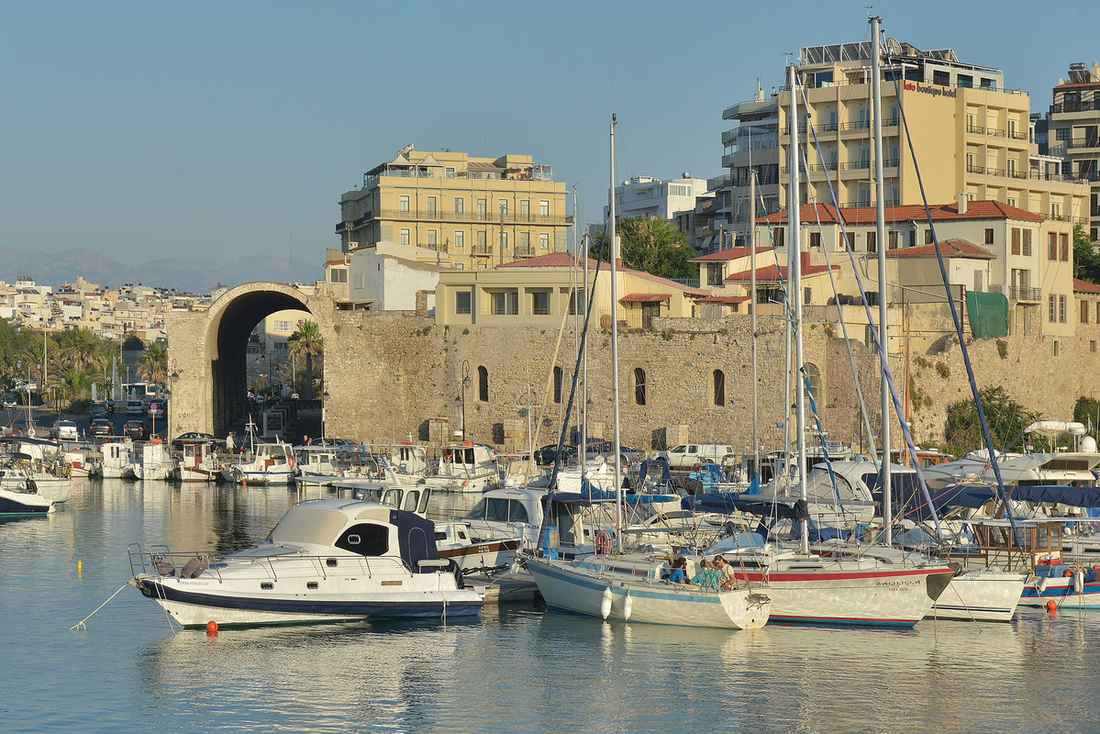
The Santorini to Crete ferry runs to Heraklion in 1.5 to 3 hours, with daily year-round sailings from around 15 euros, linking the volcanic Cyclades with Greece’s largest island. This guide covers the journey time, the prices, the operators, the ports and tips for the crossing.
Crete is an easy onward hop from the wider Santorini travel guide. It lies to the south. The sections below cover the ferry.
How long is the Santorini to Crete ferry?
The Santorini to Crete ferry to Heraklion takes from about 1 hour 35 minutes on a high-speed catamaran to around 3 hours on a conventional ferry. Crete lies south of Santorini, and the route is one of the quicker ways to reach the island.
The crossing to Crete is short. Heading south from Santorini to the port of Heraklion, the fast catamarans and high-speed ferries make the run in about 1 hour 35 minutes. The larger conventional vessels take roughly 3 hours but are steadier and cheaper. This is the standard link between the southern Cyclades and Crete. Travellers pair Santorini’s caldera scenery with Crete’s mountains, beaches and ancient Minoan sites such as Knossos. Because Crete is a major island with its own airport, the route also serves those flying out of Heraklion, set within the wider how to get to Santorini.
The exact duration turns on the vessel type and the sea state. A high-speed catamaran cuts a direct line across the open water and holds a fast cruising pace. A conventional car ferry sails a steadier course and absorbs swell without the sharp motion of a fast boat. In the summer months the meltemi wind lifts the sea between the islands, and the conventional ferries hold their timetable more reliably than the fast catamarans on a rough day. Booking the earliest daily departure leaves a buffer for onward travel across Crete once you land at Heraklion.
How much does the ferry cost?
The Santorini to Crete ferry costs from around 15 euros for a basic foot-passenger ticket up to about 90 euros or more for premium seats on fast boats, averaging roughly 35 to 60 euros. Cars cost from around 55 euros.
Fares span a wide range to suit different budgets. A one-way foot-passenger ticket starts from around 15 euros on a conventional sailing, with numbered seats from roughly 17 to 18 euros. Premium and business-class seating on the high-speed vessels rises to about 90 euros and beyond, so most travellers pay between 35 and 60 euros. Taking a vehicle costs from around 55 euros for a car. As on every Greek route, prices climb in the peak July and August season and as boats fill, so booking ahead secures both a place and a better price, set out alongside the guide to a Santorini itinerary.
The price gap between the two ferry classes reflects both speed and comfort. A conventional car ferry at the lower fare trades an extra hour of sailing for the cheapest crossing and a steadier ride. The high-speed catamaran charges the premium fare for the quicker run and the numbered airline-style seating. Foot passengers travelling light gain the most from the cheapest deck and economy tickets. Drivers who want the flexibility of a car on Crete pay the vehicle supplement on top of the passenger fare, and reserving that vehicle space early matters far more in July and August than on a quiet spring sailing.
Who are the operators and what is the schedule?
The route is served by Blue Star Ferries and SeaJets, running year-round with up to three daily crossings in summer. Ferries depart from Athinios, Santorini’s main port, and arrive at Heraklion in central Crete. Most vessels carry cars.
Two main operators keep the route busy. Blue Star Ferries and SeaJets run the connection with a mix of high-speed catamarans and larger conventional car ferries. Unusually for the Cyclades, the link operates all year round, with up to three crossings a day in the summer months, giving good flexibility. The ferries leave from Athinios, Santorini’s main port at the foot of the caldera cliffs, and dock at the port of Heraklion in the centre of Crete’s north coast. Heraklion sits close to the city and well placed for Knossos and the island’s beaches and mountains. Most vessels carry cars, handy for touring Crete, set out alongside the guides to the Santorini ports and Santorini car rental.
The two operators split the route by vessel and speed. Blue Star Ferries runs the conventional car ferries that carry vehicles at the lower fare across the steadier three-hour crossing. SeaJets fields the high-speed catamarans that prioritise speed on the shorter run. The summer timetable stacks up to three daily departures across both operators, while the winter service thins to a leaner year-round schedule. Afternoon and evening departures dominate the timetable, so the crossing often lands you in Heraklion after dark. Checking each operator’s sailing list for your travel date confirms both the departure hour and whether the boat carries vehicles.
How do you book tickets and use an e-ticket?
Book the Santorini to Crete ferry online or through an agent, then keep your booking reference for boarding. Arrive at Athinios port early, collect or show your e-ticket, and board through the vehicle deck or passenger gangway once the crew calls the sailing.
Booking runs through the operator websites, ticket agents and travel platforms, and each returns a booking reference tied to your name. An e-ticket carries a QR code or reference number that the crew scans at boarding, so a saved screenshot or a printed copy both work at the gate. Foot passengers walk aboard through the passenger gangway, while drivers queue the car in the marshalling lanes and board through the vehicle ramp. Keeping the reference to hand speeds the check at the quayside, where the crew work through the boarding queue against the sailing manifest.
- Save the booking reference or QR code to your phone before you reach the port.
- Print a paper copy as a backup in case of a flat battery or no signal.
- Match the passenger names on the ticket to the passport or ID you carry.
- Arrive early enough to clear the boarding queue before the sailing time.
What types of ferry and seat can you choose?
The route runs conventional car ferries and high-speed catamarans. Conventional ferries offer deck and numbered seats at lower fares with a steadier ride, while high-speed catamarans offer economy, numbered and premium airline-style seating on the faster crossing.
The vessel type shapes both the fare and the on-board experience. A conventional car ferry is a large, stable ship with open deck space, seating lounges and room for cars and lorries below. The cheapest ticket buys deck access, while numbered seats add a reserved place in a lounge. A high-speed catamaran is a sleeker, faster boat with fixed airline-style seating throughout. Economy fills the standard cabin, numbered seats reserve a specific spot, and premium or business seating buys extra legroom and a quieter section. Foot passengers on a budget lean toward the conventional deck fare, while travellers who value a fixed reserved seat pick the numbered option on either class.
How do you find your ferry at Athinios port?
Athinios port sits below the caldera on Santorini’s west coast, reached by bus or taxi down a winding road. Signage at the quay marks the departure berths, so arrive early, confirm your vessel and berth, and join the boarding queue before departure.
Athinios is Santorini’s main ferry harbour, tucked at the foot of the cliffs below the caldera rim. The road down twists through switchbacks, and buses time their runs to the main sailings while taxis wait at the rank in Fira. The quay lines up the departure berths along the waterfront, and boards and staff direct passengers toward the right vessel by operator and destination. The port grows hectic in season as arrivals and departures overlap, so reading the signage on arrival and confirming your berth early avoids a last-minute scramble. Foot passengers follow the pedestrian route to the gangway, while drivers filter into the numbered vehicle lanes.
The descent to Athinios takes planning on a busy summer day. The bus from Fira runs to the port on a timetable built around the ferry departures, and the fare is modest. A taxi covers the same route faster but at a higher price, and the rank empties quickly when several boats sail close together. Allowing extra time on the road covers the traffic that backs up on the switchbacks when a large ferry unloads. Once at the quay, a quick check of the departure boards and a word with the operator’s staff confirm the berth, and the boarding queue forms alongside the vessel ahead of the sailing time.
What about luggage and travelling with a car?
Foot passengers carry bags aboard and stow them in luggage racks or beside their seats. Drivers board through the vehicle ramp, so arrive earlier with a car and take only what you need up to the passenger areas.
Luggage travels with you on the crossing rather than being checked in. Foot passengers bring bags up the gangway and set them in the racks near the entrance or keep them at their seat. Wheeled cases roll easily on the flat decks of the conventional ferries, while the high-speed catamarans keep luggage in racks by the doors. Drivers load the car first: vehicles board through the stern or bow ramp under the crew’s direction, park in tight lanes, and passengers then head up to the lounges. Travelling with a car means arriving earlier, since vehicles board ahead of foot passengers and the marshalling takes time.
- Keep valuables, documents and medication in a bag you carry to your seat.
- Label larger cases clearly and note where you stow them for the exit.
- Take a light layer up top, as the deck cools once the boat is under way.
- Note your car’s deck and lane so you return to it quickly on arrival.
Can you travel with pets or need step-free access?
Greek ferries carry pets in carriers or designated areas, and larger conventional vessels offer ramps and lifts for step-free access. Confirm the pet policy and accessibility with the operator when booking, and arrive early to settle a pet or arrange boarding help.
Pets travel on the route within the operator’s rules, which set out carriers, designated deck areas and any cabin arrangements. Small animals ride in a carrier, while larger dogs use the designated outdoor spaces on the conventional ferries. The larger vessels handle step-free access more easily, with ramps at the vehicle deck and lifts between decks, so a traveller using a wheelchair boards without stairs. The compact high-speed catamarans have tighter layouts, so confirming the access details with the operator ahead of travel matters. Arriving early gives the crew time to settle a pet or arrange boarding assistance before the boat fills and the sailing is called.
What amenities are on board the ferry?
Greek ferries carry seating lounges, a cafe or snack bar, deck space and restrooms. Conventional car ferries offer more room to move and open decks, while high-speed catamarans keep passengers in fixed seating with a smaller refreshment counter for the shorter crossing.
On-board facilities scale with the size of the vessel. A conventional car ferry gives passengers indoor lounges, an open deck for sea air and views, a cafe or snack bar serving drinks and light food, and restrooms throughout. The extra sailing time on the steadier boat leaves room to stretch the legs, watch the coastline and grab a coffee. A high-speed catamaran keeps passengers in fixed airline-style seats for the faster run, with a refreshment counter and restrooms but limited deck access. Both classes suit the crossing to Heraklion, and the choice comes down to whether you value open deck space and a slower ride or the shortest possible journey.
Where can you go next from Crete?
From Heraklion you reach the Minoan palace of Knossos, the city’s old harbour and museum, and onward Cyclades ferries. Crete rewards a longer stay, with its mountains, beaches and Minoan history spread across the north coast and beyond.
Landing at Heraklion opens the whole of Crete and the routes beyond it. The Minoan palace of Knossos sits just outside the city, the leading archaeological site on the island and the heart of Bronze Age Crete. Heraklion itself holds a Venetian harbour, a fortress on the mole and an archaeological museum that gathers the Minoan finds under one roof. Beyond the city, the north coast runs east and west to beaches, harbour towns and the mountains inland. Ferries from Heraklion also head back into the Cyclades, so the island slots into a wider island-hopping loop rather than a dead end, set out alongside the wider Santorini travel guide.
Heraklion works as a base for a run of day trips across central Crete. The archaeological museum pairs naturally with a morning at Knossos, since the palace finds sit in the museum galleries. The old harbour, the Koules fortress and the market streets fill an afternoon in the city itself. Drivers push out to the beaches east and west of Heraklion or climb into the hills toward the plateaus and gorges inland. A rental car collected at the port turns the north coast into an easy touring route, which is why so much traffic on the Santorini crossing books a vehicle for the onward days on Crete.
Is the crossing rough, and how do you avoid seasickness?
The crossing is calm in settled weather, but the meltemi wind lifts the sea in July and August. Conventional ferries ride steadier than fast catamarans in wind, so choose the larger vessel, sit low and central, and travel earlier in the day for comfort.
Sea conditions on the route swing with the season and the wind. In calm spring and autumn weather the crossing to Heraklion stays smooth on either class of boat. The summer meltemi wind funnels down the Aegean and roughens the water between the islands, and that is when the vessel choice matters. A conventional car ferry has the mass and the hull to hold a steady line through swell, so it rides more comfortably than a light high-speed catamaran on a windy day. Sitting low and toward the centre of the boat cuts the felt motion, and travelling on an earlier departure often catches calmer morning water before the wind builds through the afternoon.
- Pick the conventional car ferry over the catamaran on a windy forecast.
- Choose a seat low and central where the boat moves least.
- Eat lightly and stay hydrated before and during the crossing.
- Fix your gaze on the horizon or the coastline rather than a screen.
How do the ferry options compare?
The two ferry classes trade speed for comfort and price. The high-speed catamaran runs the crossing in about 1 hour 35 minutes, while the conventional car ferry takes around 3 hours but rides steadier and costs less.
The table below sets the two options side by side on the figures already covered in this guide. The high-speed catamaran wins on speed and suits travellers racing an onward connection at Heraklion. The conventional car ferry wins on price, ride comfort and open deck space, and it carries vehicles at the lower fare. Matching the boat to your priorities, whether that is the quickest run or the steadiest and cheapest crossing, keeps the day on Crete off to a smooth start.
| Ferry type | Approx duration | Comfort and notes |
| High-speed catamaran | About 1 hour 35 minutes | Fastest run, fixed airline-style seats, more motion in wind |
| Conventional car ferry | Around 3 hours | Steadier ride, open decks, lower fares, carries cars |
Frequently Asked Questions
How long does the Santorini to Crete ferry take?
The Santorini to Crete ferry to Heraklion takes from about 1 hour 35 minutes on a high-speed catamaran to around 3 hours on a conventional ferry. Crete lies south of Santorini, and the route runs year-round, making it an easy way to combine the Cyclades with Greece’s largest island.
How much is the Santorini to Crete ferry?
The ferry costs from around 15 euros for a basic foot-passenger ticket up to about 90 euros or more for premium seats on fast boats, averaging roughly 35 to 60 euros. Cars cost from around 55 euros, with prices rising in peak July and August, so book early.
Where does the Santorini to Crete ferry arrive?
The Santorini to Crete ferry arrives at the port of Heraklion in central Crete, departing from Athinios, Santorini’s main port. Heraklion is close to the city and well placed for the Minoan palace of Knossos and Crete’s beaches and mountains. Most ferries carry cars.
Which operators run the Santorini to Crete ferry?
Blue Star Ferries and SeaJets run the Santorini to Crete route, mixing conventional car ferries with high-speed catamarans. The link operates year-round, with up to three crossings a day in summer. Ferries depart from Athinios port and arrive at Heraklion on Crete’s north coast.
Does the Santorini to Crete ferry carry cars?
Most vessels on the route carry cars, so you can drive on at Athinios and off at Heraklion. A car costs from around 55 euros on top of the passenger fare. Drivers board first through the vehicle ramp, so arrive earlier than foot passengers to clear the marshalling lanes.
Can the Santorini to Crete ferry be cancelled by weather?
The strong meltemi wind in July and August can delay or cancel high-speed catamarans on the crossing. Conventional car ferries hold their timetable more reliably in rough water. Build flexibility into your plans in summer and check the operator’s sailing status before you travel to the port.