
The Santorini cruise port is a tender port: ships anchor in the caldera and ferry you ashore by small boat to the Old Port below Fira, from where the cable car climbs to town. With Fira, Oia and the volcano all reachable, it makes a spectacular day. This guide covers tendering, getting up to Fira and Oia, and what to do.
A cruise call is an unforgettable taste of the island, a window into the wider Santorini travel guide. The caldera setting is dramatic. The sections below cover a day in port.
Where do cruise ships dock in Santorini?
Cruise ships do not dock in Santorini. They anchor offshore in the flooded caldera and tender passengers ashore by boat, to the Old Port below Fira for independent visitors and to Athinios port for organised excursions.
Santorini has no cruise quay. The island sits on the rim of a drowned volcanic crater, and the water inside the caldera runs too deep for a ship to drop anchor at a pier. Vessels moor in the open caldera, roughly opposite Fira, and shuttle guests in by tender.
The Old Port, also called Skala Fira, sits directly beneath the capital and handles independent visitors. Athinios, the working ferry harbour further south, takes coaches for organised tours because its road links the coaches to Oia and the wineries. The anchorage view across the caldera ranks as the finest arrival in the Cyclades, set within the wider how to get to Santorini. The tender crossing is the first hurdle of the day.
How does the tender process and disembarking work step by step?
Your ship issues numbered tender tickets, calls each group to a lower deck, and loads you onto a shared tender boat for the ten-minute crossing. Ship-tour passengers get priority, so independent visitors wait longer to board.
Tendering follows a set order on every ship. Passengers on ship-organised excursions leave first, then remaining guests collect a numbered ticket from a lounge and wait for their batch to be called over the tannoy. That queue can stretch across the first hour in port on a crowded day.
Once your number is called, crew guide you down to a low gangway and onto the tender, which seats dozens. The boat crosses to the Old Port pier in around ten minutes, running low over the caldera water. Landing at Skala puts you at the foot of the cliff, among the harbour cafes and the cable-car base station. Reaching Fira above is the next step, set out alongside the guide to the Santorini cable car. The climb up defines the whole day.
How do you get from the Old Port to Fira?
From the Old Port you reach Fira, 220 metres above, by cable car in about three minutes for around 10 euros, by walking up nearly 600 zig-zag steps, or by donkey, which is not advised. The cable car is quickest.
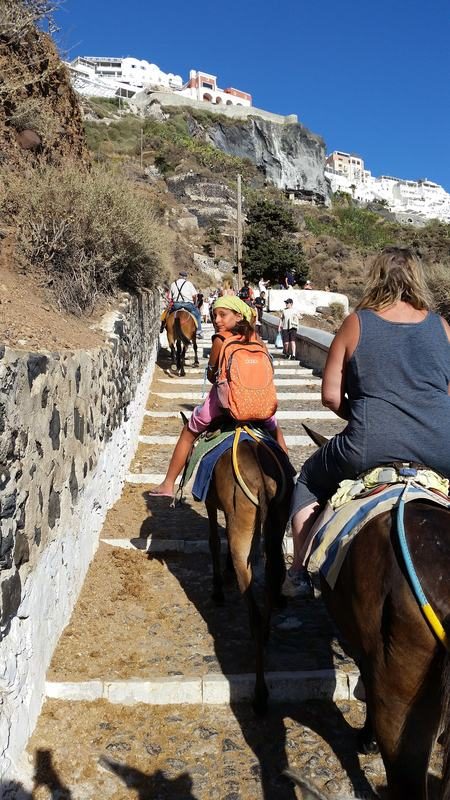
The Old Port sits at the foot of the cliff directly below Fira, with no road, so you must climb up to the town. The quickest way is the cable car, which glides 220 metres up the caldera wall in about three minutes for roughly 10 euros one way, with sweeping views. The alternative is the steep zig-zag path of nearly 600 steps on foot, hot, tiring and shared with donkeys.
Riding a donkey up remains possible but is not recommended on welfare grounds. The cable car is the clear winner, though on busy cruise days queues both up and down grow long, so allow time, set out alongside the guide to Fira and its cable car. The town is the main hub for the rest of the day.
How busy does Santorini get on big cruise days?
Santorini gets extremely crowded when four or five ships call together, chiefly in Fira, Oia and at the cable-car station. Mid-morning to mid-afternoon is the peak, when tender arrivals, day-trippers and hotel guests converge on the same clifftop lanes.
Crowding on Santorini rises and falls with the ship schedule. Days with four or five vessels in the caldera push tens of thousands of visitors onto the island at once, and they funnel into the same two towns. Fira’s cable-car queue is the first pressure point, with waits that can run past an hour at the return rush before the ships sail. Oia fills through late morning and stays packed until sunset, when its main street barely moves. Quieter windows open early in the morning and after four in the afternoon, once the first ships depart the caldera. Timing your movements against that rhythm saves hours, set within the wider Santorini itinerary. Reaching Oia is the next planning question.
How do you get from Fira to Oia by bus, tour or transfer?
From Fira you reach Oia by KTEL public bus, an organised tour, a private transfer or a taxi, with the drive taking about 25 minutes. The bus is cheapest but fills fast, while a pre-booked transfer removes the timing risk.
Oia lies at the northern tip of the island, and every option starts from Fira’s central bus terminal. KTEL buses run the route through the day for two or three euros and take about 25 minutes, but on packed cruise days they leave full and standing room vanishes. A private transfer or taxi covers the same road on your own schedule, useful when the ship’s all-aboard time is fixed. An organised half-day tour bundles the drive with a guide and often a winery stop at Pyrgos. Choosing among them turns on budget and how tight your port window runs, set out alongside the guide to the Santorini bus network. Fira itself rewards time before you leave.
What is there to see and do in Fira?
In Fira you can walk the caldera-edge promenade, see the Three Bells of Fira church, browse jewellery shops, and visit the Museum of Prehistoric Thera. The clifftop terraces give the classic caldera panorama near the cable car.
Fira packs the island’s capital energy onto a cliff edge. The caldera-view promenade links the cable-car top station with a chain of terraces looking out over the volcano and the anchored ships below. The blue-domed Three Bells of Fira, sometimes called Agios Theodoros, is the town’s photographed church, perched over Firostefani. Jewellery workshops, ceramics and Greek delis line the inner lanes. The Museum of Prehistoric Thera holds the frescoes and artefacts dug from the Bronze Age town at Akrotiri, giving context to the whole caldera story. Half a day fits Fira comfortably before moving on, set out alongside the guide to Oia. The northern village is the other headline stop.
What is there to see and do in Oia?
In Oia you can find the blue-domed churches, wander the whitewashed marble lanes, see the ruined castle at Goulas, and hike down to Ammoudi Bay. The northern village holds Santorini’s signature caldera views and its famous blue domes.
Oia is the postcard the island is known for. Its main pedestrian street runs along the caldera rim, lined with cave houses, boutique galleries and cafes carved into the cliff. The blue-domed churches sit just below the walkway near the western end, framing the caldera behind them. The old castle ruins at Goulas mark the sunset viewpoint, though on a cruise day you land there mid-afternoon rather than at dusk. A stone stair of around 300 steps drops from the village to Ammoudi Bay, where fishing tavernas line the water and boats leave for Thirassia. Oia rewards an unhurried two hours on foot, set out alongside the guides to the volcano. Judging your time is the practical concern.
How long do you need ashore in Santorini?
You need about six to eight hours ashore to see both Fira and Oia without rushing. A shorter call of four to five hours suits Fira plus one sight, while a full day adds Oia and a caldera boat trip.
Time ashore drives every other decision. A standard cruise call of eight hours in the caldera leaves roughly six usable hours once tender and cable-car queues are counted, enough for Fira in the morning and Oia in the afternoon. Shorter stops on repositioning itineraries are better spent in Fira with one add-on such as the museum or a wine tasting nearby. A late-departure call opens the door to a village like Pyrgos, a caldera cruise to the volcano, or a beach on the island’s east coast at Kamari. Matching ambition to your all-aboard time keeps the day calm, set within the wider Santorini day trips. Whether to book a ship excursion is the next choice.
Do you book a shore excursion or go independent?
Independent visits work well on Santorini thanks to the cable car, cheap buses and short distances, and they cost far less than ship tours. A booked excursion buys guaranteed return timing and priority tendering for short port calls.
The independent-versus-excursion question turns on control and cost. Doing it yourself means the cable car, a KTEL bus to Oia and freedom over your schedule for a fraction of the ship’s price, and Santorini’s compact geography makes that easy. The trade-off is timing risk: an independent traveller who misjudges the return queues owns that mistake, whereas a ship excursion guarantees the vessel waits and grants earlier tenders ashore. Pre-booked private tours through third parties split the difference, giving a fixed transfer and guide without the cruise-line markup. Weighing price against peace of mind settles it for each traveller, set out alongside the guide to Santorini taxis and transfers. Practical habits smooth any plan you pick.
What practical tips help cruise visitors most?
The key tips are heading up the cable car early to beat queues, pre-booking Oia transport, allowing a wide buffer for the return tenders, carrying cash and water, and wearing sturdy shoes. Confirm your all-aboard time and last-tender time first.
Cruise days reward a short checklist. Going up the cable car in the first wave avoids the mid-morning crush, and pre-booking an Oia transfer removes the standing-room bus gamble. Buffer time is the real safeguard, because the cable car down and the tender line both back up before sailing, and the last tender leaves earlier than the all-aboard time.
Cash covers the bus and cliffside tavernas where cards lag, and a water bottle matters on the hot cliff paths in July and August. Comfortable shoes handle Fira’s steps and Oia’s marble lanes. Building the day around the return, not the arrival, keeps it stress-free, set out alongside the guide to Santorini taxis. Travellers on flexible plans extend the visit into an overnight.
Is it worth staying overnight in Fira after a cruise?
Staying overnight in Fira is worth it where your itinerary allows a break, because it unlocks the Oia sunset and quiet early mornings that day-callers miss. The trade-off is the caldera-view room premium and rejoining your ship later.
An overnight changes the whole character of a Santorini visit. Cruise callers land and leave inside the crowded midday window, whereas an overnight guest sees the caldera empty after the last ship sails and again before the first arrives. That quiet, plus a proper Oia sunset without the day-tripper crush, is the reward. The cost is real, though: caldera-view rooms in Fira and Imerovigli command a premium, and leaving the cruise mid-voyage means catching a ferry or flight to meet the ship at a later port. Travellers on flexible plans gain most from the pause, set out alongside the guide to Oia and its sunset. Santorini also rarely stands alone on an itinerary.
Can you visit the volcano and hot springs on a cruise day?
You can join a caldera boat trip to the volcanic islet of Nea Kameni and the warm springs at Palea Kameni on a cruise day, provided your port call runs long enough. The excursion needs three to four hours.
The volcano trip is the active alternative to town-hopping. Boats leave the Old Port for Nea Kameni, the black volcanic cone in the middle of the caldera, where a marked path climbs to the steaming crater rim in about twenty minutes on foot. The route then anchors off Palea Kameni, and swimmers drop into the rust-coloured warm springs fed by the volcano. The full circuit swallows three to four hours, so it fits a long call rather than a short one. Trading Oia for the crater suits travellers drawn to the geology, set out alongside the guides to the Santorini volcano. Access matters as well as ambition on a cruise day.
Is the Santorini cruise port accessible for limited mobility?
The Santorini cruise port is challenging for limited mobility, because the Old Port has no road and the cable car involves steps at both stations. Wheelchair users are better served by a ship excursion tendering to Athinios.
Access is the honest weak point of a Santorini call. The Old Port sits at the cliff foot with no vehicle road, and reaching town means the cable car, the 600 steps or a donkey, none of them easy for wheelchair users or travellers with reduced mobility. The cable-car cabins themselves have steps at boarding, and Fira’s lanes are cobbled and stepped. A ship excursion that tenders to Athinios and uses a coach removes the cable-car barrier, though the caldera towns stay uneven underfoot. Planning around these limits prevents a stressful morning, set within the wider how to get to Santorini. Athinios itself deserves a closer look.
What is Athinios port and why do organised tours use it?
Athinios is Santorini’s main ferry harbour on the southwest coast, below Fira. Ship excursions land there because coaches can park and drive straight to Oia, the wineries and Akrotiri, unlike the road-free Old Port beneath the cliff.
Athinios plays a different role from the Old Port. The harbour sits at the end of a switchback road that climbs the caldera wall by bus and coach, so it connects to the island’s road network in a way Skala cannot. Ship-organised tours tender guests here rather than to Fira, board waiting coaches, and set off directly for Oia, the Akrotiri excavation or a winery at Megalochori. Independent travellers rarely land at Athinios, since reaching Fira from there means a bus ride rather than the caldera cable car. The split keeps coach traffic away from the crowded Old Port, set within the wider Santorini day trips. Season shapes how any of this feels underfoot.
When is the best season for a Santorini cruise call?
The cruise season runs from April to October, with July and August the hottest and most crowded. Late spring and September bring warm days, calmer tender crossings and thinner queues, making them the steadiest windows for a comfortable port call.
Season changes the whole rhythm of a cruise day. High summer delivers reliable sun but also fierce heat on the cable-car steps, peak crowds in Oia and the fullest tender queues of the year. Late spring and September keep the warmth while trimming the crush, and the meltemi wind that can rock tenders tends to ease outside high summer. April and October are quieter still, though the odd blustery day can slow the tender operation. Choosing a shoulder-month call rewards you with shorter cable-car lines and clearer photos, set within the wider Santorini itinerary. Santorini rarely stands alone on an itinerary either.
Which ports are often paired with Santorini on Greek itineraries?
Santorini usually appears alongside Mykonos and Athens on Aegean itineraries, often with Crete at Heraklion, plus Rhodes, Nafplio or a Turkish call at Kusadasi. Round trips sail from Athens at Piraeus, making Santorini the scenic centrepiece.
Santorini rarely travels alone on a cruise map. The classic Greek Isles loop from Athens pairs it with Mykonos for nightlife and beaches, and regularly adds Heraklion for the Minoan palace of Knossos on Crete. Longer eastern Mediterranean sailings fold in Rhodes with its medieval old town, Nafplio on the Peloponnese, or the Turkish port of Kusadasi for Ephesus. These itineraries mostly begin and end at Piraeus, the port of Athens, where passengers connect to the Acropolis before boarding. Santorini’s caldera arrival ranks as the visual highlight of the whole circuit, set within the wider Santorini day trips. The questions below cover what travellers ask most.
Where are the best photo spots on a Santorini cruise day?
The best photo spots are the blue-domed churches in Oia, the caldera-view terraces along Fira’s promenade, the Three Bells of Fira, and the arrival view from the tender or cable car. Each frames the volcano and the whitewashed cliff towns.
Photography drives the whole Santorini itinerary for the camera-minded traveller, and the caldera obliges. The tender crossing and the cable car both hand you the classic wide shot of Fira stacked up the cliff with the volcano behind. Along Fira’s promenade, the terraces at Firostefani catch the Three Bells church against open water.
Oia holds the signature frame: the trio of blue domes above the western caldera, best shot from the walkway just past the main square. The castle ruins at Goulas give the widest Oia panorama toward Ammoudi. Chasing these views in the quieter early hours beats the midday crush, set out alongside the guide to Oia and its blue domes. The questions below cover the details travellers ask most.
Frequently Asked Questions
Is Santorini a tender port for cruises?
Santorini is a tender port, as the deep caldera and small harbours prevent cruise ships from docking. Ships anchor offshore and tender passengers ashore by small boat, usually to the Old Port below Fira for independent visitors, or to Athinios for ship excursions with coaches waiting. The tender operation is run by the ship’s crew, so timings depend on the number of vessels sharing the caldera that day.
How do you get from the cruise port to Fira?
From the Old Port you get up to Fira, 220 metres above, by cable car in about three minutes for around 10 euros, by climbing nearly 600 zig-zag steps on foot, or by donkey, which is not advised. The cable car is the most sensible option, though queues build on busy days.
Can you see Oia on a cruise day in Santorini?
You can see both Fira and Oia on a cruise day, reaching Oia from Fira by KTEL bus, an organised tour or a private transfer in about 25 minutes. Allow six to eight hours ashore for both, and leave a wide buffer for the cable car and tender queues on the way back. Pre-booking the Oia leg is the safest way to protect that timing when the ship’s departure is fixed and the buses run full.
How long does the tender ride to Santorini take?
The tender ride from the anchored ship to the Old Port takes roughly ten minutes across the caldera. Boarding takes longer than the crossing on busy days, because independent passengers wait for their numbered group to be called after ship-tour guests have left first. The return crossing is the same ten minutes, but the queue to board a tender back can run far longer in the late afternoon as four or five ships load at once.
Do you need a shore excursion to visit Santorini by cruise?
You do not need a shore excursion, as Santorini is easy to explore independently using the cable car and the KTEL bus to Oia. A booked excursion mainly buys priority tendering and guaranteed return timing, which helps on very short port calls or fixed all-aboard times. Independent visitors save money and gain freedom over their route, at the cost of managing the return queues themselves.
What time do you head back to the tender in Santorini?
Head back to the cable car at least ninety minutes before your all-aboard time. The return cable-car queue and the tender line both back up as ships prepare to sail, and the last tender leaves earlier than all-aboard, so building in buffer prevents a missed departure. A missed ship in Santorini leaves you arranging your own onward flight or ferry to the next port, so err firmly on the side of an early return to the cable-car station.