
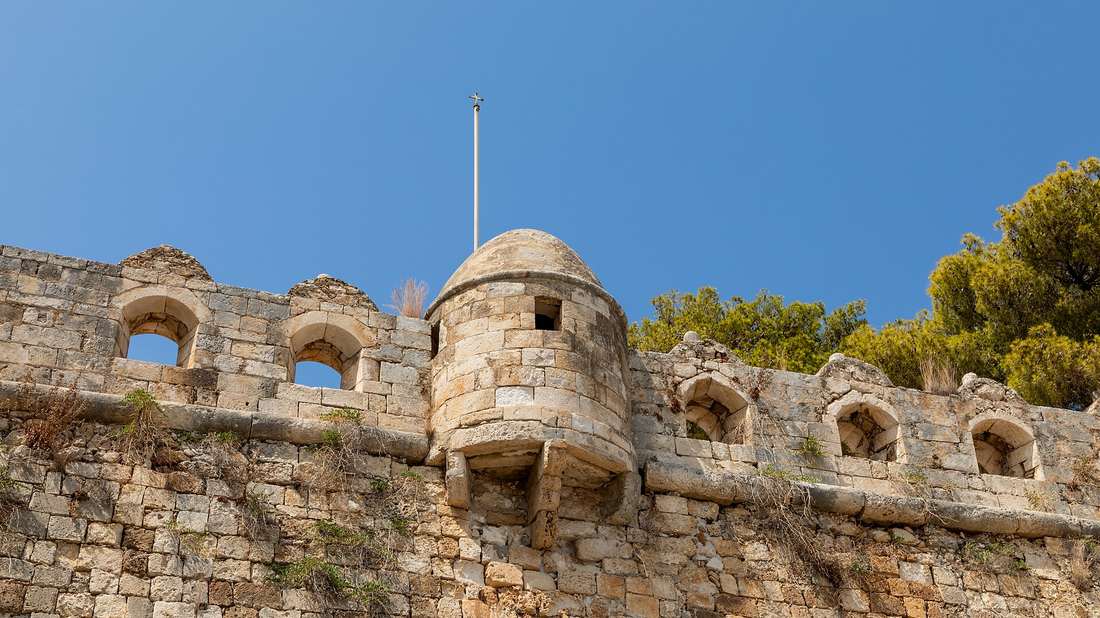
The Fortezza is the Venetian citadel that crowns the low hill of Palaiokastro above the old town of Rethymno, on the north coast of Crete. Its low, star-shaped ramparts and angled bastions were built to absorb cannon fire, and inside stand a domed former mosque, a gunpowder store, cisterns and the rector’s residence. The walls open wide views over the tiled roofs of the old town, the Venetian harbour and the sea. This guide covers the building of the fort, its layout, the walk up from the harbour and the summer festival. Plan the whole citadel visit as part of a wider Crete trip with My Greece Tours.
The Fortezza ranks among the best-preserved Venetian fortresses in the Mediterranean, and a short climb from the Venetian harbour brings you to its gate. The sections below cover its construction after the corsair raids, the walled interior, the ruined cathedral that became a domed mosque, the roof views over Rethymno and the open-air concerts held here each summer. Read this page alongside the wider Crete travel guide to fit the citadel into a full island itinerary of Venetian towns, monasteries and coast.
Why did the Venetians build the Fortezza above Rethymno in Crete?
The Venetians built the Fortezza in the late sixteenth century after devastating Ottoman corsair raids on Rethymno. They chose the hill of Palaiokastro to create one walled refuge able to shelter the whole population of the town behind heavy ramparts.
The decision to fortify Palaiokastro followed years of corsair attacks that burned and looted the open coastal town of Rethymno. Venetian engineers rejected a scattered defence and planned one great walled enclosure on the hill above the harbour, high enough to command the sea approaches and the plain behind. The scheme aimed to protect the entire civilian population, not a garrison alone, so the walls had to ring a large summit rather than a compact keep. Work began in the late sixteenth century. It drew on forced local labour, stone quarried nearby and the latest ideas in gunpowder-age fortification. The result reshaped the skyline of Rethymno.
It gave the town the strong point it had lacked on the day the raiders struck the exposed shore below the hill.
The Fortezza formed part of a wider Venetian defensive line along the north coast of the island. Travellers tracing that line often pair it with the great fortresses and old towns nearby. A stop at nearby Rethymno shows how the citadel and the walled port worked as one system, the harbour sheltering ships while the hill covered the town. The angled bastions and low profile mark a clear break from tall medieval castle walls, which crumbled under cannon. Rethymno’s Fortezza belongs to the same generation of star forts raised across Venetian Crete to hold the island against a rising Ottoman threat.
Its scale reflects how seriously the raids were taken, and the enclosure had to hold an entire town under fire, not merely a garrison behind a keep.
What can visitors see inside the walls of the Fortezza?
Inside the ramparts stand a ruined cathedral later turned into a domed mosque, a rectangular gunpowder store, the rector’s residence and stone cisterns. The angled bastions ring a broad grassy summit, and paths link the surviving vaulted buildings across the citadel.
The largest surviving structure is the former cathedral of Saint Nicholas, converted under Ottoman rule into the mosque of Sultan Ibrahim. It is a square hall crowned by a wide dome that dominates the centre of the enclosure. Nearby stands a rectangular gunpowder magazine with thick protective walls, built to store the powder that fed the cannon on the bastions. The rector’s residence, the councillors’ quarters and a set of deep cisterns for collecting rainwater complete the practical core of the fort, since a siege refuge needed water and shelter as much as guns. Grass and low ruins fill much of the interior today.
Marked paths guide walkers between the buildings, past the gun positions and along the inner faces of the great angled bastions that ring the whole summit above the town.
The interior rewards a slow, unhurried circuit rather than a quick look from the gate. The exhibits set inside restored halls explain the building’s long history phase by phase. Return visitors fold the Fortezza into a wider run of sights on a Crete 3-day itinerary, giving it a full morning before moving on to the coast or the mountains. The domed mosque, the powder store and the cisterns each show a different era, Venetian, Ottoman and modern restoration, layered on the same hill. Standing among these buildings makes the scale of the enclosure clear.
The walls had to ring enough ground to hold an entire town in an emergency, not merely a small garrison behind a compact keep, and the open interior still carries that generous scale today across its grassy floor.
How do you reach the Fortezza from the Venetian harbour?
The Fortezza is a short, steep climb from the Venetian harbour and the old town of Rethymno. Walkers thread up through narrow lanes to the western gate on Palaiokastro hill, a route of minutes that needs sturdy shoes for the cobbled slope.
The approach starts at the small Venetian harbour, with its curving stone mole and lighthouse, and climbs west through the maze of the old town. The lanes narrow and rise past Venetian doorways, Ottoman fountains and shaded tavernas before reaching the open ground below the ramparts. The main entrance sits on the landward side, where a gate pierces the angled outer wall and admits visitors to the interior. The gradient is short but firm, and the cobbles can be slick, so flat, gripped footwear helps on the way up and down. A ticket office at the gate controls entry.
The roof and bastion walks begin just beyond it, opening at once onto the wide panorama over the town and the sea below the walls of the hilltop citadel.
The walk up doubles as a tour of the old town itself, so allow time to wander rather than rush straight to the gate. The same lanes lead on to other sights, and a visit here sits neatly within a plan of things to do in Crete across the western half of the island. Drivers face limited parking on the hill, so leaving the car near the harbour and climbing on foot is the simplest approach. The route back down offers a different set of views over rooftops and courtyards, and the harbour tavernas make an easy stop once the citadel circuit is done.
The descent takes only minutes, and the shaded lanes give welcome cover from the midday sun on the return to the waterfront below.
What views and features make the Fortezza a highlight of Crete?
The roof and bastion walks give wide views over the tiled roofs of the old town, the harbour and the open sea. The Lion of Saint Mark reliefs, the domed mosque and the star-shaped ramparts mark it as a highlight of Crete.
The great draw is the sweep of the panorama from the ramparts. The walk along the bastions opens onto the terracotta roofs of Rethymno, the curve of the harbour with its lighthouse and the long line of the north-coast sea. The star-shaped plan itself is a feature, since the angled bastions and low, sloping walls let visitors trace how gunpowder-age forts turned back cannon that would have breached tall medieval curtain walls. The domed former mosque anchors the centre, a rare survivor showing the Ottoman reworking of a Christian cathedral. Together the walls, the buildings and the outlook explain why the citadel crowns any visit to the town.
The Fortezza stands among the emblematic Venetian monuments of the whole island and draws the eye from every corner of the old town below.
The Fortezza also sets the town in its wider setting. From the walls the eye follows the coast and the hills toward the great inland monuments of the region. Travellers often join a visit here with the trip to Arkadi Monastery in the hills behind Rethymno, pairing citadel and monastery in one day. The best light for the views falls in the early morning and the late afternoon. Choosing the right season shapes the whole experience, so it helps to check the best time to visit Crete before fixing the dates.
The combination of hard military engineering and soft panoramic outlook gives the fort its lasting appeal, and the roof walk rewards visitors with the finest single wide view over the roofs of the old town and the busy fishing harbour below.
What events and festivals take place at the Fortezza in summer?
In summer the Fortezza hosts open-air concerts and the Rethymno Renaissance festival, staged within its walls. The enclosure’s broad interior and ramparts turn the citadel into an evening venue, drawing audiences up the hill for music and performances under the open sky.
The summer programme uses the fort’s open interior and its high position above the town as a natural stage. The Rethymno Renaissance festival fills the enclosure with concerts, theatre and events that echo the era of the Venetian builders. Separate open-air concerts run through the warm months as well. The setting adds to the performances, since the ramparts frame the sea and the lights of the harbour once the sun drops, and the acoustics of the walled space suit music. Evening events also let visitors see the citadel after the daytime crowds thin, with the domed mosque and the bastions floodlit against the dark.
Checking the festival calendar before a trip turns a routine daytime visit into an evening under the stars on the walls of the old citadel above the harbour.
Planning a summer stay around the festival calendar shapes where a traveller bases themselves. A night event on the hill favours a room within an easy walk of the harbour and the old town. The choice of base across the island feeds into the wider question of where to stay in Crete, and Rethymno makes a strong western hub for reaching the fort, the beaches and the mountains behind. The events run through the hottest weeks, so light clothing, water and a booked ticket smooth the evening. The Fortezza thus works as both a daytime monument and a summer stage.
Its walls carry music above the same harbour they once guarded against the corsairs, joining old defence and modern festival on one commanding hill above the town.
Frequently Asked Questions
How old is the Fortezza in Rethymno and why was it built?
The Venetians built the Fortezza in the late sixteenth century, after devastating Ottoman corsair raids struck the open coastal town of Rethymno on the north coast of Crete. The raids exposed how vulnerable the unwalled port was, so the rulers of the island chose the low hill of Palaiokastro above the town. They raised a large walled citadel able to shelter the whole population behind heavy ramparts. The engineers used a star-shaped plan with low, sloping walls and angled bastions designed to absorb and deflect cannon fire, a sharp break from tall medieval castle walls. The enclosure ringed enough ground to hold an entire town in a siege, not just a small garrison.
The Fortezza formed part of a wider Venetian defensive line along the coast that also fortified nearby towns, and it stands today among the best-preserved Venetian fortresses across the Mediterranean, crowning the old town of Rethymno above the sea.
Is the Fortezza worth visiting on a trip to Rethymno?
The Fortezza crowns any visit to Rethymno and sits a short, steep climb from the Venetian harbour and the old town, so it slots easily into a day in the city. Inside the ramparts stand a ruined cathedral turned into a domed mosque, a rectangular gunpowder store, the rector’s residence and stone cisterns. The roof and bastion walks open wide views over the tiled roofs, the harbour and the sea. The star-shaped walls show gunpowder-age military design at close hand, while the layered Venetian and Ottoman buildings tell the town’s history in stone. A ticket at the gate covers the interior and the wall walks.
Visitors often join the citadel with beach time and a nearby monastery in one day. A wider list of hidden gems in Crete helps round out an itinerary once the fort is seen, tying the citadel to quieter corners across the western half of the island.
How much time does a Fortezza visit take, and what to bring?
A full circuit of the Fortezza takes about ninety minutes to two hours, enough time to walk the ramparts, climb the bastions for the views and see the domed mosque, the gunpowder store and the cisterns without rushing. The climb up from the harbour is short but steep on cobbled lanes, so sturdy, gripped shoes help, along with water, a hat and sun cover, since much of the interior is open grassy ground with little shade. Early morning and late afternoon bring the best light for photographs and the coolest walking. Summer evenings can add an open-air concert or a festival performance inside the walls. Buy the ticket at the gate on arrival.
Pairing the fort with a wider plan such as the Heraklion Venetian sights builds a strong day of history across the north coast of the island, linking two of the great fortified Venetian harbour towns of Crete on one route.