
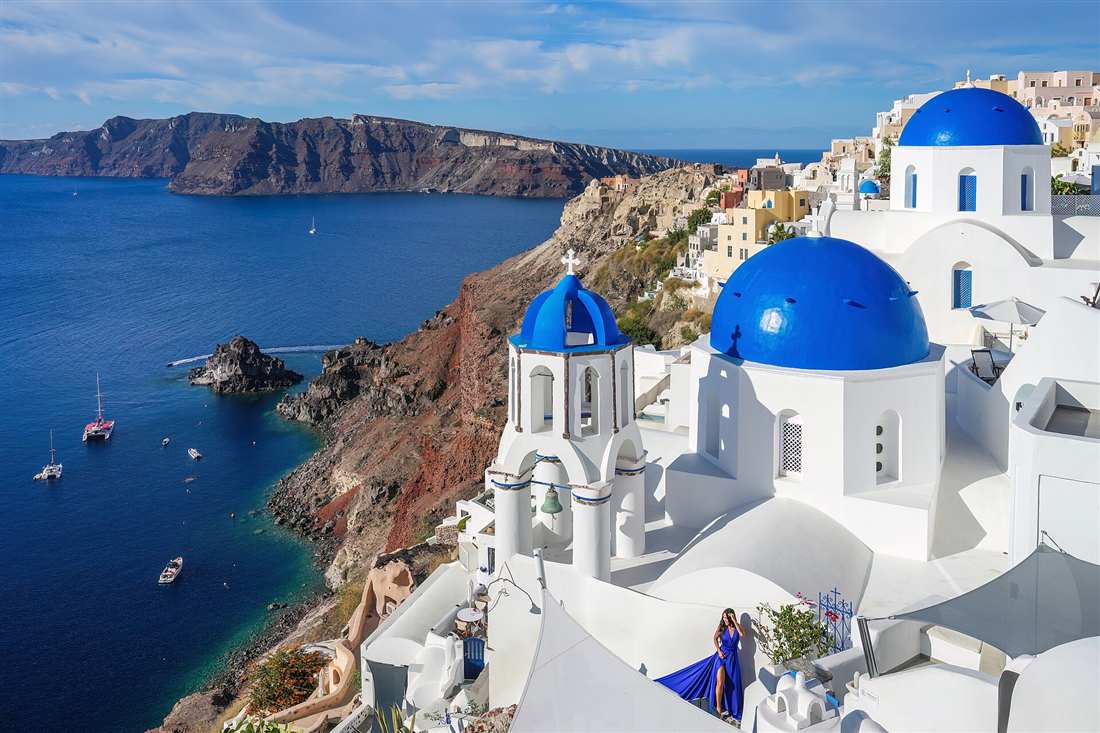
Cyclades tours cover the ring of islands in the middle of the Aegean Sea: the caldera of Santorini, the windmills of Mykonos, the sacred island of Delos, the marble villages of Naxos and Paros, the sea caves of Milos and the quiet Small Cyclades. Plan the rest of the trip with Greece Tours.
This page covers the Cyclades tours you can book, from island hopping and sailing to day trips by boat, the sights of each island, the Cycladic culture, the food and wine, the outdoor trips, and how the ferries, airports and winds shape the route.
What do Cyclades tours cover?
Cyclades tours cover the island group in the middle of the Aegean Sea: Santorini, Mykonos, sacred Delos, Naxos, Paros, Milos, Ios, Folegandros, Syros, Tinos, Andros, Amorgos and the Small Cyclades. They run as island-hopping trips, sailing cruises, day trips by boat and tours on each island.
The Cyclades lie in the Aegean Sea, south-east of the Greek mainland. The group counts about 220 islands. The name comes from the Greek word for a circle. The islands form a ring around Delos, the sacred island of Apollo. Naxos is the largest island. Syros has the largest population, and its town of Ermoupoli is the capital of the Cyclades and of the South Aegean region.
The main islands are Amorgos, Anafi, Andros, Antiparos, Delos, Ios, Kea, Kimolos, Kythnos, Milos, Mykonos, Naxos, Paros, Folegandros, Serifos, Sifnos, Sikinos, Syros, Tinos and Santorini. The Small Cyclades lie south-east of Naxos. Their inhabited islands are Ano Koufonisi, Irakleia, Schoinoussa and Donousa. Cyclades tours reach the big islands by ferry and the small ones by boat trip.
Which groups of islands do Cyclades tours visit?
- Southern Cyclades: Santorini, Therasia, Anafi, Ios, Sikinos and Folegandros.
- Central Cyclades: Naxos, Paros, Antiparos, Mykonos and Delos.
- Small Cyclades: Koufonisia, Schoinoussa, Irakleia and Donousa, between Naxos and Amorgos.
- Western Cyclades: Kea, Kythnos, Serifos, Sifnos, Milos and Kimolos.
- Northern Cyclades: Andros, Tinos and Syros.
- Eastern edge: Amorgos, the nearest Cycladic island to the Dodecanese.
Which eras do Cyclades tours cover?
Cyclades tours walk through more than five thousand years. The Cycladic culture flourished in the Bronze Age, from about 3100 BC. Its people carved flat figurines of white island marble. Bronze Age towns stood at Akrotiri on Santorini, Phylakopi on Milos, Skarkos on Ios and Kastri on Syros. The Minoan eruption of Santorini buried Akrotiri around 1600 BC.
Delos became the religious centre of the Ionian Greeks. It later held the treasury of the Delian League, founded in 478 BC. In 1207 the Venetian noble Marco Sanudo founded the Duchy of the Archipelago, with its seat on Naxos. It ruled all the Cyclades except Mykonos and Tinos. The Ottomans annexed the duchy in 1579. Tinos stayed Venetian until 1715. The islands joined the Greek state around 1830. Ermoupoli on Syros grew in the 1820s into the leading port of the new country. Cyclades tours see each of these eras in the castles, churches and ruins of the islands.
Which formats do Cyclades tours take?
- Island-hopping tours of three to seven days with ferries and hotels on two to four islands.
- Sailing and catamaran cruises of a day or a week between the islands.
- Day trips by boat from one island to another: Naxos to Santorini, Paros to Mykonos, Mykonos to Delos.
- Island tours by bus, minibus, jeep or e-bike on a single island.
- Food and wine tours in the vineyards of Santorini and the villages of Naxos and Paros.
- Outdoor tours: hiking, sea kayaking, snorkelling and windsurfing.
Our page on Greek island hopping covers the ferry routes between the island groups. Delos joined the UNESCO World Heritage list in 1990. It is the one World Heritage site of the Cyclades and a stop on Cyclades tours from Mykonos, Naxos, Paros and Tinos.
Which island-hopping Cyclades tours link the islands?
Island-hopping Cyclades tours link two to four islands in three to seven days. The standard pairs are Santorini with Mykonos, Santorini with Ios, and Naxos with Paros. The tours book the ferries and the hotels. Tours that start in Athens add the crossing from Piraeus.
The Santorini and Mykonos pair is the classic route. “Island Hopping: Santorini to Mykonos” links the two islands by ferry. “Mykonos & Santorini in 3 Days: Greek Island Escape” starts in Athens. “Island Hopping: Santorini to Ios” pairs the caldera with the beaches of Ios. Cyclades tours of this kind use the fast ferries that run between the central and southern islands in summer.
Naxos and Paros lie 8 km apart across a narrow channel. They form the heart of the central Cyclades. Island-hopping Cyclades tours stay on one and cross to the other by day. Paros lies about 150 km south-east of Piraeus. Naxos lies next to it, with the Small Cyclades to its south-east.
Which day trips link two islands?
Day trips by boat carry Cyclades tours from one island to the next and back. “Naxos: Santorini Day Trip by Boat” crosses from Naxos to the caldera. “From Paros: Day Trip to Mykonos” reaches Mykonos town. “Delos and Mykonos One Day Cruise from Naxos” stops at the sacred island and then at Mykonos. From Santorini, a full-day cruise reaches Ios. Our page on Santorini day trips lists the trips that leave the caldera.
How far apart are the islands on island-hopping Cyclades tours?
- Mykonos to Delos: 2 km, a short boat crossing.
- Paros to Antiparos: less than 2 km across the strait, with a car ferry from Pounda.
- Paros to Naxos: 8 km across the channel.
- Milos to Kimolos: a 1 km channel.
- Piraeus to Kythnos: 104 km, one to four hours by ferry.
- Piraeus to Sifnos: about 130 km; Piraeus to Syros: 144 km; Piraeus to Serifos: about 170 km.
- Lavrio to Kea: about an hour by ferry.
How do island-hopping Cyclades tours plan the route?
Ferries in the Cyclades run on lines. The western line runs from Piraeus to Kythnos, Serifos, Sifnos, Milos and Kimolos. The central line runs to Syros, Paros, Naxos, Ios and Santorini. Mykonos and Tinos connect with Rafina and Piraeus. Island-hopping Cyclades tours follow one line, because crossing between lines takes longer. The strong summer wind, the meltemi, blows at force 7 to 8 on its worst days. At that strength the inter-island ferries stay in port.
Our pages on Mykonos island hopping and Milos island hopping cover the routes from two of the main islands. Our page on travel between the Greek islands covers ferries and flights in full.
Which sailing and cruise Cyclades tours run?
Sailing Cyclades tours run from a day to a week. “Athens to Mykonos Island Hopping 7 Day Sailing Tour” sails between the islands from Athens. Day cruises by catamaran and sailing yacht leave Santorini, Mykonos, Naxos, Paros, Milos and Syros for beaches and sea caves.
Week-long sailing Cyclades tours sleep on board. They anchor in a different bay each night and stop at the island ports for dinner. A yoga and sailing retreat of seven nights also leaves Athens. The meltemi decides the route. It blows from the north from about mid-May to mid-September. It is strongest in the afternoon and dies down at night. Leisure sailors use it as a steady sailing wind.
Day cruises follow a fixed loop. On Santorini, catamarans sail the caldera, stop at the volcano and the hot springs, and swim at the beaches of the south. On Milos, they reach the sea caves of Kleftiko and the island of Polyaigos. On Naxos and Paros, they sail to the Small Cyclades. On Syros, a day cruise serves a barbecue on board. Our page on the Santorini catamaran cruise covers the caldera loop.
Which Cyclades tours sail to the Small Cyclades?
“Naxos: Full-Day Small Cyclades Sailing Cruise” leaves Naxos for the islands of the Small Cyclades and has more than 200 reviews. “Paros: Full-Day Sailing Yacht Cruise” leaves Paros for a day of swimming stops. A traditional wooden boat runs from Naxos to Koufonisia with a barbecue. Another Naxos cruise swims at the Rina sea cave on the coast of Naxos and then crosses to Koufonisi.
Which Cyclades tours sail from Syros and Tinos?
“Syros, day cruise with BBQ on board” sails from 11:30 to 17:30 and grills lunch on deck. From Tinos, boats cross to Delos and run private charters and sunset cruises along the coast. Our pages on the Tinos sunset cruise and Syros boat trips cover the northern boats. Cyclades tours in the north also sail between Andros, Tinos and Mykonos on the Rafina ferry line.
Which private boats run in the Cyclades?
Private boat tours run from each main port. Speedboats from Folegandros visit Milos and Polyaigos. RIB boats from Ios cross to Sikinos. Self-drive boats on Milos need no licence and reach Kleftiko. On Mykonos, a small yacht cruise visits Rhenia and Delos. Luxury catamarans on Mykonos and Naxos serve meals and drinks on board. Our page on Milos boat tours covers the boats of the western islands.
Cruise ships also call at the Cyclades. They anchor off Fira on Santorini, between Nea Kameni and the town, and dock at Mykonos. Our pages on the Santorini cruise port and the Mykonos cruise port cover the shore excursions.
What do Cyclades tours show on Santorini?
Cyclades tours on Santorini show the flooded caldera, the cliff-top towns of Fira and Oia, the Bronze Age town of Akrotiri, the volcano of Nea Kameni and the hot springs, Ancient Thera on Mesa Vouno and the vineyards of Assyrtiko. The island lies about 200 km south-east of the mainland.
Santorini, officially Thira, is the southernmost island of the Cyclades. It covers about 73 square kilometres. It is the largest island of a small ring of islands formed by the Santorini caldera. The ring also holds Therasia and the uninhabited Nea Kameni, Palaia Kameni, Aspronisi, Anydros and Christiana. Santorini is the most active volcanic centre of the South Aegean volcanic arc. The name comes from Saint Irene, after an old church in the village of Perissa.
The Minoan eruption struck around 1600 BC. It was one of the largest volcanic eruptions in human history. It left a sea-filled caldera and ash deposits hundreds of metres deep. The eruption destroyed the town at Akrotiri and damaged the coast of Crete with earthquakes and tsunamis. Ancient writers called the island Kalliste, “the most beautiful one”. The name Thera came from Theras, the leader of its Spartan settlers.
What do Cyclades tours see in Fira and Oia?
Fira is the capital of Santorini. Its white houses stand on the edge of the caldera, 400 metres above the sea. From Fira the view spans the 18 km caldera, from Cape Akrotiri to Cape Agios Nikolaos. A cable car, a zigzag footpath and donkeys link the town with its old port. The Archaeological Museum of Thera and the Museum of Prehistoric Thera stand in the town.
Oia covers the north-west tip of Santorini and the whole of Therasia. Its two-storey captains’ houses recall the merchant fleet of the late 19th century. In 1890 Oia had about 2,500 residents and 130 sailing ships. The earthquake of 9 July 1956 destroyed part of the town. It then rebuilt itself as a tourist town. Cyclades tours end the day in Oia for the sunset over the caldera. Our page on Oia covers the village.
What is Akrotiri?
Akrotiri is a Bronze Age town buried by the eruption. The ash preserved its streets, its three-storey buildings and its wall paintings. Only the southern tip of the town has been uncovered. Walls stand up to eight metres high. Spyridon Marinatos began the modern excavation in 1967. Linear A inscriptions and the style of the frescoes link the town to Minoan Crete. An Akrotiri entry ticket with audio commentary covers the visit. Our page on Akrotiri covers the site.
What do Cyclades tours see at the volcano?
Nea Kameni stands in the middle of the caldera. It is about 2 km across. Eruptions built it over the past two thousand years, the last in 1950. Boats land visitors at its shore, and a gravel path climbs to the rim of a crater 130 metres high. “Santorini: Volcano and Hot Springs Boat Tour” adds a swim in the warm water off Palaia Kameni. Ancient Thera stands on the limestone hill of Mesa Vouno, above Kamari. Spartan settlers founded it. A street almost 800 metres long crosses the site. “Santorini: Top Sights Day Trip, Wine Tasting, & Oia Sunset” has more than 3,000 reviews. Our page on Santorini covers the island in full.
What do Cyclades tours show on Mykonos?
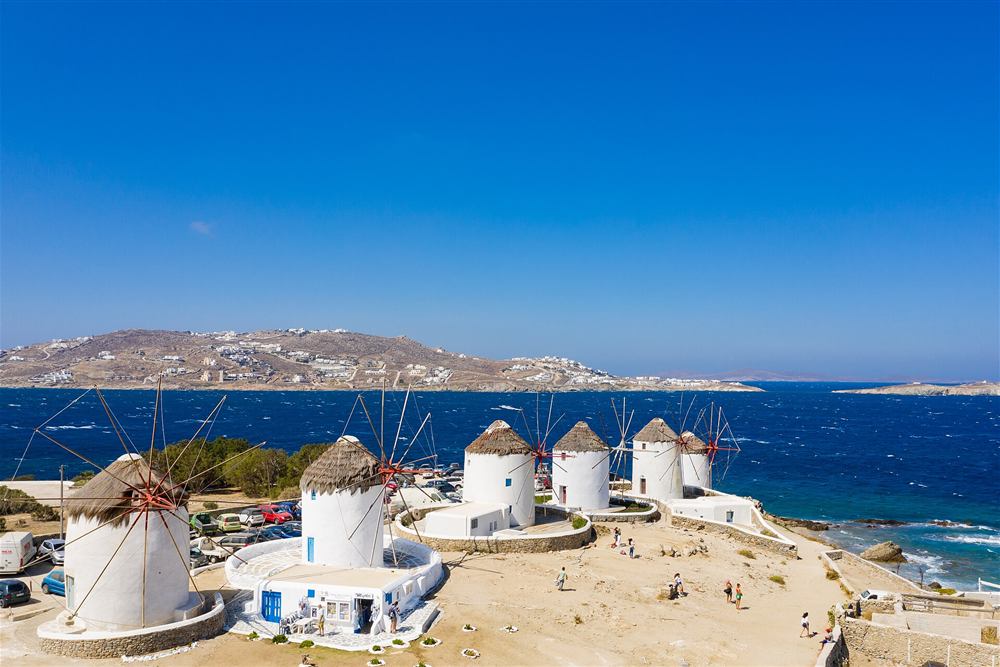
Cyclades tours on Mykonos show the town of Chora with its windmills, Little Venice and the church of Panagia Paraportiani, the beaches of the south coast, and the boat crossing to Delos, 2 km away. Mykonos is called “the Island of the Winds”.
Mykonos lies between Tinos, Syros, Paros and Naxos. It covers 85.5 square kilometres and rises to 341 metres at its highest point. The main town, Mykonos or Chora, stands on the west coast. The name comes either from the ancient word for a pile of stones or from the hero Mykonos, son of Anius. The island owes its nickname to the strong winds that blow across it.
Walking Cyclades tours in Chora follow the lanes from the harbour to Little Venice. There, houses with balconies stand on the edge of the sea. The windmills line the ridge above the quarter. Panagia Paraportiani, “Our Lady of the Side Gate”, stands in the Kastro quarter. It joins five churches in one whitewashed building. Four stand at ground level and carry the fifth on top. Work on it began in 1425 and ended in the 17th century.
Which history do Cyclades tours tell on Mykonos?
Herodotus names the Carians as the first people of Mykonos. Ionians from Athens followed in the 11th century BC. Delos lay 2 km away, so Mykonos served as a supply and transit island for the sanctuary. After the Fourth Crusade, Andrea Ghisi took the island in 1204. Venice ruled it directly from 1390. In 1537 the Ottoman admiral Hayreddin Barbarossa took it, and it stayed Ottoman until 1830.
In the War of Independence of 1821, Mykonos followed Manto Mavrogenous. She was an educated aristocrat who spent her family fortune on the Greek cause. Her statue stands in Manto Mavrogenous Square in the town. The island airport also carries her name. It lies 4 km from the town and first opened in 1971. Our page on Mykonos covers the island in full.
Which Cyclades tours start on Mykonos?
Mykonos is a base for boat Cyclades tours. “From Mykonos: Delos Island Round-Trip Boat Transfer” carries visitors to the sacred island. “From Mykonos: Ancient Delos Tour” adds a tour of the ruins, and a small-group visit runs with a licensed expert. A yacht cruise from Mykonos adds a swim at Rhenia to the Delos visit, and it has more than 800 reviews. Luxury catamarans sail the south coast with meals on board. A ferry links Mykonos with Naxos for travellers moving on. Our page on Mykonos boat tours covers the boats.
The beaches of the south coast draw the day visitors. Buses and small boats link Chora with the beaches of Ornos, Psarou, Paradise and Super Paradise. Tinos lies across the strait to the north-west. Our page on the Tinos day trip from Mykonos covers the crossing.
What do Cyclades tours see on Delos?
Cyclades tours on Delos visit the sacred island where myth placed the birth of Apollo and Artemis. The ruins cover temples, the Terrace of the Lions, the houses of the merchants, the theatre quarter and Mount Cynthus. Delos joined the UNESCO World Heritage list in 1990.
Delos is a small island near Mykonos, close to the centre of the Cyclades. It covers only 3.43 square kilometres. Yet it is one of the main mythological, historical and archaeological sites of Greece. The excavations here are among the largest in the Mediterranean. Finds stand in the Archaeological Museum of Delos and in the National Archaeological Museum in Athens.
Stone huts show that people lived on Delos from the third millennium BC. Between 900 BC and AD 100 it was a major cult centre. Dionysus and Leto, the mother of Apollo and Artemis, were worshipped here along with the twins. The island drew pilgrims first from the Ionian Greeks and later from all Greece. Our page on Delos covers the site.
Why was no one born or buried on Delos?
Athens performed “purifications” to keep the island fit for the gods. In the 6th century BC the tyrant Pisistratus moved every grave in sight of the temple. In 426 BC, in the sixth year of the Peloponnesian War, the whole island was cleared of graves on the advice of the Delphic Oracle. A new decree banned all births and deaths on Delos. Pregnant women and the dying were carried to Rhenia next door. The southern half of Rhenia became the cemetery of Delos. Today Rhenia is uninhabited and covers 14 square kilometres.
What do Cyclades tours walk past on Delos?
Boats land at the Sacred Harbour. From there, three conical mounds are visible, landscapes held sacred to a goddess. The path leads past the sanctuary of Apollo and the Terrace of the Lions. The Naxians dedicated the marble lions in the 7th century BC, and the originals now stand in the site museum. The Delian League met here after 478 BC and kept its treasury on the island until Pericles moved it to Athens in 454 BC.
In the Hellenistic period Delos became a great free port. A Phoenician colony traded here, and merchants from across the Mediterranean built houses with mosaic floors. UNESCO describes the site as the image of a great cosmopolitan Mediterranean port. Mount Cynthus, which keeps its pre-Greek name, rises above the ruins. A sanctuary of Zeus crowns its summit. Cyclades tours with time to spare climb it for the view over the ring of islands.
Which Cyclades tours reach Delos?
Boats to Delos leave from Mykonos, Naxos, Paros and Tinos. No one stays on the island overnight. Our page on the Delos tour from Mykonos covers the short crossing. Our page on the Tinos to Delos cruise covers the route from the north. Cyclades tours from Naxos combine Delos with an afternoon in Mykonos town.
What do Cyclades tours show on Naxos?
Cyclades tours on Naxos show the Portara on its islet, the Venetian Kastro of Chora, the Temple of Demeter at Sangri, the mountain villages of Filoti, Apeiranthos and Chalki, the unfinished kouroi in the marble quarries, and Mount Zas, at 1,001 metres the highest peak of the Cyclades.
Naxos is the largest island of the Cyclades. Its capital, Chora or Naxos town, is the largest town. The main villages are Filoti, Apeiranthos, Vivlos, Agios Arsenios, Koronos and Glinado. The island was a centre of the Cycladic culture of the Bronze Age and of the Archaic period. It was also a source of emery, a hard rock used as an abrasive. Herodotus called Naxos, around 500 BC, the most prosperous Greek island.
Myth ties Naxos to the gods. The young Zeus grew up in a cave on Mount Zas. Theseus left Ariadne on the island after she helped him kill the Minotaur. Dionysus, the protector of Naxos, found her there and fell in love with her. The Richard Strauss opera Ariadne auf Naxos tells that part of the story.
What is the Portara?
The Portara, “the great door”, is the marble gateway of an unfinished temple of Apollo. The tyrant Lygdamis began the temple around 530 BC. It was of the Ionic order, 38 metres long and 16 metres wide, and faced the sacred island of Delos. Work stopped around 524 BC, when Sparta removed Lygdamis from power. The door frame is made of marble blocks of up to 20 tons each. They came from the quarry at Flerio, about 10 km away. Unfinished kouroi, huge marble statues of young men, still lie in the ancient quarries at Flerio and Apollonas. The islet of Palatia joins the town by a causeway built in 1919. Crowds gather here at sunset. Entry is free. Our page on the Portara of Naxos covers the monument.
“Naxos Castle Walking Tour and Sunset at the Portara” climbs through the Venetian Kastro to the gate. Marco Sanudo founded the Duchy of the Archipelago here in 1207 and rebuilt the fortress of the town. The Archaeological Museum of Naxos stands in the Kastro. It fills a Venetian building that once housed a Jesuit school, and it became a museum in 1972. Its collection holds Early Cycladic figurines from Naxos, Kato Koufonisi and Keros.
Which villages do Cyclades tours visit on Naxos?
Apeiranthos stands 28 km north-east of Chora, at 650 to 700 metres. It is built on the foothill of Mount Fanari. Its dialect and customs resemble those of the mountain villages of Crete. The village has four museums: archaeology, folk art, geology and natural history. It is the second largest village of the island after Filoti. “Authentic Naxos: Demeter temple, Apiranthos, Filoti & Chalki” covers the inland route with the marble Temple of Demeter at Sangri. Chalki holds the first distillery of kitron, opened in 1896.
Mount Zas overlooks Filoti. The Cave of Zeus lies at 628 metres on its western slope. Two main paths reach the summit: the easy one from the chapel of Agia Marina and a harder one from the Aria spring past the cave. A led hike from the villages climbs the peak. “Experience Marble Carving: Naxos Island” teaches work in the island marble. Our page on hiking on Naxos covers the trails. Our page on Naxos covers the island.
Which Cyclades tours reach the Small Cyclades and Amorgos?
Cyclades tours to the Small Cyclades sail from Naxos to Koufonisia, Schoinoussa, Irakleia and Donousa, 32 islands and rocks between Naxos and Amorgos. They pass Keros, a key site of the Cycladic culture. Amorgos, further east, is known for the Hozoviotissa monastery on its cliff.
The Small Cyclades lie south-east of Naxos. They count 32 islands and rocks. Four are inhabited: Ano Koufonisi, Irakleia, Schoinoussa and Donousa. Irakleia is the largest, at 18 square kilometres. Ano Koufonisi has the largest population. Since the 11th century, the Hozoviotissa monastery of Amorgos has owned large parts of these islands. In the last ice age they formed one landmass. The sea rose around 9000 BC and cut them apart. Our page on the Small Cyclades from Naxos covers the boat trips.
What do Cyclades tours find on Koufonisia?
Koufonisia is a group of three islands: Ano Koufonisi, Kato Koufonisi and Keros. Ano Koufonisi is the smallest and most densely populated island of the group. Kato Koufonisi covers 4.3 square kilometres and holds only rural houses. Its small church of Panagia stands on a jetty over ancient ruins. Pirates once used the channel between the two islands as a shelter. A traditional boat from Agia Anna on Naxos cruises to Koufonisia with a barbecue on board. Our page on Koufonisia covers the islands.
Keros lies about 10 km south-east of Naxos. It covers 15 square kilometres and is uninhabited. Landing is forbidden. The island was a major site of the Cycladic culture around 2500 BC. The “Keros Hoard” of broken marble figurines was found here. On the islet of Daskalio, once joined to Keros, excavators found the largest building of its period in the Cyclades, 16 metres long. Cyclades tours sail past Keros on the way to Koufonisia.
What do Cyclades tours find on Schoinoussa, Irakleia and Donousa?
Schoinoussa lies south of Naxos, between Irakleia and Koufonisia. It covers 8.5 square kilometres. Its three settlements are Chora, Mesaria and the port of Mersini. It records the second lowest average rainfall in Greece, about 240 mm a year. Donousa is the easternmost of the Small Cyclades. It lies 16 km east of Naxos and 25 km north of Amorgos. Myth says Dionysus hid Ariadne here from Theseus. Our pages on Schinoussa, Iraklia and Donousa cover each island.
What do Cyclades tours see on Amorgos?
Amorgos is the easternmost island of the Cyclades and the nearest to the Dodecanese. With 16 islets it forms a municipality of 126 square kilometres. In antiquity it held three city-states: Arkesini, Minoa and Aigiali. The walls of Arkesini survive. Amorgos gave its name to two types of Cycladic figurine. The Kapsala type dates to around 2700 BC, and the Dokathismata type to 2400–2100 BC.
The Hozoviotissa monastery stands against a sheer cliff above the sea near Chora. It has owned land in the Small Cyclades since the 11th century. Walking Cyclades tours climb the stairway to its door and follow the old paths between Chora, Aigiali and the monastery. Our pages on Amorgos and hiking on Amorgos cover the island and its trails.
What do Cyclades tours show on Paros and Antiparos?
Cyclades tours on Paros show the Byzantine church of Panagia Ekatontapiliani in Parikia, the fishing harbour of Naousa, the mountain village of Lefkes, the ancient marble quarries and the windsurfing beaches of the east coast. A short ferry from Pounda crosses to Antiparos, its cave and the sanctuary island of Despotiko.
Paros lies 8 km west of Naxos and about 150 km south-east of Piraeus. It covers 165 square kilometres. A single mountain, 724 metres high, slopes down on all sides to a coastal plain. The island is made of marble. In antiquity its fine white stone gave the word Parian to marble of this quality. The poet Archilochus was born on Paros.
Parian marble was the stone of the great sculptors. The Venus de Milo, the Winged Victory of Samothrace and the Medici Venus are carved from it. The ancient quarries lie at Marathi, Chorodaki and Agios Minas. Two shafts at Agios Minas carry the names Grotto of the Nymphs and Grotto of Pan, after the reliefs at their entrances. Cyclades tours on Paros reach the quarries of Marathi by road from Parikia.
What do Cyclades tours see in Parikia and Naousa?
Panagia Ekatontapiliani stands in Parikia, the port town. Its name means “the church of a hundred gates”. Tradition dates it to 326 and links its founding to Saint Helen, the mother of Constantine the Great. Justinian added to the building. It holds a main church, two chapels and a baptistery with a cross-shaped font. Legend says the church has 99 known doors and one hidden door. It is the second Marian pilgrimage church of the Aegean after Tinos.
Naousa is a fishing village in the north-east of Paros. The Venetians founded it in the late 14th century and built a small fortress to guard the port. Part of it still stands. From 1770 to 1775 Naousa served as a Russian naval base during the Orlov Revolt. The beach of Kolympithres lies nearby. A highlights tour links the village with the inland village of Lefkes, on the slopes of the central mountain. Our page on Paros tours covers the island routes.
Which outdoor Cyclades tours run on Paros?
The strong wind in the strait between Paros and Naxos makes the east coast a centre for windsurfing. Golden Beach near Drios and the beaches of Pounda, Logaras and Piso Livadi line the coast. A fishing trip leaves Naousa or Piso Livadi with lunch on board. “Paros: Greek Cooking Class with Full Meal” and a wine tour run inland. Our page on Paros covers the island in full.
What do Cyclades tours see on Antiparos?
Antiparos lies less than one nautical mile south-west of Paros. A car ferry sails all day from Pounda, 5 km south of Parikia. A passenger ferry also runs from Parikia. The island is 11 km long and 4.5 km wide. Its highest point, Agios Ilias, reaches 308 metres. Its ancient name, Oliaros, probably meant “wooded mountain”. The main village grew around a Venetian castle. Bougainvillea covers its white houses.
The Cave of Antiparos holds halls of stalactites and stalagmites. Saliagos, an islet nearby, is the oldest known settlement of the Cyclades. Despotiko, 700 metres south-west of Antiparos, is uninhabited, but excavations there have revealed an important sanctuary. Boats reach it from Agios Georgios. “Pounda: Paros & Antiparos Cruise, Swimming & Lunch” has more than 480 reviews. Our pages on Antiparos and the Antiparos day trip from Paros cover the island.
What do Cyclades tours show on Milos and Kimolos?
Cyclades tours on Milos show the white volcanic rock of Sarakiniko, the sea caves of Kleftiko, the cliff-top town of Plaka, the Christian catacombs, the Bronze Age town of Phylakopi and the place where the Venus de Milo was found. Boats cross 1 km to Kimolos and sail to Polyaigos.
Milos is a volcanic island and the south-westernmost of the Cyclades. With its uninhabited islets it covers 160 square kilometres. Obsidian, a volcanic glass, was traded from Milos as early as 15,000 years ago. Boats beached on its coves, and their crews cut the stone from the quarries. The trade made Milos an early centre of the Aegean world, between mainland Greece and Crete. Our page on Milos covers the island.
What did Milos give the world’s museums?
The Venus de Milo was found on Milos in 1820. It has stood in the Louvre since 1821. The statue is carved from Parian marble and stands over 2 metres high. It shows Aphrodite and dates from the Hellenistic period, around the 2nd century BC. The Poseidon of Melos stands in the National Archaeological Museum in Athens. The Asclepius of Milos is in the British Museum.
Phylakopi lies on the north-east coast. It was a Bronze Age town, lived in from the mid-3rd millennium BC to the 12th century BC. The British School at Athens first dug it from 1896 to 1899. A room there held the fresco of the flying fish. Its Mycenaean megaron has a main hall about 8.6 by 6.2 metres. “Milos Island: Archaeology & Culture Tour” covers these sites.
What do Cyclades tours see in Plaka and the catacombs?
Plaka, officially Milos, is the chief town. It sits on top of a large rock above the gulf of Milos. Cars cannot enter its lanes. The Catacombs of Milos lie below it, near Trypiti. They are an underground Christian cemetery of the 1st to 5th centuries AD. They stand next to the ancient agora and 200 metres east of the ancient theatre. Their galleries measure 1 to 5 metres wide and 1.6 to 2.5 metres high.
Which boat Cyclades tours sail from Milos?
Sarakiniko lies on the north shore. Wind and waves have shaped its grey-white volcanic rock into smooth forms. Locals compare it to the surface of the moon. The wreck of the ship “Africa” lies on its east side. Kleftiko lies on the south-west coast. Its white cliffs, arches and sea caves are reached mainly by boat. “Milos: Full day Milos and Poliegos Catamaran Cruise” has more than 90 reviews. Morning and half-day catamarans reach Kleftiko with lunch. Our page on Kleftiko covers the sea caves.
What do Cyclades tours see on Kimolos and Polyaigos?
Kimolos lies north-east of Milos across a 1 km channel. It covers 36 square kilometres. Its main village, Chorio, stands on a hill in the south-east. In the Middle Ages the island was called Argentiera, after the silver-coloured rocks of its south coast. Those rocks gave “Kimolian earth”, a white clay used in antiquity as fuller’s earth. Skiadi, a huge mushroom-shaped rock, stands in a valley inland. Wind-blown dust carved it over centuries.
Polyaigos lies east of Kimolos. It is the largest uninhabited island of the Aegean. Its name means “many goats”, and only goats live there. Its southern beaches and sea caves shelter Mediterranean monk seals. Our pages on Kimolos and the Kimolos day trip from Milos cover the crossing.
What do Cyclades tours show on Sifnos, Serifos, Kythnos and Kea?
Cyclades tours in the western islands show the pottery villages and cliff-top Kastro of Sifnos, the hilltop Chora and iron mines of Serifos, the hot springs of Kythnos at Loutra, and Ioulis on Kea, the Cycladic island closest to Athens. Ferries run on the Piraeus–Kythnos–Serifos–Sifnos–Milos line.
The western Cyclades form a chain south-east of Attica. Ferries from Piraeus call at Kythnos, Serifos, Sifnos, Milos and Kimolos in turn. Kea and Kythnos also connect with Lavrio, 60 km south-east of Athens. Cyclades tours in the west move down the chain one island at a time.
What do Cyclades tours see on Sifnos?
Sifnos lies between Serifos and Milos, about 130 km from Piraeus. It is 15 km long and 7.5 km wide. The main town is Apollonia, home of the folklore museum. Its name comes from an ancient temple of Apollo. Artemonas, the second town, takes its name from a temple of Artemis. Kastro stands on a high cliff on the east shore. It was the capital until 1836, and it keeps medieval houses and the archaeological museum. The port is Kamares, on the west coast.
Sifnos was rich in antiquity. Its gold, silver and lead mines worked from the 3rd millennium BC. The Siphnians built a treasury at Delphi in the 6th century BC to hold their offerings. They were among the first Greeks to mint coins, from around 600 BC. Ancient mines survive at Agios Sostis. Our pages on Sifnos and Sifnos boat trips cover the island.
What do Cyclades tours see on Serifos?
Serifos lies south of Kythnos and north-west of Sifnos, about 170 km from Piraeus. In myth, Danae and the infant Perseus washed ashore here in a wooden chest. Perseus later returned with the head of Medusa and turned King Polydektes to stone. Chora stands on a hilltop below a medieval castle. In the late 19th century the island mined iron ore. The mines closed in the 1960s. The Aspros Pyrgos, a marble watchtower of about 300 BC, stands near Mega Chorio. The fortified Monastery of the Taxiarchs was built in 1572 near Galani. Our page on Serifos covers the island.
What do Cyclades tours see on Kythnos and Kea?
Kythnos is also called Thermia, after its hot springs. It lies between Kea and Serifos, 104 km from Piraeus. Loutra, in the north-east, keeps a working bathhouse fed by thermal springs. Chora and Dryopida are the two main villages. Chora has flat Cycladic roofs, and Dryopida has sloping tiled roofs. A Mesolithic settlement at Maroulas, from 10,000 to 8,000 BC, is one of the oldest in the Cyclades. The port is Merichas. Our page on Kythnos covers the island.
Kea is the Cycladic island closest to Attica. It lies about an hour by ferry from Lavrio and 20 km from Cape Sounio. Its capital, Ioulis, stands inland on a height, like the old Cycladic towns built for fear of pirates. The port is Korissia, and Vourkari is a fishing village. In the Archaic period Kea held four city-states: Ioulis, Karthaia, Poieessa and Koressos. The poets Simonides and Bacchylides were born here. A Bronze Age town stood at Agia Irini. Our page on the Kea day trip from Athens covers the short crossing.
What do Cyclades tours show on Ios, Folegandros and Sikinos?
Cyclades tours in the southern islands show the hilltop Chora and Bronze Age Skarkos on Ios, the cliff-edge Chora of Folegandros 200 metres above the sea, the quiet wine island of Sikinos with its temple-church of Episkopi, and Anafi east of Santorini.
Ios lies halfway between Naxos and Santorini. It covers 109 square kilometres, and its coast runs 86 km, with 32 km of sandy beaches. A footpath climbs from the port at Ormos to Chora, the main village. Chora has whitewashed houses, narrow lanes and steep stairways closed to cars. Plutarch linked the name Ios to the violets, “ia”, that grew on the island. Islanders still call it Nio. The highest point, Kastro, reaches 723 metres. Tradition places the tomb of Homer on Ios. Our page on Chora of Ios covers the village.
Skarkos stands on a hill near the west coast, just outside Chora. It is an Early Cycladic settlement of the mid-3rd millennium BC. Its two-storey houses and walls up to four metres high survive. It covers 1.1 hectares and housed 200 to 300 people. It is the largest and best preserved site of the Keros-Syros culture. Its conservation won an EU prize for cultural heritage. Boat Cyclades tours from Ios sail to Mylopotas and the beaches of the south. Our page on Ios covers the island.
What do Cyclades tours see on Folegandros?
Folegandros forms the southern Cyclades with Sikinos, Ios, Anafi and Santorini. It covers 32 square kilometres. It has three villages: Chora, the port of Karavostasis and Ano Meria. A paved road joins them. Chora stands on the edge of a cliff 200 metres high. The poet Aratus called the island “iron Folegandros” for its rugged ground. Venice ruled it from 1207 for more than three centuries.
The coast holds tall cliffs and a large cave. Katergo beach is reached only on foot or by boat from Karavostasis. Ano Meria has an ecological and folklore museum. Boat Cyclades tours from Folegandros run group trips with snorkelling, private sunset cruises and speedboat trips to Milos and Polyaigos. Wine tastings run at the Domaine Paliomilos. Our pages on Folegandros and Folegandros boat tours cover the island.
What do Cyclades tours see on Sikinos and Anafi?
Sikinos lies midway between Ios and Folegandros. In antiquity it was called Oinoe, “island of wine”. Terraces once used for farming cover almost the whole island. The port is Alopronia. The Chora on the hill joins two settlements, Kastro and Chorio. Seven mapped footpaths cross the island. Episkopi, an ancient building later turned into a church, stands inland. Scholars now see it as a Roman mausoleum and later Byzantine church. Its restoration won a Europa Nostra award. “From Ios: RIB Boat Trip to Sikinos Island and Winery Tour” crosses from Ios. Our page on Sikinos covers the island.
Anafi lies east of Santorini. It covers 40 square kilometres. Myth says Apollo made it appear to the Argonauts as a shelter from a storm. At the monastery of Panagia Kalamiotissa stand ruins of a temple of Apollo Aegletus. Mount Kalamos rises above the monastery as a huge rock. Our page on Anafi covers the island, and our page on Thirasia covers the other small island of the Santorini ring.
What do Cyclades tours show on Syros, Tinos and Andros?
Cyclades tours in the northern islands show Ermoupoli on Syros, the neoclassical capital of the Cyclades, and medieval Ano Syros above it; the pilgrimage church of Panagia Evangelistria, the dovecotes and the marble villages of Tinos; and the green valleys, hiking paths and Neolithic Strofilas of Andros.
Syros lies 144 km south-east of Athens. It covers 83.6 square kilometres. Ermoupoli, the “Town of Hermes”, is the capital of the island, of the Cyclades and of the South Aegean region. Refugees from other islands founded it in the 1820s, during the War of Independence. It soon became the leading commercial and industrial centre of Greece and its main port. The Greek Steamship Company was founded here in 1856. Piraeus overtook it in the late 19th century.
Walking Cyclades tours in Ermoupoli start in Miaoulis Square, with the city hall, cafés and palm trees. The quarter of Vaporia holds the neoclassical mansions of the sea captains. Ano Syros stands on the hill of San Giorgio, north-west of the port. The Venetians built it in the early 13th century. Marble steps lead up through its lanes to the Catholic cathedral of Saint George, with a view over Tinos, Delos, Mykonos, Paros, Andros and Naxos. The rebetiko musician Markos Vamvakaris and Demetrius Vikelas, the first president of the International Olympic Committee, were born on Syros. Our pages on Syros and the Syros walking tour cover the town.
What do Cyclades tours see on Tinos?
Tinos lies between Andros, Delos and Mykonos. It covers 194 square kilometres. The island is known across Greece for the church of Panagia Evangelistria and its icon of the Virgin Mary. Every 15 August, on the feast of the Dormition, pilgrims fill the town. Pilgrims cross the 800 metres from the ferry wharf to the church on their knees. The same date recalls the sinking of the Greek cruiser Elli in the harbour in 1940 by an Italian submarine.
Tinos also has about 80 windmills, about 1,000 decorated dovecotes and 50 active villages. Venetian fortifications crown the mountain of Exomvourgo. Venice held the island until 1715. Orthodox and Catholic communities live side by side. The island gave Greece the painters Nikolaos Gysis and Nikiforos Lytras and the sculptor Yannoulis Chalepas. Its marble villages keep the craft of carving alive. Our pages on Tinos and Tinos tours cover the island.
What do Cyclades tours see on Andros?
Andros is the northernmost island of the Cyclades. It lies about 10 km south-east of Euboea and 3 km north of Tinos. It is nearly 40 km long and up to 16 km wide. It is mountainous, with fertile valleys and plenty of water. The main towns are Chora, Gavrio, Batsi and Ormos Korthiou. At Apoikia the spring of Sariza flows from a carved stone lion’s head.
Strofilas, on the west coast, was the largest organised Neolithic settlement of the Cyclades. It dates to about 4500–4000 BC. Its walls carry rock carvings of animals and a flotilla of ships. Zagora, a walled town of the 10th to 8th centuries BC, lies nearby. Palaeopolis, the ancient capital, was built into a steep hillside. The breakwater of its harbour lies under the water. Our pages on Andros tours and hiking on Andros cover the island.
What do Cyclades tours show of Cycladic culture?
Cyclades tours show the Bronze Age Cycladic culture through its marble figurines, its towns at Akrotiri, Phylakopi, Skarkos and Kastri, and the sanctuary of Keros. The Museum of Cycladic Art in Athens holds more than 3,000 objects, and island museums in Fira, Naxos, Milos and Ios hold local finds.
The Cycladic culture flourished on the islands in the Bronze Age, from about 3100 BC. Its early phase ran until about 2300 BC. Its people farmed, fished for tuna and sailed between the islands in long oared boats. They carved flat, schematic figurines from the pure white marble of the islands. They show women far more than men, and the canonical type is a reclining woman with folded arms. The purpose of the figures remains unknown.
The archaeologist Christos Tsountas dug burial sites across the islands in 1898 and 1899 and coined the term “Cycladic civilisation”. In the 20th century collectors prized the figures for their modern look, close to the work of Brancusi and Arp. Looters robbed graves to supply the market, and forgeries spread. Cyclades tours learn the story in the island museums.
Which sites of Cycladic culture do Cyclades tours visit?
- Akrotiri, Santorini: a Bronze Age town buried in ash around 1600 BC, with three-storey houses and frescoes.
- Phylakopi, Milos: a town lived in through the whole Bronze Age, with the flying fish fresco.
- Skarkos, Ios: the best preserved site of the Keros-Syros culture, with walls up to four metres.
- Kastri, Syros: a hilltop town of 2800–2300 BC, one of the first in Greece with stone walls and round bastions.
- Keros and Daskalio: a sanctuary of broken figurines and the largest Early Bronze Age site of the Cyclades.
- Strofilas, Andros: a fortified Neolithic village with rock carvings of ships.
Where do Cyclades tours see the figurines?
The Museum of Cycladic Art stands in the centre of Athens. Nikolaos and Dolly Goulandris founded it in 1986 to house their collection. It holds more than 3,000 objects. Its temporary exhibitions fill the neoclassical Stathatos Mansion. Cyclades tours that start or end in Athens visit it before or after the islands.
On the islands, the Archaeological Museum of Naxos shows figurines from Naxos, Kato Koufonisi and Keros. The Museum of Prehistoric Thera in Fira shows the frescoes and finds of Akrotiri. The museum in Chora of Ios shows the finds of Skarkos. Amorgos gave its name to the Kapsala and Dokathismata types of figurine. The Early Cycladic “frying pans” are another puzzle: flat clay discs with a handle and carved decoration. The Naxos museum shows one from Koufonisia with a nine-rayed star. The Spedos type, with softer rounded forms, is the most common of all.
What food and wine do Cyclades tours taste?
Food Cyclades tours taste the Assyrtiko and Vinsanto wines of Santorini, grown in basket-shaped vines on volcanic soil, the kitron liqueur and cheeses of Naxos, and the island cooking of Paros, Naxos and Folegandros in classes and food walks. Wine tastings run on Santorini, Naxos, Paros, Ios and Folegandros.
Assyrtiko is a white grape native to Santorini. It grows in the dry, ash-rich volcanic soil of the island. Santorini is described as free of phylloxera, so its old vines grow on their own roots. Growers train the vines low to the ground in basket shapes called kouloura. The baskets shield the grapes from the wind and the sun. Assyrtiko keeps its acidity even when the grapes are very ripe. Its wines have a stony, citrus and salty profile.
Vinsanto is the sweet wine of Santorini. It is made from grapes dried in the sun after the harvest. Under Venetian rule, Santorini wine sold across the Mediterranean and Europe. It survived long sea voyages thanks to its sugar and alcohol. The Russian Orthodox Church adopted Santorini wine for the Eucharist. Nykteri, the “night wine”, was once the island’s leading white. Santorini also grows Athiri, Aidani and the red Mandilaria. “Santorini: Top Sights Day Trip, Wine Tasting, & Oia Sunset” joins a winery with the sunset. Our page on the Santorini food tour covers the island kitchen.
What do Cyclades tours taste on Naxos?
Kitron is a citron liqueur made only on Naxos. It is distilled from the fruit and the leaves of the citron tree. It comes in three kinds. The green is the sweetest, at 30 percent alcohol. The clear stands at 33 percent. The yellow is the strongest, at 36 percent, with the least sugar. The first distillery opened in Chalki in 1896. Islanders drink it after meals.
“Naxos: Naxos Town Food Tour with Tastings and Wine” has more than 300 reviews. “Kourounochori, Naxos: Gregory’s Traditional Cooking Class” cooks in a mountain village. A winery tour pairs Naxos wine with local cheeses, and a sunset tour mixes wine with mythology. A private e-bike tour ends with a farm lunch. Our page on the Naxos food tour covers the stops.
What do Cyclades tours taste on the other islands?
- Paros: “Paros: Greek Cooking Class with Full Meal”, a wine tour and tasting, and an evening of Aegean food in Naousa.
- Folegandros: wine tasting at the Domaine Paliomilos and an eight-course food and wine pairing.
- Ios and Sikinos: a RIB crossing from Ios to a winery on Sikinos, the ancient “island of wine”.
- Syros: a food walk through the lanes of Ermoupoli.
- Mykonos: a food tour of the town and meals on board the catamarans.
Our pages on the Paros food tour, the Syros food tour and the Folegandros wine tasting cover these tastings.
Which outdoor Cyclades tours run on land and sea?
Outdoor Cyclades tours include hikes up Mount Zas on Naxos and on the path networks of Andros, Tinos, Amorgos and Paros, sea kayaking at the Rina cave on Naxos, snorkelling from boats off Ios and Folegandros, windsurfing on the Paros–Naxos strait, e-bike rides and a via ferrata on Tinos.
Hiking Cyclades tours walk the old stone paths between villages. On Naxos, the climb to Mount Zas starts at the chapel of Agia Marina or at the Aria spring. On Amorgos, the paths join Chora, the Hozoviotissa monastery and Aigiali. On Sikinos, seven mapped footpaths cross the terraces. Our pages on hiking on Tinos, hiking on Paros and the Syros hiking trails cover the routes of each island.
Tinos has a via ferrata, a protected climbing route with fixed cables. Our page on the Tinos via ferrata covers the route. Kythnos has the thermal waters of Loutra at the end of a walking day.
Which sea Cyclades tours paddle, dive and surf?
“Naxos: Rhina Cave and Coastline Sea Kayaking Tour” starts from Eggares and has more than 100 reviews. It paddles into the Rina sea cave. A farm and sea kayak tour at Kampos on Naxos adds snorkelling and a picnic. Private boats from Ios and Folegandros stop for snorkelling in clear coves. Milos has sea caves at Kleftiko and on Polyaigos, where monk seals shelter.
The meltemi turns the Cyclades into a windsurfing ground. The strait between Paros and Naxos has a constant strong wind. The beaches of the east coast of Paros serve the surfers. Leisure sailors use the same wind for day sails. On Ios, e-bike tours climb the hills above Chora. On Santorini, quad bikes run the island roads.
Which land Cyclades tours run on the islands?
Bus and minibus tours cover the larger islands in a day. Two highlights bus tours on Naxos stop at the villages and a beach. “Naxos Small Group Tour: Explore Naxos Villages by Minibus” has a rating of 4.9. On Paros, a local driver takes small groups to the hidden villages, including Prodromos and Lefkes. On Santorini, a five-hour semi-private tour and a customised private tour cover the villages, the wineries and the caldera views. Quad bikes and ATVs run on Santorini, Mykonos and Paros. Our pages on the Mykonos ATV quad tour and the Paros ATV quad tour cover the rentals with a route.
Which Cyclades tours suit families?
Families take the shorter Cyclades tours. The boat to Delos from Mykonos takes a short crossing. The Nea Kameni climb follows a gravel path to the crater rim. Marble carving on Naxos and cooking classes on Paros and Naxos fill a morning. The shallow sandy beaches of Naxos, Paros and Koufonisia suit swimming with children.
How do you plan Cyclades tours: ferries, airports and seasons?
Plan Cyclades tours around the ferry lines from Piraeus, Rafina and Lavrio and the airports of Santorini, Mykonos, Naxos, Paros, Milos and Syros. The meltemi blows from mid-May to mid-September, so the calmer weeks for small boats fall before and after it.
Three ports of Athens serve the Cyclades. Piraeus is the main port. Rafina, 25 km east of the centre of Athens, is the second port of the capital and serves the northern and central Cyclades. Lavrio, 60 km south-east of Athens, serves Kea and Kythnos. High-speed ferries link Piraeus with Naxos and the central islands. Seasonal fast ferries link Santorini with Ios, Paros and Mykonos, and Milos with Paros.
Which airports serve Cyclades tours?
Santorini International Airport lies north of Kamari, about 6 km south-east of Fira. It first opened in 1972. Its runway is 2,197 metres long and takes medium-sized jets. Mykonos Airport lies 4 km from the town and first opened in 1971. Both receive seasonal flights from across Europe. Naxos, Paros, Milos and Syros have smaller domestic airports with flights to Athens. Island-hopping Cyclades tours fly into one island and out of another to save a ferry day.
How long do Cyclades tours last?
Cyclades tours run from a morning to a week. A boat trip to Delos from Mykonos fills a morning. A caldera cruise on Santorini or a Kleftiko cruise on Milos fills a day. The island-hopping tours between Santorini and Mykonos or Ios last three days or more. The sailing tours from Athens last seven days. Transfers are short: Mykonos airport lies about 10 minutes from the town, and Santorini airport is served by buses, taxis and hotel pickups.
How does the meltemi shape Cyclades tours?
The meltemi is the strong, dry north wind of the Aegean. It blows from about mid-May to mid-September. It is strongest in the afternoon and dies down at night. It comes up in clear weather without warning and reaches force 7 to 8 on the Beaufort scale. On those days the smaller yachts and the inter-island ferries stay in port. The wind also cools the summer heat. Its name comes from the Italian “mal tempo”, bad weather.
- Late spring: calm seas, green hills and open hiking paths before the summer heat.
- Summer: full ferry timetables, the 15 August pilgrimage on Tinos, and the meltemi at its strongest.
- Early autumn: warm sea, the grape harvest on Santorini and Naxos, and quieter ports.
- Winter: reduced ferries and flights, with the main towns of Syros and Naxos open all year.
Our pages on the best time to visit Santorini and how to get to Naxos cover two of the main gateways.
Frequently Asked Questions
How many islands are in the Cyclades?
About 220 islands. The main inhabited ones include Santorini, Mykonos, Naxos, Paros, Milos, Ios, Folegandros, Sifnos, Serifos, Kythnos, Kea, Syros, Tinos, Andros and Amorgos, plus the Small Cyclades.
Which is the largest island of the Cyclades?
Naxos is the largest island. Mount Zas on Naxos, at 1,001 metres, is the highest peak of the Cyclades. Syros has the largest population.
Why are the islands called the Cyclades?
The name comes from the Greek word for a circle. The islands form a ring around Delos, the sacred island of Apollo and Artemis.
How many days do Cyclades tours need?
A day trip covers one island by boat. Three days pair two islands, such as Santorini and Mykonos. A week of sailing or island hopping covers four or more islands.
Which Cyclades tours visit Delos?
Boats to Delos leave from Mykonos, 2 km away, and from Naxos, Paros and Tinos. No one stays overnight on the island, a UNESCO World Heritage site since 1990.
Which ports serve Cyclades tours from Athens?
Piraeus, the main port, Rafina, 25 km east of Athens, and Lavrio, 60 km south-east of Athens, for Kea and Kythnos.
Which Cyclades islands have airports?
Santorini and Mykonos have international airports with seasonal flights from Europe. Naxos, Paros, Milos and Syros have smaller domestic airports with flights to Athens.
What is the meltemi?
The strong, dry north wind of the Aegean. It blows from about mid-May to mid-September, peaks in the afternoon and reaches force 7 to 8, which keeps the smaller boats in port.
What wine do Cyclades tours taste on Santorini?
Assyrtiko, a white grape grown in basket-shaped vines on volcanic soil, and Vinsanto, a sweet wine made from sun-dried grapes.
Where was the Venus de Milo found?
On Milos, in 1820. The statue, carved from Parian marble, has stood in the Louvre in Paris since 1821.
Which Cycladic island lies closest to Athens?
Kea, about an hour by ferry from Lavrio and 20 km from Cape Sounio. Cyclades tours reach it on a day trip from the capital.