
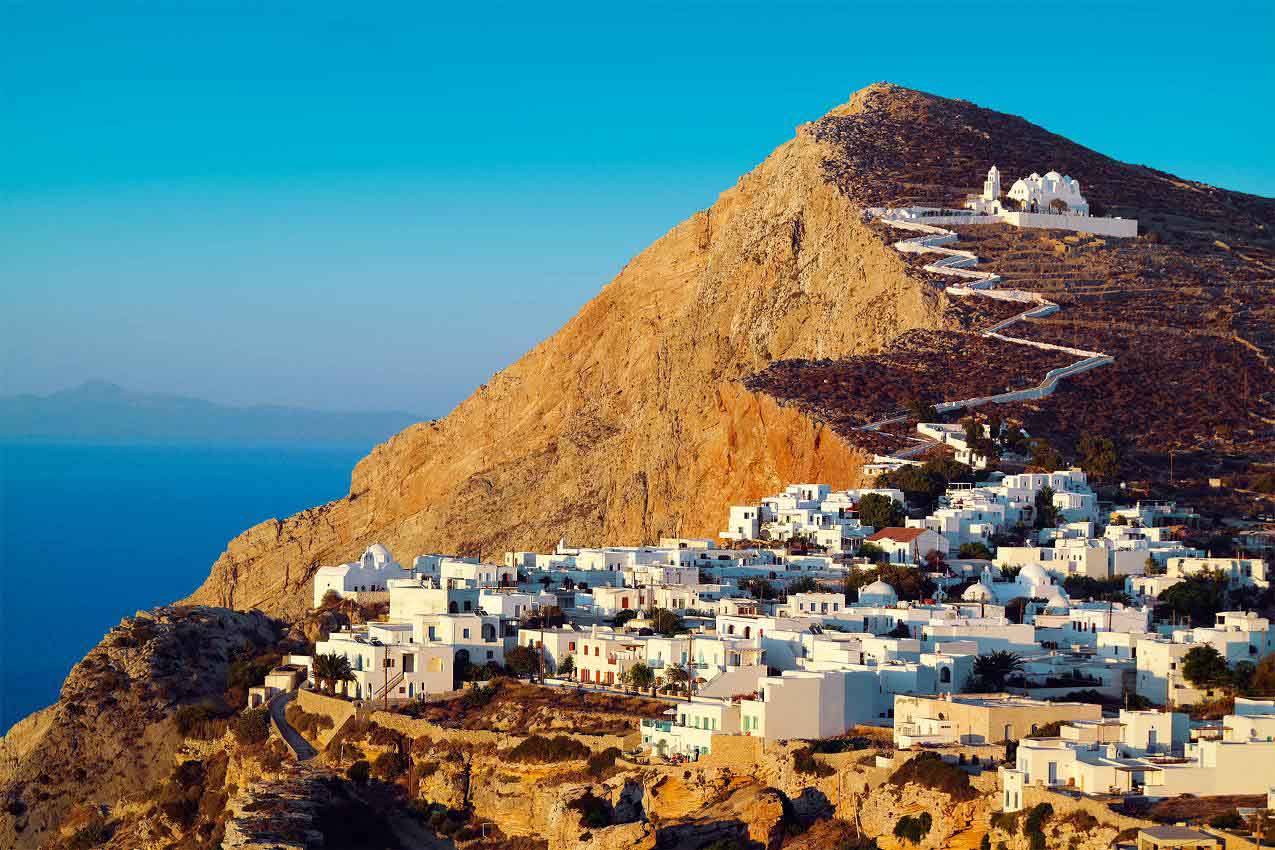
The tours below sail around Folegandros by speedboat, snorkel its coves and taste its wines.
Folegandros Private Tours and Travel Guide: The Ultimate Greek Escape
If you have ever felt overwhelmed by the summer crowds on Santorini or Mykonos, you are not alone. As a local Greek tour guide who grew up on the neighboring islands of Milos and Santorini, I have spent my entire life exploring the Cyclades. I love my home islands, but sometimes, even I need an escape to somewhere that feels a little more like the Greece of thirty years ago. That place is Folegandros.
Folegandros sits between Milos and Santorini in the south-west Cyclades, and Greece Tours covers it with its neighbours, from boat trips to wine tastings.
Folegandros is dramatic, untouched, and unapologetically authentic. It doesn’t have an airport, and that is its greatest defense. It attracts a specific kind of traveler: those who appreciate silence, rugged hiking trails, and the kind of sophistication that doesn’t need to shout. When I organize Folegandros private tours, I tell my guests to leave their watches behind. This island operates on its own time.
In this Folegandros travel guide, I am going to share everything I know about this jagged rock in the Aegean. From the best things to do in Folegandros Greece to the hidden beaches only us locals know how to reach, this is my personal blueprint for your holiday planning. Whether you are looking for Folegandros hiking trails or the best sunset spot that isn’t swarming with selfie sticks, I have got you covered.
Why Folegandros Is the Cyclades’ Best-Kept Secret
Why visit Folegandros? It is a question I get asked often by travelers trying to decide between the dozens of islands in the archipelago. The answer lies in its unique atmosphere. Folegandros is not trying to be the next big thing. It is confident in its stark, wild beauty. The island is essentially a mountain top sticking out of the sea, with sheer cliffs that drop hundreds of meters into the deep blue water.
Unlike the lush greenery of the Ionian islands like Corfu or Lefkada, Folegandros has a dry, elemental charm. It is raw. The architecture here is strictly traditional: you won’t find massive all-inclusive resorts ruining the skyline. The local community has fought hard to preserve the island’s character, meaning that Folegandros tourism feels sustainable and respectful.
For me, the magic happens in the details. It is the smell of wild thyme and oregano as you walk the paths, the way the light hits the white-washed walls of Chora in the late afternoon, and the feeling of exclusivity. When you are here, you feel like you are in on a secret. It offers a level of chic relaxation that is hard to find elsewhere, making it a favorite for couples and travelers seeking a sophisticated, low-key vibe. It is truly unique island access in Greece.
Where is Folegandros, and how is the island shaped?
Folegandros lies in the southern Cyclades between Sikinos and Milos, 15 miles east of Milos and 22 miles northwest of Santorini. It covers 32.216 square kilometres and stretches 13 kilometres from north-northwest to south-southeast, with a narrowest width of 1.1 kilometres.
Folegandros counts among the major islands of the Cyclades, a group of about 220 islands. It belongs to the Thira regional unit of the South Aegean region, together with Santorini, Anafi, Ios and Sikinos. The island of Sikinos lies between Folegandros and Ios, 14 miles from the first and 10 miles from the second. The uninhabited island of Kardiotissa sits midway between Sikinos and Folegandros, and Polyaigos lies 11.5 nautical miles to the northwest. The municipality of Folegandros takes in the main island and its neighbouring islets, and it counted 719 residents at the 2021 census.
The port of Karavostasis sits at the southeast end of Folegandros. It lies 102 miles from Piraeus and 32 miles from Naxos, the sea leg covered by the Naxos to Folegandros ferry. Chora, the capital, stands near the east coast, 3 kilometres northwest of the port. Ano Meria occupies the west-central part of Folegandros, on the central road that ends at the port, and a paved road links Chora, Karavostasis and Ano Meria.
A narrow neck called Porta marks the middle of Folegandros. Two coves, Vathy and Plaka, bite into it from opposite sides and divide the island into two halves of equal length. The municipality of Folegandros describes both halves as mountainous and treeless.
The highest summit of Folegandros is Agios Eleftherios at 415 metres, in the southeast half. Panagia at 365 metres, Troulos at 312 metres and Orthonikas at 305 metres rise in the same half, while Merovigli at 310 metres and Profitis Ilias at 285 metres top the northwest half. The main valley, Livadi, opens in the south. The island has no large rivers, only torrents, and springs are scarce, so the water supply of Folegandros depends on storage cisterns.
- Chora: the capital, with 455 residents at the 2021 census, up from 425 in 2011.
- Ano Meria: a semi-mountainous village at a mean altitude of 265 metres, 5.5 kilometres northwest of Chora; its local community covers 13.666 square kilometres.
- Karavostasis: the port village, with 84 residents in 2021 and 87 in 2011.
- Agali: a coastal hamlet in the exact middle of Folegandros, at the head of Vathy bay, 4.5 kilometres west of Chora.
- Livadi: an old farming hamlet at 60 metres, 1.5 kilometres southwest of Karavostasis, with 1 resident in 2021.
- Agios Georgios: the northernmost recorded settlement, near Cape Kastellos, 10 kilometres northwest of Chora, with no residents in recent censuses.
The climate of Folegandros is dry, with very little rain. Strong north winds strike the island for almost the whole year, and its trees lean towards the south under their force. In winter the gusts can stop scheduled ships from approaching. Terraces protect the crops, and a circular wall rings each fruit tree; in Ano Meria these round shelters, called dentrospita, guard lemon trees above all. South winds are rare on Folegandros. They blow more in spring and bring fog, which lies thicker on land than at sea.
How did the terrain shape the cliffs and coast of Folegandros?
Folegandros is the top of a submerged mountain terrain, unlike volcanic Milos and Santorini. Its stony, abrupt shores run for about 32 kilometres and alternate capes, bays and beaches, from Cape Kastellos in the north to Cape Kyparissi, the westernmost point.
The Cyclades rise as the peaks of a submerged mountain terrain, with the volcanic islands of Milos and Santorini as the exceptions. Folegandros, a near neighbour of both, belongs to the mountain group rather than the volcanic one. The island itself is mountainous and stony, with steep shores, and strong north winds hammer its central ridge.
The main bays of Folegandros lie around the isthmus of Karavostasis on the southeast coast and at Vathy, also called Agali, on the southwest coast. Vathy is the largest bay of the island. The hamlet of Agali sits at its head, with the beach of Galifos to the west and Fyra to the south.
Around the port, the shore of Folegandros breaks into beaches. Chochlidia forms the natural end of the harbour under tamarisk trees, Vardia lies on the east side of the village and Latinaki lies to the south. The north coast holds the beaches of Serfiotiko, Lygaria and Agios Georgios, while Livadi, Dendro and Avlaki line the south and west.
Clockwise from Cape Kastellos, the east coast of Folegandros passes the bay of Agios Georgios, the cove of Sifnaiika, Platia beach, Cape Kavalari and the bay of Serfiotiko. The shores of Syllaka, Maroulides and Pitsinia lead past Porta Katergaki to the bay of Vorina. Cape Mesotrouli, the bay of Plaka, Cape Panagia, the bay of Atherinos, Cape Chondromoutsouna and the bay of Demeneou then bring the coast to Karavostasis.
- Cape Kastellos: the north-northwest tip of Folegandros, with the bay of Lygaria on its western side.
- Cape Kyparissi: the westernmost point, past the bay of Ampeli and the shore of Varsamo.
- Cape Aspropounta: the main cape of the south side, between the bay of Agali and the bay of Livadaki.
- Cape Vintsentzos: the headland between the bay of Karavostasis and the bay of Livadi.
- Cape Georgitsi: a southeast headland between Cape Vathy and the bay of Katergo; the Cave of Georgitsi lies near Karavostasis.
Rocky islets lie off the southeast shore of Folegandros. Agios Ioannis, in Livadi bay southeast of the port, had no residents at the 2011 or 2021 census. Farther out, the three rocks of Tria Adelfia sit between the southeast tip of Folegandros and the southwest tip of Kardiotissa. The two main rocks cover about 0.041 and 0.027 square kilometres, and the third covers only 0.0008. Kardiotissa itself spans 1.430 square kilometres, belongs to the municipality of Sikinos and carried the ancient name Lagusa.
Past the southeast tip, the coast of Folegandros turns west-northwest along the shores of Delagranta, Kokkina, Alatsaria and Skales, the bay of Lakkos, Cape Mega and the shore of Fragkou. Beyond the bay of Agali come Cape Melissa, the bay of Livadaki, the bay of Kalamaki, the cove of Avlaki and the bay of Ampeli. From Cape Kyparissi the shore runs northeast past Plakari and the bay of Dyo Avlakia to Lygaria, back at Cape Kastellos.
Which plants and wildlife are protected on Folegandros?
The largest part of Folegandros is a Natura 2000 site of rocky ground, shrubs and caves that shelter Mediterranean monk seals. Its protected list includes Eleonora’s falcon, Bonelli’s eagle, the javelin sand boa and the plants Silene holzmanii and Symphytum cycladense.
Natura 2000 is the nature protection network of the European Union. It combines Special Areas of Conservation under the Habitats Directive with Special Protection Areas under the Birds Directive, and it covers land and sea. The Birds Directive dates from 1979, and the Habitats Directive, Council Directive 92/43/EEC, followed in 1992. By 2022 the network covered more than 18% of the land area of the European Union and more than 7% of its marine area.
On Folegandros the protected area takes in the larger part of the island. The habitat is rocky, with shrubby vegetation, and its caves give refuge to the Mediterranean monk seal (Monachus monachus). This seal is believed to be the rarest pinniped in the world. Greece holds 250 to 300 animals, and the Habitats Directive lists the species as a priority. Monk seals now rest and give birth only in sea caves, which frequently have underwater entrances and lie on remote or rugged coasts, the type of shore that surrounds Folegandros. Births peak in September, October and November, and storms that strike the coastal caves are a major cause of pup deaths.
Eleonora’s falcon (Falco eleonorae) leads the bird list of Folegandros. Two-thirds of the world population of this falcon breeds off Greece. It nests on coastal cliffs, lays up to four eggs and breeds in late summer, when it hunts the small migrant birds that cross the Mediterranean islands. It winters in Madagascar, and a single one-way flight can reach 9,000 kilometres.
The falcons reach Greece from early April; arrivals peak after the end of that month and continue to mid-July. Chicks fledge in late September and the first half of October, and the species stays away from its nest sites from November to March. Adults measure 36 to 42 centimetres, with a wingspan of 87 to 104 centimetres, and occur in a dark and a light colour form.
- Bonelli’s eagle: Aquila fasciata, a large bird of prey named after the Italian ornithologist Franco Andrea Bonelli.
- Peregrine falcon: Falco peregrinus, a crow-sized falcon known for its speed.
- Lesser kestrel: Falco naumanni, a small falcon and summer migrant that winters in Africa.
- Long-legged buzzard: Buteo rufinus, a raptor whose range runs from southeastern Europe to East Africa.
- Scopoli’s shearwater: Calonectris diomedea, a seabird that breeds on rocky islands and steep Mediterranean coasts and forages in the Atlantic outside the breeding season.
- Audouin’s gull and European shag: a gull restricted to the Mediterranean, the west coast of Saharan Africa and the Iberian Peninsula, and a cormorant that breeds on rocky coasts.
Storks, barn swallows, turtle doves and nightjars also appear on the protected bird list of Folegandros. Reptiles on the same list include the four-lined snake, the largest snake species in Greece at around 150 centimetres, plus the javelin sand boa, Kotschy’s gecko, other geckos and vipers. Adult four-lined snakes carry four black lines from the neck to the tail; the species climbs trees and bushes, swims well and feeds on rodents, birds, lizards and eggs. The javelin sand boa (Eryx jaculus) is the only boa species in Greece and in Europe. It is harmless to people, grows to 80 centimetres and feeds on rodents, small lizards, chicks and invertebrates.
In the sea, the list of Folegandros includes the fan mussel (Pinna nobilis), a clam endemic to the Mediterranean with a shell of up to 120 centimetres. It lives at depths of 0.5 to 60 metres, and its byssus threads were once the source of sea silk. A newly discovered pathogen, Haplosporidium pinnae, killed 99% of the population in Spain in 2016, and mortality spots appeared in Greece by 2019.
The plant list of Folegandros starts with Silene holzmanii and Symphytum cycladense, both priority species under the Habitats Directive. It continues with Eryngium amorginum, Helichrysum orientale, an Aegean anthyllis, endemic bellflowers, crocuses and wild carnations, all on the protected flora list of the Natura 2000 area.
What is the history of Folegandros?
Folegandros has a written history that runs from a Dorian city-state on Athenian tribute lists from 425 BC, through Venetian rule under Marco Sanudo and permanent Ottoman rule from 1617, to its entry into the Greek state in 1828 with 1,000 inhabitants.
The Venetian chapter began after the Fourth Crusade. Marco Sanudo, a Venetian nobleman and nephew of the former Doge Enrico Dandolo, created the Duchy of the Archipelago in 1207 and ruled it from Naxos for 20 years. Folegandros was one of 11 islands he kept as his personal possession, alongside Milos, Sifnos, Ios and Sikinos. The local municipality dates his capture of the island to 1212. For a side-by-side view of the two former Sanudo islands today, see Milos vs Folegandros.
Histories of the Sanudo family record no battles or bloodshed in these conquests. The new lords appeared in each harbour and declared their ownership. On Folegandros, Sanudo raised a large fortress at the highest point of Chora, on the site of the ancient city. Under Venice, the island went by the name Policandro.
Venetian rule on Folegandros ended in 1566, when Turkish pirates left the island deserted. The duchy itself had paid tribute to the Ottoman Empire since 1537, and the Ottomans annexed it in 1579. Ottoman rule over the island became permanent in 1617 and lasted until 1821. In 1646 the island, under its old name Polykandros, formed part of the Archdiocese of Sifnos. In 1715 the Ottoman grand admiral Canum Hoca, who had taken command in December 1714 at the start of a war with Venice, plundered Folegandros and enslaved its people. Canum Hoca was a Greek Muslim from the fortress town of Koroni, and he served three times as Kapudan Pasha. In the Ottoman era, the wood of Folegandros circulated in Cyclades trade alongside the wine of Santorini and the salt of Milos.
Greek forces took back the island during the War of Independence of 1821 to 1829, which ended more than six centuries of foreign rule. Folegandros joined the new Greek state in 1828 with 1,000 inhabitants. From the middle of the 19th century, the island prospered on funds from emigrants who had done well in Constantinople and Alexandria. In early 1884 the British explorers Theodore and Mabel Bent visited the island; the couple also excavated the ancient settlement on nearby Sikinos.
- 1830 and 1835: The London Protocol of 1830 united the Cyclades with Greece, and on 10 March 1835 Government Gazette 4A founded the Municipality of Folegandros, with its seat in Chora.
- 1912: The municipality was abolished and replaced by the Community of Folegandros, while Ano Meria became the seat of a separate community.
- 1941 to 1944: The community passed to the prefecture of Chania in 1941 and to the prefecture of Attica and Boeotia in 1942; Ano Meria returned to the Cyclades prefecture for good in 1944.
- 1978 and 1984: Karavostasis was designated a traditional settlement in 1978 and gained a ferry pier in 1984; until then, small boats carried people and goods to ships anchored offshore.
- 2010: The community became the Municipality of Folegandros again.
Before the pier opened, passengers crossed between ship and shore in small boats. Today, small boats take visitors along the same coast on Folegandros boat tours.
What do ancient inscriptions and writers say about Folegandros?
Inscriptions place Dorian settlers from Santorini on Folegandros and record a tribute of 2,000 drachmas to Athens in 425 BC, while a Delphi text links the island to the Temple of Apollo. Aratus called it “iron Pholegandros”, and Ptolemy wrote the name as Pholekandros.
Three stories explain the name of Folegandros. In the first, shepherds from western Greece, all of them men, settled the island, which took the name Polyandros. Sailors kept an echo of that name in Polykantro. In the second, Pholegandros, a son of King Minos of Crete, led Minoan settlers to the island and gave it his name. The third, put forward by scholars and recorded by the municipality, credits Phoenician traders. They used Folegandros as an anchorage early in the first millennium BC and called it phelekgundari, meaning rocky land.
The municipality names Carians from Asia Minor as the first inhabitants, and historical texts describe Folegandros as a refuge for people fleeing persecution in Crete. Archaeology adds two clues. Remains of a prehistoric settlement survive at Cape Kastellos, at the northern end of the island near Agios Georgios. At prehistoric Akrotiri on Santorini, inscription fragments list very large quantities of textiles. This points to Akrotiri as a centre for wool from neighbouring islands, with Ios, Sikinos, Folegandros and Anafi named as possible sources. Laboratory tests on wool fibres found at Akrotiri identify them as the oldest preserved evidence of wool use in the Mediterranean outside Egypt.
By the 5th century BC, Folegandros was a Dorian city-state, and its town stood where Chora stands today. Inscriptions found on the island link its people to Dorians from Santorini of the Aegeid clan. Athens ruled Folegandros as a member of the Delian League, and the city appears on Athenian tribute lists from 425/424 to 416/415 BC. An inscription found on the Athenian Acropolis records its annual tribute of 2,000 drachmas. The tribute lists were stone tablets: each payment was written in Attic numerals, and one-sixtieth of it was set aside for Athena, the patron goddess of Athens. A later inscription from Delphi, found near the Treasury of the Siphnians and dated to the 4th or 3rd century BC, shows Folegandros either paying toward repairs of the Temple of Apollo or founded as a colony on the orders of the oracle.
Ancient writers also named the island. The poet Aratus of Soli, who lived from c. 315/310 to 240 BC, called it “iron Pholegandros” because of its rough ground. The geographer Strabo recorded Folegandros, and Ptolemy wrote the name as Pholekandros.
- Inscriptiones Graecae XII,3: Published in Berlin in 1898 and edited by Friedrich Hiller von Gaertringen, this volume gathers the inscriptions of Pholegandros with those of Syme, Telos, Nisyros, Astypalaea, Anaphe, Thera, Melos and Kimolos.
- Supplement: Hiller von Gaertringen added a supplement to the same volume in 1904.
- The IG project: Begun by the Prussian Academy of Science and continued today by the Berlin-Brandenburg Academy of Sciences and Humanities, it aims to publish all known ancient inscriptions from mainland and island Greece.
- Smith’s dictionary: William Smith’s Dictionary of Greek and Roman Geography, issued in London between 1854 and 1857, carries an entry on Pholegandros.
Why was Folegandros a place of exile?
Folegandros became a place of exile because Greek governments used small Aegean islands to punish political opponents. From 1926 to 1969 they sent communists, Trotskyists and Centre Union deputies there, among them Pandelis Pouliopoulos and Michel Pablo. Roman rulers had used the island the same way.
Exile on Folegandros began in antiquity, when the Romans used the island as a place of banishment. The modern chapter opened in 1926, under the dictatorship of Theodoros Pangalos. On 24 August 1925, Pandelis Pouliopoulos, general secretary of the Communist Party of Greece (KKE), went on trial in Athens with 23 others for promoting the autonomy of Macedonia and Thrace. When the trial resumed on 22 February 1926, the charges were dropped, yet the defendants were exiled to Anafi, Amorgos and Folegandros. The group sent to the island included Pouliopoulos, Giannis Zevgos, Giorgos Kolozov, Giorgos Nikolis, Periklis Karaskogias and Orfeas Oikonomidis. All were freed when the dictatorship fell on 22 August 1926.
Wider use followed the Idionymon, law 4229 of 1929, proposed by the government of Eleftherios Venizelos to prosecute communists, anarchists and union action. Between 1928 and 1971, 29 Aegean islands served as places of exile and prison, Folegandros among them. In the 1930s, Kostas Vasalos, a union official on Lesbos who joined the KKE in 1933, spent six months on Folegandros. The journalist and translator Loukas Kastanakis was sent there for 2 months in 1935 by the Kondylis government. In 1937 the 4th of August regime of Ioannis Metaxas named Agios Efstratios, Anafi, Sifnos and Folegandros as exile sites for communists of a lesser degree of seriousness. Estimates put the number of political exiles in Greece under Metaxas above 5,000.
The Metaxas years sent writers and party cadres to the island. The Trotskyist Michel Pablo, born Michalis Raptis, was turned away by the orthodox communists there and joined the cattle and horse thieves who were also serving exile. He met his future wife, Elli Dyovounioti, during that exile, before his transfer to Acronauplia in 1937; the couple was later deported to Paris. The writer and translator Fula Chatzidaki, then married to Miltiadis Porfyrogenis, was first exiled to Folegandros and later to Kimolos. The writer Dimitris Chatzis was arrested in 1936 and, after torture, exiled to the island; he was freed months later.
When the Greco-Italian War began, exiles on Folegandros, Kimolos and Anafi asked the Ministry of Security to send the men to the front line and the women to forward field hospitals as nurses. The regime refused. Giorgis Trikalinos and the other prisoners on the island also sent a memorandum to the Metaxas government asking to fight the Italian invaders, and it was rejected. In 1941, as German forces invaded, Stergios Anastasiadis, who had led the exile group, escaped at the head of a group of 8 Cretans and reached Heraklion the next day. The Security police held them there until the German attack on Crete, when the bombing of the city set them free.
- Babis Drakopoulos: A communist youth leader exiled to Folegandros in November 1938, he escaped in 1941.
- Vasos Georgiou: A journalist held first on Aegina, then exiled to Folegandros, Gavdos and Agios Efstratios, he escaped in 1942.
- Stefanos Papagiannis: An artillery officer who fought with ELAS, he was exiled to Folegandros after the liberation and escaped with 11 other exiled officers.
- Gerasimos Vasilatos: A close associate of Georgios Papandreou, he was exiled with 10 other Centre Union deputies to Folegandros and then to Syros.
- Stergios Chasapidis: A Centre Union deputy for Pieria, he was displaced in 1967 to Folegandros and then to Anafi, until 1969.
The colonels’ dictatorship of 1967 also sent the Centre Union deputies Georgios Serpanos, Talbot Kefallinos and Giannis Papaspyrou to Folegandros. The municipality records the island as a periodic place of exile until 1969. Greece abolished displacement for good after the dictatorship fell in 1974.
Exclusive Folegandros Private Tours and Experiences
Because Folegandros is small, many visitors make the mistake of thinking they can just “wing it.” While you certainly can explore solo, booking Folegandros private tours unlocks a layer of the island that is inaccessible to the average tourist. As a guide, I always emphasize that the best experiences here require a bit of local know-how.
Private Boat Charters to Hidden Beaches
The coastline here is dramatic, but many of the best Folegandros beaches are impossible to reach by car and difficult to reach on foot. A private boat tour is, without a doubt, the best way to see the island. We can take you to secluded coves where you are the only people swimming in the crystal-clear water. Skipping the scheduled public tourist boats means we can linger as long as we want at Katergo or explore sea caves that the big boats can’t get close to.
Guided Hiking Expeditions Across Ancient Paths
Folegandros is a hiker’s paradise. The island is crisscrossed by a network of ancient paths called kalderimia. These were the old donkey roads that connected the villages before asphalt. I organize hiking tours that take you through the rugged interior, past dry-stone walls and forgotten chapels. It is not just about the exercise: it is about understanding the history of how locals lived here for centuries.
Culinary Workshops and Private Farm Visits
Folegandros local cuisine is distinct from the rest of the Cyclades. One of my favorite experiences to arrange is a private cooking class in a traditional home or a visit to a local cheese maker. You can learn how to make matsata (the local pasta) from scratch. It connects you to the land and the people in a way that simply ordering food at a restaurant cannot.
Historical Walking Tours of the Kastro
The Kastro in Chora is not just a neighborhood: it is a fortress. Walking through it with a guide brings the stones to life. I love showing guests the hidden defensive architectural details designed to protect the inhabitants from pirates in the Middle Ages. It is a living museum, and understanding its context makes the walk infinitely more rewarding.
Exploring the Island’s Iconic Villages
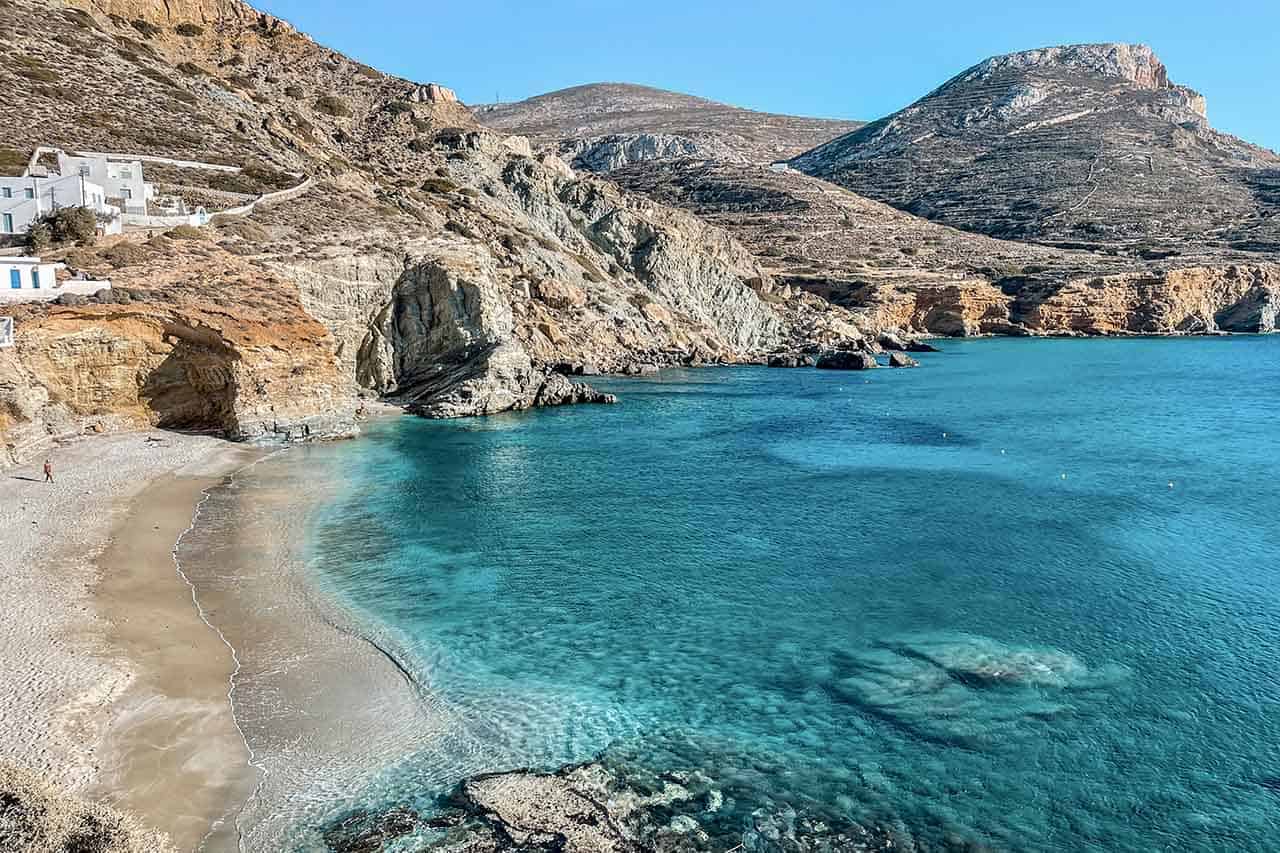
The island only has three main settlements: Karavostasi (the port), Chora (the main town), and Ano Meria. Each has a completely different personality, and to truly understand Folegandros history and culture, you need to spend time in all three.
Chora: One of the Most Beautiful Villages in Greece
I have visited villages all over Greece, from Pelion to Mystras, but Folegandros Chora village holds a special place in my heart. Unlike many Cycladic capitals that are a maze of narrow streets, Chora is defined by its squares. One square flows into the next, each shaded by massive plane trees and lined with tavernas and cafes. In the evenings, these squares buzz with life. It is pedestrian-only, so the air is clean, and the vibe is incredibly relaxed. It is one of the most photogenic spots in the Aegean.
The Medieval Charm of the Kastro Neighborhood
Within Chora lies the Kastro, the oldest part of the town. Built by the Venetians in the 13th century, it was constructed on the very edge of a 200-meter cliff. The houses themselves form the outer wall of the castle. Entering the Kastro feels like stepping back in time. The streets are incredibly narrow, the houses are tiny and white, and the view from the northern side, looking straight down into the sea, is dizzying and spectacular.
Ano Meria: A Glimpse into Traditional Rural Life
If Chora is the living room of the island, Ano Meria is the farm. This village is spread out over several kilometers and retains an agricultural lifestyle that has largely vanished elsewhere. Here, houses are not clustered together: they are independent farmsteads known as themonies. You will see donkeys, goats, and wood-burning ovens still in use. It is raw, windswept, and fascinating.
Must-Visit Attractions and Landmarks
While the whole island feels like an attraction, there are a few specific sites that you simply cannot miss during your Folegandros holiday planning.
The Church of Panagia: History and Sunset Views
This is the icon of Folegandros. Perched on a zigzag path above Chora, the Church of Panagia is the largest church on the island. The walk up takes about 15 to 20 minutes, and I recommend doing it just before sunset. The view from the top is unrivaled, you can see the entire island, the village below, and the endless sea. It is built on the ruins of an ancient temple, and you can still see ancient inscriptions built into the church walls.
Aspropounta Lighthouse
Built in 1919, this lighthouse is reachable via a hike from Ano Meria or Livadaki. It stands 58 meters above the sea and offers a solitary, haunting beauty. It is a great spot for photographers looking for unique angles away from the village crowds.
Ecological and Folklore Museum in Ano Meria
To understand the themonia way of life, you must visit this museum. It is essentially a preserved traditional farmhouse. You can see the wine press, the oven, and the tools that families used to survive on this dry rock. It is a small, humble museum, but it provides deep context to the sights you see around the island.
How was the Kastro of Folegandros built, and how are its old villages protected?
Marco Sanudo, founder of the Duchy of the Aegean, took Folegandros in 1212 and built a fortress at the highest point of Chora. The Kastro grew into a fortified village with two gates, and Greece lists Chora, Ano Meria and Karavostasis as traditional settlements.
The Kastro of Folegandros grew as a medieval village that shielded the islanders from pirate raids. People have lived inside it without a break since its foundation. Its houses are still lived in and stay in good repair. They were modified after the threat of raids ended, yet the architectural character of the Kastro has stayed the same.
Travellers who combine the two islands can follow a Milos and Folegandros route. After Folegandros joined the Greek state, families began to settle outside the walls, and the modern settlement of Chora took shape. In the same period, Folegandros emigrants in Egypt, Constantinople and Athens sent money and goods home.
Chora has four successive squares, flagstone lanes and well-kept houses with small whitewashed yards. The Pounta square faces the sheer northern side of the Kastro. The Dounavides square gives shade at midday, and the Piatsa square, with its two churches, fills with people in the evening. Its residents are known as Choraites.
- Gates: two entrances, the Lotzia and the Paraporti, open on the side of the Kastro that faces Chora.
- Streets: two main lanes run side by side, the Kato Roua and the Mesa Roua, and the Kato Roua ranks among the best-known photo spots on Folegandros.
- Square: both lanes end at the only square inside the Kastro, just before its western tip.
- Church: that square doubles as the courtyard of the Pantanassa church.
Greece gives the title of traditional settlement to places that keep their old appearance and local character, and more than 900 settlements hold it by law. At Karavostasis, the port of Folegandros, old buildings called syrmata, where fishermen dragged up their boats, still stand. The chapel of Agios Artemios, recorded since 1888, counts as the oldest building of the port.
What is the church of Panagia, and how does Folegandros celebrate its feasts?
The Panagia is the church of the Dormition of the Virgin on the rock above Chora. A marble plaque records a renovation in 1687, and the present building dates from works between 1816 and 1821. Each Easter, its icon visits every house on Folegandros.
The Panagia of Folegandros is a rectangular, single-aisled basilica topped by domes, with a tall white bell tower. It once served as the main church of a convent. Ancient sculptures and statue bases stand in the courtyard and inside the church. A cobbled path climbs to it from the Pounta square. Local legend links the icon kept here to old pirate stories of the island.
Easter is the main feast of Folegandros. Residents prepare for days: they clean the squares and streets, repaint the white ntames on the paving slabs, and cook Easter dishes and sweets. Every house that receives the icon offers wine, raki, sweets and treats to the people who walk with it. On Sunday, the young people of Folegandros greet the icon with bursts of fireworks in the lanes of the Kastro. The procession lasts three days and reaches homes, farms and boats.
- Easter Sunday: the icon leaves the Panagia church, the crowd meets it at the Pounta square, and it passes every street and house of Chora; at sunset, residents of Ano Meria carry it on foot to the church of Agios Georgios for the night.
- Easter Monday: from early morning the icon visits every house in Ano Meria, greeted with celebratory gunshots and firecrackers called varelota; late in the afternoon, the people of Chora take it to the Pantanassa church in the Kastro.
- Easter Tuesday: the longest route runs to Petousis, Livadi and Karavostasis, blessing the homes and the caiques of the port; weather permitting, the icon boards a caique for a short trip to the nearby bays, escorted by other boats, then returns to the Panagia church, where it stays until the next Easter.
- Summer panigyria: the three largest feasts honour Christ the Saviour on 6 August, the Panagia, patron of Folegandros, on 15 August, and Agios Panteleimon in Ano Meria, with a night party on 26 July.
- Autumn panigyria: the feast of the Cross fills the Agios Nikolaos square in Chora on 13 September, and Karavostasis honours Agios Artemios on 19 October.
Before tourism reached Folegandros, these panigyria were the main entertainment of the island. A panigyri follows the vespers of a church feast. Folegandros musicians, though amateurs, bring the violin and the laouto, young and old dance the traditional island dances, and residents serve local food and drinks to every guest. After the Panagia service in August, the party moves to the Pounta square with local musicians.
The chapel of Agios Panteleimon in Ano Meria replaced a simple shrine in 1838, after the saint appeared again and again in an old man’s dreams. Local tradition says the altar stone turned up in a nearby field and water appeared in the ravine below. The poros stones for the vaulted roof came from Kimolos on a ship bound for Cyprus, which ran aground on the west coast of Folegandros near the building site. A paved courtyard with stone benches and a large eucalyptus fronts the chapel, and a marble plaque is set into the courtyard wall.
Folegandros belongs to the Holy Metropolis of Syros, created in 1833, which also covers Sikinos, Milos and ten other islands. Smaller churches mark its roads and bays. On the road from the port to Chora stand the chapel of Agioi Anargyroi and the chapel of Agioi Pantes, built inside a rock. The chapel of Agios Nikolaos sits on the beach of the same name west of Agali, and a ring of chapels surrounds Ano Meria, among them Stavros, Taxiarchis, Agios Andreas and Chrysopigi.
How do the people of Ano Meria on Folegandros live, and what does its museum show?
Ano Meria is the farming village of Folegandros, spread along the north-western edge of the island, where households still sow barley for their animals. Its Ecomuseum, opened in the summer of 1988, shows a restored thimonia homestead with an olive press and rain cisterns.
Life in Ano Meria follows a farming model that has changed little in decades. Each household plans its year around barley for the livestock and a family vegetable plot on the smallest scraps of scarce arable land. The village is a scatter of dry-stone walls and house clusters with old windmills, and the church of Agios Georgios stands at its centre. Greengrocers, a wood-fired bakery and a traditional pasteli workshop serve the area. Ano Meria was recognised as a settlement in 1897; today its local community also takes in Agios Georgios and Agali.
Thimonies, the farm homesteads, also stand in the south-east of Folegandros. Petousis, one of the oldest and smallest farming settlements of Folegandros, lies 3.5 km from Chora among homesteads, animal pens and local farmers, and the Livadi area spreads its thimonies from the sea inland.
The Cultural Association “Folegandros”, based at the Pounta square in Chora, runs the Ecomuseum. A narrow rocky path off the road from Chora to Ano Meria leads to its low wooden gate, a copy of the original. The oldest building stood by the 18th century. Its dry-stone walls use no mortar, and their outer faces stay bare: through the centuries of piracy, houses kept the colour of the rocks to stay invisible from a distance. The largest room of the old building was the family home until the 19th century, and the last four children were born there. Later it became a cellar for the harvest and the farm tools.
The roofs rest on large schist slabs and unplaned beams of wild cypress, called feida, so each room is long and narrow to fit the trunk; feida trees stopped growing on Folegandros in the 19th century. A mix of lime and earth, a thick layer of dried seaweed and a clay earth that turns waterproof when dry cover the slabs. Donkeys carried that earth from a distant field, and the carpenter who copied the old doors and wooden locks, a former fisherman, also comes from Ano Meria. In the olive press, three men turned a heavy stone roller, and a wooden lever squeezed sacks of pulp, hand-knitted by women, on a stone slab 1.50 metres long. The oil went into special jars glazed inside. The oven burned scrub, furze and thyme, since Folegandros has no tree wood.
- Water: the settlement lived on rainwater from the roofs; the homestead keeps two cisterns, a small threshing floor, a plough and a harrow, and large slanted slabs beside a cistern served as the laundry.
- Grapes: a rectangular basin on a low rock served as the treading floor, and the lower round hollow still shows the colour of the wine; today, a Folegandros wine tasting introduces visitors to the wine of the island.
- Weaving: plant dyes, wool processing and weaving all came from Folegandros; raised weaves and curly katsara pieces were the festive textiles, and every house wanted at least one katsaro.
- Cheese: local cheese-making produces souroto, a fresh goat-and-sheep cheese, plus xynotyro, anthotyro and the hard sketo cheese served with matsata.
- Sweets: karpouzenia is a sweet of watermelon, honey and sesame baked in the oven.
- Food festivals: the Agrosourotoxynotyri food festival takes place in the yard of the Ano Meria primary school, and the Kaikokakavia feast fills the port of Karavostasis on 21 August; the municipality of Folegandros organises both with the South Aegean Region, the hoteliers and the women’s association Oi Polykandries.
The last weaver of Folegandros, Eleftheria Veniou, wove to order the textiles now shown in the Ecomuseum, where an unfinished piece still sits on the old loom. Rag rugs called koureloudes, woven from strips of old clothes, covered the floors of Folegandros homes. The newer house of the homestead, built at the end of the 19th century, has a parlour, a bedchamber and a kitchen, and no electric light. Residents first met the project with distrust, and Chora later resented that it opened in Ano Meria and not in the Kastro; both communities of Folegandros now support it. Each summer, the association hosts exhibitions of painting, ceramics, photography and weaving, plus poetry and music evenings and theatre performances.
Pristine Beaches and Coastal Gems
Folegandros beaches are not like the organized beaches of Mykonos with loud beach bars and sunbeds. They are wilder, often pebbly, and stunningly clear. If you are looking for hidden beaches in Folegandros, you will find plenty, but be prepared to walk or take a boat.
Katergo Beach: The Island’s Crown Jewel
If you only visit one beach, make it Katergo. It is a long stretch of fine pebbles with turquoise water, situated at the base of a cliff. There is no shade and no canteen, so bring water. The best way to get here is by the local boat from Karavostasi, though there is a hiking trail for the adventurous.
Agali and Agios Nikolaos: Accessible Beauty
Agali is one of the few beaches reachable by car or bus. It is a beautiful bay with several tavernas, making it great for families. From Agali, you can take a short boat ride or a 20-minute coastal hike to Agios Nikolaos beach. This spot offers plenty of shade from tamarisk trees and a fantastic view back toward the island.
Livadaki and Ambeli: Secluded Spots for Privacy
For those willing to hike, Livadaki is a stunning white-pebble cove. It requires a trek from Ano Meria (about 45 minutes), but the isolation is the reward. Ambeli is another small beach on the western side, known for its incredible sunsets, though the road to get there is rough.
Gastronomy Guide: Local Cuisine and Dining Tips
Food is a massive part of the Folegandros experience. The island relies on local produce, and the flavors are intense. When we talk about Folegandros things to do, eating is high on the list.
Traditional Matsata and Where to Try It
You cannot leave the island without trying matsata. This is fresh, handmade pasta, usually served with rooster in red sauce (kokkinisto) or rabbit. The pasta is thick and chewy, absorbing the sauce perfectly. The best places to try this are the family-run tavernas in Ano Meria, where the grandmothers are often still in the kitchen rolling out the dough. It is comfort food at its finest.
Best Spots for Sunset Drinks and Fine Dining
Chora is the place for evening dining. After the sun goes down, the squares fill up. For a romantic evening, look for tables in the smaller squares of the Kastro area. Don’t forget to try Rakomelo, warm raki with honey and spices. It is the signature drink of the island and perfect for the breezy Cycladic nights.
Essential Travel Logistics for Folegandros
Planning a trip here requires a bit more foresight than visiting the larger islands. Here is what you need to know before visiting Folegandros.
How to Get to Folegandros from Athens and Santorini
Since there is no airport, you will be arriving by sea. Folegandros ferries from Athens (Piraeus port) run daily in the summer. The high-speed ferry (usually Seajets) takes about 4 hours, while the conventional ferry (Zante Ferries) is cheaper but can take up to 9 hours. A very popular option is to fly into Santorini and take a ferry from there: the trip is less than an hour, making Folegandros day trips from Santorini possible, though I highly recommend staying at least a few nights.
Getting Around: Car Rentals vs. Private Transfers
The bus system is reliable and connects the port, Chora, and Ano Meria, but it stops running relatively early in the evening. If you want freedom, renting a car or an ATV is a good idea, but be warned: parking in Chora is limited. For a hassle-free experience, especially if you want to enjoy the wine and rakomelo, private transfers are the way to go. I often arrange these for my clients so they don’t have to stress about navigation on the narrow roads.
Best Time to Visit to Avoid Crowds
The best time to visit Folegandros depends on what you want. July and August are peak season: the island is full, and accommodation is expensive. For me, the sweet spot is visiting Folegandros off season, specifically late May, June, or September. The weather is warm, the sea is swimmable, but the frantic energy of August is gone. This is also when the hiking trails are most enjoyable.
Where to Stay: Luxury Hotels and Boutique Suites
Folegandros hotels and accommodation lean towards boutique luxury rather than massive complexes. Most of the high-end options are clustered around Chora or Karavostasi.
Travellers based on Sifnos cross by speedboat for the day: the Folegandros day trip from Sifnos page covers the crossing, the ferry, Chora, the Kastro, the Panagia church and the beaches.
If you want views that will make your jaw drop, look for properties on the cliffside of Chora. Waking up to that endless blue horizon is worth every penny. For a quieter, beach-focused stay, the port area of Karavostasi has some excellent new hotels. Just remember to book early. The island is small, and the best rooms vanish months in advance, especially if you are looking for Folegandros vacation packages.
Conclusions
Folegandros is not for everyone. If you need neon lights, shopping malls, and loud beach parties, you should probably stick to Mykonos. But if you are looking for a place that feels authentic, where the luxury comes from the silence and the landscape, then this island is waiting for you.
As someone who has spent years exploring every corner of Greece, from the monasteries of Meteora to the beaches of Crete, I can honestly say Folegandros has a unique soul. It stays with you. Whether you want to hike the ancient paths, sail around the dramatic coastline, or just sit in a square in Chora and watch the world go by, I am here to help you make it happen. Let’s plan your perfect Folegandros escape together.
Key Takeaways
- Booking exclusive Folegandros private tours unlocks hidden beaches and authentic local experiences inaccessible to the average traveler.
- The island’s charm centers on the pedestrian-friendly squares of Chora and the medieval architecture of the Kastro fortress.
- A private boat charter offers the best way to reach secluded coastal gems like Katergo Beach that are difficult to access by land.
- Visitors should sample unique local cuisine, particularly the handmade Matsata pasta served in the rural village of Ano Meria.
- Travelers must arrive by ferry from Athens or Santorini, as the island preserves its tranquility by remaining airport-free.
Frequently Asked Questions about Visiting Folegandros
Why should I choose Folegandros over popular islands like Santorini?
Folegandros offers an authentic, untouched experience distinct from the crowds of Santorini. It features dramatic cliffside views, traditional architecture, and a quiet, sophisticated atmosphere. Without an airport, it remains a “secret” destination perfect for travelers seeking silence, rugged hiking trails, and genuine local culture.
What unique experiences do Folegandros private tours offer?
Booking Folegandros private tours unlocks access to secluded spots often missed by casual tourists. You can enjoy private boat charters to inaccessible beaches like Katergo, guided hikes along ancient “kalderimia” paths, and intimate culinary workshops to learn how to make local specialties like matsata.
How do I get to Folegandros if there is no airport?
You can reach the island by ferry. High-speed ferries from Athens (Piraeus) take about 4 hours, while conventional ones take up to 9 hours. A popular option is to fly into Santorini and take a short, one-hour ferry ride to Folegandros.
How many days should I plan for a trip to Folegandros?
For a complete experience, 3 to 5 days is ideal. This allows enough time to explore the main villages of Chora and Ano Meria, hike to the Church of Panagia for sunset, and enjoy a full day at pristine beaches like Katergo without feeling rushed.
What is the best local dish to try in Folegandros?
You must try matsata, a traditional handmade pasta unique to the island. It is typically served with rooster or rabbit in a rich red sauce. The best places to taste authentic matsata are the family-run tavernas in the village of Ano Meria.
Is Folegandros suitable for families with young children?
Yes, but it is best for families who enjoy nature and tranquility over resorts with kids’ clubs. While Agali beach is accessible and family-friendly, parents should note that many other beaches require hiking or boat access, and the island’s terrain is steep and rugged.
- Rhodes Private Tours: Explore Rhodes Destinations & Attractions | Rhodes Greece Excursions & Tours
- Samos Dream Tours: Explore Samos Tours, Excursions & Samos Greece Experiences
- Santorini Greece Travel Guide: Best Things To Do in Santorini
- Sifnos Travel Guide: Your Ultimate Sifnos Guide to Visit Sifnos Island in Sifnos Greece