
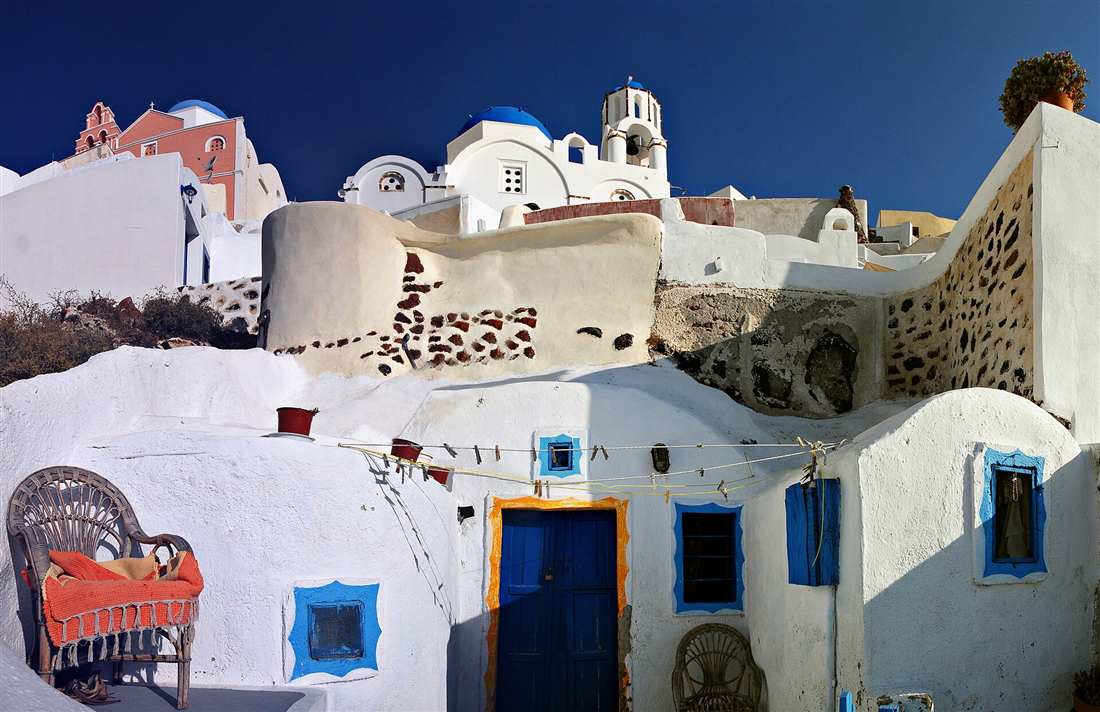
A Santorini food tour is a guided tasting walk that starts in the square at Firostefani and follows the caldera path towards Fira, stopping at family-run shops and bakeries, with every tasting and drink included. Plan the whole trip with Greece Tours.
This guide covers the Santorini food tour in full: where the walk goes, what you taste, the sunset format with local drinks, the winery and meze combination, how long it takes, the group size, what it costs, the dietary options, who it suits, what to bring, and how to book.
What Is a Santorini Food Tour and What Does It Include?
This tour is a guided walking route through Firostefani and Fira that stops at bakeries, cheese shops and family kitchens for prepaid tastings, with a local guide explaining each dish, its producer and the ingredient behind it along the way.
The set price on a Santorini food tour covers the guide, the food and the wine. A Santorini food tour is booked ahead for a fixed, agreed price per person. The format groups six to eight tastings into one continuous walk, so a guest moves from a bakery counter to a cheese shop to a family kitchen without a menu or a bill at any single stop. Everything tasted is prepaid and folded into the ticket, and the guide carries the itinerary — introductions to each shop owner happen on arrival, and the tasting is served plated or wrapped for eating on the move.
For wine drinkers, a Santorini food tour pairs with two cellar visits. The destination changes every fifteen minutes rather than staying fixed at one table. Guests taste white eggplant dip at one counter, walk to a bakery for tomato pie, then continue toward a cheese producer selling the local soft cheese. Nothing is reheated; each stop serves what it makes daily for its own customers.
A Santorini food tour starts in the square at Firostefani. The walking pace stays social rather than sport-paced, with pauses built in at viewpoints over the caldera. The guide answers questions about ingredients, farming on the island’s volcanic soil and the history behind a recipe as the group moves, turning the walk into a working introduction to island food.
Where Do Santorini Food-Tour Walks Lead Through Fira and Firostefani?
A Santorini food tour starts in the square at Firostefani and follows the caldera-edge path south into Fira, turning off the main promenade into the back lanes where the bakeries, cheese counters and family shops sit away from the cruise-day crowds.
Planning a Santorini food tour ahead beats the scramble for a summer date. For a first evening on the island, a Santorini food tour sets the ground for the rest of the week. The opening stretch runs along the caldera rim, the volcano and the sea directly below the path on one side and whitewashed chapels lining the other. The group covers this section slowly, pausing at the first viewpoint before turning inland toward the older lanes of Firostefani.
The dietary requirements are declared before a Santorini food tour is confirmed. Past the rim, the route drops into narrow back lanes lined with bougainvillea and stone walls, where a bakery selling tomato pie and a cheese shop sit two doors apart. These lanes carry none of the caldera traffic, and the pace slows as the guide points out working ovens and produce crates outside each shop.
The price of a Santorini food tour covers the guide, the tastings and the drinks. The walk covers a flat to gently sloped route of about two kilometers on foot, finishing near the center of Fira. Steps and cobbles appear on the lane sections rather than the open caldera path itself, and the group stops fully at each tasting point rather than eating while still moving.
What Do You Taste on a Santorini Food Tour?
This walking tour serves local mezes stop by stop: white aubergine dip, caper leaves in vinegar, tomatokeftedes and fava at a taverna kitchen, loukoumades drizzled with Greek honey, a skewer of souvlaki, and a taste of the island’s aged and fresh cheeses.
A Santorini food tour is booked ahead for a fixed, agreed price per person. The choice of Santorini food tour comes down to the route, the hour and the group size. White aubergine, grown in Santorini’s volcanic soil, appears as a dip served with fresh bread, and the guide explains why the variety differs from mainland eggplant in size and flavor. Caper leaves, pickled rather than fresh, arrive as a sharp, salty counterpoint served alongside the dip at the same stop.
A Santorini food tour includes the hotel transfer where the operator offers it. Tomatokeftedes and fava turn up at a taverna stop: fried tomato fritters bound with onion and herbs, next to a smooth yellow-split-pea puree finished with olive oil. Both dishes rely on ingredients grown on the island, and the guide points out the difference between this fava and the dried-pea version sold elsewhere.
A Santorini food tour runs three to four hours across the caldera path. The savory run closes with souvlaki from a grill counter and a plate of the local soft and aged cheeses, then turns sweet with loukoumades — fried dough balls soaked in syrup and Greek honey. For the full list of island dishes beyond what fits into one walk, our guide to Santorini food covers the wider menu in detail.
What Is the Sunset Santorini Food Tour Like?
The sunset version of the tour starts in the late afternoon and times its final stops to the caldera light, adding a craft beer stop, seasonal small-plate tapas and a tasting of three Greek spirits alongside the traditional customs that go with each pour.
For a first evening on the island, a Santorini food tour sets the ground for the rest of the week. A private Santorini food tour keeps the walk to one party. Starting later than the standard format, this version reaches its viewpoint stops as the light over the caldera turns gold, then amber. The stops lean toward evening food: seasonal tapas plates rather than daytime snacks, and a craft beer stop from a small island brewery in place of a bakery visit.
The view over the caldera is the backdrop to every Santorini food tour. Three Greek spirits appear across the walk: raki, ouzo and a Santorini-made spirit distilled from grape must, each poured in a small glass and paired with a bite so the drink’s strength is balanced by food.
The stops on a Santorini food tour take in bakeries, shops and small kitchens. The guide explains the customs that go with each pour — the toast, the reason raki is drunk in one motion rather than sipped, and why ouzo is served with water on the side. The tour ends after sunset, with the last stop lit by lantern rather than daylight.
What Is the Santorini Wine and Food-Tour Combination at the Wineries?
This Santorini food tour pairs two winery visits with a sommelier-led tasting of Assyrtiko, Nykteri and the sweet Vinsanto, then finishes with a meze menu at a restaurant, combining the vineyard walk with a seated food stop rather than a string of street tastings.
The choice of Santorini food tour comes down to the route, the hour and the group size. The sunset slot on a Santorini food tour fills first in high season. The first winery stop introduces Assyrtiko, the dry white grown in the island’s low, basket-trained vines, and explains why the variety resists the wind and drought of the slopes. The sommelier pours vintages side by side so the group tastes the difference in acidity and minerality directly.
Every Santorini food tour starts with the meeting point and the plan for the walk. The second winery adds Nykteri, an oak-aged Assyrtiko picked overnight, and Vinsanto, the sun-dried sweet wine aged for years in barrel. The sommelier walks through the sun-drying process before pouring, so the sweetness of the Vinsanto is tasted with the production method already explained.
Booking a Santorini food tour ahead secures the date and the place on the walk. After the wineries, the group sits down to a meze menu at a restaurant, closing the day with a full plated meal rather than another standing tasting. Readers comparing this format against a wine-only itinerary can check our dedicated page on Santorini wineries for the vineyard-only version.
How Long Does a Santorini Food Tour Take?
This walking tour runs three to four hours in its standard format, covering six to eight stops on foot, while the half-day version that adds the wineries extends to around five hours including the seated meze meal at the end.
Families take a Santorini food tour for the short walk and the seated stops. The standard walking tour fits the three-to-four-hour window because each stop is timed to around fifteen minutes: enough to taste, hear the story behind the dish and move on without the group feeling rushed at any single shop.
A Santorini food tour carries water and shade stops through the summer months. The winery-and-food combination runs longer because it adds two seated tasting stops rather than standing tastings, plus transfer time between the town walk and the vineyard stops outside Fira. The meze meal at the close extends the total further.
A Santorini food tour ends in Fira with the last tasting and a drink. Both formats cover a similar walking distance in the town portion — around two kilometers — with the difference in total time coming from the pace set at each stop.
How Big Are the Groups on a Santorini Food-Tour Walk?
Group sizes on this walk stay capped in the small range, kept low enough that a family-run shop can serve the whole group without breaking its normal counter service, and a private version is bookable for a party wanting the guide to itself.
A Santorini food tour starts in the square at Firostefani. A shop selling tomato pie or soft cheese from behind one counter cannot serve a large crowd without stopping its regular customers, so the operator caps the group at a size that fits inside the smallest doorway on the route.
The set price on a Santorini food tour covers the guide, the food and the wine. The small-group cap also keeps the guide’s attention on each traveler: questions about a recipe or an ingredient get answered directly rather than shouted over a crowd, and the pace can adjust to a slower walker without holding up the group.
The guide on a Santorini food tour introduces the producers along the way. A private booking removes the cap entirely, running the same stops and tastings for one party alone, with the schedule and pace set around that group rather than a fixed departure time shared with others.
Who Guides Santorini’s Food-Tour Walks?
This tour is led by a local guide who introduces the group to the producers and shop owners in person at every stop, answers questions on ingredients and island history, and runs in English alongside other languages depending on the group booked.
The price of a Santorini food tour covers the guide, the tastings and the drinks. The guide’s role goes beyond narration: each stop is a real shop with its own owner, and the guide makes the introduction, translates where needed, and steps back while the owner explains their product before adding context on the recipe’s place in island cooking.
Planning a Santorini food tour ahead beats the scramble for a summer date. Questions the guide answers range from the reason white aubergine grows on volcanic soil, to why loukoumades appear at celebrations, to which grape varieties survive the wind on the caldera slopes — questions that come up naturally as the group tastes.
A Santorini food tour crosses the caldera path, the back lanes and the steps. Tours run primarily in English, with other language departures available depending on demand; a guest needing a specific language confirms this at booking rather than assuming it on every departure.
What Does a Santorini Food-Tour Booking Cost and What Is Included?
Pricing for a Santorini food tour is set per person at booking and covers the guide, every tasting at every stop, the drinks poured along the way and the wine served at the winery stops, with a hotel transfer added where the operator offers one.
A Santorini food tour runs three to four hours across the caldera path. The per-person price is fixed at booking and confirmed on the operator’s own booking page rather than estimated in advance, since the winery-inclusive format and the sunset format carry different stop counts and costs.
A Santorini food tour is booked ahead for a fixed, agreed price per person. What is included goes beyond the food itself: every drink poured during the walk, from the craft beer on the sunset format to the wine at the winery stops, sits inside the ticket price rather than billed separately.
For wine drinkers, a Santorini food tour pairs with two cellar visits. A hotel transfer forms part of the booking where the operator offers one, picking guests up from accommodation in Fira, Firostefani or Imerovigli and returning them after the final stop; a guest booking from further out confirms transfer availability before paying.
Does a Santorini Food-Tour Booking Cater for Dietary Requirements?
A Santorini food tour substitutes vegetarian and vegan versions of most stops on request, and declares gluten and nut content for each dish, provided the kitchen gets notice at booking so the shop and taverna stops can prepare the swap in advance.
The stops on a Santorini food tour take in bakeries, shops and small kitchens. Vegetarian and vegan travelers get a substitution at stops built around meat or dairy — the souvlaki stop and the cheese stop most directly — with the kitchen preparing a plant-based version of the same course.
For a first evening on the island, a Santorini food tour sets the ground for the rest of the week. Gluten and nut content gets declared per dish at booking, since bakery items and the fried loukoumades both carry gluten, and certain shops finish dishes with nuts. A guest with an allergy states it at booking rather than at the first stop.
The dietary requirements are declared before a Santorini food tour is confirmed. The drink stops carry an alcohol-free option for guests who skip the wine, ouzo or raki tastings, with a non-alcoholic pour offered in its place so the guest still receives a drink at every stop.
Is a Santorini Food Tour Suitable for Children and Limited Mobility?
This walking tour accepts children from a minimum age set by the operator at a reduced child price, but the caldera path carries steps and uneven cobbles over roughly two kilometers, making the route unsuitable for a guest who cannot manage stairs or uneven ground.
Booking a Santorini food tour ahead secures the date and the place on the walk. The minimum age exists partly for the tasting content — wine and spirits at multiple stops — and partly for the walking distance itself, which a very young child covers slowly. Operators list a child price below the adult rate for guests old enough to join.
The choice of Santorini food tour comes down to the route, the hour and the group size. The caldera-edge path includes steps at multiple points and cobbled sections through the back lanes, without a paved, flat alternative built into the route. A guest using a wheelchair or a walker checks with the operator before booking, since the format lacks a step-free path.
A Santorini food tour includes the hotel transfer where the operator offers it. Shade sits at a premium on the open caldera stretch, though the back-lane portion runs between buildings that block direct sun for part of the route. A guest sensitive to heat benefits from choosing a morning or sunset departure over a midday slot.
When Is the Best Season for a Santorini Food-Tour Walk?
The walking-tour season runs from April to November, with a morning departure working through the direct heat of high summer and the late-afternoon and sunset slots suiting the same months when the midday sun makes the caldera path uncomfortable.
A Santorini food tour ends in Fira with the last tasting and a drink. High summer heat on the exposed caldera path pushes most guests toward a morning start before the sun climbs, or the late-afternoon and sunset departures once the direct heat has passed; midday sits as the least comfortable slot.
A private Santorini food tour keeps the walk to one party. April, May and the autumn months from September through November carry lighter crowds and cooler walking conditions, without losing the tastings tied to the harvest — grapes for the wineries and the last of the summer produce both fall inside it.
The view over the caldera is the backdrop to every Santorini food tour. Cruise-ship arrivals fill Fira’s main streets in the middle of the day, so a tour timed for early morning or late afternoon avoids the densest crowds on the caldera promenade. Santorini sees its heaviest day-trip traffic between late morning and mid-afternoon, a window this route sidesteps.
What Do You Wear and Bring on a Santorini Food Tour?
Comfortable closed shoes matter most on this walk, since the caldera path and back lanes run over cobbles and steps; a hat and sun protection cover the exposed stretch, water keeps the group hydrated between stops, and a light layer suits the wind after sunset.
The guide on a Santorini food tour introduces the producers along the way. Closed, worn-in shoes with a solid sole handle the cobbled lanes and the uneven caldera path far better than sandals, which slip on the smooth, polished stone in parts of Fira. A guest arriving in new or open shoes finds the walk less comfortable by the final stops.
The sunset slot on a Santorini food tour fills first in high season. Sun protection covers the exposed caldera stretch: a hat, sunscreen and sunglasses for a morning departure, since shade only appears once the route turns into the back lanes. Water carried by the guest supplements what is offered at stops on a summer morning slot.
Every Santorini food tour starts with the meeting point and the plan for the walk. A light layer earns its place on the sunset departure, since the wind off the caldera picks up once the sun drops and the temperature falls faster than on the mainland. Arriving with a light lunch beforehand leaves room for the tastings that follow at every stop.
How Do You Book a Santorini Food-Tour Walk and Where Does It Fit a Trip?
Booking a Santorini food tour ahead of the date secures the sunset slot, which fills first in high season, and lets a guest declare dietary requirements and confirm the meeting point in advance, pairing naturally with a caldera-focused morning earlier the same day.
A Santorini food tour crosses the caldera path, the back lanes and the steps. The sunset departure sells out earliest in the high-summer months, so booking weeks ahead protects the preferred date and time rather than leaving the slot to a last-minute search once already on the island.
Families take a Santorini food tour for the short walk and the seated stops. Dietary requirements and any mobility concern are best declared at the time of booking, not on arrival at the first stop, since the kitchens along the route need notice to prepare a substitution and the guide needs notice to adjust the pace.
A Santorini food tour carries water and shade stops through the summer months. The meeting point sits at the square at Firostefani and gets confirmed in the booking details; a guest new to the island benefits from locating it the day before rather than at departure time. The walk pairs naturally with a caldera-focused morning spent sightseeing, or with a separate Santorini cooking class booked on another day for a hands-on follow-up to the tastings.
Frequently Asked Questions
How long is a Santorini food tour?
The walking tour runs three to four hours across a handful of stops on the caldera path between Firostefani and Fira. The winery and food combination runs a half day and adds two cellar visits.
What is included in a Santorini food tour?
The guide, every tasting on the route and the drinks that go with them. The winery tours add the wine at each cellar and a meze menu. Hotel transfer is included by the operators that offer it.
Do Santorini food tours cater for dietary requirements?
Yes, declared at booking. The kitchens prepare vegetarian and vegan substitutions with notice, and the guide carries the allergy list for gluten and nuts. The drink stops hold an alcohol-free option.