
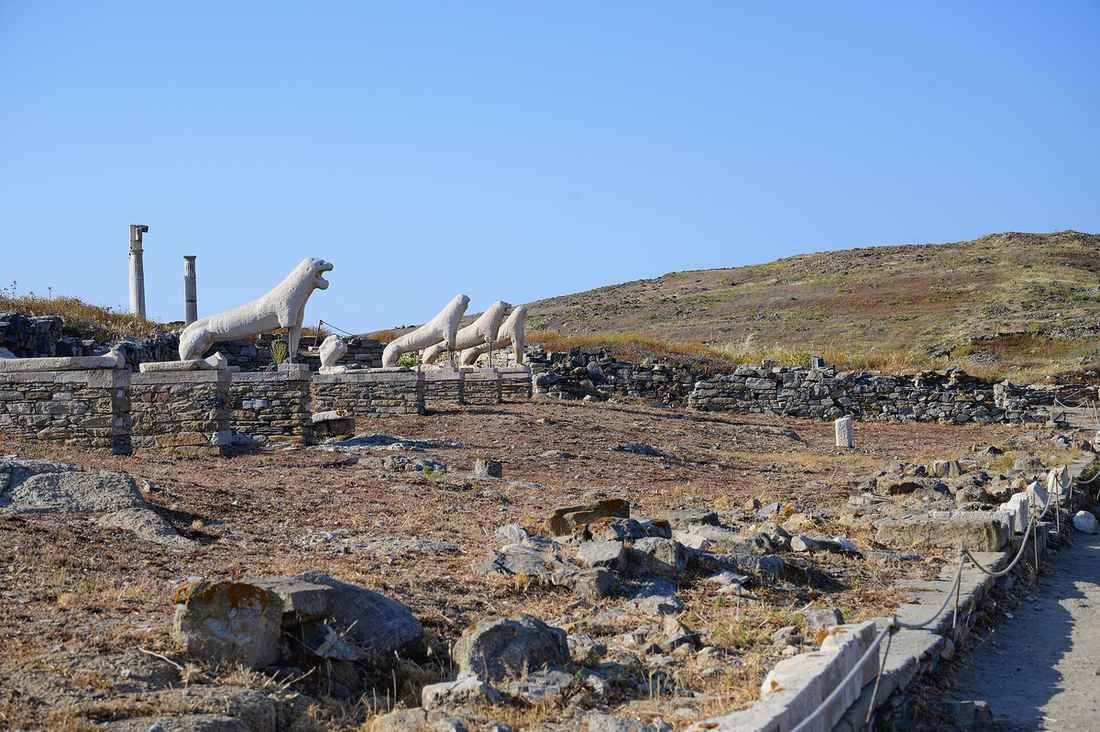
A Delos tour from Mykonos is a short boat trip to the sacred, uninhabited island of Delos, a UNESCO World Heritage Site and the mythical birthplace of Apollo and Artemis, where guided walks reveal one of Greece’s greatest archaeological sites. This guide covers the boats, the tours, what to see, the museum and practical tips.
The Delos day trip is the most rewarding cultural excursion in the Mykonos travel guide, and complements the existing Delos guide. The sections below cover the tour in full.
What is a Delos tour from Mykonos?
A Delos tour from Mykonos is a half-day boat excursion to the nearby sacred island of Delos, a UNESCO World Heritage Site and the mythical birthplace of Apollo and Artemis. After a short crossing, a guide leads a walking tour through the vast ancient ruins and the archaeological museum before you return.
A Delos tour is the most important cultural excursion you can take from Mykonos, transporting you from the island’s beaches and nightlife to one of the most sacred and significant sites of the ancient Greek world. Delos is a small, uninhabited island just off the coast of Mykonos, a UNESCO World Heritage Site and, according to myth, the birthplace of the twin gods Apollo and Artemis, which made it one of the holiest sanctuaries in antiquity and a thriving cosmopolitan city. A tour involves a short boat crossing from Mykonos, followed by time on the island, typically with a guide who leads a walking tour through the extensive ruins of temples, houses, markets and monuments, and a chance to see the on-site archaeological museum. Because Delos is uninhabited and protected, you cannot stay overnight, so it is always a half-day or day trip from Mykonos. For anyone interested in history, mythology or archaeology, it is an unmissable experience, set out alongside the guide to things to do. Getting there is quick and easy.
How do you get to Delos from Mykonos?
You reach Delos by boat from the Old Port in Mykonos Town, with the crossing taking around 30 minutes. Boats leave from the Delos ticket area beside the Old Port, with check-in closing about 30 minutes before departure. Tours run in the morning and early afternoon, with fixed return times, mainly from April to October.
Reaching Delos is straightforward, as it lies just a short distance off the west coast of Mykonos. The boats leave from beside the Old Port in Mykonos Town, by the Delos Tours ticket office and its dedicated departure area, and the crossing takes around 30 minutes across the channel. Because Delos is uninhabited and access is controlled, you travel on scheduled tour boats rather than a regular ferry, with check-in closing about 30 minutes before departure, so arrive in good time. Sailings run on fixed times, typically several departures in the morning and early afternoon, each with a set return time later in the day, so you choose how long to spend on the island within the schedule. The boats operate mainly through the main season from around April to October, and not in winter. One important caveat is the weather: in strong winds the sea can become too rough and the crossing or the visit may be cancelled, as Delos becomes inaccessible, so it is wise to plan your Delos trip early in your stay to allow for a back-up day, set out alongside the guides to the ports and Mykonos weather. A guided tour brings the ruins to life.
Should you take a guided tour of Delos?
A guided tour of Delos is highly recommended, because without a guide the site is just a field of ruins with little context, while a knowledgeable guide brings the mythology, history and buildings vividly to life. Guided tours usually include a roughly two-hour walking tour of the ancient city’s highlights.
While you can visit Delos independently, taking a guided tour is strongly recommended and makes an enormous difference to the experience. Delos is a vast, complex archaeological site of temples, houses, sanctuaries, markets and monuments, but without explanation it can appear as little more than an expanse of scattered stones and foundations, leaving visitors unsure of what they are seeing. A knowledgeable guide transforms this, weaving together the island’s mythology as the birthplace of Apollo and Artemis, its history as a sacred sanctuary and bustling cosmopolitan port, and the stories behind the individual buildings, so the ruins come alive with meaning. A typical guided tour includes a roughly two-hour walking tour through the highlights of the ancient city, led by an expert who issues the site tickets, points out the key sights and answers questions, before leaving you free time to explore further or visit the museum before the return boat. For most visitors, a guide turns a confusing ruin into a fascinating, memorable introduction to ancient Greece, set out alongside the guide to the Delos guide. The site is full of remarkable highlights.
What can you see on Delos?
On Delos you can see the highlights of the ancient city, including the Terrace of the Lions, the Temple of Apollo, the House of Dionysos with its mosaics, the statue of Cleopatra, the Hellenistic residential quarter and the theatre, plus panoramic views from Mount Kynthos and the rich archaeological museum.
Delos is one of the richest archaeological sites in Greece, and a tour reveals an astonishing array of highlights from its days as a sacred sanctuary and thriving city. Among the most famous sights are the Terrace of the Lions, where a line of archaic marble lions guards the sacred way, and the Sanctuary and Temple of Apollo at the heart of the religious complex. In the residential quarter, the elegant Hellenistic houses such as the House of Dionysos and the House of Cleopatra preserve beautiful floor mosaics and statues, including the figures of Cleopatra and her husband, while the ancient theatre and the cisterns show the scale of the city. The Avenue of the Lions, the markets and the sanctuaries of foreign gods reflect Delos’s cosmopolitan past, and a climb up Mount Kynthos rewards you with panoramic views over the island and across to Mykonos and the Cyclades. The on-site archaeological museum displays many original finds and statues. Together these make Delos an unforgettable open-air museum of antiquity, set out alongside the guide to the Archaeological Museum. A few tips help you prepare.
What should you bring and know for a Delos tour?
For a Delos tour, bring water, sun protection, a hat and comfortable walking shoes, as the site is large, open and has little shade. Note that the site admission fee is usually separate from the boat ticket, there are few facilities on the island, and the visit takes a half day overall.
A little preparation makes a Delos tour far more comfortable, as the island is an exposed archaeological site with minimal facilities. Wear sturdy, comfortable walking shoes, since you will be walking over uneven ancient stones and paths for a couple of hours, and bring sun protection including high-factor sunscreen, sunglasses and a hat, plus plenty of water, because Delos is large, open and offers very little shade under the strong Aegean sun. There is a small cafe and toilets near the museum, but facilities are limited, so come prepared. Be aware that admission to the archaeological site is usually charged separately from the boat ticket and is paid separately, though guides typically handle issuing the tickets. The whole excursion, including the crossing, the guided walk and free time, generally takes a half day, with morning tours popular for cooler conditions. Finally, because rough seas can cancel the trip, keep your plans flexible and book early in your stay. With water, shade and good shoes, you can fully enjoy this remarkable site, set out alongside the guide to a Mykonos itinerary. Timing your visit matters.
When is the best time to take a Delos tour?
The best time to take a Delos tour is the morning, for cooler temperatures and better light on the ruins, and the shoulder months of May, June, September and October for pleasant weather and fewer crowds. Avoid the windiest days, as rough seas can cancel the crossing to the exposed island.
Timing your Delos tour well improves both comfort and enjoyment. Within the day, the morning tours are generally the best choice, as the temperatures are cooler for walking the open, shadeless site and the light is softer and lovely on the ancient ruins, whereas the midday and early-afternoon heat on Delos can be intense in high summer. Across the year, the shoulder months of May, June, September and October are ideal, offering warm but comfortable weather, beautiful light and fewer crowds than the peak, so you can explore the ruins more pleasantly; July and August are hottest and busiest. A key practical consideration is the wind, because Delos is small and exposed, and in strong winds the sea becomes too rough for the boats and the trip can be cancelled, so it is wise to schedule your Delos visit for early in your Mykonos stay, leaving spare days as a back-up in case of bad weather. Choosing a calm morning in the shoulder season gives the finest Delos experience, set out alongside the guides to when to visit and day trips. The questions below cover the points travellers ask most.
Why is Delos so important and is the tour worth it?
Delos is one of the most important archaeological and sacred sites in Greece, the mythical birthplace of Apollo and Artemis and a major religious sanctuary and city in antiquity, now a UNESCO World Heritage Site. A guided tour is well worth it, turning a field of ruins into a vivid journey through ancient history.
Understanding why Delos matters makes the tour far more rewarding, and its significance is hard to overstate. In Greek mythology, Delos was the birthplace of the twin gods Apollo and Artemis, which made it one of the holiest sanctuaries in the ancient Greek world, a place of pilgrimage and worship for centuries. It grew into a wealthy, cosmopolitan sacred city and trading hub, with temples, treasuries, grand houses, markets and sanctuaries to gods from across the Mediterranean, so that today its extensive ruins form one of the most important and complete archaeological sites in Greece, recognised as a UNESCO World Heritage Site. Walking among the remains, from the Terrace of the Lions and the Temple of Apollo to the mosaic-floored Hellenistic houses and the theatre, is to walk through layers of ancient history and myth. This is exactly why a tour, and especially a guided one, is so worthwhile: it transforms what might otherwise look like a confusing expanse of stones into a vivid, meaningful story of gods, pilgrims and traders. For anyone with an interest in history, mythology or simply remarkable places, the short trip from Mykonos to Delos is among the most rewarding things to do on the whole holiday, set out alongside the guide to the Delos guide. Few day trips offer so much.
Frequently Asked Questions
How do you get to Delos from Mykonos?
You reach Delos by boat from the Old Port in Mykonos Town, with the crossing taking around 30 minutes. Boats depart from the Delos ticket area, with check-in closing about 30 minutes before departure. Tours run in the morning and early afternoon with fixed return times, mainly from April to October.
Do you need a guide for Delos?
A guided tour of Delos is highly recommended, because without a guide the site is just a field of ruins with little context, while a knowledgeable guide brings the mythology, history and buildings vividly to life. Guided tours usually include a roughly two-hour walking tour of the ancient city’s highlights.
What is there to see on Delos?
On Delos you can see the Terrace of the Lions, the Temple of Apollo, the House of Dionysos with its mosaics, the statue of Cleopatra, the Hellenistic houses and the theatre, plus panoramic views from Mount Kynthos and the rich archaeological museum, all on a sacred UNESCO World Heritage island.