
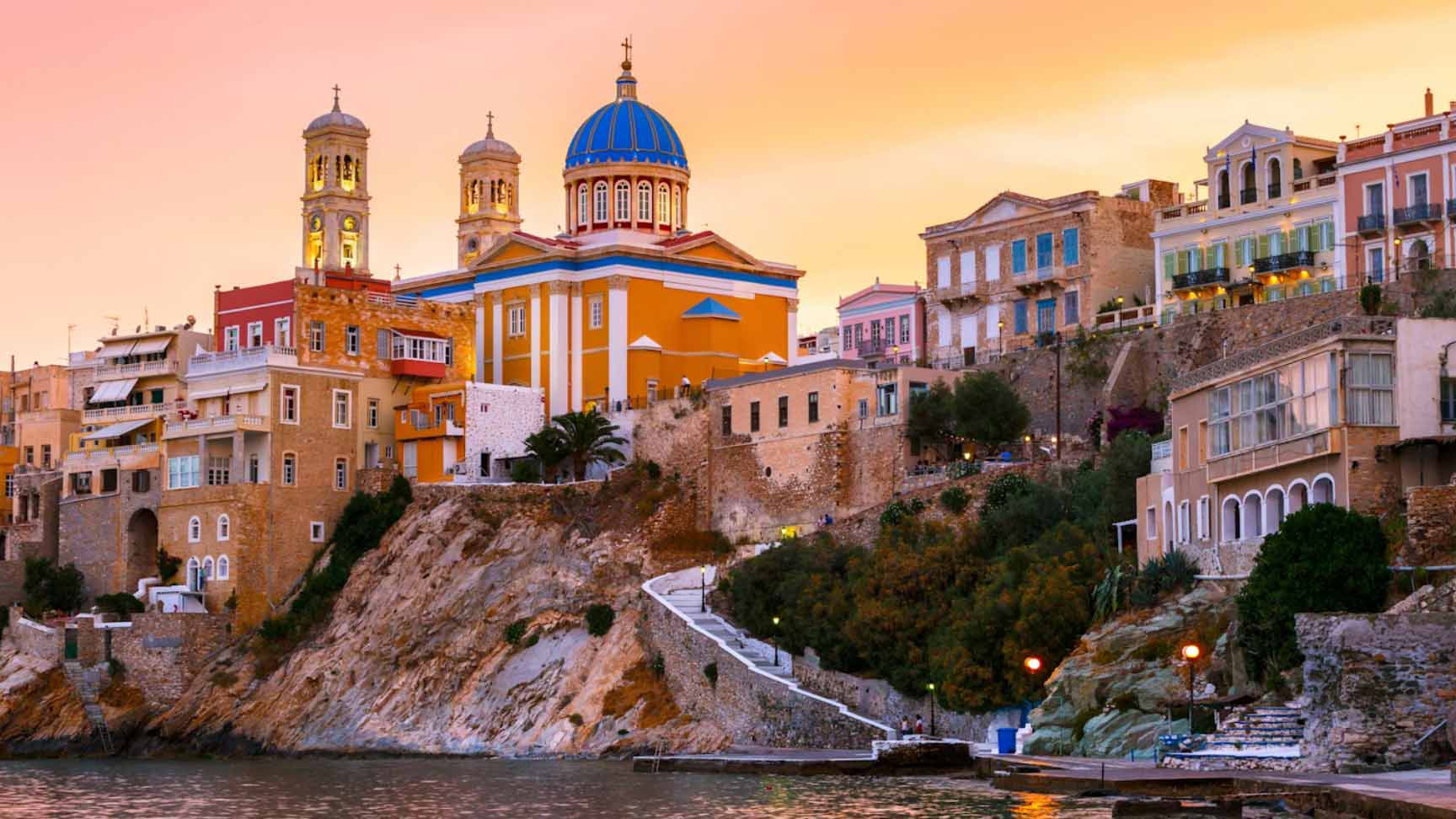
Syros sits at the centre of the Cyclades and serves as the administrative capital of the South Aegean region. The island keeps a working port, law courts, and a year-round population near 21,500, so life continues well past the summer season. Ermoupoli, the main town, rose in the 1820s as refugees built a trading harbour that once rivalled Piraeus. Its neoclassical mansions, marble squares, and the hillside quarter of Ano Syros give the island a layered character that separates it from its sandy neighbours. Travellers reach Syros by ferry from Piraeus or by a short flight, then base themselves in town and drive out to the beaches.
Ferries from Piraeus reach Syros in about 2.5 to 4 hours, depending on whether you board a high-speed catamaran or a conventional boat. The island also holds Syros Island National Airport, named after the writer Dimitrios Vikelas, with flights from Athens of roughly 35 minutes. Once on Syros, the port of Ermoupoli becomes the natural hub, with the ferry quay, tavernas, and the marble Miaouli Square within a short walk. Distances stay small: the west-coast beach of Galissas lies about 9 kilometres from town, and the fishing village of Kini sits a similar drive away. A rental car or the local bus network links the settlements across the 84 square kilometre island.
What makes Ermoupoli the neoclassical capital of Syros and the Cyclades?
Ermoupoli is the capital of Syros and of the South Aegean region, built in the 1820s by refugees who turned a natural harbour into a marble trading city of neoclassical mansions, public squares, and a grand town hall.
Plateia Miaouli forms the civic heart of Ermoupoli, a wide marble square framed by palm trees and cafe tables. The neoclassical Town Hall on its north side was designed by the German architect Ernst Ziller and finished in the 1890s. A bandstand, a statue of Admiral Andreas Miaoulis, and the Cycladic Historical Archive sit within the same plaza. Evening life gathers here as families walk between the arcades and the marble paving reflects the street lamps. The square connects by short pedestrian lanes to Chiou market street, where shops selling loukoumi and leather goods trade under first-floor balconies. The dedicated Ermoupoli town guide lists opening hours and walking routes.
The Apollon Theatre opened in 1864 as a miniature copy of Milan’s La Scala, giving the island an opera house in the middle of the Aegean. An Italian-trained architect shaped the horseshoe auditorium, the painted ceiling, and the tiered boxes. Ermoupoli hosted touring Italian opera companies here through the nineteenth century, and the hall still stages concerts and film screenings. Its ceiling medallions honour Verdi, Rossini, Mozart, and Donizetti, linking the small port to the European stage. Restoration in the late twentieth century returned the red-and-gold interior to its original look. Daytime visitors tour the auditorium for a modest entrance fee before the evening programme starts.
Vaporia spreads east of the town centre as the district where nineteenth-century shipowners built their mansions above the sea. Its name comes from the steamships, or vapori, that funded the wealth on display in painted facades and iron balconies. The blue-domed church of Agios Nikolaos anchors the quarter, its twin marble bell towers rising over the rooftops. Behind the church, stone stairs drop to swimming platforms cut into the rock, where residents dive straight into deep water. The grandest mansions now serve as boutique hotels, letting guests sleep in rooms with frescoed ceilings and harbour views. A walk along the seafront terraces traces the character that earns Vaporia its name as the captains’ quarter.
The working harbour keeps Ermoupoli busy through the year, with ferries, fishing boats, and the regional government offices all crowded along the waterfront. Chiou and Protopapadaki streets hold the main shopping run, where confectioners have sold Syros loukoumi and halvadopita since the nineteenth century. The covered market and the fish stalls near the port supply the tavernas that line the quay. Stepped lanes climb from the harbour toward the two hilltop quarters, Vrontado on the Orthodox side and Ano Syros on the Catholic side. This concentration of port, commerce, and administration explains why Ermoupoli never empties in winter, unlike smaller Cycladic towns that close down after September.
Why is Ano Syros a medieval Catholic settlement above Ermoupoli?
Ano Syros is the medieval hilltop town founded by Venetian Catholics in the thirteenth century around the cathedral of San Giorgio. Its car-free lanes, Catholic churches, and the birthplace of rebetiko musician Markos Vamvakaris crown the ridge above Ermoupoli.
Venetians settled the hill of San Giorgio in the thirteenth century, building a fortified town that looked inward for protection from pirates. The Catholic cathedral of Saint George crowns the summit, rebuilt over earlier churches and reached by stepped alleys. Under Ottoman rule Syros kept its Catholic majority through French and papal protection, which shaped a community distinct from the Orthodox islands nearby. The Capuchin and Jesuit orders founded monasteries on the slope, and their bells still mark the hours. Whitewashed houses press against each other along vaulted passages barely wide enough for a loaded mule. From the cathedral terrace the view runs across Ermoupoli’s rooftops to the harbour and the open Aegean beyond.
Markos Vamvakaris, the founding figure of rebetiko music, was born in Ano Syros at the start of the twentieth century and grew up in these lanes. A small square named after him holds his bronze bust and faces the town he later left for the docks of Piraeus. The house where he lived now works as a modest museum, showing his bouzouki, photographs, and handwritten lyrics. Tavernas around the square play rebetiko in the evenings, keeping the sound tied to its birthplace. His songs turned the hardship of refugees and dockworkers into a national style still recorded across Greece. Travellers climb here for the music history as much as for the Catholic monuments higher up the ridge.
The dual identity of Syros comes from this split between a Catholic hilltop and an Orthodox port. Ano Syros keeps Roman Catholic parishes, while Vrontado on the opposite hill holds the Orthodox church of the Resurrection. The two communities celebrate Easter on the same date by local agreement, a rare arrangement in Greece. Catholic feast days fill the Ano Syros calendar, and a Catholic bishop still sits on the island. This balance gave Syros a reputation for tolerance that drew traders from across the Mediterranean. You can follow the full route in the Ano Syros walking guide, which maps the churches and the stepped climb up from town.
Reaching Ano Syros takes a steep climb on foot from Ermoupoli or a short bus ride to the upper car park. The main lane, called Piazza, threads past workshops, ceramic studios, and tavernas set on terraces above the sea. Evening is the favoured time to visit, when the heat drops and the lamps light the whitewashed steps. The settlement holds fewer than a thousand permanent residents, yet it fills with diners once the sun sets. Local cheese, capers, and louza appear on menus that trade on the view rather than on size. A single loop through the lanes, the cathedral, and Vamvakaris square takes about two hours at a slow pace.
How do you get to Syros by ferry and by air?
Syros connects to Piraeus by ferry in 2.5 to 4 hours and to other Cycladic islands through frequent daily sailings. Syros Island National Airport also receives short flights from Athens, giving the island two reliable travel routes across the year.
Ferries from Piraeus form the main gateway to Syros, running through the year rather than only in summer. High-speed catamarans cover the crossing in about two and a half hours, while conventional car ferries take closer to four. The route passes Kea, Kythnos, and at times Tinos before reaching Ermoupoli’s central quay. Because Syros holds the regional port authority, boats arrive at most hours, and the schedule holds up better in wind than routes to smaller islands. Tickets sell through the port agencies on the waterfront and through the ferry operators online. Foot passengers walk straight into town, while drivers roll off directly onto the harbour road below Miaouli Square.
Syros works as a ferry hub for the northern and western Cyclades, with direct links to Mykonos, Tinos, Andros, Paros, and Naxos. Sailings to Mykonos and Tinos take under an hour on a fast boat, making day trips practical. Connections reach Amorgos and the small Cyclades through the regular island lines during summer. The central position let Ermoupoli grow as a coaling and repair station in the age of steam, and the same geography keeps it useful. Travellers island-hopping across the group often route through Syros to change boats. The port authority posts live departure boards, and delays stay rare compared with the exposed southern harbours.
Syros Island National Airport sits on a plateau south of Ermoupoli and carries the name of the writer Dimitrios Vikelas. Flights from Athens land in about 35 minutes, run by the national carrier under a public-service contract. The single runway handles turboprop aircraft, so the schedule stays light with one or two arrivals a day. The airport gives Syros a fast link in winter, when rough seas slow the ferries. A taxi covers the ten-minute drive into Ermoupoli, and the rental desks operate on request rather than as permanent counters. Booking ahead matters, because the small aircraft fill quickly around public holidays and the August peak.
Getting around Syros works best with a rental car, since the beaches and villages spread across a compact road network. The island bus runs from the Ermoupoli quay to Ano Syros, Galissas, Kini, Vari, and Poseidonia on a printed timetable. Taxis wait at the port, though the fleet stays small, so booking helps in high season. Distances stay short, with the furthest southern beaches about 12 kilometres from town. Scooters suit the flatter southern roads but struggle on the steep climb to Ano Syros. A car opens the quieter northern coast, where dirt tracks lead to coves that the bus never reaches.
Which beaches on Syros are worth planning a day around?
Syros holds calm, family beaches on its south and west coasts, including Galissas, Kini, Vari, Poseidonia, Megas Gialos, and Komito. The organised bays carry tavernas and umbrellas, while Delfini, Agathopes, and Komito stay quieter for swimmers seeking space.
Galissas holds the busiest west-coast beach, a curved bay of fine sand backed by tamarisk trees, tavernas, and rooms for rent. A footpath over the northern headland leads to Armeos, a smaller cove used by naturists. The fishing village of Kini sits a short drive north, facing a sunset that draws diners to its seafront tables. Kini’s sheltered bay suits families, with shallow water and fish tavernas built almost onto the sand. The neighbouring cove of Delfini, reached by a dirt track, gives a quieter stretch under low cliffs. These west-facing beaches catch the afternoon light, so they fill later in the day than the eastern shore.
The south coast of Syros shelters the calmest swimming, starting with Poseidonia, also called Delagrazia, where nineteenth-century villas line a sandy bay. Wealthy Ermoupoli families built summer mansions here, and the neoclassical facades still front the beach road. Nearby Agathopes offers shallow turquoise water and a small islet a short swim offshore, backed by a protected wetland. Komito lies at the end of the southern road, a broad sandy beach with tamarisk shade and a single taverna. Megas Gialos, on the southeast coast, splits into two coves under old trees and suits early families. These southern bays face away from the meltemi wind, so they stay usable when the north coast turns rough.
Vari occupies a deep bay on the southeast coast, with sand, warm shallow water, and a line of tavernas along the front. The bay’s shape blocks the wind, making Vari the safest choice for small children on a breezy day. Above it, Achladi and Ampela form quieter coves reached by short roads off the main southern route. On the town side, Agios Nikolaos and Vaporia give quick swims from the rock platforms below the mansions. The eastern beach of Azolimnos, a fifteen-minute drive from Ermoupoli, holds a working fishing hamlet with fresh seafood. This spread of coves means a north wind never closes the whole island to swimmers.
Reaching the beaches on Syros rarely takes more than 20 minutes by car from Ermoupoli. Galissas, Kini, Vari, and Poseidonia sit on the bus route, while Komito, Delfini, and Agathopes need a car or scooter. Organised bays rent umbrellas and sunbeds and keep tavernas open through the swimming season from June to September. The quieter coves carry no facilities, so water and shade planning matters on the exposed tracks. A boat tour from the port reaches the sea caves and northern coves that stay closed to road traffic. Early July through early September gives the warmest sea, while June and late September trade heat for space.
What foods define Syros, from loukoumi to San Michali cheese?
Syros built its food identity on Ermoupoli confectionery and island dairy, led by loukoumi, halvadopita, San Michali PDO cheese, and cured louza. The town’s nineteenth-century sweet shops and the mountain cheese-makers still supply products tied by name to the island.
Syros loukoumi carries the strongest food name on the island, a soft gel of sugar and starch dusted in icing sugar and scented with rosewater, mastic, or bergamot. Refugees from Chios brought the recipe to Ermoupoli in the nineteenth century, and family firms have boxed it by the harbour ever since. Halvadopita pairs the same tradition, a round nougat wafer packed with almonds and honey and sold in stacked tins. The confectioners along Chiou street hand out samples and ship boxes across Greece as gifts. These sweets travel well and keep for weeks, which turned them into the standard souvenir from Syros. A factory-shop tour near the port shows the copper pans and marble slabs still used in production.
San Michali cheese carries a Protected Designation of Origin tied only to Syros, made from the milk of cows grazing the island’s north. The hard, sharp cheese ages for at least four months and grates over pasta like a mature Italian hard cheese. Louza, the island’s cured pork, comes seasoned with pepper, cinnamon, and clove, then air-dried and sliced thin as a meze. Local kopanisti adds a peppery soft cheese to the table, spread on rusks with tomato. The island dairies sit around the northern village of San Michalis, where the cheese takes its name. A plate of louza, San Michali, and capers with a glass of island wine sets the standard opening course.
Syros tavernas build menus on the surrounding sea and the small farms of the interior. Fresh fish, grilled octopus, and sea urchin appear at the harbour tables in Kini and Azolimnos, priced by the day’s catch. The island grows capers, tomatoes, and fennel that fill the local pies and fritters. Marathokeftedes, or fennel fritters, and tomato keftedes served as fried patties open a typical meal. Wild greens gathered on the hillsides, dressed with island olive oil and lemon, round out the spread. Ermoupoli also keeps a cafe culture from its trading past, with marble-topped tables serving spoon sweets and thick coffee through the afternoon.
The covered market near the port supplies the raw material for the island kitchen, from cheese and louza to fish and vegetables. Ermoupoli holds the widest choice of tavernas, ouzeries, and patisseries, concentrated around Miaouli Square and the waterfront. Ano Syros trades on its terrace views, serving cheese plates and rebetiko alongside grilled meat. The southern villages of Vari and Poseidonia run seasonal fish tavernas open from spring to autumn. Prices sit below Mykonos levels, since Syros lives on its own economy rather than on luxury tourism. A food-focused visit pairs a morning at the covered market with an evening table above the harbour lights.
What outdoor activities and boat tours does Syros offer?
Syros rewards walkers with old stone footpaths linking villages, chapels, and northern coves, while boat tours from Ermoupoli reach sea caves and beaches off the road network. The rugged north, called Apano Meria, holds the island’s wildest hiking terrain.
The northern half of Syros, known as Apano Meria, keeps a network of stone paths once used by farmers and monks. Marked trails link the hamlets of Kambos, Syringas, and San Michalis to remote chapels and terraced fields. The route to the bay of Grammata passes ancient inscriptions carved by sailors praying for safe passage. Another path drops to Aetos and Lia, two northern beaches reached only on foot or by boat. The terrain runs dry and rocky, so walkers carry water and start early in the summer heat. A local walking group maintains the waymarks, and the northern trailheads begin at the end of the Kambos road.
Boat tours leave the Ermoupoli and Kini harbours to reach the coastline that roads never touch. A typical trip rounds the north cape to the beaches of Grammata, Aetos, and Lia, stopping for swims in clear water. Smaller boats explore the sea caves along the western cliffs, where the rock drops straight into deep blue. Sunset cruises from Kini trace the west coast as the light fades behind the neighbouring islands. Fishing trips let visitors haul in the evening meal and cook it aboard or at a taverna. The calm southern bays also rent kayaks and paddleboards for self-guided exploring along the shore.
Syros supports diving on reefs and a small wreck off the southern coast, run by a dive centre based near Galissas. The clear Aegean water gives visibility often past 20 metres, with rocky walls and caves for trained divers. Windsurfers use the exposed bays on windy meltemi days, while the sheltered south suits beginners. The interior offers cycling on quiet paved roads that climb between the villages and drop back to the coast. Rock-fishing from the Vaporia platforms and the northern capes fills quiet mornings for anglers. This range of land and sea activity keeps active travellers busy beyond the beach and the town.
Cultural events fill the Syros calendar through the warmer months, centred on the Ermoupoli squares and the Apollon Theatre. The Ermoupolia summer festival stages concerts, theatre, and exhibitions across the town’s public buildings. A world-music and jazz festival draws performers to the harbour stage in July. Religious feasts on both the Catholic and Orthodox calendars bring processions through Ano Syros and Vrontado. The Animasyros animation festival turns the port into a screening venue in autumn, tying the trading city to a modern art form. These gatherings give reasons to visit outside the beach season, when the town rather than the coast takes the lead.
Where should you stay on Syros and when is the best time to visit?
Ermoupoli suits travellers wanting town life, culture, and ferries, while Galissas, Kini, and Vari fit a beach-based stay. Syros stays pleasant from late spring to October, with July and August busiest and the shoulder months quieter and cooler.
Ermoupoli makes the natural base on Syros for a first visit, putting the ferry quay, restaurants, and neoclassical sights within walking distance. Restored mansions in Vaporia work as boutique hotels, offering harbour views and frescoed ceilings above the swimming platforms. Rooms near Miaouli Square place travellers among the cafes and the evening promenade. Staying in town removes the need to drive for dinner, since the tavernas, bars, and bakeries cluster along the waterfront. The port location also suits island-hopping plans, with the early ferries reached on foot. The dedicated Ermoupoli guide lists the neighbourhoods, from the grand seafront to the quieter upper lanes.
Galissas gives the strongest beach base on Syros, with rooms, tavernas, and a bus link within walking distance of the sand. Kini suits couples wanting a quiet fishing-village feel and a west-facing sunset over dinner. Vari and Megas Gialos on the south coast fit families, with shallow bays and calm water sheltered from the wind. Poseidonia carries the island’s grander summer houses, a small resort of neoclassical villas near sandy Agathopes. Each of these settlements sits within a 20-minute drive of Ermoupoli, so a beach stay still reaches the town easily. A rental car helps at every base except Galissas, where the bus and the beach both sit on the doorstep.
The season on Syros runs from late spring to October, with the sea warm enough for swimming from June onward. July and August bring the hottest days, the busiest ferries, and the meltemi wind that cools the afternoons. Room rates climb during August and around the mid-month feast, so early booking pays off. Spring and September trade the crowds for softer light, open tavernas, and easier parking. Winter keeps Ermoupoli alive as a working capital, though beach services close and the ferries thin out. The Easter processions, celebrated together by both churches, make spring a distinctive time to arrive.
A three-day visit covers Ermoupoli, Ano Syros, and two or three beaches at a relaxed pace. Adding a fourth day opens the northern trails or a boat trip to the Grammata coves. Base yourself in Ano Syros for atmosphere and views, or in town for convenience and ferries. Combine Syros with Tinos or Mykonos, both under an hour away by fast boat, for a wider Cycladic route. Book the ferry and the room ahead for the August peak, when the island fills with Greek as well as foreign travellers. Syros rewards a slower trip that mixes the marble town, the Catholic hill, and the southern beaches.
What do Syros tours see at Kastri and prehistoric Syros?
Syros tours in the north see Kastri, a fortified hilltop settlement of the Early Bronze Age, and the cemetery of Chalandriani below it, where hundreds of tombs gave their name, with Keros, to the Keros-Syros culture of the Cyclades, and the famous clay frying pans engraved with the oldest pictures of Aegean ships.
Around 2700 to 2300 BC, the people of Kastri built stone walls with towers around their houses on a rocky height above the sea, one of the earliest fortified villages in Greece. The Chalandriani cemetery nearby held small stone tombs with pottery, marble figurines and the flat clay objects known as frying pans, decorated with spirals and long oared ships.
Syros tours on foot reach Kastri by a path from the north of the island, and guided hikes join the site with the wild landscape of Apano Meria. The finds are shown in the archaeological museum of Ermoupoli and in Athens, and a cave in the hills north of the town is linked by tradition with Pherecydes of Syros, the philosopher of the 6th century BC.
- Kastri – the fortified settlement of the Early Bronze Age.
- Chalandriani – the cemetery of hundreds of tombs.
- Keros-Syros culture – the phase of Cycladic civilisation named after the island.
- Frying pans – the clay objects engraved with oared ships.
- Cycladic figurines – the marble figures from the tombs.
- Pherecydes – the philosopher of ancient Syros.
Our Kastri and Chalandriani page covers the site. Syros tours to Kastri start early in summer, since the northern paths have little shade.
What industrial and maritime history do Syros tours discover?
Syros tours discover how refugees from Chios, Psara and Asia Minor founded Ermoupoli in the 1820s and made it the first port and industrial town of the new Greek state, with shipyards, tanneries and textile mills, a history told in the Industrial Museum and the working Neorion shipyard, and in the music of Markos Vamvakaris.
During the War of Independence, Catholic Syros stayed neutral under French protection, and Greek refugees fleeing the massacres of Chios and Psara settled on its shore. Their trading town grew fast, and by the middle of the 19th century Ermoupoli handled much of the country’s shipping, built its mansions and theatre, and opened factories along the coast.
The Industrial Museum, in old factory buildings, shows the machines, tools and products of that age, and the Neorion shipyard, founded in the 1860s, still repairs ships in the bay. Markos Vamvakaris, the father of rebetiko music, was born in Ano Syros, and a small museum there keeps his memory, so Syros tours end the history walk with his songs.
- Refugee founders – the families from Chios, Psara and Asia Minor.
- Neutral Syros – the Catholic island under French protection.
- First industrial town – the shipyards, tanneries and mills.
- Industrial Museum – the machines of the 19th century.
- Neorion shipyard – the yard still at work in the bay.
- Markos Vamvakaris – the rebetiko musician born in Ano Syros.
Our Industrial Museum and Markos Vamvakaris pages cover the story. Syros tours on foot link the museum with Vaporia and Ano Syros.
What do Syros tours see in Posidonia and the south-west villages?
Syros tours in the south-west see Posidonia, also called Dellagrazia, with the summer villas that the merchant families of Ermoupoli built among gardens by the sea, the small harbour and yacht marina of Finikas, and the family beaches and villages of the south coast, from Megas Gialos to Vari.
In the 19th and early 20th centuries, the wealthy families of Ermoupoli escaped the summer heat of the town to Posidonia, where they built villas in neoclassical and eclectic styles with towers, terraces and walled gardens. The villas still stand along the streets and the waterfront, and a walk through the village shows the taste of the old merchant class.
Finikas, next door, has a small harbour of fishing boats and sailing yachts with tavernas on the quay, and the south coast beyond it is a string of quiet bays with shallow water. Syros tours by car or scooter loop through these villages in half a day from the town.
- Posidonia – the village of merchant villas.
- Dellagrazia – the old Italian name of Posidonia.
- Villa gardens – the walled gardens of the summer houses.
- Finikas – the harbour and yacht marina.
- Megas Gialos – the family beach of the south.
- Vari – the sheltered bay of the south-east.
Our Posidonia page covers the villas. Syros tours end the south-west loop with a swim at Finikas or Megas Gialos.
Which festivals do Syros tours plan around?
Syros tours plan around the carnival of Ermoupoli before Lent, the Syros International Film Festival in summer, the Animasyros festival of animation in early autumn, the classical music and opera of the Apollo theatre, and the Catholic and Orthodox feasts that fill the streets of Ano Syros and Ermoupoli.
As the capital of the Cyclades with a year-round population, Syros keeps a cultural calendar that runs beyond the beach season. The carnival brings parades and masked parties to the town, the film festival screens films in open-air venues and old buildings, and Animasyros draws animators from around the world.
The island also has two Christian traditions side by side, Catholic on the hill of Ano Syros and Orthodox in the lower town, and their feasts, processions and Easter celebrations are a draw of their own. Syros tours in these weeks book hotels ahead, since the town fills with visitors.
- Carnival – the parades of Ermoupoli before Lent.
- Syros International Film Festival – the summer screenings.
- Animasyros – the autumn festival of animation.
- Apollo theatre – the concerts and opera of the season.
- Catholic feasts – the processions of Ano Syros.
- Orthodox Easter – the celebrations of Ermoupoli.
Our Animasyros and Syros carnival pages cover the dates. Syros tours plan a visit around one of the festivals for the island’s town life.
Which day trips do Syros tours offer to Tinos and Mykonos?
Syros tours by ferry reach Tinos in under an hour, with its great church of the Virgin, marble villages and dovecotes, and Mykonos in about an hour, with its windmills and Little Venice, making Syros a practical base for day trips to its neighbours in the northern Cyclades.
Syros sits at the centre of the ferry routes of the northern Cyclades, and boats leave Ermoupoli for Tinos and Mykonos every day in summer, with the most crossings in July and August. A morning ferry leaves time for a full day on the neighbouring island and a return in the evening to the quieter streets of Ermoupoli.
Tinos suits visitors who want villages, marble crafts and the pilgrim church of Panagia Evangelistria, while Mykonos suits those who want its famous town, beaches and nightlife. Syros tours by sea also include day cruises around the island’s own coast with swimming stops in coves without roads.
- Tinos – the island of the Virgin and the marble villages.
- Mykonos – the windmills and Little Venice.
- Morning ferries – the departures from Ermoupoli.
- Evening return – back to Syros for the night.
- Island cruises – the coves of the Syros coast.
- Central position – the ferry hub of the northern Cyclades.
Our Syros to Tinos ferry page covers the crossing. Syros tours to Tinos and Mykonos book the fast ferries a day ahead in August.
Frequently Asked Questions
How long is the ferry from Athens to Syros?
Ferries from Piraeus, the port of Athens, reach Syros in about two and a half hours on a high-speed catamaran and closer to four hours on a conventional car ferry. Boats run through the year because Syros holds the regional port authority, so winter service stays more reliable than on smaller Cycladic islands. Departures cluster in the morning and late afternoon, and foot passengers walk straight into Ermoupoli from the quay.
Is Syros a good island for families?
Syros suits families through its calm south-coast beaches, walkable capital, and year-round services. Vari, Megas Gialos, and Poseidonia offer shallow, sheltered water for young children, while Ermoupoli keeps pharmacies, a hospital, and playgrounds within the town. The island draws Greek family travellers rather than a party crowd, so evenings stay relaxed around the squares. Short distances mean a beach, a meal, and a walk through the marble streets fit into one easy day.
What is Syros known for?
Syros is known as the capital of the Cyclades, centred on the neoclassical port of Ermoupoli and the medieval Catholic town of Ano Syros. The island stands out for its opera house, the Apollon Theatre, and for confectionery such as loukoumi and halvadopita. Its dual Catholic and Orthodox identity, its shipping heritage, and the birthplace of rebetiko pioneer Markos Vamvakaris set Syros apart from the sandy, party-focused Cyclades nearby.
How many days do you need on Syros?
Three days give enough time to see Ermoupoli, climb Ano Syros, and swim at two or three beaches without rushing. A fourth day opens the northern hiking trails or a boat trip to the Grammata coves reachable only from the sea. Travellers combining Syros with Tinos or Mykonos add a night either side, since both islands sit under an hour away by fast ferry. A slower week suits anyone wanting the beaches, the food, and the culture together.
Why does Syros have a large Catholic community?
Syros kept a Catholic majority because Venetian settlers founded Ano Syros in the thirteenth century and French and papal protection shielded the community under Ottoman rule. The island avoided the worst of the Greek War of Independence by claiming that protection, which drew Catholic families and traders. Ano Syros still holds Roman Catholic parishes and a Catholic bishop, while Orthodox Ermoupoli grew later around refugee arrivals. The two communities share the same Easter date, a rare local agreement in Greece.
Which beach on Syros is best for swimming?
Vari offers the safest swimming on Syros, a deep southern bay with warm, shallow water sheltered from the meltemi wind. Galissas gives the fullest beach day, with sand, tavernas, and a bus link on the west coast. Kini draws visitors for calm water and a sunset dinner, while Komito and Agathopes reward drivers with quieter sand. The choice depends on the wind, since the south coast stays calm when the north turns rough.
Find more experiences in My Greece Tours
- Tinos, the pilgrimage island a short ferry hop from Syros
- Mykonos, the cosmopolitan Cyclades neighbour of Syros
- Paros, a central Cyclades hub linked to Syros by ferry
- Antiparos, the quiet island beside Paros near Syros
- Naxos, the largest Cyclades island south of Syros
- Ios, the lively southern Cyclades island reached via Syros
- Sifnos, the pottery and food island west of Syros
- Serifos, a rugged western Cyclades escape near Syros
- Sikinos, a tranquil island connected through the Syros routes
- Milos, the volcanic island of coloured beaches in the Cyclades
- Folegandros, a clifftop Chora island in the south Cyclades
- Santorini, the caldera island linked to the Syros ferry network
- Kythnos, the thermal-spring island in the western Cyclades
- Andros, the green hiking island of the northern Cyclades
- Amorgos, the dramatic eastern Cyclades island beyond Naxos