
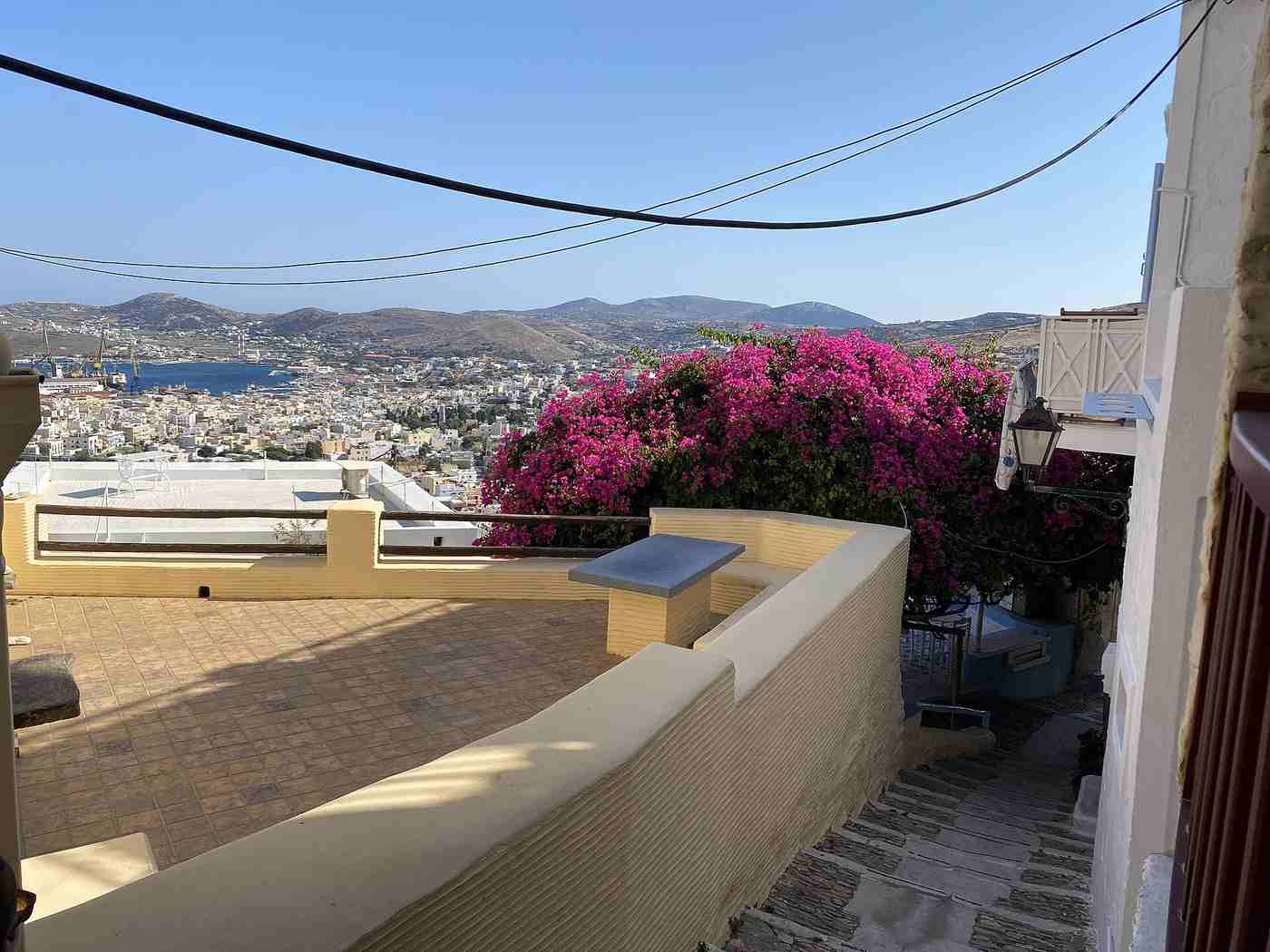
Ano Syros is the medieval Catholic town that crowns the ridge above Ermoupoli on the island of Syros. Venetian settlers founded it in the thirteenth century on the hill of San Giorgio, ringing the summit with houses built for defence against pirates. The settlement kept a Roman Catholic majority through the Ottoman centuries, protected by France and the papacy. Car-free stepped alleys climb past whitewashed houses to a cathedral at the top. Ano Syros also gave Greece the rebetiko pioneer Markos Vamvakaris, whose birthplace draws travellers up the hill. The quarter forms one half of the dual identity that defines the island of Syros. Plan the whole trip with Greece Tours.
The hill rises directly behind Ermoupoli, the marble port capital, and faces the Orthodox quarter of Vrontado across a shallow valley. Visitors reach the top on foot up stepped lanes from the town, or by the local bus that climbs to the upper car park. A single main street, called Piazza, threads past the cathedral, workshops, and terrace tavernas. The loop through the churches and the Vamvakaris square takes about two hours at a slow pace. Fewer than a thousand people live here through the year, yet the lanes fill with diners once the sun drops. This guide maps the history, the monuments, and the climb up from Ermoupoli.
What makes Ano Syros a medieval Catholic settlement above Ermoupoli?
Ano Syros is a fortified medieval town built by Venetians in the thirteenth century on the hill of San Giorgio. Its car-free stepped alleys, inward defensive layout, and Catholic churches crown the ridge directly above the port of Ermoupoli.
The medieval builders set Ano Syros on a cone hill so the houses themselves formed a wall. Outer homes present blank stone backs to the slope, while doors and windows open inward onto narrow lanes. This defensive plan protected the town from the pirate raids that struck the Aegean through the medieval centuries. Vaulted passages, covered stairways, and dead-end courtyards break up the climb toward the summit. The lanes stay too narrow and too steep for cars, so the quarter remains free of traffic to this day. Residents once moved goods by mule along these steps. The layout survives almost intact from its Venetian origin.
Venetian rule brought the Roman Catholic faith to the hill, and the community held that faith for centuries. The Latin Church organised the town around its parishes, its bishop, and the cathedral of Saint George at the top. Ano Syros grew apart from the Orthodox islands nearby, keeping Italian family names and a Catholic calendar. The society clustered around the churches, the monasteries, and the open squares between them. This concentration gave the settlement a compact, layered form that later spread down the slope toward the sea. The Catholic majority shaped the street names, the feast days, and the architecture that visitors read today.
Ano Syros stood alone on its hill for centuries before the port below existed. Refugees from Chios, Psara, and other islands built Ermoupoli on the shoreline during the Greek War of Independence. The new Orthodox town grew fast around trade and shipping, while the old Catholic quarter kept its medieval shape. The two settlements now sit stacked together, the modern port at sea level and the medieval town on the ridge. A visitor climbing from the marble squares of the harbour passes from the nineteenth century into the middle ages within a short walk. This vertical layering of eras gives the island a rare depth.
Ano Syros today works as a lived-in neighbourhood rather than an open-air museum. Craft workshops, ceramic studios, and small galleries occupy houses along the main lane. Elderly residents tend potted plants on the steps, and cats stretch across the warm stone. Evening brings diners up from the port to the terrace tavernas that face the sunset. The whitewashed walls, blue shutters, and stone arches frame views back across Ermoupoli to the Aegean. Beach visitors staying at Galissas beach drive over for an evening on the hill. A walk here pairs the medieval fabric with a working island community.
How did Venetian settlers and French protection shape the Ano Syros Catholic community?
Venetian settlers planted a Roman Catholic community at Ano Syros in the thirteenth century, and France later shielded it under Ottoman rule. French and papal protection let the town keep its faith, its churches, and a Catholic bishop through the Ottoman centuries.
The Republic of Venice controlled the Cyclades through the Duchy of the Aegean from the thirteenth century onward. Venetian and Genoese families settled Syros and raised the fortified town on the San Giorgio hill. They installed the Latin rite, built the first churches, and tied the island to Catholic Europe. Syros held one of the strongest Catholic communities in the Aegean under this rule. The Venetian period fixed the town plan, the parish structure, and the religious calendar that followed. The faith stayed rooted on the hill long after Venice lost its grip. Ano Syros carried this Latin inheritance into the Ottoman era without breaking.
Ottoman forces took the Cyclades in the sixteenth century, yet Syros kept its Catholic majority intact. France claimed the role of protector for Roman Catholics across the Ottoman lands, and Syros fell under that shield. French consuls, Capuchin friars, and Jesuit priests reinforced the island’s ties to Catholic Europe. The Sultan granted the community rights to worship, ring bells, and run its own schools. This protection spared Syros the pressures that reduced Catholic numbers elsewhere in Greece. The island earned a name for tolerance, drawing traders from across the Mediterranean. Ano Syros stayed the base of that protected community throughout the period.
Greek fighters rose against Ottoman rule in the early nineteenth century, and the Catholics of Syros invoked French protection to stay neutral. The island avoided the destruction that struck rebel centres across the Aegean. This safety turned Syros into a refuge, and thousands of Orthodox refugees landed on its shores. The newcomers founded Ermoupoli at the foot of the hill and built the trading port from nothing. The old Catholic town watched a new Orthodox city rise below it within a single generation. Two faiths, two quarters, and two civic traditions settled side by side on one island. Ano Syros kept its French-backed identity while Ermoupoli grew into the regional capital.
The Catholic community of Ano Syros survives as a living church, not a relic. A Roman Catholic bishop still holds the See of Syros, one of the last active Catholic dioceses in Greece. Latin-rite parishes celebrate mass in the hill churches, and Catholic feast days fill the local calendar. The two communities of the island share the same Easter date by a local agreement rare in the country. French cultural ties linger in family names, school traditions, and the design of the churches. Roughly half the island’s residents trace Catholic roots, a balance unmatched across the Cyclades. Ano Syros remains the historic core of that faith.
Why does the San Giorgio cathedral crown the summit of Ano Syros?
The Catholic cathedral of San Giorgio, dedicated to Saint George, stands at the summit of Ano Syros. Venetians first built a church here in the medieval period, and the cathedral remains the spiritual and visual peak of the whole hill.
The cathedral of San Giorgio caps the highest point of Ano Syros, reached by the longest climb of stepped lanes. Venetian settlers raised the first church on this spot in the medieval centuries, and later rebuildings kept the site. The plain white facade and single bell tower stand over the whole town and the port below. Inside, the Latin-rite altar, painted icons, and marble floor serve the island’s Roman Catholic parish. The terrace outside the doors opens the widest view on the hill, across Ermoupoli to the open Aegean. The cathedral gives its name, San Giorgio, to the entire settlement in older records.
The Capuchin monastery of Saint Jean sits on the slope below the cathedral, founded under French protection. Capuchin friars arrived from France in the seventeenth century and built the house as a mission base. The order ran a hospice, a school, and a refuge for sailors and traders passing through the port. Its church and cloister still stand along the western lanes of the hill. The monastery reinforced the French link that shielded the island’s Catholics for centuries. Thick stone walls and a walled garden mark the compound apart from the houses around it. The Capuchin foundation ranks among the oldest religious houses on Syros.
The Jesuit monastery crowns a separate rise on the eastern side of Ano Syros, beside its own church. Jesuit priests reached the island in the seventeenth century and established the house to teach and preach. The order built a strong school tradition that educated generations of the island’s Catholic families. Its church holds paintings, relics, and an archive tied to the community’s long history. The Jesuit and Capuchin houses together anchored Catholic learning on the hill for centuries. Both orders answered to Rome while leaning on French diplomatic cover under Ottoman rule. These monasteries frame the cathedral as the third pillar of Catholic Ano Syros.
Small Catholic chapels dot the lanes between the cathedral and the two monasteries. Each parish keeps its own feast day, and processions wind through the stepped streets on those dates. Bells from the hill answer the Orthodox bells of Vrontado across the valley above Ermoupoli. The Catholic Holy Week draws the community to San Giorgio for the island’s shared Easter celebration. Candlelit night processions trace the medieval streets during the summer patron festivals. The concentration of churches in so tight a space marks Ano Syros as a Catholic centre of Greece. Visitors time an evening climb to catch a service or a feast.
Who was Markos Vamvakaris and where is his house-museum in Ano Syros?
Markos Vamvakaris, the father of rebetiko music, was born in Ano Syros at the start of the twentieth century. His childhood house on the hill now works as a small museum, and a nearby square holds his bronze bust.
Markos Vamvakaris grew up in the poor lanes of Ano Syros before leaving for the docks of Piraeus as a young man. He learned the bouzouki there and shaped the underground rebetiko style that spread across Greece. His songs turned the hardship of refugees, dockworkers, and outsiders into a national musical language. Fellow musicians called him the patriarch of the form, and his recordings still sell today. Vamvakaris carried the memory of his island hometown through a life spent in the mainland ports. The rough, honest sound he built traces straight back to these steep Syros streets. His name now stands beside the giants of Greek popular music.
The house where Vamvakaris spent his childhood stands on a lane in the upper town, marked as a museum. Inside, the rooms display his bouzouki, photographs, letters, and handwritten lyrics from a long career. The collection traces his path from the Syros steps to fame in the Piraeus music halls. Local caretakers open the house through the tourist season, charging a modest entry fee. The building keeps the plain form of a working-class Ano Syros home from the period. Visitors climb the stepped alleys to reach it, following signs from the main lane. The museum ties the music history directly to the streets that produced it.
A small square in Ano Syros carries the name of Markos Vamvakaris and holds his bronze bust. The statue faces out over the town he left, toward the port and the sea beyond. Musicians and visitors gather on the terrace, and the square hosts concerts during the summer festivals. The bust became a place of pilgrimage for lovers of rebetiko from across Greece. Cafe tables ring the open space, giving a spot to rest on the climb toward the cathedral. The square marks the emotional centre of the town for anyone who follows the music. Evening light on the bronze draws photographers to the terrace.
Rebetiko still sounds through Ano Syros on summer nights, kept alive in the tavernas around the square. Live players work the bouzouki and baglama for diners who climb the hill for the music. The town runs a rebetiko festival each year in tribute to its most famous son. This living tradition sets Ano Syros apart from quieter historic quarters across the wider island of Syros. Fans of Greek music treat the hill as a shrine to the origin of the genre. The steps, the square, and the tavernas together form an open museum of rebetiko. Vamvakaris turned a poor Catholic hilltop into a landmark of national culture.
What do the car-free stepped alleys of Ano Syros look like on foot?
The car-free stepped alleys of Ano Syros climb the hill in a maze of whitewashed passages, covered stairways, and open squares. The main lane, called Piazza, links the port entrance to the cathedral through workshops and terrace tavernas.
Piazza forms the spine of Ano Syros, a narrow paved street that climbs from the lower gate toward the summit. The lane widens now and then into open squares where cafes set tables against the walls. Craft shops, ceramic studios, and jewellers occupy the ground floors along its length. The route passes the Vamvakaris square, the town hall, and turnings toward the churches on the slope. Whitewashed steps and stone arches frame the climb at every turn. Piazza stays busy on summer evenings as diners and walkers move between the tavernas. The street gives the clearest single path through the medieval town.
The side alleys off Piazza run too narrow for two people to pass with ease. Outer walls rise blank and windowless where the houses once formed the town’s defence. Covered passages tunnel beneath upper rooms, and stairways double back on the steep gradient. Doors painted blue and green break the white plaster, and pots of basil line the steps. Cats sleep on warm thresholds, and washing hangs across the gaps between facing houses. The plan can disorient a first-time visitor, since the lanes twist without a grid. A slow wander rewards the effort with quiet corners and sudden sea views.
The higher lanes of Ano Syros open long views across the rooftops of Ermoupoli to the harbour. The Orthodox quarter of Vrontado rises on the facing hill, topped by its own domed church. Between the two hills the marble squares and neoclassical mansions of the port fill the valley floor. Ferries and fishing boats trace the water beyond the town, and the open Aegean stretches to the horizon. Sunset turns the whitewashed walls gold and throws the eastern islands into silhouette. The cathedral terrace holds the widest of these views over the whole layered scene. Photographers climb for the light in the hour before dusk.
Walking Ano Syros calls for flat shoes and a slow pace on the uneven stone steps. The gradient stays steep from the lower gate all the way to the cathedral at the top. Water and a hat help on the climb through the summer heat, since shade thins near the summit. Evening walks trade the heat for cool air and lit steps under the lamps. The full loop through the churches, the square, and the main lane runs about two hours at an easy pace. Benches and cafe terraces give rest points along the route. A steady climb rewards walkers with the finest urban view on Syros.
Where can you eat rebetiko-taverna dinners in Ano Syros?
Ano Syros serves dinner on terrace tavernas along its main lane, including Lilis, where live rebetiko plays on summer evenings. Menus lean on island cheese, cured louza, capers, and grilled meat, matched with views over the port.
Lilis ranks among the best-known tavernas of Ano Syros, set on a terrace with a view over Ermoupoli. The kitchen serves island staples, and live musicians play rebetiko for diners on summer nights. Guests book ahead for the terrace tables, since the space fills once the sun drops. The setting ties the food directly to the music history born on the same hill. Bouzouki and baglama players work the room between courses through the warm season. A meal here pairs local cooking with the sound that Vamvakaris carried off the island. Lilis draws travellers who climb the steps for dinner and music together.
Ano Syros menus build on the produce of the island and the surrounding sea. San Michali, the local cow cheese with a protected name, opens the meal as a hard, sharp starter. Louza, the island’s air-dried cured pork, arrives sliced thin with pepper and clove. Capers gathered on the hillsides, tomato fritters, and fennel patties fill the mezze plates. Grilled meat, fresh fish, and wild greens follow as the main courses. Island wine and raki wash down the spread on the open terraces. The cooking stays simple, seasonal, and tied to the farms of northern Syros.
The terrace tavernas of Ano Syros trade on the sunset as much as the plates. Tables perch on stepped platforms above the port, catching the breeze on warm nights. Lamps light the whitewashed walls as the town shifts from day heat to evening cool. Diners climb from the harbour for the view, the music, and the slower pace on the hill. Prices sit below the levels of Mykonos, since Syros lives on its own year-round economy. The kitchens keep to island recipes rather than tourist menus. An evening on these terraces blends food, music, and the layered view across the valley.
Dinner draws the biggest crowds to Ano Syros, so the tavernas fill from sunset onward. Booking a terrace table pays off in high summer, when day-trippers and locals compete for the view. The walk up takes about twenty minutes on foot from the port, or a short bus ride to the top. Diners staying near the beaches at Galissas beach drive over for the evening. The tavernas open through the season from spring to autumn, with shorter hours in winter. Cash still helps at the smaller family kitchens along the lane. A late table lets the heat drop before the climb back down.
How do you reach Ano Syros from Ermoupoli on foot or by bus?
Ano Syros sits a twenty-minute walk up the stepped lanes from central Ermoupoli, or a short local bus ride to the upper car park. The climb runs steep, so evening visits suit the cooler hours best.
The walk up to Ano Syros starts from the northern end of Ermoupoli, near the church of Anastasi. Stepped lanes climb the hill in a steady gradient, gaining height over about twenty minutes. Signs and the shape of the town guide walkers toward the summit and the cathedral. The route passes houses, chapels, and open squares that reward frequent stops. Flat shoes and water make the climb easier through the summer heat. Walkers reach the Piazza lane partway up and follow it toward the main sights. The on-foot approach gives the fullest sense of the medieval town.
The local bus offers the easy route up to Ano Syros for anyone skipping the climb. Services leave the Ermoupoli quay and wind up the hill road to a car park near the top. The ride takes under ten minutes and runs on a printed timetable through the day. From the upper stop, a short level walk reaches the cathedral and the main lane. Evening buses carry diners up to the tavernas and back down after dinner. Drivers can also park at the upper lot, though spaces stay tight in high summer. The bus suits families, older visitors, and anyone avoiding the steps.
Evening ranks as the finest time to climb Ano Syros, once the day heat fades. The setting sun lights the whitewashed walls and opens the widest views over the port. Tavernas and craft shops stay open late through the summer season. Morning visits trade the sunset for cool air, quiet lanes, and open church doors. Spring and autumn bring softer light and thinner crowds than the August peak. The Catholic feast days add processions and music to the calendar across the warm months. A dusk arrival catches both the view and the start of the taverna evening.
A single loop through Ano Syros covers the cathedral, the monasteries, and the Vamvakaris square in about two hours. The climb, the churches, and a terrace dinner fill an easy half-day from the port. The hill pairs naturally with a wider stay based in Ermoupoli or across the island of Syros. Combine the medieval town with the neoclassical harbour below for a full picture of the island’s dual character. A car or the bus links the hill to the beaches on the south and west coasts. The stepped lanes reward slow walking over any rush to tick off sights. Ano Syros stands as the historic high point of any visit to the island.
Frequently Asked Questions
What is Ano Syros known for?
Ano Syros is known as the medieval Catholic town that crowns the hill above Ermoupoli on Syros. Venetians founded it in the thirteenth century around the cathedral of San Giorgio, and the community kept its Roman Catholic faith through Ottoman rule under French protection. The car-free stepped alleys, the Capuchin and Jesuit monasteries, and the shared Catholic-Orthodox Easter set the town apart. Ano Syros also stands as the birthplace of Markos Vamvakaris, the father of rebetiko music, whose house-museum and bust draw visitors up the hill.
How do you get to Ano Syros?
Ano Syros sits directly above Ermoupoli, reached on foot up stepped lanes or by the local bus. The walk from the northern edge of town climbs the hill in about twenty minutes on uneven stone steps. The bus leaves the Ermoupoli quay and runs to a car park near the summit in under ten minutes. From the upper stop, a short level walk reaches the cathedral and the Piazza main lane. Evening visits suit the cooler hours, and buses carry diners up to the tavernas and back.
Why is Ano Syros Catholic?
Ano Syros is Catholic because Venetian settlers founded the town in the thirteenth century and installed the Latin Church on the hill. France and the papacy protected the community through the Ottoman centuries, letting it keep its churches, schools, and bishop. The island invoked that French protection to stay neutral during the Greek War of Independence, which preserved the Catholic majority. A Roman Catholic bishop still holds the See of Syros today, and Latin-rite parishes fill the hill churches. Roughly half the island’s residents trace Catholic roots, a balance rare in Greece.
Who was Markos Vamvakaris?
Markos Vamvakaris was the founding figure of rebetiko, the underground music of the Greek ports, born in Ano Syros at the start of the twentieth century. He grew up in the poor lanes of the hill before leaving for the docks of Piraeus, where he learned the bouzouki and built the style. His songs turned the hardship of refugees and dockworkers into a national musical language still recorded today. The house where he grew up now works as a museum, and a nearby square holds his bronze bust.
How long do you need in Ano Syros?
A visit to Ano Syros takes about two hours for a single loop through the cathedral, the monasteries, and the Vamvakaris square. Adding a terrace dinner turns the trip into an easy half-day from Ermoupoli. Walkers wanting to explore every lane, church, and viewpoint can fill a longer afternoon and evening. The town works best as part of a wider stay on Syros, paired with the harbour and the beaches. An evening arrival catches both the sunset views and the start of the taverna hours.
What is the difference between Ano Syros and Ermoupoli?
Ano Syros is the medieval Catholic town on the hill, while Ermoupoli is the neoclassical Orthodox port built below it in the nineteenth century. Ano Syros dates to the thirteenth-century Venetian period, with car-free stepped alleys and Catholic churches. Ermoupoli rose later around trade and shipping, with marble squares, mansions, and an opera house. The two stack together on one slope, the modern capital at sea level and the medieval quarter on the ridge. Together they give Syros its dual Catholic-Orthodox identity.