
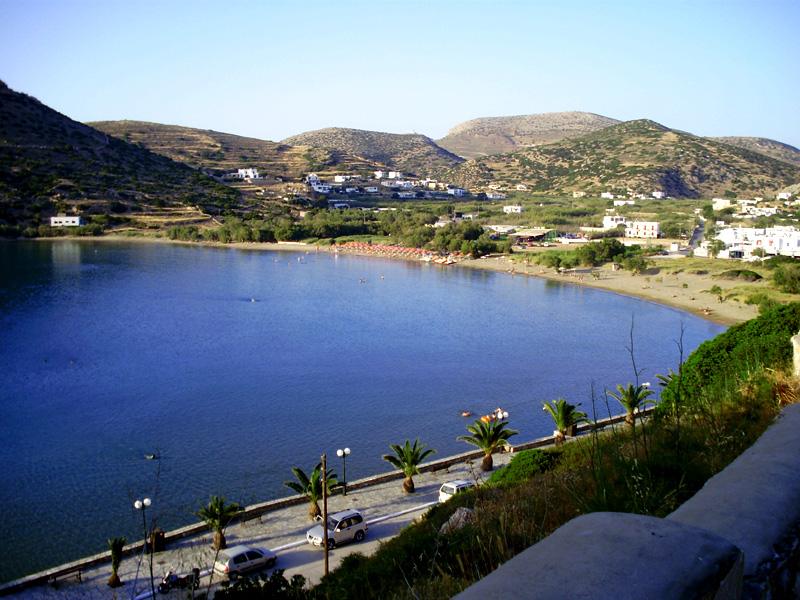
Galissas beach is the main sandy bay on the west coast of Syros, a sheltered crescent of pale sand fringed by tamarisk trees and backed by a small village of tavernas and rooms. The shallow, calm water and easy bus link from Ermoupoli make it the island’s most family-friendly stretch of coast. Plan the whole trip with Greece Tours.
The bay sits roughly 9 kilometres from the port capital, reached in about 15 minutes by KTEL bus or car. A whitewashed chapel, Agia Pakou, stands above the southern headland, and the naturist cove of Armeos lies beyond it on the far side of that same headland. This guide covers access, the sand itself, wind protection, the village amenities, and how Galissas measures against Kini, Delfini, Vari and Komito.
Where is Galissas beach on Syros and how do you reach it?
Galissas beach lies on the west coast of Syros, roughly 9 kilometres from the port capital. KTEL buses cover the route in about 15 minutes, while a hire car or taxi reaches the sheltered sandy bay along a signed inland road.
Galissas occupies a rounded bay midway down the western shore of Syros, the administrative centre of the Cyclades. The main road from the port town of Ermoupoli crosses the island’s central ridge before dropping to the coast. Frequent KTEL buses run the 9-kilometre route in roughly 15 minutes on the summer timetable. Drivers follow signs for Galissas and Finikas, then leave the car in the gravel bays behind the seafront. The bay faces west, so it catches the afternoon sun and looks out to the open Aegean. A dense row of tamarisk trees marks the back of the sand and shades the first line of tavernas and rooms. The free public sand lies at the southern end, while sunbeds fill the centre and the north.
Buses depart from the central terminal beside the Ermoupoli waterfront, close to the ferry quay where boats arrive from Piraeus and the other Cyclades. The service runs frequently in high season, with an earlier start and a later last return than the shoulder months. A single fare costs only about two euros, so most visitors skip the hire car for beach days. The road leaves Ermoupoli for the west side of the island and climbs through Talanda, giving a wide view back across to Ano Syros and the twin hill of Anastasi, before dropping to Galissas through low farmland and stone walls. Taxis from the port charge a set fare and take about the same 15 minutes. Reaching the bay without a car is straightforward for anyone staying in town.
Parking near the sand is limited to two small unpaved areas and the verges of the village lane. Arriving before 11am secures a space in July and August, when day visitors and campers fill the seafront. Scooters and quad bikes, rented widely across Syros, slot into gaps the cars cannot use. The village itself is compact, so the walk from any parking spot to the water takes under five minutes. A single paved road loops through Galissas, linking the beach, the campsite entrance and the cluster of tavernas. Signposts in both Greek and Latin script keep the turning from the main island road easy to find. Cars, scooters and the occasional tour minibus all share the same narrow entry lane in high season.
Galissas works well as a base as well as a day trip, since the village holds enough rooms, studios and small hotels to stay overnight. Guests who book here reach the sand on foot and avoid the parking pressure entirely. The bay also connects by local road to the neighbouring beaches of Finikas and Agathopes to the south. A short drive north returns visitors toward Ano Syros and the capital for evening dining and the medieval upper town. Cyclists use the same quiet inland roads, though the final descent to Galissas is steep. Most travellers treat the bay as one stop on a wider tour of the western coast. Buses and rental scooters keep the neighbouring bays within a fifteen-minute reach of Galissas.
What is the sandy bay at Galissas beach like for families?
Galissas beach offers a wide arc of soft, pale sand with shallow, calm water that deepens slowly offshore. The gentle gradient, tamarisk shade and seafront tavernas make the bay the most family-friendly beach on Syros during the summer season.
The sand at Galissas runs for roughly 300 metres in a smooth crescent, wider at the centre than at either headland. Its surface is fine and pale, comfortable underfoot and easy for children to dig and build on. The seabed slopes gently, so the water stays knee-deep for roughly five metres before it reaches an adult’s waist. Parents keep younger children within a safe, shallow zone close to shore without constant worry about sudden drops. Tamarisk trees along the back edge throw natural shade over towels laid on the free sand. Their low canopy cools the strip through the hottest afternoon hours, reducing the need to hire an umbrella for every visit.
Organised sections occupy the central and northern parts of the beach, with sunbeds and straw parasols set in tidy rows. Rental costs a modest daily fee, and the beds sit close enough to the tavernas for easy food and drink service. The southern end stays free of loungers, leaving room for families who prefer to spread out on their own mats. A firm strip of wet sand at the waterline gives toddlers a level place to paddle and play. Lifeguard cover is not permanent, so parents watch their own children as on most Cycladic beaches. The overall layout keeps quiet corners and busier serviced zones within the same short walk.
Water clarity at Galissas stays high because the bay drains cleanly and the seabed is mostly sand rather than weed. Snorkelling children spot small fish near the rocks that edge each headland, where the depth increases. The calm surface makes the bay suited to inflatable rings, paddleboards and first swimming lessons. A gentle current runs along the northern rocks, so families keep smaller swimmers toward the sandy centre. Showers and two taps stand near the tavernas for rinsing off salt and sand before lunch. Public toilets sit within the village a short walk back from the sand, alongside a mini-market stocking water, sunscreen and beach toys. Rinse-off taps and a couple of freshwater showers stand at the edge of the serviced section.
Amenities extend beyond the water’s edge, which matters for a full day out with children. Tavernas along the front serve simple Greek dishes, ice cream and cold drinks throughout the afternoon. Shaded terraces give a cooler place to eat when the midday sun grows strong on the open sand. A children’s play area and level lanes make pushchairs manageable across the small village. The bus stop sits only a couple of minutes from the beach, easing the trip back to Ermoupoli with tired legs. These combined features explain why Galissas earns its reputation as the calmest family choice on the island. Umbrellas, changing rooms and a small first-aid point round out the practical side of a long beach day here.
Why does Galissas beach stay calm when the Syros meltemi blows?
Galissas beach faces west and sits inside a curved bay sheltered by headlands on both sides. This position blocks the meltemi, the strong summer wind that arrives from the north, keeping the water calm while exposed eastern and northern beaches on Syros turn rough.
The meltemi is the dry north wind that sweeps the Aegean through the core summer months, often for days at a time. It builds through the morning and peaks in the afternoon, whipping up short, choppy waves on exposed shores. Beaches that open to the north or east on Syros take the full force and can become uncomfortable for swimming. Galissas, by contrast, sits on the western side and tucks into a bay guarded by rising ground. The northern headland and the hill behind it break the airflow before it reaches the sand. The result is a sheltered pocket where the sea stays flatter than the open coast on a windy day.
Local knowledge treats Galissas as a reliable fallback when the forecast shows a strong meltemi. Families and older swimmers move here from the wind-hit beaches once the gusts pick up after midday. The tamarisk trees also cut the breeze at towel level, so sand does not blow across the strip as it does on open beaches. Boats moor more easily in the calmer water, and the small watersports operations keep running on days the exposed coast shuts down. Even on a settled day, the bay reads a degree or two warmer because the wind stays light. This sheltered quality is the single trait that shapes Galissas’s summer popularity. On the worst meltemi days the difference in wave height between here and the open coast is obvious.
The protection is not absolute, and a westerly or southerly wind can still push swell into the bay. Such winds are far less common than the dominant northerly meltemi across a Cycladic summer. On the rare day the sea turns choppy at Galissas, nearby Finikas and Agathopes to the south often stay calmer. Checking a simple wind forecast the evening before helps travellers pick the sheltered side of Syros. Apps and local taverna owners both track the coming meltemi days closely. Reading the wind direction, rather than only the beach name, is the practical skill for a Cycladic beach holiday. Ferry crossings to Syros can slow on strong meltemi days, so the sheltered bay matters for arrival plans too.
The same headlands that block the wind also create clear, defined swimming zones within the bay. The southern arm carries the Agia Pakou chapel and a band of rock that shelters the quieter end. That same southern arm rises to the chapel, and the Armeos cove lies hidden on its far side. Between them the sand curves in a broad, protected sweep facing the sunset. Photographers value the west-facing angle because the sun drops directly into the sea beyond the bay. That combination of calm water and an open western horizon draws steady evening crowds to the tavernas along the front. Sunset fills the seafront through the summer, with tables booked out along the water by early evening.
What sits around Galissas beach on Syros — tavernas, rooms and the campsite?
Galissas holds a compact village behind the sand with a row of tavernas, a mini-market, studios and small hotels. A long-running campsite sits a short walk back from the water, giving the bay a mix of budget and family accommodation rare on Syros.
The village of Galissas wraps around the head of the bay in a single loop of lanes. A line of tavernas faces the sea, their terraces set under reed canopies just back from the sand. Menus cover grilled fish, meze plates, salads and the loukoumi sweets that Syros is known for across Greece. Prices sit below those of the smart waterfront restaurants in Ermoupoli, which suits families staying a week. A mini-market near the beach stocks water, fresh bread, sunscreen and the basics for a self-catering stay. Cafes open early for breakfast and stay busy into the evening as diners linger over the sunset view across the water.
Accommodation clusters within a five-minute walk of the sand, keeping cars unnecessary once you arrive. Options range from simple domatia rooms to studios with kitchenettes and a handful of small family hotels. Several places are run by the same families for years, and repeat guests book the same rooms each summer. Rates fall well below the peak-season prices of the capital, making Galissas a value base for the western coast. Booking ahead for July and August is wise, since the limited stock fills early. Staying in the village puts the beach, tavernas and bus stop all within a short, flat walk of the door. Hosts often arrange airport or port transfers, and studios often include parking behind the village lanes.
The Galissas campsite sits among trees a couple of hundred metres back from the beach. It offers pitches for tents and vans, along with basic cabins, showers and a small shop. Backpackers arriving by ferry use it as an affordable base for exploring Syros without a hire car. The site’s shaded ground stays cooler than the open sand through the hottest part of the day. A regular bus link means campers reach Ermoupoli and Ano Syros easily for sightseeing and nightlife. This budget option is uncommon on the Cyclades, where most islands offer only hotels and pricier studios. Nightly pitch fees run low, and the site stays open through the main summer season from late spring.
Practical services round out the village and support longer stays without a trip back to town. A bakery, a couple of bars and seasonal shops selling beach gear cover most daily needs. Watersports desks on the sand hire out paddleboards, kayaks and pedaloes through the peak months. A small car and scooter rental point lets guests reach the rest of the island for day trips. The bus stop on the loop road connects Galissas with the port, the airport road and the southern beaches. Together these amenities let visitors settle into the bay for a week rather than treating it only as a day stop. A cash point sits back in Ermoupoli rather than the village, so most visitors carry euros for the tavernas.
How do you find the Armeos naturist cove near Galissas beach on Syros?
Armeos is a small naturist cove reached on foot over the southern headland of Galissas beach. The path climbs past the Agia Pakou chapel and drops in about ten minutes to a sheltered pebble and rock inlet on the far side.
The path to Armeos starts at the southern end of the Galissas sand, past the last of the tavernas. It climbs the low headland on a rough track worn into the dry hillside over years of use. Walkers pass below the Agia Pakou chapel, where the view over the bay is worth a stop, then follow the trail as it drops toward the hidden cove. Sturdy sandals help, since the ground is stony and loose in places rather than a paved walkway. A second, more precarious line runs around the edge of the headland and finishes with a short wade through the sea. The descent takes around ten minutes at an easy pace, with sea views opening on the way down. Armeos comes into sight as a small, sheltered inlet tucked out of view from the main family beach. Signposts are sparse, so first-time walkers follow the worn line of the path up from the southern rocks and past the chapel.
Armeos is Syros’s established naturist cove, quieter and more secluded than the main bay. The shore here is a mix of coarse pebbles and flat rocks rather than the soft sand of Galissas. Deeper, clear water right off the edge makes it a favourite for snorkelling and swimming rather than paddling. There are no sunbeds, tavernas or showers, so visitors carry their own water, shade and food. The cove sits behind the southern headland, and it swims beautifully whenever the wind is coming from anywhere but the north. Regulars value the calm and the sense of separation from the busier village beach just over the hill. Morning light and calm early water make the first hours after sunrise the quietest time at the cove.
Reaching Armeos rewards a little preparation given the lack of facilities on arrival. Water, a hat and a beach mat matter more here than on the serviced main beach. The rocks grow hot by midday, so most visitors come earlier or in the later afternoon light. The wooded ground behind the cove is a summer camping spot, so a free patch of shade is hard to find from mid-June to mid-September and the cove suits shorter stays unless you bring an umbrella. Mobile signal can drop behind the headland, a point worth noting for anyone meeting friends. The return climb back over the hill to Galissas takes the same ten minutes and a steady pace in the heat. Carrying at least two litres of water per person is sensible given the exposed rocks and lack of shade.
The Armeos walk pairs naturally with a full day based at Galissas beach. Swimmers split the day between the shallow family sand and the deeper, quieter cove. The headland crossing itself offers wide views over the western coast of Syros and the open Aegean. Small boats sometimes anchor off Armeos, arriving by sea rather than the footpath. Respecting the cove’s naturist tradition and its quiet keeps it welcoming for the regulars who use it. For most visitors the contrast between the two beaches is the highlight of a stay on this side of the island. Combining both in one visit fills a full day without needing a car or a second drive.
What is the Agia Pakou chapel above Galissas beach?
Agia Pakou is a small whitewashed chapel standing on the southern headland above Galissas beach. The white church against the blue sea is the bay’s landmark, reached by a short climb from the sand and used for a summer feast day.
Agia Pakou sits on the low rocky point that closes the southern end of the Galissas bay. Its whitewashed walls and single bell make a clear marker visible from the length of the beach. A short path leads up from the last stretch of sand to the chapel and its small paved terrace. The climb takes only about three minutes and rewards walkers with a wide view back over the crescent of sand. From the point the whole bay unfolds, with the tamarisk line, the tavernas and the headland framing the water. The chapel’s white form against the blue sea is the image most associated with Galissas across the Cyclades.
The chapel follows the Cycladic pattern of a tiny family or votive church perched on a headland. Cubic in shape and painted a bright white, it carries a blue-domed bell arch typical of the islands. Inside sit a simple iconostasis and a handful of icons, kept by the local families who tend the building. Such chapels dot the coasts of Syros, each marking a point of the sea a community watches over. Agia Pakou’s position on the swimming bay makes it one of the most visited on the island. Visitors step inside quietly during the day, keeping shoulders covered as a courtesy in the small space. The bell is rung by the caretaking family on the feast day and for the occasional evening service.
A name-day feast, or panigyri, brings the chapel to life once a year in the warmer months. Local families gather for a service, then share food, wine and music near the church through the evening. These feasts are a living part of island culture rather than a staged event for visitors. Travellers who happen upon one are usually welcomed to join the celebration around the headland. The rest of the summer the chapel stays a quiet spot for a short walk and a photograph. Its terrace also gives one of the best viewpoints for the sunset over the western horizon of the bay. Couples often time their walk up for the final half hour of daylight over the open sea.
The headland around Agia Pakou marks the calmer, quieter southern corner of Galissas beach. The rocks below the chapel shelter a band of clearer, deeper water good for snorkelling. Families with older children swim out from here toward the point where small fish gather. The walk up doubles as an easy outing that breaks a long beach day for restless children. From the top the view stretches south toward Finikas and the outline of neighbouring islands on a clear day. The chapel and its headland give Galissas a focal landmark that sets it apart from the plainer bays nearby. The short climb takes about five minutes from the sand and suits most ages in the cooler hours.
How does Galissas beach compare with other Syros beaches like Kini and Komito?
Galissas beach is the most sheltered and family-oriented of the west-coast bays on Syros. Kini offers sunset dining, Delfini a quieter naturist strip, Vari a shallow enclosed cove, and Komito a wilder southern beach, each suiting a different kind of day.
Kini lies a short drive north of Galissas and shares the same west-facing sunset over the Aegean. Its horseshoe bay holds a fishing harbour and a line of fish tavernas known across Syros for fresh seafood. The sand is narrower than at Galissas, and the village leans toward evening dining rather than a long beach day. Families often pair the two, swimming at Galissas by day and driving to Kini for dinner as the sun drops. Kini also takes a little more of the northerly wind than the tucked-in Galissas bay. The two beaches together cover both a sheltered swim and a classic Cycladic sunset meal. The drive between Galissas and Kini takes only about ten minutes on the quiet inland road.
Delfini sits just north of Kini and offers a quieter, partly naturist stretch of sand reached by a short track. It draws visitors who want more seclusion than the busy family beaches of the western coast. Facilities are limited, so most people bring their own shade and supplies as at Armeos. The water is clear and calm, though the beach is more exposed than the deep Galissas bay. Reaching it takes a rougher drive and a short walk, which keeps the crowds thinner. For travellers who value quiet over amenities, Delfini balances the busier serviced sand at Galissas within the same corner of the island. Parking sits above the beach, and a short downhill walk on loose ground leads to the sand.
Vari and Achladi lie on the south coast, where shallow enclosed coves suit small children as well as Galissas does. Vari’s bay is almost fully ringed by land, so its water stays warm and flat through the summer. Rooms and tavernas back the sand, giving it a family feel close to that of Galissas. Komito, further south near the airport, is a wilder beach of sand and rock backed by low hills and almost no buildings. It draws those chasing space and a natural setting rather than organised sunbeds and tavernas. Each southern option trades part of Galissas’s easy amenities for either warmer water or open, undeveloped shore. Komito lies about a twenty-minute drive south of Galissas, close to the island’s small airport.
Choosing between them comes down to the day you want rather than a single best beach on Syros. Galissas wins for the combination of shallow water, shade, tavernas and a reliable bus from the capital. Kini adds the sunset seafood dinner, while Delfini and Armeos offer quieter, naturist-friendly sand. Vari suits the youngest swimmers, and Komito rewards anyone willing to trade comfort for wild scenery. A week on the island can take in all of them, using Galissas as the calm anchor. The short distances across Syros make hopping between these western and southern bays an easy part of any stay. Most of these bays sit within a fifteen-minute drive of each other on the western and southern coasts.
Frequently Asked Questions
Is Galissas beach on Syros sandy or pebbly?
Galissas is a sandy beach, one of the rare broad stretches of soft, pale sand on Syros. The roughly 300-metre crescent is fine underfoot and slopes gently into shallow water, which is why families favour it. The nearby Armeos cove, over the southern headland, is pebble and rock rather than sand, so the two beaches offer different ground within a short walk.
How do I get from Ermoupoli to Galissas beach without a car?
KTEL buses run from the central terminal on the Ermoupoli waterfront to Galissas frequently in summer. The 9-kilometre trip takes about 15 minutes and costs only about two euros. Buses leave near the ferry quay, so arriving passengers reach the beach easily. A taxi covers the same route for a set fare in roughly the same time.
Is Galissas beach good for young children?
Galissas suits young children well. The water is shallow and calm, deepening slowly over roughly five metres of soft sand, and the bay is sheltered from the strong summer meltemi wind. Tamarisk trees shade the back of the sand, and tavernas, showers and a mini-market sit a short walk away. There is no permanent lifeguard, so parents supervise their own children as on most Cycladic beaches.
Can you camp at Galissas beach on Syros?
Galissas has an organised campsite set among trees a couple of hundred metres back from the sand. It offers pitches for tents and vans, basic cabins, showers and a small shop. This is one of the rare campsites on the Cyclades and makes Galissas a budget base for exploring Syros. A regular bus links the site to Ermoupoli and Ano Syros for sightseeing.
What is the Armeos cove near Galissas?
Armeos is a small naturist cove reached on foot over the southern headland of Galissas beach, a walk of about ten minutes each way. Its shore is pebble and rock with deeper, clear water good for swimming and snorkelling. There are no facilities, so visitors bring their own water and shade. It swims well whenever the wind is not from the north.
Why is Galissas beach calm when other Syros beaches are windy?
Galissas faces west and sits inside a curved bay guarded by headlands and a hill to the north. This shelters it from the meltemi, the dominant north wind of the Aegean summer, which builds through the afternoon. When exposed northern and eastern beaches on Syros turn choppy, Galissas usually stays calm, so locals treat it as the reliable option on windy days.
Mostly correct – BUT as someone who lives here on Syros can I point out :
1. The obviously wrong bit that that the chapen of Agia Pakou, and the naturist cove of Armeos (aka Agia Paou by locals) does not lie over the northern headland!! The chapel is above the southern headland of Galissas bay, and the short hike to Armeos (a bit rocky in places but fine in decent walking sandals) passes below the chapel – stop off there for some amazing views) before dropping to the little beach the other side. There is also a more precarious rounte aroudn the edge of the headland, which involves going through the sea at the last bit! The cove with its wooded hinterland is a summer hang out for ‘hippies’ who camp there, so it is hard to find a shady spot from mid Jun to mid September. When the wind is not from the north it’s a lovely bay to swim in though.
2. The road over from Ermoupolis to Galisass does not climb up past Ano Syros – as you leave the town for the west side of the island you climb up through Talanda – you do get a great view back across to Ano, as well as the twin hill of Anastasi. But the only place you get by road ‘climbing past Ano Syros’ is the rough back roads of the undeveloped northern hills!
Thank you for your comment, we corrected it.