
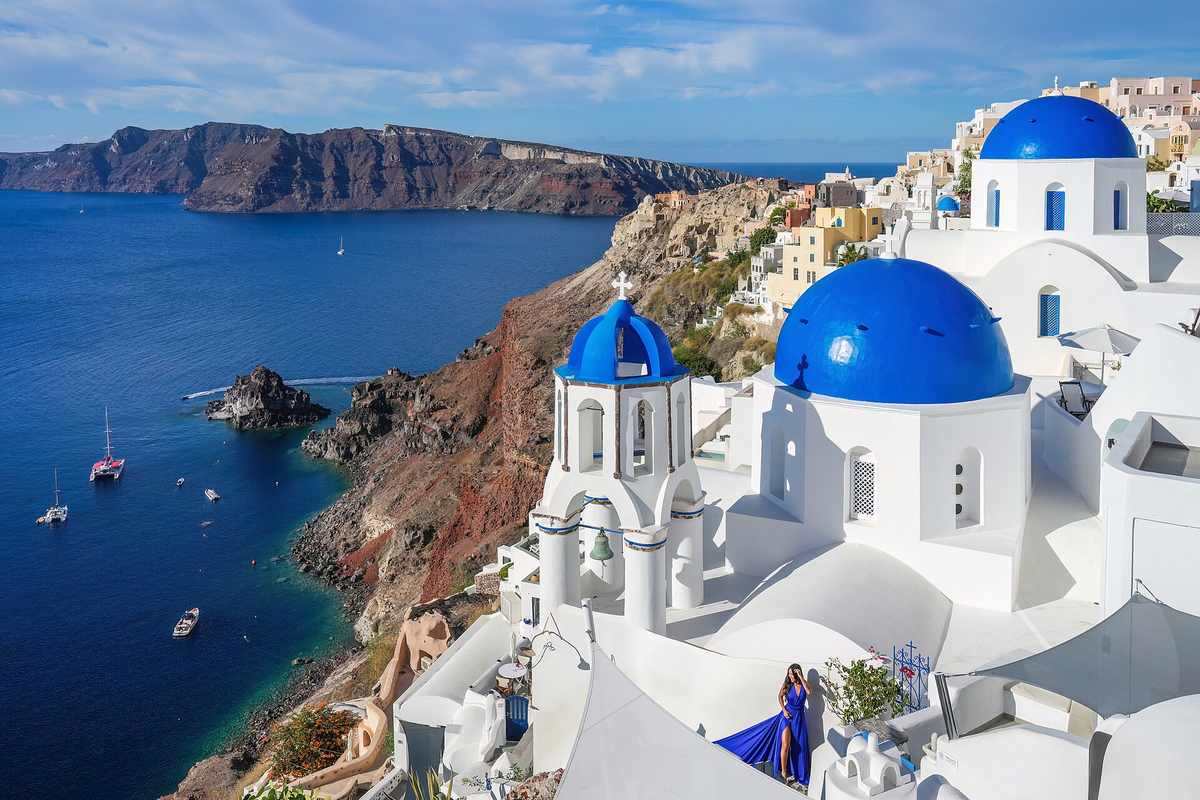
Oia Santorini is the island’s most beautiful and photographed village, a cascade of whitewashed cave houses, blue-domed churches and clifftop terraces on the northern tip of the caldera, famous above all for its sunset. This guide covers what to do in Oia, the sunset, Ammoudi Bay below it and tips for visiting. Plan the whole trip with Greece Tours.
Oia is the postcard image of Santorini, the jewel of the wider Santorini travel guide. It crowns the caldera’s northern cliffs. The sections below cover the village.
What is Oia like?
Oia is a traditional clifftop village on the northern tip of the caldera, built from whitewashed cave houses, blue-domed churches, clifftop pools and marble lanes. It is the most photogenic and most exclusive corner of Santorini, lined with luxury suites, galleries and fine restaurants.
Oia is Santorini at its most beautiful. It tumbles down the caldera cliffs at the island’s northern end, and its whitewashed and pastel cave houses, sculpted blue domes and infinity pools spill toward the sea in the scene that defines Greece. The village was once a wealthy maritime settlement, home to sea captains whose fortunes built its grand houses. Today it is the most exclusive corner of Santorini, its pedestrian marble lanes lined with luxury cave-hotel suites, art galleries, boutiques and clifftop restaurants.
The beauty draws crowds, especially at sunset, yet a stroll through the lanes in the gentle morning light reveals why Oia is so adored, set within the wider things to do in Santorini. The village sits about 11 kilometres north-west of Fira, a 25-minute bus ride along the caldera rim. Its name is pronounced “EE-a”, and it carries the whitewashed Cycladic look that made the island world-famous. The sunset is its crowning glory.
Why is Oia famous for its sunset?
Oia is famous for its sunset because it sits on the western tip of the caldera, so the sun drops straight into the sea behind the village. The classic viewpoint is the ruined Venetian castle, which fills one to two hours before sundown in summer.
The sunset is what made Oia world-famous. Its position on the north-western point of the caldera means the sun sets each evening directly over the sea beyond the village, silhouetting the windmills and domes and flooding the white houses with colour. The ruined Venetian castle at the village’s tip is the legendary viewpoint, offering an almost 360-degree panorama, though it packs shoulder to shoulder one to two hours before sundown in high season.
Quieter alternatives spread the crowd out. The steps by Panagia Platsani church, west-facing restaurant terraces booked in advance, and the harbour of Ammoudi Bay below all frame the same golden descent, set out alongside the guide to the Santorini sunset. Arrive at least ninety minutes early for the castle, bring water, and stake a spot on the rocks or a low wall. The whole sky glows for a good half hour, so latecomers still catch the colour even after the sun clears the horizon. There is a full day of pleasures before dusk.
What are the best things to do in Oia?
The best things to do in Oia are wandering the marble lanes and admiring the blue domes, browsing the art galleries and boutiques, visiting the small Maritime Museum, photographing the windmills, and walking down to Ammoudi Bay. The cliff path from Fira also ends here.
Oia rewards slow exploration beyond the sunset. Wandering its narrow, traffic-free marble streets reveals the famous blue-domed churches, hidden chapels, sea-captains’ mansions and viewpoints at every turn, perfect for unhurried photography in the soft early light. Art lovers can browse galleries showing Santorini-inspired work, alongside boutiques selling volcanic-stone jewellery and hand-painted ceramics, while the small Maritime Museum tells the story of Oia’s seafaring heyday for a modest ticket.
The restored windmills make iconic photo stops, and the spectacular Fira-to-Oia cliff hike finishes in the village, set out alongside the guide to Fira. Photographers chase three set-piece shots here: the blue-domed churches lined up against the caldera, the windmills above the village, and the pastel cave houses stepping down toward Ammoudi. Early morning delivers all three without the crush, so keen photographers often shoot at dawn and return for the evening light. Ammoudi Bay lies just below.
What is Ammoudi Bay?
Ammoudi Bay is the tiny old fishing harbour directly below Oia, reached by about 300 steps down the cliff or a short drive. It is known for its waterfront fish tavernas, red cliffs and cliff-jumping spot, offering a sea-level sunset and fresh seafood.
Ammoudi Bay is Oia’s charming counterpoint at sea level. You reach it by descending around 300 steps from the village, or by a winding road, and the little harbour sits beneath dramatic red volcanic cliffs. A handful of celebrated fish tavernas line the water, serving grilled octopus and the day’s catch right beside the boats. From the rocks beyond, confident swimmers cliff-jump and snorkel around a small islet.
The bay offers a quieter, sea-level view of the sunset with the boats and waves in the foreground, set out alongside the guide to Santorini food. Walking back up the steps is a genuine workout of ten to fifteen minutes, so travellers who prefer to save their legs take a short taxi or a donkey ride to the top. Book a waterfront taverna table for the sunset hour, since the small harbour fills fast once the boats come in. A few practical tips make a visit easier.
What are the best tips for visiting Oia?
The best tips are to visit early morning for empty lanes and soft light, wear comfortable shoes for the steps, arrive well before sunset for parking or take the bus, and book caldera-view restaurants ahead.
Timing and footwear make all the difference in Oia. The village is built on hundreds of steep, narrow steps, so comfortable shoes are essential and heels a mistake, and anyone with mobility limits should plan around the climbs. Early morning is the magic hour, with quiet, light-filled lanes for photos before the day-trippers and cruise crowds arrive, while between 11am and 4pm in summer Oia reaches maximum capacity.
For sunset, arrive several hours ahead if driving, since parking is very limited, or take the bus from Fira, and book any caldera-view restaurant well in advance, set out alongside the guides to where to stay in Santorini and a Santorini itinerary. Carry water and sun protection, since the marble lanes hold the heat and offer little shade. The questions below cover the points travellers ask most.
How do you get to Oia and get around?
You reach Oia by KTEL bus from Fira in about 25 minutes, by taxi, by hire car, or on foot via the caldera hike. The village core is car-free, so you park outside and explore its marble lanes on foot.
Getting to Oia is straightforward from anywhere on the island. Frequent KTEL buses run from the Fira terminal along the caldera rim, taking about 25 minutes for a low flat fare, and taxis cover the same route faster at a higher price. Drivers reach Oia in around 20 minutes from Fira, but the village core is pedestrianised, so cars go into the car parks on its edge.
Inside Oia, everything happens on foot along the marble main lane and the stepped alleys that branch off it toward the caldera. The walk from the bus stop to the castle viewpoint takes ten to fifteen minutes at a gentle pace, passing the shops, galleries and churches on the way. For a scenic arrival, the ten-kilometre Fira-to-Oia caldera path delivers walkers straight into the top of the village, set out alongside the guide to the Fira to Oia hike.
Day-trippers arriving by cruise ship reach Oia from the old port below Fira, where a cable car, a donkey path and a steep stair climb the cliff to the town, followed by a bus or taxi transfer along the rim. Independent travellers usually find the KTEL bus the simplest option, since it runs frequently through the day and drops passengers in the central square beside Panagia Platsani. A hire car or ATV adds flexibility for reaching the beaches and villages beyond, but the sunset traffic jam around Oia is a strong reason to arrive by bus on that evening. Where you stay shapes the whole experience.
Where should you stay in Oia?
Stay in Oia in a cave suite or boutique cave hotel on the caldera edge for the sunset view and infinity pool, the reason the village draws honeymooners. Rooms are expensive and reached by steps, so budget travellers often base in Fira instead.
Oia is the most exclusive place to sleep on Santorini. Its accommodation is dominated by cave-house suites and small boutique hotels carved into the caldera cliff, most with private terraces, plunge pools or infinity pools looking straight out over the caldera and the sunset. This clifftop position and privacy make Oia the classic honeymoon base, though it commands the island’s highest room rates.
The trade-off is access and cost. Caldera-edge suites are reached down flights of steps with no vehicle access, which suits couples but challenges families with young children or heavy luggage. Travellers who want the Oia experience without the price often stay in Fira, Firostefani or a central village and visit Oia by bus, set out alongside the guide to where to stay in Santorini. Knowing the best season sharpens the plan.
When is the best time to visit Oia?
The best time to visit Oia is late spring or early autumn, in May, June or September, when the weather is warm, the light is clear and the crowds are lighter than midsummer. July and August bring the fiercest heat and the densest sunset crowds.
Oia shines through the long Santorini season from spring to autumn. May and June bring warm, settled weather, greener surroundings and a village that is busy but still walkable, while September holds onto summer warmth as the peak crowds thin. These shoulder months give the clearest light for photography and the easiest sunset viewing, when the castle fills but does not overflow as it does in high summer.
July and August are the hottest and most crowded weeks. Daytime heat on the shadeless marble lanes climbs, and the castle viewpoint packs out well before dusk, so an early-morning visit and a booked restaurant terrace matter most then, set out alongside the guides to the best time to visit Santorini and Oia versus Fira. The village churches shape its famous silhouette.
What are Oia’s blue-domed churches?
Oia’s blue-domed churches are the Greek Orthodox chapels whose cobalt cupolas and white walls define the skyline. The most photographed cluster of three domes sits above Ammoudi, while Panagia Platsani on the main square is the largest church.
The blue domes are the single most recognisable image of Oia. Scattered through the village are small Greek Orthodox churches and private chapels, their vaulted roofs painted deep blue against whitewashed walls and bell towers, a colour scheme repeated across the Cyclades but perfected here on the caldera edge. The famous postcard viewpoint frames three domes stacked one behind another with the blue sea beyond, reached down a short lane near the eastern end of the main street.
Panagia Platsani, the Church of the Assumption, anchors the central square by the bus stop, its courtyard a natural gathering point and a calmer place to watch the sky change than the crowded castle. Chapels such as Agios Nikolaos and Agios Georgios add smaller domes along the lanes, each a quiet corner between the shops. Treat the churches as working places of worship, dress modestly at the doorways, and photograph them without blocking the narrow paths, set out alongside the guide to the Santorini villages. Dining is one of Oia’s real pleasures.
Where should you eat in Oia?
Eat in Oia at a caldera-view restaurant for sunset dinner, at a taverna on the main lane for Greek dishes, or down at Ammoudi Bay for the freshest seafood by the water. Caldera-edge sunset tables need booking well ahead.
Oia’s dining spans fine caldera-view restaurants and simple family tavernas. The clifftop terraces are the headline experience, pairing plates of Santorini specialities with an uninterrupted view of the sunset over the caldera, and these tables are the hardest to get, so a reservation days ahead is the difference between a dream dinner and a long wait. Along the main marble street, smaller tavernas and cafes serve Greek classics, fresh salads and local wine at gentler prices.
For seafood, the fish tavernas of Ammoudi Bay below the village are the local favourite, serving grilled octopus, fresh fish and seafood pasta at tables almost in the water, set out alongside the guide to Santorini food. Local plates to look for include fava, the yellow split-pea purée, tomato fritters made with the island’s small tomatoes, and white aubergine, all grown in the volcanic soil. Pair them with a crisp glass of Assyrtiko, the island’s signature white wine.
Prices in Oia sit above the island average, and the caldera-view restaurants carry a premium for the setting as much as the food. Travellers watching their budget can eat well by choosing a taverna a lane back from the cliff, ordering mezze plates to share, or taking the main meal at lunch, when the same kitchens serve the view without the sunset surcharge. Cafes and bakeries along the main street offer coffee, pastries and light bites for a quick stop between the shops and the viewpoints. A little history explains why the village looks as it does.
What is the history of Oia?
Oia grew wealthy in the nineteenth century as a base for Santorini’s merchant sailing fleet, when captains built the mansions and cave houses that line the cliff. A major earthquake damaged the village, and later restoration turned it into the preserved settlement seen today.
Oia’s beauty is the product of its maritime past. Through the nineteenth century the village prospered from a fleet of merchant sailing ships that traded across the eastern Mediterranean, and the wealth of its sea captains raised the two-storey neoclassical mansions on the upper lanes and the vaulted cave houses cut into the soft volcanic rock below. The cave dwellings, dug straight into the pumice cliff, stayed cool in summer and warm in winter, an ingenious response to the island’s climate.
The great Amorgos earthquake of the mid-twentieth century struck Santorini hard and left much of Oia in ruins, and many residents left in the decades that followed. From the later decades of that century onward, restoration transformed the abandoned cave houses into the boutique hotels and homes seen today, protected by strict building rules that preserve the whitewashed Cycladic look, set out alongside the guide to Santorini history. Managing the crowds is the key to enjoying the village.
How crowded is Oia, and how do you avoid the crowds?
Oia is the most crowded village on Santorini, busiest from late morning to sunset when cruise passengers arrive. Visit at dawn for empty lanes, and watch the sunset from Ammoudi Bay or a booked terrace rather than the packed castle.
Crowds are the one drawback of Oia’s fame. From late morning until the sunset hour, cruise-ship passengers and bus tours pour into the narrow main lane, and the castle viewpoint fills to bursting well before dusk in the peak season. The village is small, so its single marble street bottlenecks quickly when the crowd builds, turning a stroll into a slow shuffle by early afternoon.
The remedy is timing. Arrive at first light, when the lanes are almost empty and the low sun paints the domes gold, and you will have the classic viewpoints nearly to yourself. Staying overnight in Oia gives the same reward after the day-trippers leave. For sunset, sidestep the castle scrum by descending to Ammoudi Bay, reserving a west-facing restaurant terrace, or settling on the steps by Panagia Platsani, all of which frame the same glowing sky with room to breathe, set out alongside the guide to Oia versus Fira. The questions below cover the points travellers ask most.
Frequently Asked Questions
What is Oia Santorini known for?
Oia is known as Santorini’s most beautiful and photographed village, famous for its whitewashed cave houses, blue-domed churches, clifftop pools and, above all, its sunset. It also has art galleries, boutiques, fine restaurants and the fishing harbour of Ammoudi Bay below.
Is Oia worth visiting?
Oia is well worth visiting for its extraordinary beauty, blue domes and famous sunset, ideally in the early morning when the lanes are quiet. It is the most crowded and expensive village, so plan around the crowds, but its postcard scenery is the highlight of Santorini.
How do you get from Fira to Oia?
You get from Fira to Oia by frequent KTEL bus in about 25 minutes for a low fare, by taxi or hire car, or on foot via the ten-kilometre caldera cliff hike, which takes two and a half to five hours and ranks among the island’s top experiences.
How long should you spend in Oia?
Most visitors spend half a day to a full day in Oia, combining a morning stroll through the quiet lanes with the blue domes and the Maritime Museum, a walk down to Ammoudi Bay for lunch, and a return for the evening sunset from the castle or a booked terrace.
Is Oia expensive?
Oia is the most expensive part of Santorini, with the island’s priciest cave-suite hotels and caldera-view restaurants. Visiting for the day by bus is inexpensive, so travellers can enjoy the lanes, the domes and the sunset without paying for a room on the caldera edge.
What time is sunset in Oia?
Sunset in Oia falls in the early evening, later in summer than in spring or autumn, so the exact time shifts with the season. Arrive at the castle viewpoint at least ninety minutes early in the busy months to claim a spot, since the crowd gathers long before the sun drops.
Is Oia good for a honeymoon?
Oia is the classic Santorini honeymoon base, with clifftop cave suites, private plunge pools and infinity pools facing the caldera sunset. Its romantic setting, fine restaurants and quiet early-morning lanes suit couples, though the many steps and high prices are worth weighing before booking.
Can you swim in Oia?
You cannot swim from Oia village itself, which sits high on the cliff, but you can swim at Ammoudi Bay below, where confident swimmers cliff-jump and snorkel around a small islet. The nearest sandy beaches lie on the south and east coasts, reached by car or bus.