
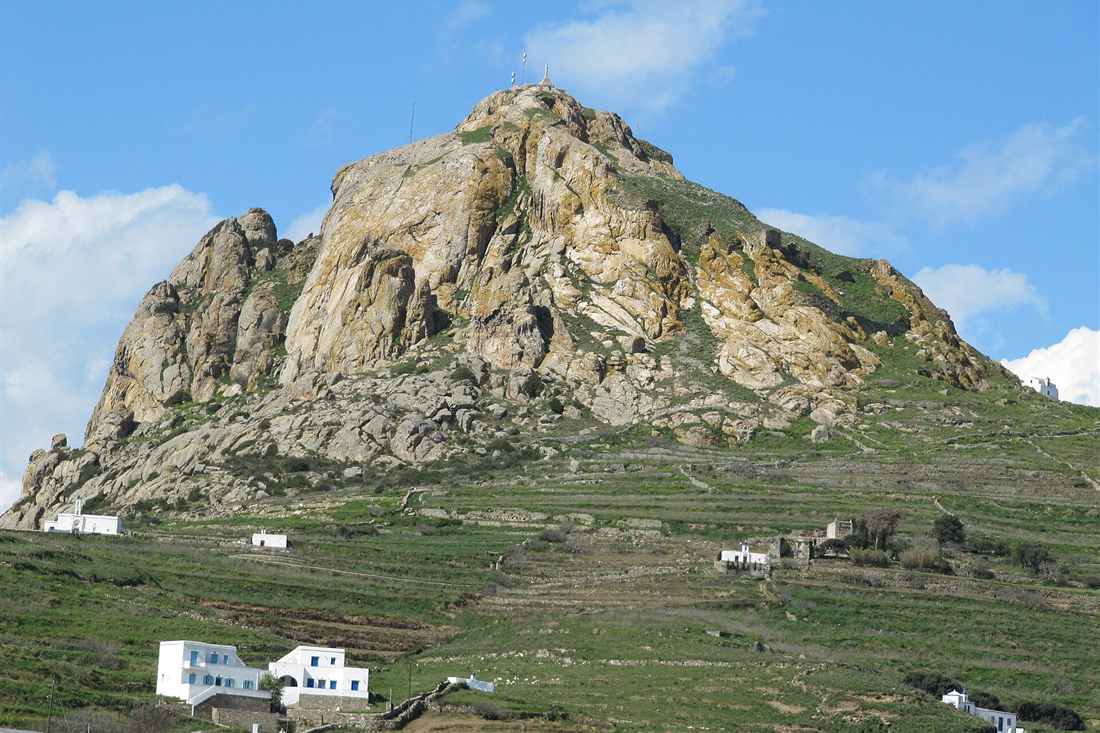
The Tinos via ferrata is an equipped climbing route on Exomvourgo, the rocky mountain in the centre of the island, where climbers stay clipped to a steel cable over iron rungs and steps below the ruined Venetian fortress on the summit. Plan the rest of the trip with Greece Tours.
This page covers the route: the mountain and its villages, the walk-in from the Sacred Heart monastery, the gear and the briefing, the guided hike and the rock-climbing option, and how the climb fits a day with Chora, Pyrgos and the coast.
What is the Tinos via ferrata?
The Tinos via ferrata is an equipped climbing route on Exomvourgo, a mountain in the centre of Tinos. Climbers follow a fixed safety line across the rock face while their feet rest on small ledges and metal holds.
The route is not a walking trail. It takes you onto steep ground where a normal path ends.
Below the rock, dry stone terraces and low scrub cover the hillside. The rock face rises in pale grey and brown bands.
From the lower section you hear goat bells from somewhere in the valley. The air smells of warm thyme and dust.
Where does the Tinos via ferrata sit on Exomvourgo?
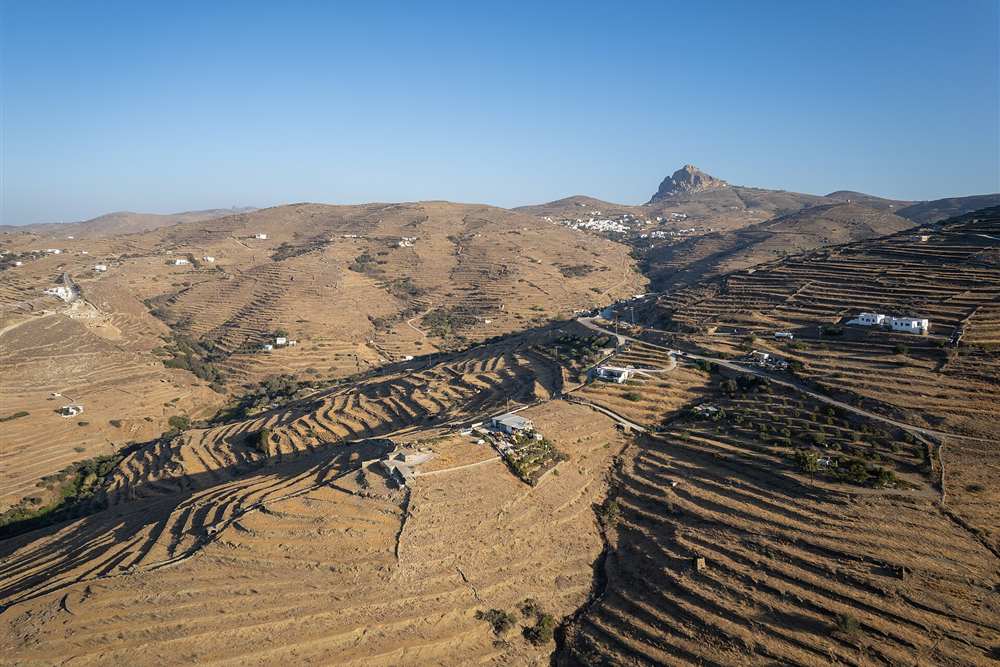
Exomvourgo stands in the centre of Tinos. The mountain rises behind the island’s central villages and is visible from many parts of the island. It carries the Tinos via ferrata on its upper flank.
The mountain appears as a long ridge above the terraces. Its outline shifts as you drive from the port into the hills.
Small roads climb from the coast toward the centre of the island. The highest part of the rock stays in view for much of the drive.
At the foot of the mountain the ground narrows between stone walls. Goats browse under olive trees and the wind moves through dry grass.
Why does Exomvourgo rock look different from other Cyclades mountains?
Exomvourgo has a rugged, rocky appearance. It does not look like the other mountains of the Cyclades, which are smoother and rounder. Its steep grey faces rise straight from the terraces.
The stone here is broken into ledges and vertical steps. You see sharp shadows in the strong midday sun.
Other high points on the island roll under maquis and terraced fields. Exomvourgo instead bares its rock like a castle wall.
The contrast is clear from the tops of nearby villages. The mountain looks pale and bare against the green and brown fields around it.
What stands on top of Exomvourgo?
A ruined Venetian fortress and town stand on top of Exomvourgo. Tumbled walls, gateways and roofless rooms cover the summit above the cliff line. Visitors walk through the remains and look far across the island.
The stone of the fortress matches the stone of the mountain. You can touch rough blocks that have worn smooth at the edges.
Inside the old town, low walls mark the shapes of rooms and narrow passages. Loose stones lie where buildings once collapsed.
From the summit you see the blue sea and the white houses of villages far below. The wind is strong at the top.
Is Exomvourgo the highest mountain on Tinos?
Exomvourgo is not the highest mountain on Tinos. That is Tsiknias. Tsiknias rises higher, but Exomvourgo keeps the ruined fortress and the Tinos via ferrata on its rocky face.
Tsiknias is a bare high point away from the central rock. It has a different shape and no climbing route of this kind.
People look at Exomvourgo and assume it must be the highest. The steepness of its sides gives that impression.
The height difference matters less than the character of the rock. Exomvourgo stands out because it rises sharply from the central plateau.
Which villages ring Exomvourgo?
Exomvourgo is ringed by small villages, among them Tripotamos and Falatados. Walkers can reach the mountain from different villages, each with narrow lanes and stone houses.
Tripotamos and Falatados sit below the mountain on different sides. Their houses hug the slopes at the edge of the terraces.
From these villages the mountain looks close but the climb to the base still takes a steady walk. White walls and blue shutters line the lanes.
A Tinos walking tour can connect the village streets with the lower slopes of Exomvourgo. You pass small chapels and dry stone walls on the way.
How long is the walk up from the Sacred Heart monastery?
The walk up from the monastery of Iera Kardia Iisou, the Sacred Heart, takes around 20 minutes. It follows a direct path from the monastery to the lower sections of the Tinos via ferrata.
The path starts below the monastery buildings and climbs over stone. You hear the bell before you see the rock.
The route is short but exposed to the sun. Visitors stop to catch breath and look back at the monastery courtyard.
At the top of the path the ground opens onto the rock face. The fixed line lies just above the last stone steps.
What ancient finds lie near Exomvourgo?
Copper Age remains have been found near Exomvourgo, and Geometric and Archaic remains lie at its southern foot. The ground around the mountain holds old settlement traces from different periods.
The southern foot of the mountain is quieter than the summit. Loose earth and low walls sit among the fields.
Visitors walking up from that side pass ground that archaeologists once sifted. The old sherds are not visible on the surface.
The presence of ancient remains adds a deeper layer to the rock. The via ferrata hangs above land that has drawn people for a very long time.
How does a via ferrata work?
A via ferrata is a climbing route with a steel cable fixed along the rock, with iron rungs and steps. A climber wears a harness and helmet and stays clipped to the cable while moving over the metal holds.
The cable is bolted to the rock at regular points. It runs through the climb like a handrail made of steel.
Rungs and steps are set where the natural rock offers no edges. You place your feet on them and keep your hands on the rock or the rungs.
The system makes steep ground possible for walkers without ropes. One fixed line keeps the route direct and easy to follow.
What kit does a guided Tinos via ferrata trip supply?
A guided Tinos via ferrata trip supplies the harness, helmet and lanyard. The guide hands out each item at the base and checks the buckles before the group starts.
The harness wraps around your waist and thighs. You tighten the leg loops so the belt sits close but not tight.
The helmet sits flat on your head and leaves your eyes clear. It protects you from small stones knocked loose above.
The lanyard is the cord that links your harness to the cable. It hangs from the front of the harness within easy reach.
How does the lanyard keep you attached on the Tinos via ferrata?
The lanyard has two carabiners and an energy absorber. Climbers clip both carabiners into the steel cable and move them one at a time, so one carabiner always stays attached.
The two arms hang from the front of the harness. Each ends in a carabiner that opens with a twist of the gate.
When you reach a bolt on the rock, you move one carabiner first. The other stays closed on the old section of cable.
The energy absorber sits between your body and the two arms. It controls the force if you slip.
What happens in the briefing and practice for the Tinos via ferrata?
The guide gives a briefing and practice at the foot of the route. You learn how to clip the carabiners, how to move your feet and how to pass an anchor before the climb begins.
The practice cable sits low on the rock, close to the ground. You can test the clip-in move without being high above the terraces.
The guide watches your hand position and corrects the order of the carabiners. The movement becomes regular after a short time.
Visitors also walk over a metal step to feel the rungs underfoot. The helmet and harness stay on during this ground practice.
Who can join the Tinos via ferrata?
The Tinos via ferrata is open to people with no climbing experience. The guided trip suits beginners who can walk on uneven ground and stay calm on exposed rock. You only need to follow the guide’s instructions.
The climb has no long vertical sections that demand trained arms. The rungs and steps carry most of the work.
A normal level of walking fitness helps on the approach path. The steepest parts are protected by the fixed line.
People of different sizes can take part if the harness fits correctly. The guide checks the harness on the ground and adjusts it.
What is the rock-climbing experience on Exomvourgo hill?
The rock-climbing experience on Exomvourgo hill is a separate guided climb on the mountain. It is bookable on GetYourGuide alongside the Tinos via ferrata guided hike. This option focuses on rock holds rather than a fixed cable.
The two activities start from different spots on the hill. The rock climb follows short rock faces where an instructor handles the safety rope.
Climbers wear a harness and receive a helmet. The moves feel more direct than the rungs of the via ferrata.
Bookings for both options appear on the same platform. You can read the posted details for each activity.
When is the best time for the Tinos via ferrata given the meltemi wind?
The meltemi wind blows hard across the Cyclades in summer. Early morning and late afternoon give the calmest conditions for the Tinos via ferrata on Exomvourgo. The rock face is exposed, so wind matters.
The wind arrives as a constant push from the sea. It cools the skin but can make the cable shake.
On the exposed ledges of the mountain the breeze feels stronger than in the streets below. You hear it before you feel it.
Midday heat and wind together make the climb heavier. Starting early gives the rock more shade and quieter air.
What do you wear and carry on the Tinos via ferrata?
You wear closed shoes with a firm grip, light layers and sun protection on the Tinos via ferrata. Carry water and a windproof layer in a small backpack. The guide handles the technical safety gear.
The rock is warm and rough under your hands. Long trousers protect your knees from the stone.
The sun strikes the exposed face for most of the day. A cap or hat must fit under the helmet.
The wind can cool you as soon as you stop moving. A light jacket tied around your waist is useful.
How does the Tinos via ferrata fit a day on the island?
The Tinos via ferrata sits a short drive from Chora, the main town beside the port. You can land in the morning, climb on Exomvourgo and still have time to see the dovecotes or the marble village of Pyrgos.
Tinos is a Cycladic island next to Mykonos. Ferries from Rafina and from Mykonos bring you to the main port at Chora.
After the via ferrata, drive into the hills to see the dovecotes and the marble village of Pyrgos. The island is known for both.
A Tinos hiking day can pair the climb with a longer walk on the slopes below Exomvourgo. The mountain stays in view as you move across the island.
How do you handle sun and heat on the Tinos via ferrata?
Cloudless summer days on Tinos bring strong sun on bare rock. The Tinos via ferrata is an exposed route, so carry water and use sun cover. Gloves protect the hands on the steel cable. Do not start without them.
Clear skies let the bare rock take full sun, and sun cover keeps strong light off the skin. A cloudless sky gives no break while the route stays open.
Water matters on the exposed route, and the climb has no clouds to block the heat. Drink water through the day, not only at the start, because the heat rises off the bare rock as the day goes on.
Wear gloves on the steel cable to protect the hands. The steel cable sits in the open sun, and gloves help the hands grip the line while the sun beats down.
How do you plan the rest of your Tinos via ferrata day?
A Tinos via ferrata day can pair with lunch in a village below the mountain and a swim on the coast in the afternoon. Do the route first, then eat in the village, then swim. The coast swim ends the day.
Stop for a meal in the village lower down after the climb. The village sits below the mountain, and village food refills the body after the climb.
Head to the coast after lunch and get into the water. The afternoon swim cools the body, and the swim comes after the meal and the climb.
The day moves from high rock to a village meal to a coast swim. That flow pairs the mountain with lunch and the water, and the route starts the day on the rock.
Frequently Asked Questions
Do you need climbing experience?
No. The guided route is open to beginners who can walk on uneven ground and follow the guide.
What gear is supplied?
A harness, a helmet and a lanyard with two carabiners and an energy absorber.
Where does the route start?
About 20 minutes on foot from the monastery of Iera Kardia Iisou, the Sacred Heart, below Exomvourgo.