
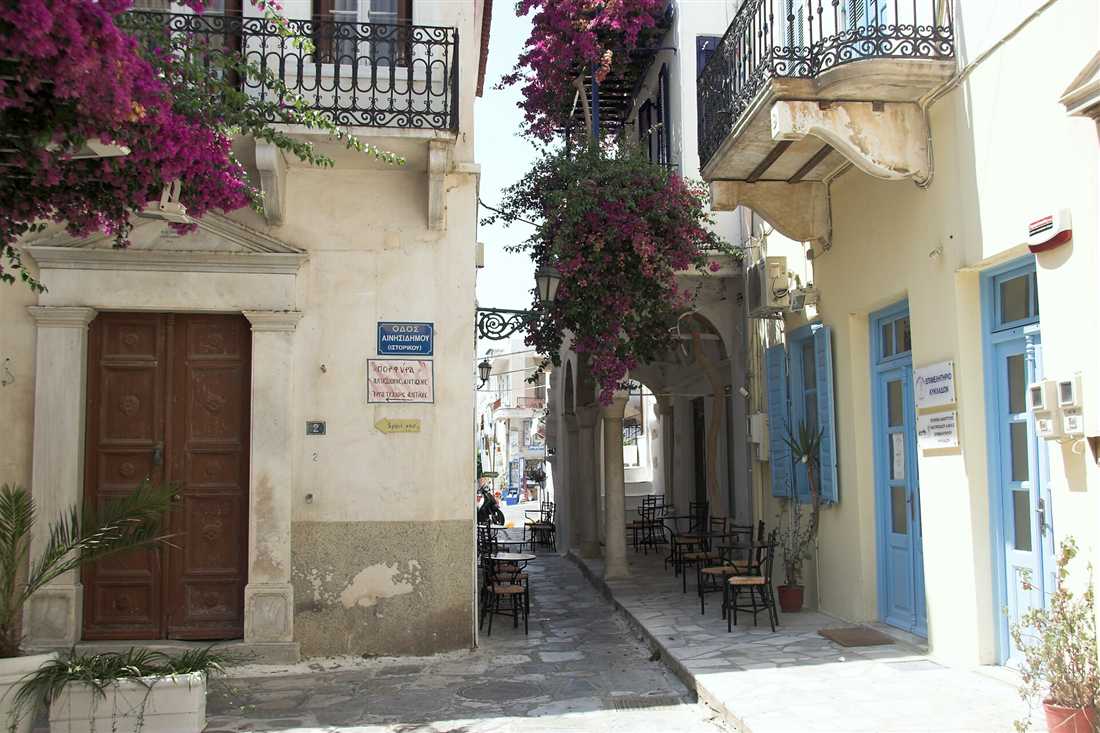
A Tinos walking tour climbs the pilgrim street from the port to Panagia Evangelistria, works the lanes of Chora, and carries on to the dovecotes around Tarampados, the marble village of Pyrgos, the boulder plain at Volax and the granite hill of Exomvourgo. Plan the rest of the trip with Greece Tours.
This page covers the walks: the town route, the church and its rules, the villages, the museums, the footpaths between them, the hours that suit the light, what to wear and how a walk fits a day trip.
Where does a Tinos walking tour go in Chora?
A Tinos walking tour in Chora starts at the port, climbs the old pilgrim street to Panagia Evangelistria, then loops through the upper lanes back to the waterfront. The route stays compact and connects the town’s main landmarks on foot.
Chora is the island’s main town, also called Tinos Town, beside the port. The town rises straight from the ferry quay.
Ferries from Mykonos and Rafina dock at the same quay. For the crossing details, read Tinos from Mykonos.
The walk passes the port front, the market street and the old pilgrim ascent. A bookable walking tour of the town covers this central loop.
How do the pilgrimage street and the church fit a Tinos walking tour?
The pilgrimage street is the main uphill line of a Tinos walking tour. It rises from the port to Panagia Evangelistria, the most important pilgrimage church in Greece. Pilgrims climb the street on foot, and some cover the final part on their knees.
Panagia Evangelistria stands above Chora. It holds an icon of the Virgin and draws pilgrims from across the country.
The climb from the port is steep and paved. The street narrows as it rises past small shops and entrance gates.
For a wider look at the island’s religious buildings, read Tinos churches. The main pilgrimage route ends at the church courtyard.
What dress code and rules apply at Panagia Evangelistria?
No shorts and no bare shoulders are allowed inside Panagia Evangelistria. Men wear long trousers. Women cover their shoulders and legs before entering. The rules are firm and apply to all visitors, not only to worshippers.
The church is an active pilgrimage site. It is not just a monument.
Long trousers are required for men. Sleeveless tops and short skirts are refused at the door.
A light scarf or long-sleeved shirt covers bare shoulders quickly. The dress check happens at the entrance.
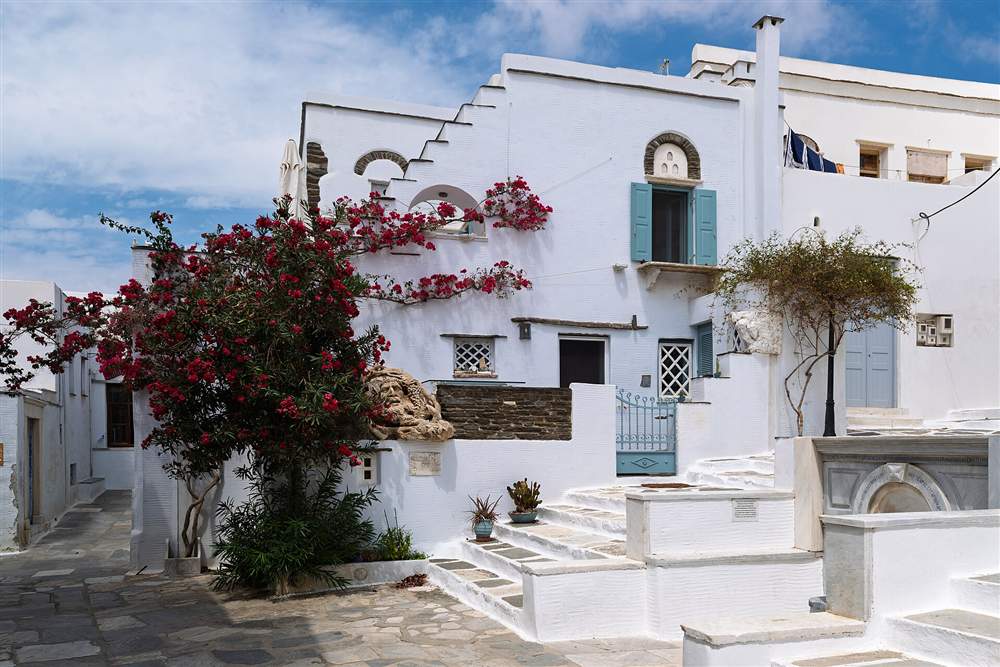
What do the old town lanes and the port front show on a Tinos walking tour?
A Tinos walking tour shows two sides of Chora. The port front stays busy with ferries and fishing boats, while the old town lanes climb past marble thresholds, small shops, and whitewashed houses. The two sit minutes apart on foot.
The port front faces the ferry quay. Boats from Rafina, Mykonos and other Cyclades arrive beside the old town.
Behind the waterfront, the lanes rise steeply. Many houses carry marble lintels and steps.
A short loop from the port to the church and back through the upper lane gives the full contrast between the working harbour and the quiet residential core.
Where can a Tinos walking tour see the dovecotes around Tarampados?
The richest concentration of Tinos dovecotes lies around Tarampados. A Tinos walking tour there follows farm roads and paths past hundreds of ornate stone dovecotes. Many date from the Venetian period and carry geometric facades.
The island has hundreds of ornate dovecotes. They are scattered through the valleys and farm terraces.
Tarampados holds the richest concentration. The geometric facades turn farm buildings into folk art.
A walk around Tarampados passes close to the carved facades. The small road above the village gives a clear view of the patterns.
What makes Pyrgos and its marble lanes special on a Tinos walking tour?
Pyrgos is the island’s main marble village. A Tinos walking tour through Pyrgos follows marble-paved lanes, passes carved fountains and small workshops, and stops in shaded squares. The village works as a living marble craft centre.
Tinos marble is quarried on the island and worked by local sculptors. Marble carving is the island’s craft tradition.
Pyrgos has marble-paved lanes and carved fountains. Workshops open directly onto the paths.
The village sits inland below the higher hills. Its shaded squares offer rest after the open village entrance.
What three museums can a Tinos walking tour visit in Pyrgos?
Pyrgos holds the Museum of Marble Crafts, the Tinian Artists Museum, and the house-museum of the sculptor Yannoulis Chalepas. A Tinos walking tour can visit all three in one village stop.
The Museum of Marble Crafts focuses on the island’s working stone tradition.
The Tinian Artists Museum preserves work by local painters and sculptors.
The house-museum of Yannoulis Chalepas records the life of a major Greek sculptor from Tinos.
Why does a Tinos walking tour continue down to Panormos Harbour?
The road from Pyrgos drops to Panormos, a fishing harbour with seafood tavernas. A Tinos walking tour can add this descent to end beside the water with a cool breeze and a quieter front.
Panormos sits on the north coast below Pyrgos. The road down is paved and descends in long bends.
Fishing boats moor in the harbour. Seafood tavernas line the waterfront.
The change from marble village to sea level is sharp. The return climb to Pyrgos is hard in midday heat.
What is the landscape at Volax on a Tinos walking tour?
Volax is a small village set in a plain of huge round granite boulders. A Tinos walking tour through Volax moves between white houses and smooth grey rocks that rise from the flat ground.
The boulders are granite and rounded. They spread across the plateau around the village.
Volax itself is small. Paths run between the houses and the rock field.
The rock shapes dominate the walk. The landscape feels unlike the marble villages of Pyrgos and Isternia.
How does a Tinos walking tour reach Exomvourgo and the Venetian Fortress?
A Tinos walking tour reaches Exomvourgo on old stone paths from Falatados and the Kakovolo landscape. The granite hill rises above the central plateau and is crowned by the remains of a Venetian fortress.
Exomvourgo is a granite hill above the central plateau. The climb is steep and open to the sun.
The Venetian fortress remains sit on the summit. The path reaches the base and then climbs the old approach.
Old stone paths from Falatados and the Kakovolo landscape lead to the hill. A rock-climbing experience on Exomvourgo hill is also bookable.
How does a Tinos walking tour use the stone footpath network between Villages?
Old stone footpaths link the villages across Tinos. The network is signposted and used for walking, so a Tinos walking tour can cross from one village to the next away from the paved road.
The paths connect Chora with inland settlements. They run through terraces, small fields and dry-stone walls.
Signposts mark the walking network. The old routes stay clear and usable.
Kardiani, Isternia, Ktikados, Arnados, Dyo Choria, Falatados and Agapi sit on or near the path system.
Which villages suit a short Tinos walking tour?
Ktikados, Arnados and Dyo Choria sit close to Chora and suit a short Tinos walking tour. Kardiani, Isternia and Agapi fit better into a longer loop through the western side of the island.
Ktikados lies just above Chora. It gives a quick rural walk from the port.
Arnados and Dyo Choria sit near the same path network. A loop through them stays compact.
Kardiani and Isternia sit higher on the west slopes. Agapi adds another stop on a longer route.
How long does a Tinos walking tour Take?
A town-focused Tinos walking tour takes about two hours on foot. A village route through Pyrgos, Volax or the footpath network takes a full day with stops and climbs. The distance sets the timing.
The Chora route covers the port, the old town and the pilgrimage church in one morning.
A longer route from Chora to Pyrgos or Volax needs a full day. Stone paths slow the pace more than paved roads.
Bookable tour lengths vary with the route. The town walk is the shortest and the most direct.
What are the best hours and the light for a Tinos walking tour?
Early morning gives the best light on the marble lanes and white walls. A Tinos walking tour started before eight avoids the strong midday heat on exposed paths. Late afternoon softens the granite tones at Volax and Exomvourgo.
The strongest heat lands on open stone paths in the middle of the day. Start early in summer.
Morning light falls directly on the port front and the pilgrimage street. It sharpens the marble detail.
Late afternoon softens the rocks at Volax and the fortress hill. Panormos catches the last sun over the water.
What do you wear and carry on a Tinos walking tour?
Wear light long trousers or a long skirt for the church, sturdy shoes for stone paths, and a hat. Carry water, sunscreen and a scarf to cover bare shoulders before entering Panagia Evangelistria.
Stone lanes and marble paving are hard underfoot. Closed shoes with grip work best.
The church requires covered shoulders and legs. A scarf or a long-sleeved shirt solves the dress code quickly.
Water and sun protection matter on open sections. Exomvourgo and Volax offer little shade.
How does a Tinos walking tour fit a day trip from Mykonos or Athens?
A Tinos walking tour fits a day trip from Mykonos because ferries dock in Chora and the town route starts beside the port. From Athens, the Rafina ferry plus a town walk works as a long day.
Chora sits directly above the port. The walking route starts where the ferry ramp ends.
For the Athens connection, read Tinos day trip from Athens. Ferries from Rafina reach Tinos and return the same day.
The town walking tour is the most compact option for a day trip. It covers the port, the church and the old lanes before the return ferry.
What does the marble craft tradition add to a Tinos walking tour?
The marble craft tradition gives a Tinos walking tour a direct link to quarrying and sculpture. The island quarries its own marble, and village workshops shape it into finished carvings. Pyrgos is the centre of the craft. Walkers meet this work on everyday streets.
Tinos marble is quarried on the island and carved by local sculptors. The craft passes from raw stone in the hills to carved pieces in village squares and churchyards.
The Museum of Marble Crafts at Pyrgos explains quarrying and carving in clear steps. Tools, blocks and finished works show the whole process from stone to sculpture.
The sculptor Yannoulis Chalepas came from Pyrgos. His house in the village is a museum that holds his work and records his life.
How are the dovecotes on Tinos built?
Dovecotes on Tinos are two-storey stone towers. The upper floor carries geometric slate patterns and openings for pigeons. The lower storey is solid stone. The design combines a working bird house with careful decoration. Builders set the slate into the upper walls.
The towers stand two storeys high and are made of stone. The lower floor supports the upper floor, which is built as a bird house with small openings.
The upper floor carries geometric slate patterns. The slate is set flat against the stone wall, and the pattern covers the whole upper band.
The Venetians brought the dovecote practice to Tinos. Their rule left this building style across the island, and the towers survive in farm land and near villages.
Why does Tinos have Catholic and Orthodox villages?
Tinos has Catholic and Orthodox villages because Venetian rule lasted on the island longer than on other Cyclades. The Catholic community grew under that rule and stayed. Orthodox villages continued beside the Catholic ones. Both traditions live on in village life.
Tinos has both Orthodox and Catholic villages. The two communities share the island and keep their own village identities in separate settlements.
The Catholic community dates from Venetian rule. Venetian control lasted longer on Tinos than on other Cyclades, so a Catholic population remained.
Catholic villages keep their own churches and feast days. Orthodox villages keep their own churches and feast days on the same island.
What are the kalderimia footpaths on a Tinos walking tour?
Kalderimia are old stone footpaths that connect Tinos villages. On a Tinos walking tour they give walkers a marked and maintained route away from roads. These paths form the island’s walking network from village to village. They follow the land without hard surfacing.
The footpaths between villages are old stone kalderimia. They are built from local stone and run across the island away from main roads.
The paths are marked and maintained for walkers. Route marks keep the way clear where the path turns or splits.
Kalderimia connect villages on the island. They give walkers a continuous route away from traffic and through farm land.
Which ridge villages above Chora suit a short walk?
Arnados and Dyo Choria stand on the ridge above Chora. A short walk from the town climbs to these villages through covered alleys. They suit walkers who want a compact route with shade. The climb starts close to the port.
Arnados and Dyo Choria are the two villages on the ridge above Chora. They sit high above the port and the town, so the route gives a quick change of scene.
Both villages have covered alleys. These narrow roofed passages give shade on the way and run through the old village core.
The path from Chora climbs to the ridge in a short route. Walkers can pass through the two villages and return to town without a long day.
How does the wind affect a Tinos walking tour?
The wind affects a Tinos walking tour most on open ground. The island is windy, and the meltemi blows hardest in July and August. Walkers feel the gusts on exposed paths and need fixed hats and light layers. Village alleys give a break.
The island is windy. Open terraces and ridge paths take the full force of the wind, and loose objects can blow away.
The meltemi blows hardest in July and August. The wind arrives in strong bursts during those months and stays steady on exposed slopes.
Covered alleys in villages give shelter from the gusts. Walkers plan stops in these shaded passages and use walls for cover.
How is a Tinos walking tour planned around the ferries?
A Tinos walking tour is planned around ferry arrivals and departures at Chora. Ferries reach Tinos from Rafina, Mykonos, Andros and Syros. The port is the natural start and end point for walking routes. Routes loop back to the town.
Ferries dock at Chora on the island’s coast. The town is the main port, and all ferry connections land at its bay.
Tinos is reached from Rafina, Mykonos, Andros and Syros. Ferry schedules set the length of a stay on the island.
Walkers build routes that begin and end in Chora. The port sits close to village roads and old paths that lead inland.
Frequently Asked Questions
Where does a Tinos walking tour start?
At the port in Chora, on the street that climbs to Panagia Evangelistria.
What is the dress code at the church?
No shorts or bare shoulders, and long trousers for men.
Which village is the marble village?
Pyrgos, with marble-paved lanes, carved fountains, workshops and three museums.