
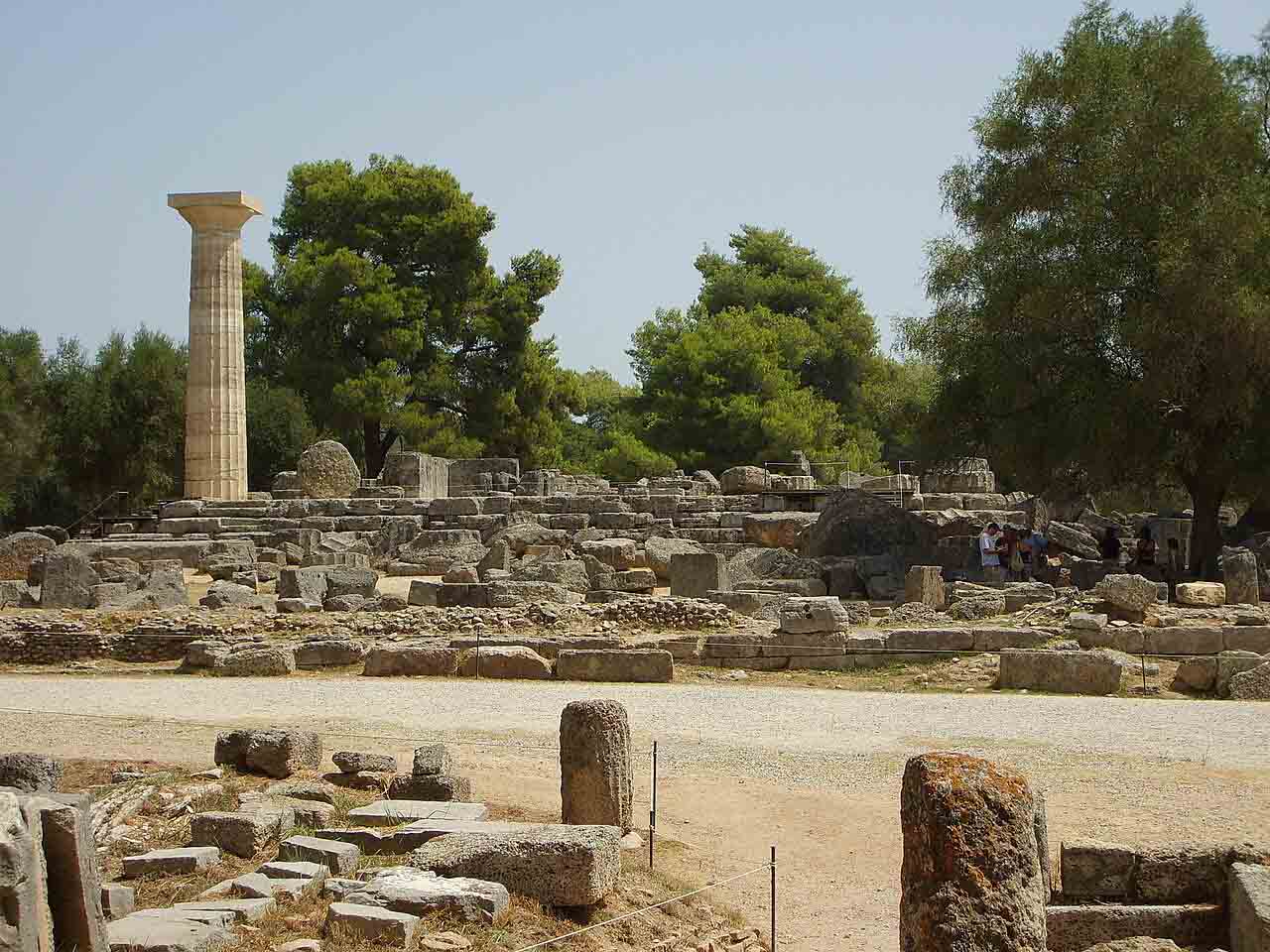
How to Get to Olympia, Greece and What to See: Explore the Archaeological Site of Olympia
Plan your journey to Olympia, Greece with our comprehensive guide. Discover convenient travel options for reaching the famed archaeological site. Uncover the history of Olympia, the birthplace of the Olympics, and explore the fascinating ruins and museum. Navigate through Olympia guided tours, uncover ancient Greek sports history, and find the best photography spots. Plus, get insider tips on the best time to visit. Book your adventure now!
Brief Overview
Embark on a captivating journey to Olympia, Greece, the birthplace of the Olympic Games, where history, mythology, and culture converge. Explore the mesmerizing archaeological site, home to the legendary Temple of Zeus, and uncover the rich legacy of ancient Greek sports history. The Archaeological Museum of Olympia offers a treasure trove of artifacts, inviting you to delve into Greece’s illustrious past. With various travel options from Athens and beyond, plan your visit between late spring and early fall for optimal weather and vibrant cultural events. Whether it’s a guided tour or a spontaneous adventure, Olympia promises an unforgettable experience.
Key Highlights
- Discover convenient travel routes, including buses and trains from Athens, to reach Olympia.
- Visit during late spring to early fall for ideal weather and fewer crowds at the archaeological site.
- Explore significant relics like the Temple of Zeus and understand Ancient Greek sports history.
- Uncover Ancient Greek artistry at the Archaeological Museum of Olympia, showcasing important artifacts.
- Immerse in Olympia’s mythological stories, focusing on the significance of Zeus within the culture.
How to Get to Olympia, Greece
Exploring the world-renowned Olympia, nestled in the Ilia prefecture, is a journey through Greece’s rich tapestry of history. To visit Olympia, travelers can choose several convenient travel routes. Starting from Athens, you can catch a direct bus or, if you prefer to drive, the well-maintained roads offer a scenic journey through Greece.
Alternatively, you could opt for a regional train that whisks you away to the heart of Greek antiquity. For those coming from international destinations, flying into Athens or Kalamata offers the quickest access to Olympia’s ancient site. Local buses and car rentals are available to support comfortable exploration.
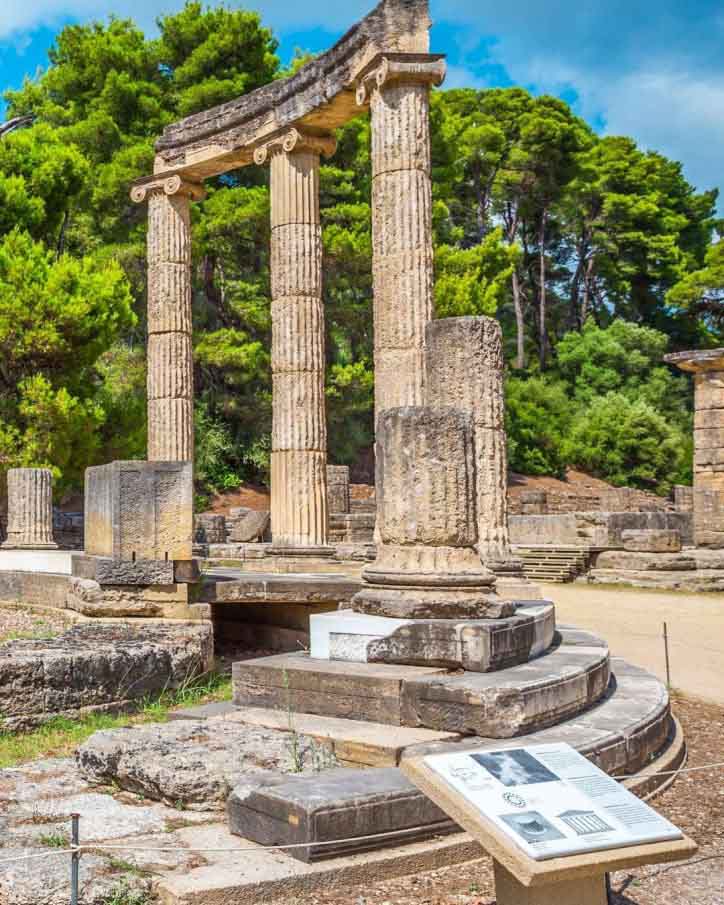
Once in Olympia, you’ll find the site imbued with the spirit of the ancient world. This Greek sanctuary, recognized as a UNESCO World Heritage site, invites visitors to delve into its mesmerizing relics. Whether you’re mosying around the grand stadium or marveling at the Temple of Zeus, each corner tells a story. Organizing your travel to Olympia is a step towards uncovering the legacy of Greek brilliance. Using these travel routes ensures you experience the historical marvel that Olympia is. Immerse yourself in Greece’s legendary past with ease, where every path in the sanctuary leads to history’s secrets.
Travel Options and Routes
Traveling to the breathtaking land of Greece and reaching Olympia is an unforgettable journey steeped in history. You’ll be pleased to discover the several routes that transport you to Olympia’s celebrated grounds. The rich tapestry of the ancient games lures travelers from around the world, eager to experience the magic of this renowned site firsthand. Begin your trip by flying into Athens International Airport, from which numerous travel options are available. Consider renting a car to embark on a scenic three-hour drive to the heart of Olympia, or take a comfortable train or bus. Each route presents a charming view of the Grecian countryside. Upon arrival, you’re greeted by the resplendent archaeological site of Olympia, a sanctuary where marvels of the ancient world come alive. Imagine witnessing the setting where the ancient games united the world in competition and celebration. Planning your journey wisely can ensure a seamless travel experience as you step into a world that’s etched its legacy through ancient games and enduring traditions.
Whether you’re drawn to the architectural splendor of this archaeological site or the mythical allure of Zeus, Olympia invites you to explore its past and immerse yourself in a rich history that inspires the world.
Best Time to Visit Olympia
When planning your travel to visit Olympia, understanding the best time to explore this enchanting location is essential. Bathed in the allure of ancient Greek culture, Olympia is a destination where history and tourism intertwine seamlessly. The optimal time to embrace the full significance of these legendary Olympic Games lies between late spring and early fall. During these months, the climate is ideal, offering manageable temperatures perfect for your visit and exploration. It’s when Olympia’s rich history becomes most accessible, with fewer crowds and vibrant events celebrating its legacy.
Visitors can fully appreciate the archaeological site and the grandeur of its ancient ruins without the hindrance of overwhelming heat. The lush landscapes surrounding Olympia thrive under sunlit skies, providing a picturesque setting for photography and immersion into cultural tourism. Engaging events and festivals that echo ancient days are frequently held, bringing the spirit of Greek culture to life. In this remarkable climate, you can delve into Olympia’s mythical past, resonating with stories that speak of gods like Zeus and heroic feats. As you plan your journey, consider aligning your visit with this optimal period to ensure an unforgettable connection with the birthplace of the Olympic Games, a testimony to history’s enduring legacy.
For those planning a visit during the optimal warm months, here are some practical activities and must-see attractions in Olympia to consider:
- Start your exploration at the ancient ruins of the Sanctuary of Zeus, where you can marvel at what’s left of the Temple of Zeus, once a wonder of the ancient world. See the full guide to the Temple of Zeus at Olympia.
- Visit the Archaeological Museum of Olympia, where you can delve into history with its impressive collection of artifacts, including the famous Hermes of Praxiteles.
- Take a leisurely walk through the lush, green landscape of the Alfeios River, perfect for enjoying the picturesque natural beauty and tranquility.
Embark on this adventure to discover the timeless allure and historical grandeur of Olympia, where each moment captivates the soul.
Exploring the Archaeological Site of Olympia
The archaeological site of Olympia is undeniably one of Greece’s most significant historical treasures. Renowned for its role as the sanctuary of the ancient games, this UNESCO World Heritage Site captivates visitors with its rich history and cultural significance. As you explore the site, you’ll wander through the remnants of once-formidable structures that played a vital role in ancient times. The site’s most iconic feature, the Temple of Zeus, stands as a testament to Olympia’s deep-rooted connections to mythology and religious heritage. Marvel at the archaeological significance of the site, where the echoes of the past resonate in every stone and column.
With each step through this remarkable site, you’ll gain insight into Ancient Greece’s profound impact on modern sports and societal values. Don’t miss the opportunity to delve into the fascinating stories of the ancient games and their evolution over centuries. The historical importance of this archaeological site can’t be overstated, as it serves as a bridge between past and present, uniting individuals under the shared spirit of competition and peace. Whether you’re a history enthusiast or simply curious about the lasting legacy of the ancient games, Olympia is a destination brimming with both heritage and inspiration.
Must-See Sights and Attractions
Embark on a riveting journey as you visit the Olympia archaeological site, one of Greece’s most revered destinations. The grand Olympia temple dedicated to Zeus stands as a testament to the region’s extensive history, drawing in visitors from around the world. Walking through these ancient grounds, you’ll feel the echoes of ancient Athens with every step. The vast sanctuary of Greece Olympia is a treasure trove; its archaeological splendors are unmatched. Renowned for hosting the ancient games, Olympia was a hub where athletes tested their mettle under Zeus’s watchful gaze. A visit here uncovers a rich tapestry of Greek culture, embedded within every artifact and ruin.
Delving into Olympia means stepping back into a world where history and myth collide. The ancient sanctuary offers a narrative that’s both enchanting and educational, making it a must-see on any itinerary. As you explore, the sprawling ruins speak of mighty athletes and spirited competitions that have left an indelible mark on Greek identity. With its famed Olympia temple and expansive grounds, this archaeological marvel provides insight into the majesty of ancient Greece. Such attractions are not only captivating but help visitors appreciate Olympia’s pivotal role in shaping the Olympic spirit.
Discovering the Ancient Games and Their Legacy
When you visit Olympia, Greece, you’re stepping into a world where the Olympic Games were born. Once every four years, athletes from across Ancient Greece congregated at the sacred site to celebrate their prowess in the games. But the significance of Olympia goes beyond just a sports venue, it’s a place where culture, history, and mythology merge to create an enduring legacy. The ancient games were not merely contests of strength and stamina but ceremonial acts honoring the mighty Zeus, who, according to legends, watched over the competitions. As you wander the ruins, envision the ancient athletes striving for victory and glory, enhancing the cultural tapestry of Greece.
The profound history of Olympia resonates through its majestic sites, including the Temple of Zeus, where the famous statue once stood as a wonder of the ancient world. Embracing the spirit of the games, imagine how these competitions became a unifying force for the Greek city-states, fostering not only athleticism but also diplomacy and cultural exchange. The legacy of the Olympic Games echoes through the millennia, bringing together nations in a tradition that continues to captivate the world. So, explore Olympia’s vast archaeological expanse and feel honored to tread on the hallowed grounds where history, culture, and the games converge in timeless harmony.
Visit the Archaeological Museum of Olympia
Discover the wonders of ancient Greece as you visit the Archaeological Museum of Olympia, one of the world’s greatest centers of history and culture. Situated near the renowned Olympia archaeological site, this museum is a testament to the nation’s rich legacy. Here, the treasures of Olympia come alive, offering a breathtaking glimpse into the past. From the intricate artifacts that unveil daily life to the grand relics that symbolize ancient achievements, each corner of the Olympia museum tells a story steeped in enchantment and tradition.
Best known for its collection of ancient Greece artifacts, the museum boasts items from various periods, including the spectacle of the Helmet of Miltiades and the grandiose sculptures of the Temple of Zeus. The museum and the UNESCO-recognized archaeological site give you a rare chance to walk through history, understanding how Olympia shaped the world we know today. Don’t miss the opportunity to uncover unique relics of the Ancient Greeks, each piece urging you to delve deeper into the mysteries of the past.
Allow yourself to be captivated by the sheer brilliance of this archaeological treasure trove, and leave with a newfound appreciation for the artistry and ingenuity that once flourished in the heart of Olympia.
| Exhibit | Historical Period | Significance | Key Artifact |
| Statue of Zeus | Classical Period | One of the Seven Wonders | Golden Ivory Statue |
| Temple of Hera | Archaic Period | Oldest Temple in Olympia | Hera’s Altar |
| Metopes of the Temple of Zeus | Classical Period | Masterpieces of Sculpture | Č Centaur and Lapith |
| Bronze Collection | Various Periods | Largest Collection in the World | Trophy Shields |
This table highlights the compelling allure and cultural significance of Olympia’s archaeological treasures.
Uncovering Treasures of Ancient Greece
Embark on an unforgettable journey by exploring the archaeological treasures of Olympia, Greece, the birthplace of the Olympic Games. Nestled within the lush landscapes, the archaeological site of Olympia is a rich tapestry of history and culture.
Begin your adventure by witnessing the ancient ruins, where grand temples dedicated to Zeus and Hera stand as testaments to a bygone era. Uncover treasures in the Olympia museum that showcase remarkable Olympic artifacts and tell stories of illustrious sporting events that laid the foundation for the modern Olympic Games. As you stroll through this hallowed ground, you’re stepping into the pages of ancient Greek history, experiencing the vibrant culture that thrived here centuries ago. It’s not just about the past; it’s about connecting with a heritage that still resonates today.
The thrilling atmosphere of the site, brimming with Olympic spirit, invites you to delve deeper into the myths and legends that swirl around Olympia. So, as you uncover these treasures, remember that you’re not just visiting an archaeological site, you’re becoming a part of Greece’s illustrious narrative. There’s no better place to immerse yourself in ancient Greece’s vibrant culture and impressive artifacts than Olympia.
The countryside around the site also teaches the Greek table: an Olympia cooking class cooks filo pies, ladera and village salads in an olive grove or farmhouse kitchen, on its own or combined with a guided tour of the site and museum or a shore excursion from Katakolo.
The Myth and Legends Surrounding Olympia and Zeus
The myth and legends of Olympia, set in the heart of Greece’s rich heritage, are magical, weaving tales of divine encounters and athletic feats. At the very core of Olympia’s enchanting allure is Zeus, the mighty king of the gods whose divine presence permeates the ancient sanctuary. The legends tell of his triumph over the Titans, establishing Zeus as a symbol of order and power.
As you stroll through the sacred grounds, imagine the echoes of the ancient games dedicated to him, a cornerstone of Greek culture and profound significance to history enthusiasts. Olympia’s mythology highlights Zeus’ mighty thunderbolt, revered in countless tales throughout Greece and beyond.
This sacred site, with its blend of mythology and tangible history, connects visitors to ancient Greece’s past. It offers a profound understanding of Olympia’s role in shaping cultural values, where gods and athletes once shared the stage. The sanctuary of Zeus, with its remnants of ancient structures, evokes a tangible sense of Greek culture that captivates every visitor. As you explore, you’re not just witnessing ruins; you’re immersing yourself in a narrative that has shaped, and continues to influence, the essence of Greek culture. Olympia’s legendary stories enrich the journey, offering a timeless connection to the grandeur of the gods and the birth of the ancient games.
In summing up, your journey to Olympia, Greece promises an unforgettable exploration of the legendary archaeological site where ancient history breathes. From delving into the intricate history of Olympia and tracing the origins of the Olympic Games to discovering mesmerizing myth and legends that echo through time, every corner unveils a new story. Book Olympia tours or choose Olympia travel packages for personalized experiences.
Regardless of whether it’s an Olympia day trip from Athens or a leisurely overnight stay, your visit to Olympia will surely etch its mark as a cherished memory. See more in My Greece Tours.
What is the best time to visit Olympia, Greece?
The optimal time to visit Olympia is between late spring and early fall. During this period, the weather is ideal, with manageable temperatures and fewer crowds, making it perfect for exploring the archaeological sites and attending vibrant cultural events. See the full guide to the best time to visit Olympia.
What are the travel options from Athens to Olympia?
You can travel from Athens to Olympia by direct bus, car, or train. Each option offers a scenic journey through the Greek countryside. Buses and regional trains provide comfortable travel, while car rentals allow for more flexibility in exploring the region.
What are the main attractions at the archaeological site of Olympia?
The archaeological site of Olympia is home to significant relics such as the Temple of Zeus, the grand stadium, and other awe-inspiring ancient ruins. Visitors can also explore the Archaeological Museum of Olympia, which houses important artifacts and offers insights into ancient Greek sports history.
How does one immerse in the mythological stories of Olympia?
Olympia is steeped in mythology, particularly surrounding Zeus, the king of the gods. Visitors can explore this captivating heritage by visiting the Temple of Zeus and learning about the legends that highlight his significance in Greek culture and the ancient games. Read the full guide to the mythology of Olympia.
Are there guided tours available for visiting Olympia?
Yes, guided tours are available to enhance your experience at Olympia. These tours provide in-depth historical context and insights into the archaeological treasures and stories of ancient Greece, ensuring a memorable and educational visit.
What is Ancient Olympia?
Ancient Olympia is the sanctuary of Zeus in the western Peloponnese where the original Olympic Games were held for nearly twelve centuries. It is a vast archaeological site of temples, treasuries, training grounds and the ancient stadium, a UNESCO World Heritage Site and one of the most important places in the Greek world.
It is the birthplace of the Games. Olympia hosted the Olympic Games in honour of Zeus from 776 BC, so the site is the origin of the world’s greatest sporting tradition and the reason the modern Olympic flame is still lit here. Read the full history of the ancient Olympic Games.
It is a sacred sanctuary. Set in the green valley where the rivers Alpheios and Kladeos meet, Olympia was a religious centre dedicated to Zeus, so its ruins are temples and altars as much as athletic grounds, a place of worship and competition together.
It is a complete site. Temples, the stadium, training halls, treasuries and two museums stand within an easy walk, so a single visit covers the full story of ancient athletics, religion and art in one green valley. Explore the lesser monuments of Olympia. The Museum of the History of the Olympic Games tells the story of the Games themselves.
Why is Olympia important?
Olympia is important as the birthplace of the Olympic Games and a supreme sanctuary of Zeus, home to the Temple of Zeus and its lost gold-and-ivory statue, one of the Seven Wonders of the ancient world. For over a thousand years it united the Greek world in a sacred truce every four years.
It united the Greeks. Every four years city-states across the Greek world sent athletes to Olympia under a sacred truce that halted wars, so the sanctuary was a rare centre of shared identity in a divided land.
It held a Wonder of the world. The Temple of Zeus housed the colossal chryselephantine statue of Zeus by Pheidias, counted among the Seven Wonders of the ancient world, so Olympia was a pilgrimage for its art as much as its Games. Read the full story of the Statue of Zeus at Olympia, the lost Wonder of the world.
It shaped the modern Games. The modern Olympic movement revived the ancient festival, and the Olympic flame is still kindled at the Temple of Hera before every Games, so Olympia links the ancient and modern worlds directly.
What can you see at the Temple of Zeus in Olympia?
At the Temple of Zeus you see the massive fallen column drums and platform of the greatest Doric temple in the Peloponnese, built between 470 and 456 BC. It once held the gold-and-ivory statue of Zeus by Pheidias, and its pediment and metope sculptures now stand in the Archaeological Museum nearby.
The scale astonishes. Great drums from the toppled columns lie where an earthquake left them, so visitors grasp the sheer size of a temple that rose over twenty metres and dominated the whole sanctuary.
The lost statue defined it. The seated Zeus of Pheidias, made of gold and ivory over a wooden core, filled the temple interior, so the building was designed around one of the most famous artworks of antiquity, now vanished.
The sculptures survive. The temple’s carved pediments, showing the chariot race of Pelops and the battle of Lapiths and Centaurs, are displayed in the museum, so the temple’s art is seen close up after the ruins themselves.
What is the Temple of Hera and the Olympic flame?
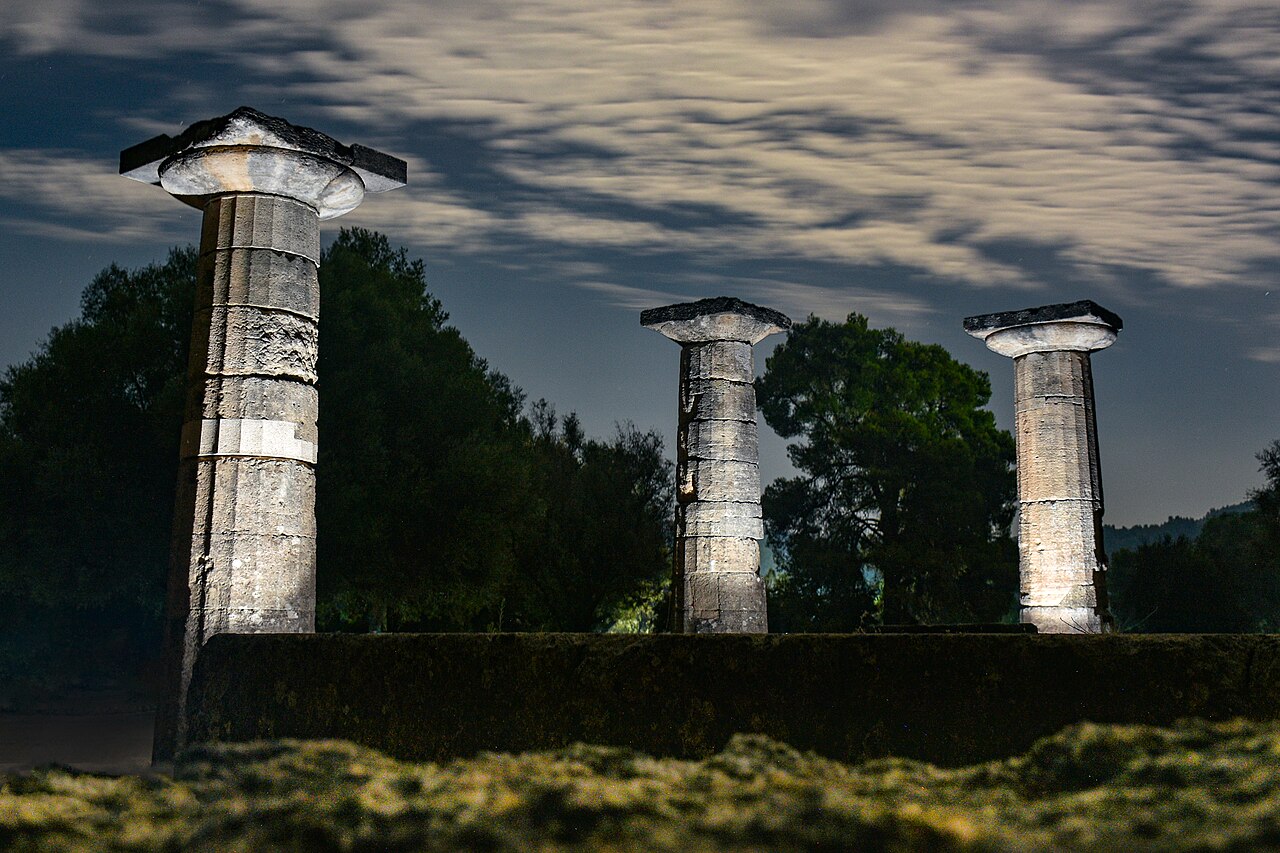
The Temple of Hera is the oldest temple at Olympia, an early Doric temple from around 590 BC dedicated to the goddess Hera. Before every modern Olympic Games, the Olympic flame is lit at its altar using a parabolic mirror and the sun’s rays, then carried by torch relay to the host city.
It is the earliest temple. The Heraion predates the Temple of Zeus by more than a century, so its worn columns show the oldest monumental architecture on the site, a temple to Hera and originally to Zeus as well.
It lights the flame. A priestess kindles the Olympic flame at the Hera altar from the sun’s rays, so the ceremony seen worldwide before each Games begins at this exact spot in Olympia. Read the full guide to the Temple of Hera at Olympia.
It framed the Games’ revival. The flame ritual ties the modern Olympic movement to the ancient sanctuary, so the Heraion is both an archaeological ruin and a living stage for the Games today. See the guide to the Olympic flame lighting ceremony.
What is the Ancient Stadium of Olympia?
The Ancient Stadium is the running track where the Olympic Games were contested, entered through a stone-vaulted tunnel. The track measures about 192 metres, the length of the original stade race, and the grass banks held up to 45,000 spectators who sat on the ground, as there were no built seats.
The entrance thrills. Athletes and judges passed through the vaulted crypt tunnel into the arena, so visitors walk the same passage onto the track, one of the most evocative moments at Olympia.
The track is original. Stone start and finish lines still mark the 192-metre course of the stade foot race, so families line up and run the length of the very track where champions once competed. See the family guide to Olympia with kids.
The banks held thousands. Sloping earth embankments seated tens of thousands of spectators without a single stone bench, so the stadium shows how the ancient crowds watched the Games on the open grass. See the full guide to the Ancient Stadium of Olympia.
What other monuments stand at Olympia?
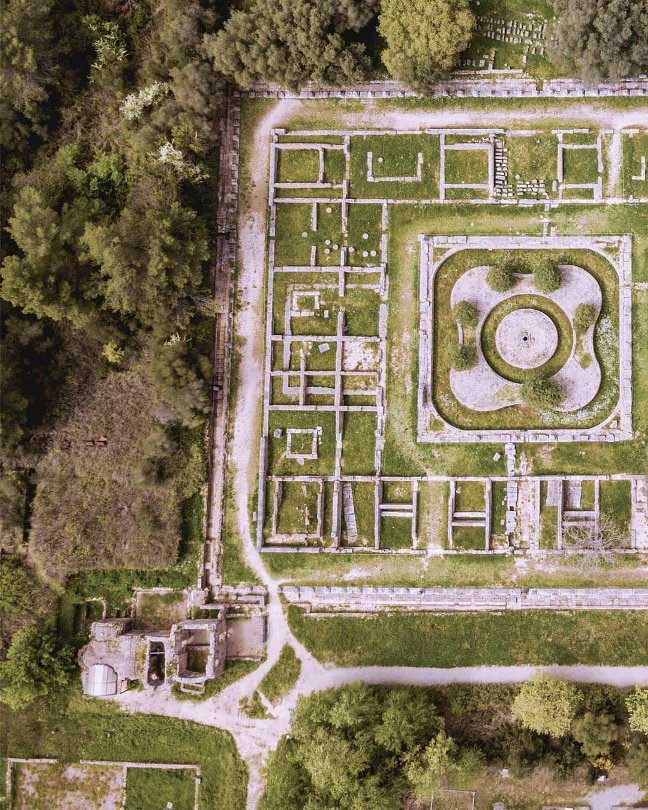
Beyond the temples and stadium, Olympia holds the Palaestra and Gymnasium where athletes trained, the Leonidaion guest house, the round Philippeion of the Macedonian kings, the Workshop of Pheidias, the Bouleuterion council house, the Nymphaeum fountain and a row of city treasuries, so the whole sanctuary rewards a slow walk.
The training grounds survive. The colonnaded Palaestra and the long Gymnasium show where wrestlers, boxers and runners prepared, so visitors see the ancient athletes’ practice halls beside the competition grounds. See the guide to the Palaestra and Gymnasium at Olympia.
The Philippeion stands apart. The elegant round monument raised by the Macedonian royal house honours Philip and Alexander, so this graceful circle of columns marks the reach of Macedonian power into the sanctuary. Read the guide to the Philippeion at Olympia.
The Workshop of Pheidias remains. The building where Pheidias created the statue of Zeus, later a Christian basilica, still stands, so the birthplace of a Wonder of the world is part of the walk through Olympia. Read the guide to the Workshop of Pheidias.
What is in the Archaeological Museum of Olympia?
The Archaeological Museum of Olympia is one of the finest in Greece. Its masterpieces are the Hermes of Praxiteles, a marble god carrying the infant Dionysos; the flying Nike of Paionios; and the great sculpted pediments and metopes from the Temple of Zeus, showing the labours of Herakles and the chariot race of Pelops.
The Hermes leads it. The marble Hermes carrying the baby Dionysos, attributed to Praxiteles, is displayed in its own hall, so the museum’s single most famous work draws visitors first. Read the full guide to the Hermes of Praxiteles.
The Nike soars. The winged Victory of Paionios, once perched on a tall pillar before the Temple of Zeus, captures a goddess descending from the sky, so the museum holds one of the great images of movement in Greek art.
The pediments crown it. The reassembled east and west pediments of the Temple of Zeus fill the central hall, so the temple’s sculpture is seen together, a highlight that repays the short walk from the ruins.
How long do you need to visit Ancient Olympia?
You need about three to four hours for Ancient Olympia: two hours for the archaeological site and one to two hours for the Archaeological Museum. A combined ticket covers both, and the site opens early, so a half day is enough for most visitors, while enthusiasts and families take a full day.
The site takes two hours. Walking the temples, stadium and training grounds at a steady pace fills roughly two hours, so a morning covers the ruins before the midday heat.
The museum adds more. The Archaeological Museum and the Museum of the History of the Olympic Games take another one to two hours, so the combined ticket rewards a half to full day at Olympia. See the guide to Ancient Olympia tickets, prices and opening hours.
Early starts win. The site opens in the morning and the valley is hot by midday, so an early arrival gives the coolest air, the softest light and the quietest ruins.
What is the best way to visit Olympia?
The best way to visit Olympia is with a guide who brings the ruins to life, either on a day trip from Athens, Nafplio or the Katakolo cruise port, or independently by car with an audio guide. See the guide to the Ancient Olympia guided tour and its options. Olympia pairs well with a night in Olympia town or with Ancient Corinth and Mycenae on a wider Peloponnese tour.
A guide adds the story. The scattered ruins mean far more with a guide or audio guide explaining the temples, the Games and the statues, so guided visits turn stones into a vivid history.
Access is easy. Olympia is reached by car, by day trip from Athens or Nafplio, or on a shore excursion from the Katakolo cruise port, so visitors arrive from many directions across the western Peloponnese. See the full guide to how to get to Olympia.
It combines well. A visit pairs naturally with Ancient Corinth, Mycenae and a base in Nafplio, so Olympia anchors a wider tour of the ancient Peloponnese, or an overnight in Olympia town. Nearby stand the medieval Chlemoutsi Castle and the mountain Temple of Apollo Epicurius at Bassae. The healing springs and beach of Kaiafas Lake lie a short drive south.
Visits to the site pair well with an Olympia olive oil tasting at a working mill or family olive grove in the Alpheios valley, a tradition that reaches back to the olive wreaths of the ancient Games.
How did the city of Elis run the Olympic Games?
The city of Elis ran the Olympic Games at Olympia. Its judges, the Hellanodikai, were Elean citizens who trained and checked the athletes for a month before each festival. The Eleans also announced the sacred truce that protected travellers to the sanctuary.
Ancient Elis lay in the north of the plain, near modern Amaliada. Its gymnasium housed the athletes during the month of training. Before the games, judges and competitors walked in procession along the sacred road to Olympia.
The truce was called the ekecheiria. Heralds from Elis carried it across the Greek world before each festival. Under it, athletes and spectators crossed warring territory in safety.
The region keeps the old name. Elis, or Ilia in Greek, is the regional unit of the western Peloponnese. Pyrgos is its capital. It forms part of Western Greece.
How was Ancient Olympia buried and found again?
Ancient Olympia was buried by earthquakes and by floods of the Alfeios and Kladeos rivers after the games ended. A thick layer of river silt covered the sanctuary. The German excavation that began in 1875 brought the temples and the stadium back to light.
Roman emperors kept the festival alive. Nero competed in AD 67. He fell from his chariot but was still declared the winner. Theodosius I ended the games about AD 393 as a pagan rite.
Earthquakes shook the sanctuary in the 6th century AD. The Kladeos and the Alfeios then flooded the valley again and again. Their silt sealed the ruins, and that cover kept much of the site intact.
Ernst Curtius led the German excavation from 1875 to 1881. Under a treaty signed in 1874, every find stayed in Greece. The finds went to the museum at Olympia.
What is Chlemoutsi Castle near Olympia?
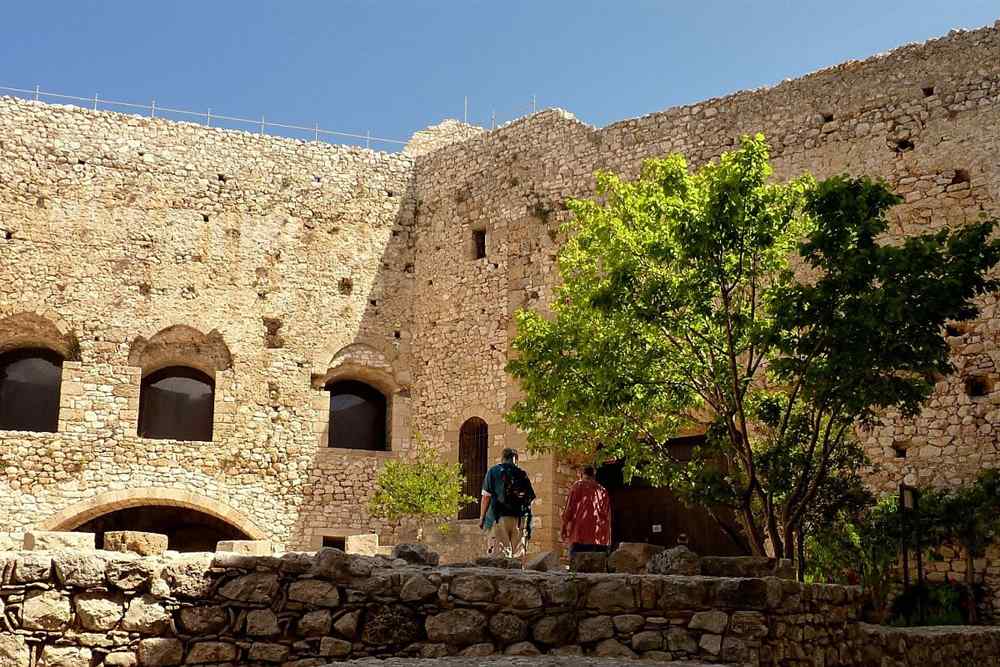
Chlemoutsi is a Frankish castle built in the 1220s on a hill above the village of Kastro, about 60 km north-west of Olympia. Its hexagonal keep holds vaulted galleries round a courtyard. From the walls the view reaches Zakynthos and Kefalonia.
Geoffrey I of Villehardouin built it and named it Clermont. It was the strongest castle of the Principality of Achaea. He paid for it with revenues taken from the church.
The inner keep is a ring of vaulted halls. The outer bailey held the garrison. The restoration reopened the galleries and set up an exhibition on the Frankish Morea inside them.
Andravida, the capital of the Frankish principality, lies inland from the castle. The ruined Gothic church of Agia Sofia still stands in the town.
Which ferry ports, spas and beaches line the northern coast of Elis?
The coast north of Olympia holds Kyllini, the ferry port for Zakynthos and Kefalonia, the sulphur spa of Loutra Kyllinis in a pine forest, and the long sand beaches of Kourouta, Glyfa and Arkoudi. The shore is one long strip of sand.
Ferries from Kyllini reach Zakynthos in about an hour and Kefalonia in about an hour and a half. The crossings are set out in getting to Zakynthos and how to get to Kefalonia.
The port town itself, with Glarentza, the springs and the beaches around it, has its own Kyllini tours page.
Loutra Kyllinis has sulphur springs that have been in use since antiquity. A spa works there among the pines and the sand.
Kourouta lies west of Amaliada, with wide sand and shallow water. Glyfa and Arkoudi are sandy resorts on the northern shore. Pine and eucalyptus trees line the back of the beaches.
Which beaches and lakes lie south of Olympia?
South of Olympia lie the thermal lake of Kaiafas, the long sand beach of Zacharo and the pine-covered dunes between them. Loggerhead turtles nest on these beaches from June. Further south the Neda river cuts a gorge on the border with Messenia.
Kaiafas lake lies behind a strip of dunes planted with pines. Sulphur springs feed the lake and two caves on the mountainside above it. The water is used for treatment as well as bathing.
Zacharo and Elaia have sand beaches that run for kilometres. The shore of the Kyparissia Gulf, from Kaiafas south into Messenia, is one of the main loggerhead nesting areas in the Mediterranean. The same species nests on Zakynthos, covered in Zakynthos sea turtles.
The Neda gorge has waterfalls and pools along a walking path.
What are Pyrgos and the Foloi forest?
Pyrgos is the capital of Elis, about 20 km west of Olympia, with a historic market and a municipal theatre designed by Ernst Ziller. Foloi is a protected oak forest on a plateau north-east of Olympia, linked in myth to the centaurs.
Pyrgos grew rich on the currant and wine trade in the 19th century. That trade paid for the theatre and the market. The motorway from Patras reaches Pyrgos in about an hour.
The Foloi forest covers about 33 square kilometres of oak. The plateau takes its name from Pholos, the centaur who hosted Herakles in the myth. Walking and cycling tracks cross the wood.
Coaches on Peloponnese tours reach Olympia by the Pyrgos road or from the cruise quay at Katakolo.
Frequently Asked Questions About Ancient Olympia
Where is Ancient Olympia located?
Ancient Olympia lies in the western Peloponnese, in the region of Elis, near the modern town of Archaia Olympia. It sits in the green valley of the Alpheios river, about 20 kilometres inland from the Katakolo cruise port and roughly a four-hour drive west of Athens. See the guide to Katakolo port.
The site is well signposted from the town of Archaia Olympia, which has hotels, tavernas and the two museums a short walk away, so visitors base themselves in the town or arrive on a day trip. See the guide to Archaia Olympia town. See the guide to where to stay in Olympia.
How do you get to Olympia from Athens?
You reach Olympia from Athens in about three and a half to four hours by car via the Corinth Canal and Patras, or on an organised day trip and multi-day Peloponnese tour. Cruise passengers reach it in under an hour from the Katakolo port on a shore excursion. See the complete guide to Katakolo to Olympia.
Guided day trips and transfers handle the long drive, so many visitors reach Olympia without driving, as the full guide to how to get to Olympia sets out.
Is Ancient Olympia worth visiting?
Yes, Ancient Olympia is well worth visiting. See the honest guide to whether Olympia is worth visiting. As the birthplace of the Olympic Games, a supreme sanctuary of Zeus and home to a Wonder of the ancient world, it is one of the most significant sites in Greece, matched by a superb museum, so it rewards every visitor with history and art together.
The green valley setting, the original stadium track and the museum masterpieces make Olympia a highlight of the Peloponnese, so it earns a place on any tour of ancient Greece.
- Meteora Greece: Explore Meteora Monasteries & Unforgettable Meteora Tours
- Milos Travel: The Ultimate Guide to Milos, Greece
- Mycenae Tours: Experience Legendary Archaeological Site
- Mykonos Greece: The Absolute Guide To Survive
- Mystras Tours: Uncover the Mysteries of Mystras with a Byzantine Castle Tour
- Nafplio, Greece: The Complete Travel Guide to the First Capital
- Naxos Greece: The Ulitmate Guide & Incredible Things to Do
- Nisyros
- Oinousses
- Paros Greece Travel Guide: Things to Do in Paros, Explore Paros Island
- Patmos
- Paxi Antipaxi Tours: Explore Paxos and Antipaxos – Experience Paxos Tours & Antipaxos Tours
- Pelion Greece: The Ultimate Pelion Travel Guide