
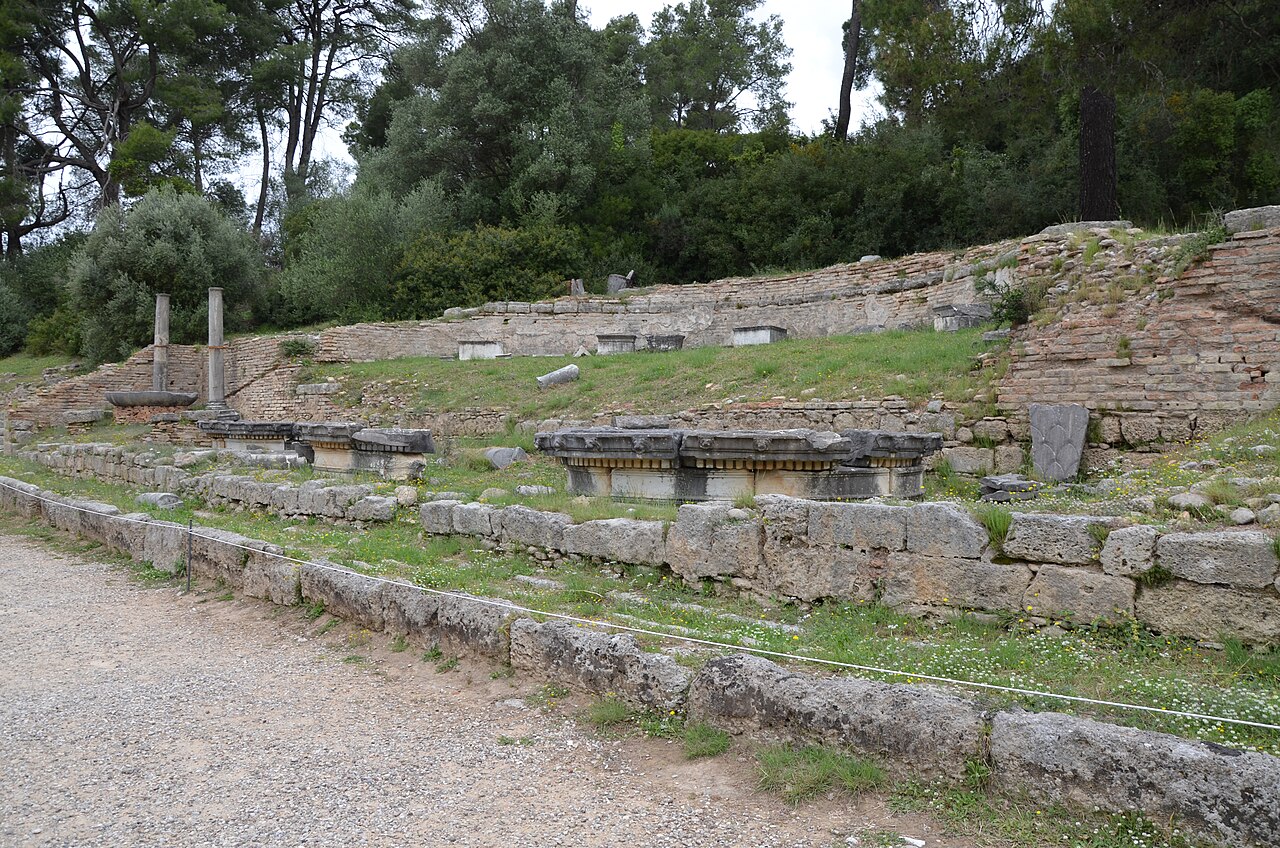
The sanctuary of Ancient Olympia was far more than the Temple of Zeus and the stadium. Within and around the sacred Altis stood a whole complex of monuments serving the worship of the gods and the running of the Olympic Games: the great ash Altar of Zeus, the ancient shrine of Pelops, the council house where athletes swore their oath, a grand guest house for distinguished visitors, a row of treasuries built by the Greek cities, and fountains, colonnades and shrines besides. Many survive today as foundations and ruins that reward a closer look. This guide covers the lesser monuments of Olympia, the buildings that filled the sanctuary beyond its famous temples and its stadium.
This guide covers the monuments of Olympia in full: the Altar of Zeus, the Pelopion, the Bouleuterion, the Leonidaion, the treasuries, the Metroon, the Nymphaeum, the Echo Stoa and the Zanes. Read it beside the full Ancient Olympia guide, the Temple of Zeus and the Philippeion.
What monuments are there at Olympia beyond the temples?
Beyond the temples and the stadium, Olympia holds many monuments: the great ash Altar of Zeus, the ancient Pelopion shrine, the Bouleuterion council house, the Leonidaion guest house, a row of city treasuries, the Metroon, the Nymphaeum fountain, the Echo Stoa colonnade, the Prytaneion, and the Zanes, statues of Zeus paid for by fines. Together they filled the sacred Altis and served the gods and the Games.
They served worship and the Games. The monuments housed altars, oaths, offerings and officials, so they ran the religious and athletic life of the sanctuary.
They fill the Altis. Most stand within or around the sacred precinct, so they cluster at the heart of Olympia.
Many survive as ruins. Foundations, columns and platforms remain, so the buildings can be traced on a walk through the site.
What was the Altar of Zeus at Olympia?
The Altar of Zeus was the most sacred spot at Olympia, a great mound of hardened ash built up over centuries from the burned thigh-bones of sacrificed animals. It stood in the open before the Temple of Zeus, and on it the central sacrifices of the Games were made. Taller than a person, mixed each year with water from the river Alpheios, it has dissolved entirely and nothing of it survives.
It was made of ash. Unlike a stone altar, it grew as a heap of ash from generations of sacrifice, so it was a living monument of ritual.
It was the holiest spot. The main sacrifices to Zeus took place here, so it was the sacred centre of the sanctuary.
It has vanished. The ash mound dissolved once the sanctuary was abandoned, so nothing of the altar remains today.
What is the Pelopion at Olympia?
The Pelopion is the ancient shrine of Pelops, the hero after whom the Peloponnese is named and whose legendary chariot victory was linked to the founding of the Olympic Games. A low mound enclosed by a wall in the sacred Altis, between the temples of Zeus and Hera, it was one of the oldest sacred spots at Olympia, where offerings were made to the hero.
It honoured Pelops. The shrine was dedicated to the hero Pelops, so it tied the sanctuary to a founding myth of the Games.
It was very old. The Pelopion was among the earliest sacred spots at Olympia, so it predates many of the temples.
It lies among the temples. The enclosure stands between the temples of Zeus and Hera, so it is central to the Altis.
What was the Bouleuterion at Olympia?
The Bouleuterion was the council house of Olympia, where the officials who ran the Games met and where athletes swore the sacred Olympic oath. It held the statue and altar of Zeus Horkios, Zeus of the Oath, before which competitors, their fathers and their trainers swore to compete fairly and to have trained properly. Dating in part to the archaic period, it stood south of the Temple of Zeus.
It was the council house. The Bouleuterion was where the Games were administered, so it was the seat of their organisation.
It held the oath. Athletes swore the Olympic oath before Zeus Horkios here, so it was central to the fairness of the Games.
It was ancient. Parts of the building date to the archaic period, so it was among the older structures of the sanctuary.
What was the Leonidaion at Olympia?
The Leonidaion was the largest building at Olympia, a grand guest house for distinguished visitors to the Games, built in the fourth century BC and named after its donor, Leonidas of Naxos. A large square building ringed by colonnades, with rooms around an inner courtyard, it lay just outside the sacred Altis and offered lodging to important guests and, later, to Roman officials.
It was the largest building. The Leonidaion was the biggest structure at Olympia, so it dominated the south-west of the site.
It housed important guests. The building lodged distinguished visitors to the Games, so it was Olympia’s grand guest house.
It was named after its donor. Leonidas of Naxos paid for the building, so it carried his name, as the full Ancient Olympia guide describes.
What were the treasuries at Olympia?
The treasuries at Olympia were a row of small temple-like buildings on a terrace at the foot of the Kronos hill, north of the Altis, built by Greek cities to house their offerings to Zeus. Each treasury, raised by a city such as Sikyon, Gela or Megara, displayed the wealth and devotion of its people, so the terrace of treasuries was a showcase of the Greek world’s cities.
They held offerings. Each treasury stored a city’s dedications to Zeus, so they safeguarded precious gifts.
Cities built them. Greek cities from across the Mediterranean raised the treasuries, so they displayed civic pride.
They lined a terrace. The treasuries stood in a row below the Kronos hill, so they formed a striking line above the Altis.
What was the Metroon at Olympia?
The Metroon was a small Doric temple in the Altis dedicated to the Mother of the Gods, Rhea or Cybele. Built in the fourth century BC, it stood on the terrace before the treasuries, north of the Temple of Zeus. In the Roman period it was reused for the worship of emperors, so the temple served first a goddess and later the imperial cult, a common change at Greek sanctuaries.
It honoured the Mother of the Gods. The Metroon was dedicated to Rhea or Cybele, so it served the great mother goddess.
It was a small Doric temple. The building was a modest temple in the Doric order, so it echoed the greater temples nearby.
It was reused by Rome. In Roman times it served the imperial cult, so its use changed over the centuries.
What was the Nymphaeum of Herodes Atticus?
The Nymphaeum was a grand semicircular fountain at Olympia, built by the wealthy Athenian benefactor Herodes Atticus in the Roman period. Set below the treasuries at the foot of the Kronos hill, it brought fresh water to the sanctuary and was decorated with statues of the imperial family and of Herodes’ own household. Several of its sculptures survive in the Archaeological Museum of Olympia.
It brought water to the site. The Nymphaeum supplied fresh water to the sanctuary, so it met a practical need.
A rich Athenian built it. The benefactor Herodes Atticus funded the fountain, so it marks the Roman age of Olympia.
Its statues survive. Sculptures from the Nymphaeum are displayed in the museum, so its decoration endures, as the museum guide describes.
What was the Echo Stoa at Olympia?
The Echo Stoa was a long colonnaded hall on the eastern side of the Altis, separating the sacred precinct from the stadium. Famous for an echo said to repeat a sound seven times, it gave the stoa its name. It provided shelter and a grand backdrop to the eastern edge of the sanctuary, and heralds and trumpeters competed before it at the start of the Games.
It was a colonnaded hall. The Echo Stoa was a long portico on the east of the Altis, so it framed that side of the precinct.
It had a famous echo. The hall was said to repeat a sound seven times, so its echo gave it its name.
It bordered the stadium. The stoa separated the Altis from the stadium, so it stood on the route to the Games.
What were the Zanes at Olympia?
The Zanes were bronze statues of Zeus that lined the path from the Altis to the stadium, paid for by the fines imposed on athletes who cheated at the Games. Each statue was inscribed with the offender’s name and offence, so every competitor passed this row of warnings on the way to compete. The Zanes made cheating a lasting public disgrace under the authority of Zeus.
They were funded by fines. The statues were paid for by penalties on cheats, so wrongdoing itself raised them.
They named the cheats. Each Zanes carried the offender’s name and offence, so their disgrace was made permanent.
They warned the athletes. The statues lined the way to the stadium, so every competitor faced them before entering, as the guide to the ancient Olympic Games describes.
What was the Prytaneion at Olympia?
The Prytaneion was the administrative building at the north-west corner of the Altis, home of the sacred hearth of Olympia, whose fire was kept always burning. Here the officials of the sanctuary held office, and the victors of the Games were honoured with a banquet after their triumph. So the Prytaneion combined a religious hearth with the civic heart of the sanctuary.
It held the sacred hearth. The Prytaneion kept an ever-burning fire, so it was a religious as well as civic building.
It honoured the victors. Winners were feasted here after the Games, so it celebrated the champions.
It housed the officials. The sanctuary’s officers held office in the building, so it was its administrative centre.
What other structures stood in the Altis?
Other structures in and around the Altis included the round Philippeion of the Macedonian kings, the Palaestra and Gymnasium where athletes trained, the Workshop of Pheidias where the Statue of Zeus was made, and countless statues and votive offerings dedicated by cities and individuals. Together with the temples and the stadium, these buildings made Olympia one of the richest sanctuaries in the Greek world.
The Philippeion stands apart. The round monument of the Macedonian kings lies in the Altis, so it adds a rare circular building, as the guide to the Philippeion describes.
The training grounds lie west. The Palaestra and Gymnasium border the Altis, so the athletes’ halls stood beside the sacred precinct, as the guide to the Palaestra and Gymnasium sets out.
Statues filled the sanctuary. Countless dedications and statues stood among the buildings, so the Altis was crowded with offerings.
What can you see of the monuments today?
Today you see the foundations, platforms and some standing columns of the monuments of Olympia, set among the trees of the green sanctuary. The plans of the Leonidaion, the Bouleuterion, the treasuries and the Metroon are clear, the Nymphaeum’s semicircle survives, and the row of treasury terraces is easily traced. A guide or plan brings these lesser ruins to life alongside the great temples.
Their plans survive. Foundations and platforms mark the buildings, so their layouts are read on the ground.
Some columns stand. Parts of several monuments have been re-erected, so a few rise above the ruins.
A guide helps. A guide or plan explains the lesser buildings, so they gain meaning beside the famous temples.
What was the South Stoa at Olympia?
The South Stoa was a long colonnaded hall on the southern edge of the sanctuary, forming the main southern facade of Olympia towards the river Alpheios. Built in the classical period, it gave shelter and a grand front to the site, and served visitors arriving from the south. With the Echo Stoa to the east, it framed the sacred precinct with elegant colonnades on two sides.
It faced the river. The South Stoa formed the southern front of the site towards the Alpheios, so it greeted visitors from that side.
It was a colonnaded hall. The building was a long portico, so it offered shelter and a grand facade.
It framed the Altis. With the Echo Stoa, it bordered the precinct, so the two colonnades enclosed the sanctuary.
What was the sacred olive tree at Olympia?
The sacred olive tree at Olympia grew beside the Temple of Zeus, and from it were cut the branches that formed the olive wreaths, the kotinos, awarded to the victors of the Games. Guarded and revered, the wild olive was central to the meaning of an Olympic victory, for the crown of its leaves was the only prize, symbolising honour rather than material reward.
It grew by the temple. The sacred olive stood beside the Temple of Zeus, so it lay at the heart of the sanctuary.
It crowned the victors. Branches from the tree formed the olive wreaths given to winners, so it provided the Olympic prize.
It symbolised honour. The olive crown was the only reward, so the tree stood for the glory of victory itself.
What was the Krypte, the entrance to the stadium?
The Krypte was the stone-vaulted tunnel that led from the sacred Altis into the ancient stadium, the passage through which athletes and judges entered the arena. About thirty metres long, it separated the sanctuary from the stadium and gave the athletes a dramatic entrance onto the track. It survives today, so visitors walk the same vaulted passage into the stadium.
It linked Altis and stadium. The tunnel joined the sacred precinct to the arena, so it was the threshold to the Games.
Athletes entered through it. Competitors and judges passed along the Krypte into the stadium, so it framed their entrance.
It survives today. The vaulted tunnel still stands, so visitors walk it onto the track, as the guide to the Ancient Stadium of Olympia describes.
What Roman monuments are there at Olympia?
Olympia gained several monuments in the Roman period, when the sanctuary remained a great centre of the Games. Among them are the Nymphaeum of Herodes Atticus, the reuse of the Metroon for the imperial cult, Roman baths and guest quarters, and a grand entrance. The Romans maintained and adorned the sanctuary, so its later monuments sit alongside the classical temples and buildings.
The Nymphaeum is the grandest. The Roman fountain of Herodes Atticus is the finest Roman monument, so it stands out at the foot of the Kronos hill.
The Metroon was reused. The old temple served the imperial cult in Roman times, so its use changed with the age.
Baths and quarters were added. Roman baths and lodgings served visitors, so the sanctuary kept pace with the times.
What was the Kronos hill at Olympia?
The Kronos hill, or Kronion, is the wooded hill that rises to the north of the sanctuary of Olympia, named after Kronos, the father of Zeus. Sacred in its own right, it forms the northern boundary of the Altis, and the terrace of treasuries and the Nymphaeum stand at its foot. Its green slopes give Olympia its sheltered, leafy setting in the valley below.
It bounds the Altis. The Kronos hill forms the northern edge of the sacred precinct, so it frames the sanctuary.
It was sacred. The hill was named after Kronos and revered, so it added to the holiness of the site.
It shelters the treasuries. The treasury terrace and the Nymphaeum stand at its foot, so its slopes rise above them.
How were the monuments of Olympia arranged?
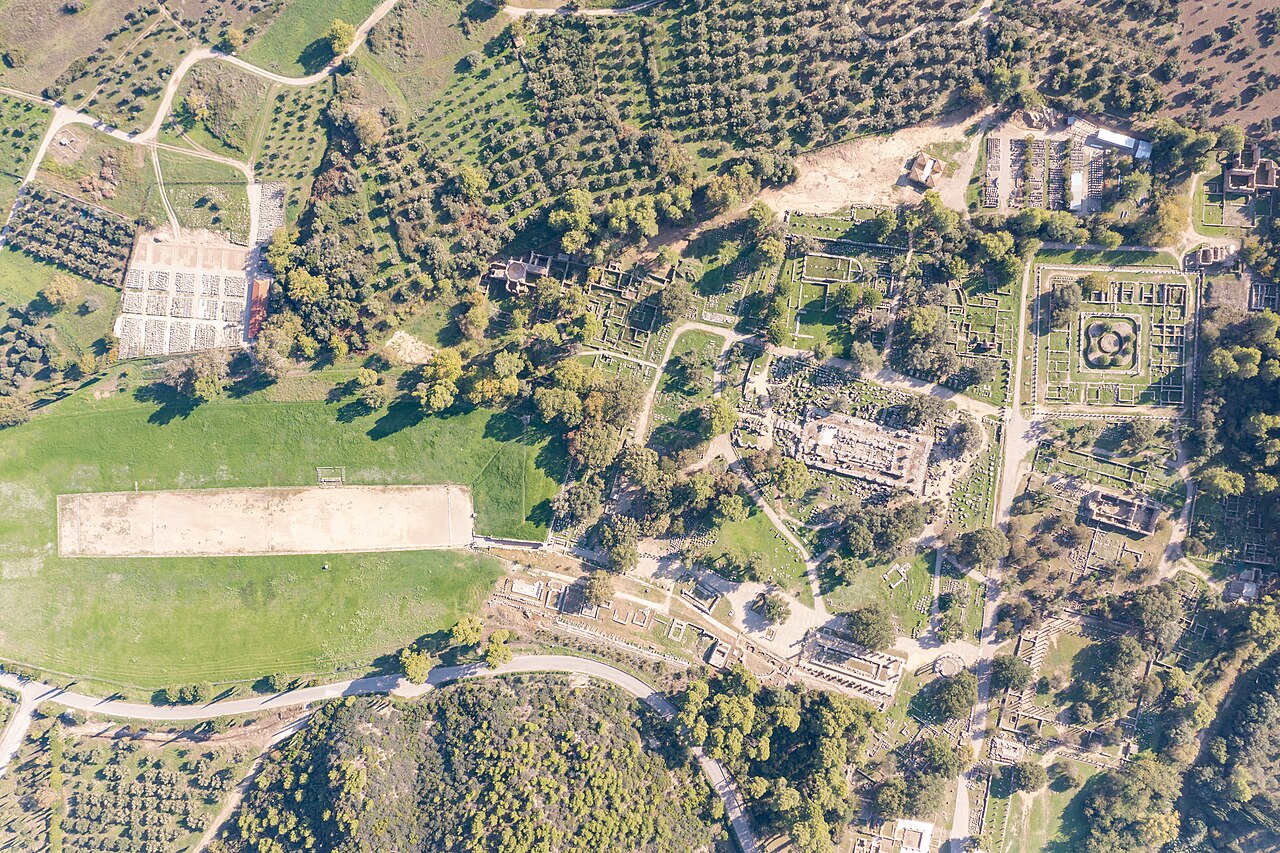
The monuments of Olympia were arranged around the sacred Altis, the walled grove of Zeus. The temples of Zeus and Hera, the Altar of Zeus, the Pelopion and the Philippeion stood within it; the treasuries, the Metroon and the Nymphaeum lined the terrace to the north; the Bouleuterion and South Stoa lay to the south; and the training grounds and the stadium bordered the precinct to the west and east.
The temples filled the Altis. The great temples and altars stood within the sacred grove, so they formed its core.
The treasuries lined the north. The treasury terrace, Metroon and Nymphaeum ran below the Kronos hill, so they bordered the north.
Training grounds and stadium framed it. The Palaestra and Gymnasium lay west and the stadium east, so athletics ringed the sacred centre.
How were the monuments of Olympia rediscovered?
The monuments of Olympia were rediscovered by excavation after lying buried under river silt for centuries. European travellers identified the site in the eighteenth century, and a long German excavation uncovered the temples, the stadium, the treasuries and the lesser buildings, along with the sculptures and finds now in the museum. The excavations continue today, so the sanctuary’s monuments are still being studied and revealed.
They were buried in silt. Floods covered the monuments for centuries, so Olympia lay hidden and largely intact.
Archaeologists uncovered them. A long German excavation revealed the buildings and finds, so the sanctuary returned to light.
Work continues. Excavation and study go on today, so the monuments are still being explored.
What votive offerings and statues stood at Olympia?
Olympia was crowded with votive offerings and statues, dedicated by cities and individuals in thanks to Zeus and to celebrate victories. Bronze and marble statues of gods, heroes and Olympic champions, tripods, weapons and works of art filled the Altis and lined its paths. Ancient writers record thousands of such offerings, so the sanctuary was as much an open-air gallery as a place of worship.
Cities and people gave them. Offerings were dedicated by states and individuals, so they expressed civic and personal devotion.
Statues honoured victors. Bronze and marble figures celebrated Olympic champions, so the paths were lined with athletes in metal and stone.
They filled the sanctuary. Thousands of offerings crowded the Altis, so Olympia was a gallery of Greek art and dedication.
What was the Heroon at Olympia?
The Heroon was a small shrine at Olympia, west of the sacred Altis near the training grounds, dedicated to an unknown hero. A modest building with a circular chamber, it served the worship of a hero whose identity is now lost. Small shrines like this, honouring local heroes, were common in Greek sanctuaries, so the Heroon added another layer of worship to the many monuments of Olympia.
It honoured a hero. The Heroon was a shrine to an unknown hero, so it served heroic worship at the site.
It was a small shrine. The building was modest, with a round chamber, so it was one of the lesser monuments.
It lay by the training grounds. The Heroon stood west of the Altis near the Palaestra, so it bordered the athletic area.
Which is the oldest monument at Olympia?
Among the standing monuments, the Temple of Hera, built around 600 BC, is the oldest at Olympia, but worship at the site is older still. The Pelopion and the Altar of Zeus go back to the earliest days of the sanctuary, and simpler shrines stood on the spot before the great temples rose. So Olympia’s sacred life reaches back well beyond even its oldest surviving buildings.
The Temple of Hera is the oldest temple. The Heraion, from around 600 BC, is the earliest standing temple, so it leads the buildings, as the guide to the Temple of Hera describes.
Worship is older still. The Pelopion and the Altar of Zeus reach back to the earliest sanctuary, so cult predates the temples.
Shrines came first. Simpler sacred spots stood before the great temples, so Olympia’s holiness is very ancient.
Why do the monuments of Olympia matter?
The monuments of Olympia matter because together they preserve a complete picture of a great Greek sanctuary, showing how worship, athletics and civic life were woven together. From the ash Altar of Zeus to the oath-taking Bouleuterion, the treasuries of the cities and the guest house of distinguished visitors, the buildings reveal the religious, political and sporting world of the ancient Olympic Games in one place.
They show a whole sanctuary. The monuments preserve a complete Greek sacred complex, so Olympia is a rare and full example.
They weave together life. Worship, athletics and civic life meet in the buildings, so they reveal the whole world of the Games.
They illuminate the Games. From altars to oath-houses and treasuries, the monuments explain how the Olympics worked, so they are historically precious.
Frequently Asked Questions About the Monuments of Olympia
What was the Altis at Olympia?
The Altis was the sacred precinct at the heart of Olympia, the walled grove of Zeus that held the sanctuary’s holiest monuments. Within it stood the Temple of Zeus, the Temple of Hera, the Altar of Zeus, the Pelopion, the Philippeion, the treasuries and many altars and statues. An irregular quadrangle bounded by the Kronos hill and a wall, the Altis was the religious core of the whole site.
Because the Altis held the holiest temples, altars and monuments, it was the sacred heart around which the rest of Olympia was arranged.
Which monuments at Olympia are best preserved?
Among the lesser monuments, the Palaestra and the Philippeion are the best preserved, with re-erected columns that give a strong sense of their form, and the Leonidaion, the treasury terrace and the Nymphaeum survive clearly in plan. The Altar of Zeus, made only of ash, has vanished entirely. Overall the site preserves the layouts of its buildings well, thanks to its long burial under river silt.
Because the site lay buried under silt for centuries, its monuments survive in plan remarkably well, with the Palaestra and Philippeion the most upstanding of the lesser buildings.
How long do you need to see the monuments of Olympia?
You need about two hours to walk the whole archaeological site of Olympia and take in its monuments, from the temples and the stadium to the lesser buildings of the Altis. Adding the Archaeological Museum brings the visit to a half or full day. A guide or a good plan makes the many foundations and ruins far easier to understand as you walk among them.
Because the monuments are spread across the green site, about two hours covers them on foot, with the museum adding to a half or full day at Olympia.
What was the Bouleuterion oath?
The Bouleuterion oath was the sacred pledge sworn by every athlete before the Games, taken in the council house before the statue and altar of Zeus Horkios, Zeus of the Oath. Athletes, their fathers and their trainers swore to compete fairly and to have trained for the required months. Breaking the oath brought fines and disgrace, so it bound the competitors to the honesty of the Games.
Because every athlete swore before Zeus of the Oath to compete fairly, the Bouleuterion was central to the integrity that the ancient Olympic Games prized above all.
Is the Altar of Zeus still visible at Olympia?
No, the Altar of Zeus is not visible at Olympia today, as it was made entirely of ash and dissolved once the sanctuary was abandoned. Unlike the stone temples and buildings, the great ash altar left no ruin, so its exact site before the Temple of Zeus is known only from ancient descriptions. It is one of the most important monuments of Olympia yet nothing of it survives.
Because the altar was built of ash rather than stone, it vanished completely, so visitors see the temples and buildings that surrounded the sacred spot rather than the altar itself.
Are the monuments included in the Olympia ticket?
Yes, all the monuments of the archaeological site of Olympia are included in the standard combined ticket, which also covers the two museums. There is no separate charge for any building. Visitors walk freely among the temples, the stadium, the treasuries, the Leonidaion and the other monuments on one ticket, so the whole sanctuary is seen on a single visit.
Because the combined ticket covers the entire site and its museums, every monument at Olympia is seen on one purchase, as the guide to Olympia tickets sets out.
What was the Leonidaion used for in Roman times?
In Roman times the Leonidaion, once the guest house of the Games, was rebuilt to serve as the residence of the Roman governor of the province when he visited Olympia. Its central courtyard was turned into an ornamental garden with a water channel around it. So the grand building continued to house distinguished visitors, adapting from Greek guest house to Roman official residence over the centuries.
Because it kept its role of lodging important visitors, the Leonidaion served first the Greek guests of the Games and later the Roman governor, remaining Olympia’s grandest guest house throughout.
How do you find the lesser monuments on a visit?
You find the lesser monuments of Olympia by following the marked paths through the site with a plan or a guide, as many survive only as foundations that are easy to miss. The temples, the stadium and the Palaestra are obvious, but the treasuries, the Bouleuterion, the Leonidaion and the site of the Altar of Zeus are best identified with the help of a map or a knowledgeable guide.
Because many of the lesser buildings are low ruins, a plan or a guide is the key to finding and understanding them among the trees of the sanctuary.
Are the monuments of Olympia worth exploring in detail?
Yes, the lesser monuments of Olympia are well worth exploring for those interested in the ancient world, as they reveal how the sanctuary and the Games actually worked. The oath-house, the treasuries, the guest house and the altars tell the story of the religion, politics and organisation behind the famous temples and stadium, so a slower, closer look greatly deepens a visit to Olympia.
Because the lesser monuments explain the workings of the sanctuary and the Games, exploring them in detail turns a walk among ruins into a rich understanding of ancient Olympia.
What is the Pelopion’s link to the Olympic Games?
The Pelopion links to the Olympic Games through the myth of Pelops, the hero who won his bride and a kingdom in a chariot race against King Oinomaos, a victory that ancient tradition connected with the founding of the Games. Honoured with sacrifices at his shrine in the Altis, Pelops was one of the heroes to whom the Games were tied, so the Pelopion stood at the mythical roots of Olympia.
Because the chariot victory of Pelops was woven into the founding legend of the Games, his shrine in the Altis connected the sanctuary directly to the origins of the Olympic Games.