
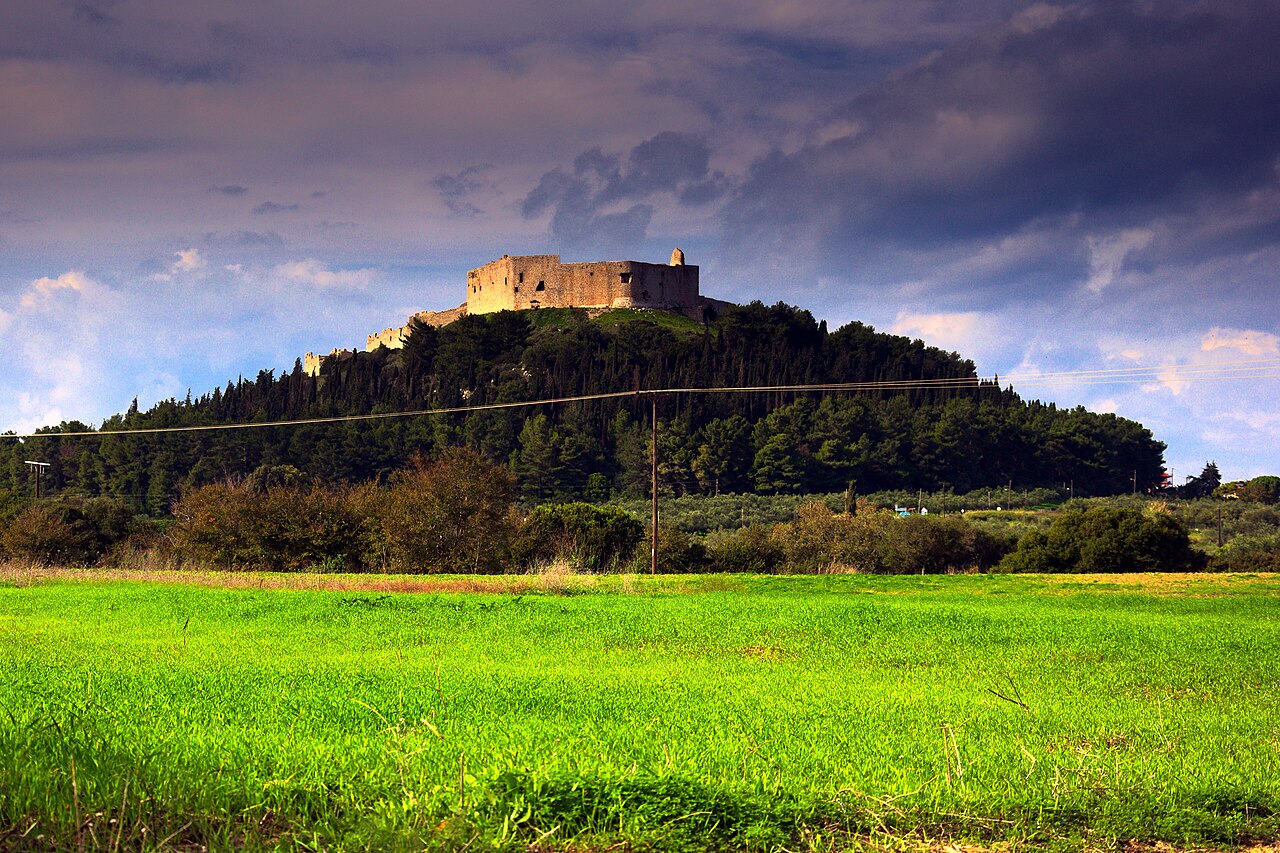
Chlemoutsi Castle, crowning a hill above the west coast of the Peloponnese, is the finest and best-preserved Frankish fortress in Greece. Built in the early thirteenth century by the Crusader prince Geoffrey I of Villehardouin, it guarded the medieval capital of the Frankish Principality of Achaea and its harbour of Glarenza. Its great hexagonal keep and vaulted halls survive almost intact, housing today the only museum in Greece devoted to the age of the Crusader knights, and from its ramparts the view sweeps across the coastal plain to the Ionian islands of Zakynthos and Kefalonia. This guide tells the full story of the castle, from its history and architecture to how to visit it.
This guide covers Chlemoutsi Castle in full: its history, its architecture, the Frankish Museum inside it, the views, where it stands, and how to visit from Olympia and the Katakolo cruise port. Read it beside the full Ancient Olympia guide and the guide to Katakolo to Olympia, as the castle pairs well with a visit to the ancient sanctuary.
What is Chlemoutsi Castle?
Chlemoutsi Castle is a medieval Frankish fortress in the north-west of the Peloponnese, near the village of Kastro and the port of Kyllini. Built in the early thirteenth century, it is the finest surviving castle of the Frankish period in Greece, with a great hexagonal keep, vaulted halls and an outer wall, and it houses the only museum in the country devoted to the age of the Crusader knights.
It is a Frankish fortress. Chlemoutsi was built by the Crusader lords who ruled the Peloponnese, so it is the finest monument of Frankish Greece.
It crowns a hill. The castle stands on a low hill above the coastal plain, so it commands sweeping views over the land and sea.
It holds a museum. The keep houses a museum of the Crusader age, so the castle tells the story of Frankish rule in the Morea.
Who built Chlemoutsi Castle and when?
Chlemoutsi Castle was built in the early thirteenth century by Geoffrey I of Villehardouin, the Frankish Prince of Achaea, using revenues seized from the clergy of his principality. It was raised to protect the nearby capital of Andravida and the wealthy port of Glarenza. As the strongest fortress of the Principality of Achaea, it became a princely residence as well as a military stronghold.
A Crusader prince built it. Geoffrey I of Villehardouin, Prince of Achaea, raised the castle, so it belongs to the era of Frankish rule after the Fourth Crusade.
It guarded the capital. The castle protected Andravida and the port of Glarenza, so it was the shield of the Frankish state in the Morea.
It was a princely seat. Beyond its defences, the castle served as a residence of the princes, so it combined strength with comfort.
What is the architecture of Chlemoutsi Castle?
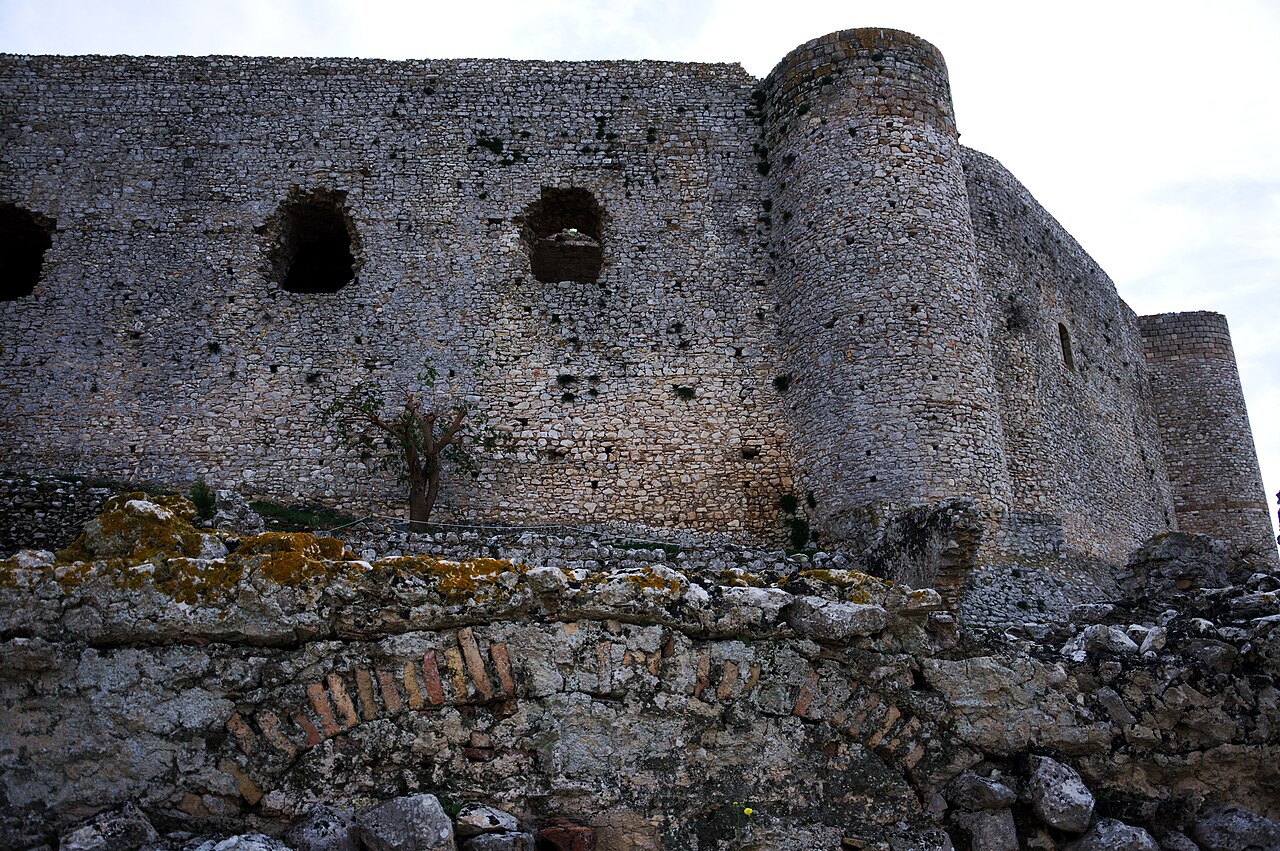
Chlemoutsi Castle is built around a great hexagonal keep at the top of the hill, with a ring of vaulted halls arranged around an inner courtyard. An outer wall encloses the more vulnerable slopes below. The halls were spacious, well-lit and fitted with fireplaces for winter, so the castle was a comfortable princely residence as well as a powerful fortress, unusual for its refined design.
A hexagonal keep crowns it. The great six-sided keep stands at the summit, so it forms the strong heart of the castle.
Vaulted halls ring the court. Spacious, well-lit halls surround the inner courtyard, so the castle offered comfort as well as defence.
An outer wall guards the slopes. A second wall encloses the weaker sides of the hill, so the fortress was well protected on every approach.
What is the Frankish Museum at Chlemoutsi?
The Frankish Museum inside Chlemoutsi Castle is the only museum in Greece devoted to the age of Frankish rule, from the thirteenth to the fifteenth century. Titled the Crusaders in the Morea, its exhibition displays hundreds of objects from the period, including sculptures, coins, pottery, frescoes and architectural pieces, telling the story of the knights who ruled the medieval Peloponnese.
It is unique in Greece. The museum is the only one in the country devoted to the Frankish age, so it fills a rare gap in Greek history.
It shows the Crusader world. Its displays cover the knights, their coins, their art and their daily life, so it brings the medieval Morea to life.
It fills the keep. The exhibition occupies the halls of the castle, so the setting and the collection tell one story together.
What are the views from Chlemoutsi Castle?
The views from Chlemoutsi Castle are among the finest in the western Peloponnese. Standing on a hill above the coastal plain of Ilia, the ramparts look out over farmland and the Ionian Sea to the islands of Zakynthos and Kefalonia, and on a clear day as far as the mainland coast of Aetolia. The commanding outlook was the very reason the castle was built here.
They reach the Ionian islands. The ramparts look across the sea to Zakynthos and Kefalonia, so the view takes in the nearby Ionian islands.
They sweep the plain. The castle overlooks the coastal plain of Ilia, so the countryside spreads out far below.
They explain the site. The commanding outlook was why the castle was raised here, so the view is both beautiful and strategic.
Where is Chlemoutsi Castle?
Chlemoutsi Castle stands in the north-west of the Peloponnese, above the village of Kastro near the port of Kyllini, in the regional unit of Ilia. It lies about forty-five kilometres north of the Katakolo cruise port and within easy reach of Ancient Olympia. The nearby port of Kyllini serves the ferries to Zakynthos and Kefalonia, so the castle sits at a crossroads of the western coast.
It is in Ilia. The castle stands in the regional unit of Ilia in the north-west Peloponnese, so it belongs to the same region as Olympia.
It overlooks Kyllini. The fortress rises above the village of Kastro near the port of Kyllini, so it guards the coast and its harbour.
It is near the ferries. Kyllini serves the ferries to the Ionian islands, so the castle sits at a busy point of the western coast.
How do you visit Chlemoutsi Castle?
You visit Chlemoutsi Castle by car or organised tour, most easily from the Katakolo cruise port about forty-five kilometres south, or from Ancient Olympia. The castle is open to visitors, with a ticket that includes the Frankish Museum. A road climbs the hill to the entrance, and the ramparts and halls are explored on foot, so a visit takes about an hour to ninety minutes.
It is reached by road. The castle is visited by car or tour from Katakolo or Olympia, so it fits into a wider tour of the western Peloponnese.
A ticket admits you. Entry includes the Frankish Museum, so the castle and its collection are seen on one visit.
It takes about an hour. The ramparts, halls and museum are explored in an hour to ninety minutes, so the castle makes an easy half-day outing.
Is Chlemoutsi Castle worth visiting?
Yes, Chlemoutsi Castle is well worth visiting. As the finest Frankish fortress in Greece, with a great keep, a unique museum of the Crusader age and sweeping views to the Ionian islands, it offers a rare glimpse of medieval Greece that few visitors know. Close to Ancient Olympia and the Katakolo cruise port, it makes a rewarding addition to a tour of the western Peloponnese.
It is the finest of its kind. As the best-preserved Frankish castle in Greece, Chlemoutsi is a monument without equal, so it rewards the visit.
It shows medieval Greece. The castle and its museum reveal the Crusader age, so they add a chapter of history most visitors miss.
It pairs with Olympia. Close to the ancient sanctuary and the cruise port, the castle joins easily with a visit to Olympia, as the Ancient Olympia guide describes.
Can you combine Chlemoutsi Castle with Olympia?
Yes, Chlemoutsi Castle combines well with Ancient Olympia, as both lie in the regional unit of Ilia within an easy drive of each other. A day tour of the western Peloponnese can take in the great sanctuary of Olympia in the morning and the medieval castle in the afternoon, pairing the ancient and the medieval, and both sit within reach of the Katakolo cruise port.
Both are in Ilia. The castle and the sanctuary share the same region, so they are easily visited together.
They pair ancient and medieval. Olympia shows ancient Greece and Chlemoutsi the medieval age, so together they span two great eras.
They suit a cruise day. Both lie near the Katakolo port, so a longer port day can combine the two, as the guide to Katakolo to Olympia sets out.
Who were the Villehardouins and the Principality of Achaea?
The Villehardouins were the Frankish family that ruled the Principality of Achaea, the Crusader state set up in the Peloponnese after the Fourth Crusade divided the Byzantine Empire. Geoffrey I of Villehardouin founded the dynasty, and his successors made the principality one of the richest and most cultured of the Crusader states, with Chlemoutsi as its great fortress and a residence of its princes.
They founded the principality. The Villehardouins established Frankish rule in the Morea, so they shaped the medieval Peloponnese for generations.
They ruled a rich state. The Principality of Achaea grew wealthy and cultured, so it was among the leading Crusader states of its day.
They held Chlemoutsi. The castle was the family’s great stronghold and a princely seat, so it stood at the heart of their power.
What happened to Chlemoutsi Castle over the centuries?
Over the centuries Chlemoutsi Castle passed through many hands. After the Frankish princes it was held by the Byzantines, then the Ottomans, and for a time the Venetians, each leaving their mark on its walls. It saw fighting in the Greek War of Independence, was damaged by earthquakes, and eventually fell out of military use, surviving today as a preserved monument and museum.
It changed rulers often. Franks, Byzantines, Ottomans and Venetians all held the castle, so its stones record centuries of shifting power.
It saw war and quake. The castle was fought over in the War of Independence and shaken by earthquakes, so it bears the scars of a turbulent history.
It became a monument. Once its military days ended, the castle was preserved as a historic site, so it now serves visitors rather than soldiers.
What was Glarenza, the port Chlemoutsi guarded?
Glarenza was the medieval port and commercial capital of the Principality of Achaea, on the coast below Chlemoutsi near the modern port of Kyllini. A busy harbour trading with Italy and the wider Mediterranean, it held a mint that struck the principality’s coins. The castle on the hill above protected this wealthy port and the nearby capital of Andravida from attack by sea and land.
It was the principality’s port. Glarenza was the main harbour and trading city of Frankish Achaea, so it was the state’s window on the sea.
It had a mint. The port struck the coins of the principality, so it was a centre of wealth as well as trade.
Chlemoutsi protected it. The castle guarded Glarenza and Andravida, so it was the shield of the principality’s heart.
What is the best time to visit Chlemoutsi Castle?
The best time to visit Chlemoutsi Castle is spring and autumn, when the weather is mild and the views are clear, and early or late in the day for the softest light. Summer is hot on the exposed hilltop, though the sea breeze eases the heat, and winter is quiet and green but sometimes wet. Clear days give the finest views to the Ionian islands.
Spring and autumn are mildest. The shoulder seasons bring comfortable weather and clear air, so they are the best for the castle and its views.
Summer is hot but breezy. The hilltop is exposed in summer, though the sea breeze helps, so an early or late visit is wisest.
Clear days reward the view. The outlook to Zakynthos and Kefalonia is best on clear days, so the weather shapes the experience.
What else is there to see near Chlemoutsi Castle?
Near Chlemoutsi Castle you can visit the port of Kyllini, with its ferries to Zakynthos and Kefalonia and its long sandy beaches, the thermal springs of Loutra Kyllinis, and the medieval remains around Andravida, the old Frankish capital. Ancient Olympia lies within an easy drive, so the castle fits into a rich tour of the western Peloponnese by land and sea.
Kyllini has beaches and ferries. The nearby port offers sandy beaches and ferries to the Ionian islands, so it adds sea and sand to a visit.
Thermal springs lie close. The spa of Loutra Kyllinis is nearby, so a visit can add a relaxing soak.
Olympia is within reach. The ancient sanctuary lies an easy drive away, so the castle joins a wider tour of the region.
Why is Chlemoutsi called the finest Frankish castle in Greece?
Chlemoutsi is called the finest Frankish castle in Greece because it survives more complete and better preserved than any other, and because its design is unusually grand. Its great hexagonal keep, its spacious vaulted halls fit for a prince, and its commanding position together make it the outstanding example of the castles the Crusader lords built across the medieval Peloponnese.
It survives nearly whole. Where most Frankish castles are ruins, Chlemoutsi stands largely intact, so it shows the type at its best.
Its design is grand. The hexagonal keep and princely halls set it above ordinary fortresses, so it ranks as the finest of its kind.
Its setting commands. The hilltop position and sweeping views complete the effect, so the castle impresses as much for its site as its stones.
Frequently Asked Questions About Chlemoutsi Castle
Why is Chlemoutsi Castle important?
Chlemoutsi Castle is important as the finest and best-preserved Frankish fortress in Greece, a rare and complete example of the castles built by the Crusader lords who ruled the medieval Peloponnese. Its great hexagonal keep, its comfortable princely halls and its unique museum of the Frankish age make it the key monument for understanding this little-known chapter of Greek history.
As the best surviving Frankish castle in the country, Chlemoutsi is the essential site for the Crusader age in Greece, and its unique museum makes it the natural place to discover a period of Greek history that few travellers ever explore.
How old is Chlemoutsi Castle?
Chlemoutsi Castle is about eight hundred years old, built in the early thirteenth century by the Frankish Prince of Achaea. It was raised soon after the Fourth Crusade brought Western knights to rule the Peloponnese, and it has stood, much repaired but essentially intact, ever since, making it one of the oldest and best-preserved medieval castles in Greece.
Its great age and remarkable preservation are a large part of why the castle is so treasured today.
What is Chlemoutsi Castle also called?
Chlemoutsi Castle is also known as the Castle of Kyllini, after the nearby port, and in the medieval Western sources it was called Clermont or Castel Tornese. The last name, Castel Tornese, arose from a mistaken link with the tornese coins once minted in the region. Today the Greek name Chlemoutsi is the one most commonly used for the castle.
The several names reflect the castle’s long history under both Greek and Western rule over the centuries.
Can you visit Chlemoutsi Castle from a cruise?
Yes, you can visit Chlemoutsi Castle from a cruise calling at Katakolo, about forty-five kilometres to the south. While most cruise passengers head to Ancient Olympia, some tours and taxis take in Chlemoutsi as an alternative or an addition, offering a medieval castle and sea views in place of, or alongside, the ancient sanctuary. The drive from the port takes about an hour.
Because the castle lies within reach of the Katakolo port, cruise passengers with a longer day can add it to Olympia for a fuller taste of the western Peloponnese, pairing the medieval fortress and its Ionian views with the ancient sanctuary of the Games.
Is Chlemoutsi Castle good for children?
Yes, Chlemoutsi Castle is enjoyable for children, who love exploring a real medieval fortress with its keep, ramparts and vaulted halls. The wide walls and sweeping views spark the imagination, and the castle is compact enough to see without tiring young legs. Sturdy shoes and care near the edges make a family visit safe as well as fun.
Because a genuine castle with towers and ramparts captures young imaginations, Chlemoutsi makes an engaging and memorable stop for families touring the western Peloponnese.
How long do you need at Chlemoutsi Castle?
You need about an hour to ninety minutes at Chlemoutsi Castle to walk the ramparts, explore the keep and vaulted halls, and see the Frankish Museum. Allowing extra time to enjoy the views to the Ionian islands and to take photographs makes a visit of around two hours comfortable, an easy half-day outing from Olympia or the Katakolo cruise port.
Because the castle is compact but rich, an hour and a half covers it well, so it fits neatly alongside a visit to Ancient Olympia on the same day.
Is Chlemoutsi Castle accessible?
Chlemoutsi Castle is partly accessible, as a road climbs the hill to the entrance and the main courtyard is reached on fairly level ground. The ramparts, the keep stairs and some older parts are uneven and stepped, so full access is limited for wheelchair users. The museum and the courtyard, however, are enjoyed by most visitors, and the views from the entrance area are already fine.
Because the approach road reaches the gate and the courtyard is level, many visitors with limited mobility still enjoy the castle, even where the upper ramparts are harder to reach.