
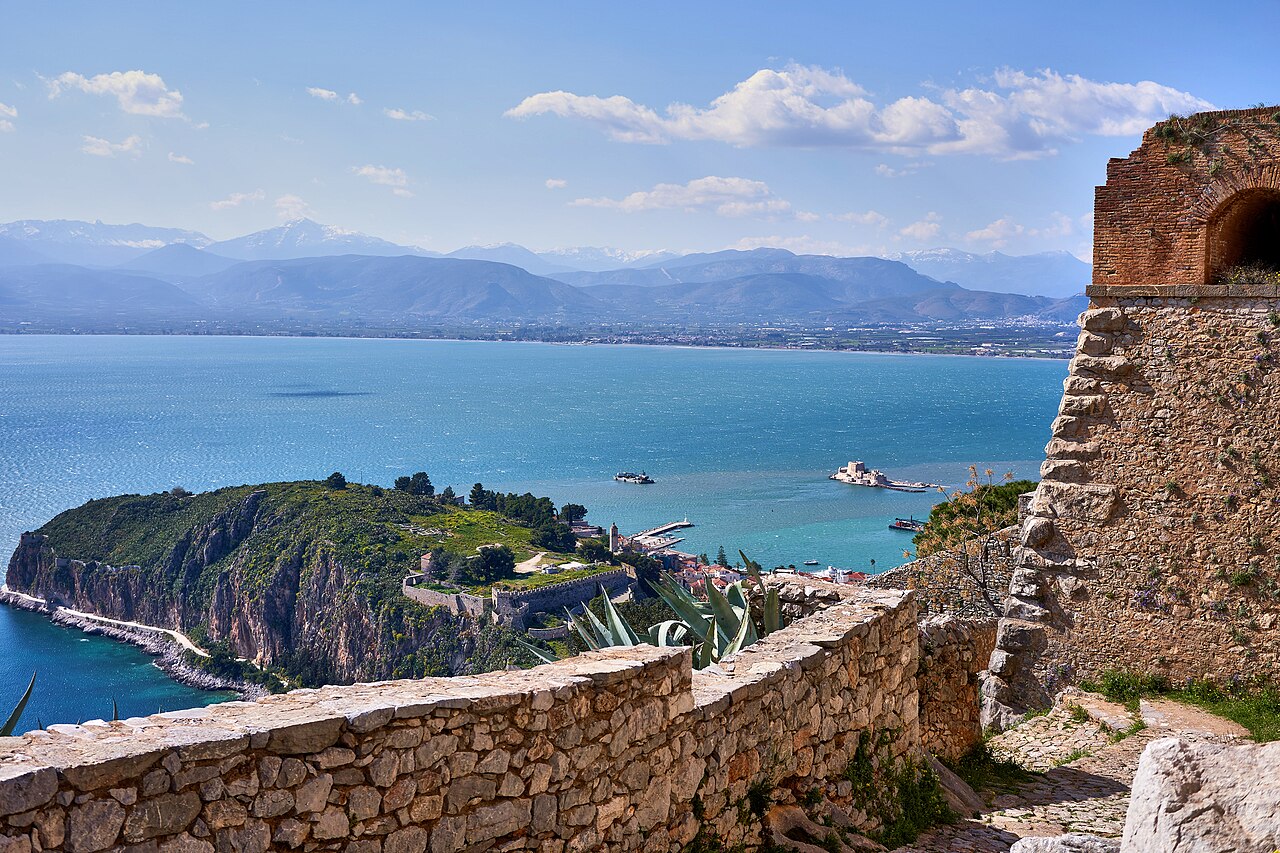
Nafplio is the most elegant town in the Peloponnese and, for many, in all of Greece. The first capital of the modern Greek state, it rises from a harbour on the Argolic Gulf beneath two great fortresses, its old town a patchwork of Venetian and Ottoman streets, neoclassical mansions and flower-filled squares. A tiny castle sits on an islet in its bay, long sandy beaches lie minutes away, and the greatest ancient sites of the Argolid, Mycenae and Epidaurus, are on its doorstep. Refined, walkable and romantic, Nafplio rewards both a day trip and a stay of several days.
This guide covers Nafplio in full: its history as the first capital, the fortresses of Palamidi and Acronafplia, the island castle of Bourtzi, the old town and its squares, the beaches, the museums, the food and wine, the day trips to the ancient Argolid, and how to reach and visit the town. Read it beside the guide to the Nafplio day trip from Athens and explore the tours below.
Why should you visit Nafplio?
You should visit Nafplio for its elegant Venetian old town, its two dramatic fortresses and the island castle of Bourtzi, its history as the first capital of modern Greece, its beaches, and its position as the perfect base for the ancient sites of Mycenae, Epidaurus and the Argolid.
Nafplio is the Peloponnese at its most refined. Unlike the ancient ruins that draw visitors to the region, Nafplio is a living, beautiful town, its old quarter a maze of marble-paved streets, neoclassical facades, Venetian fountains and Ottoman traces, gathered beneath the great rock of Acronafplia and the fortress of Palamidi, and opening onto a harbour with a castle on an islet.
It carries the weight of Greek history. As the first capital of the modern Greek state after the War of Independence, Nafplio was where the new nation took shape, and its squares and churches witnessed the founding events of modern Greece, giving the elegant town a historical depth beyond its beauty.
It is the ideal base for the Argolid. The greatest ancient sites of the region, the citadel of Mycenae and the theatre of Epidaurus, along with Ancient Corinth and Nemea, all lie within easy reach, so Nafplio combines a beautiful town, good food and beaches with the finest archaeology in the Peloponnese. Still deciding? See the honest guide to whether Nafplio is worth visiting.
What is the history of Nafplio?
Nafplio was fortified by Byzantines, Venetians and Ottomans, who each left their mark, and after the Greek War of Independence it became the first capital of the modern Greek state from 1823 to 1834. Its first governor, Ioannis Kapodistrias, was assassinated in the town in 1831.
Its strategic harbour drew every power. Guarding a fine natural harbour on the Argolic Gulf, Nafplio was fortified and fought over through the medieval and early modern centuries, held in turn by Byzantines, the Venetians, who built its greatest fortifications, and the Ottomans, so that the town today is a layered record of Mediterranean history.
It was the cradle of modern Greece. When the Greek War of Independence succeeded, Nafplio became the first capital of the new state, from 1823 to 1834, and the seat of its first government under Ioannis Kapodistrias, so the founding institutions of modern Greece took shape in its streets before the capital moved to Athens.
Its history is written in its squares. The church of Saint Spyridon, where Kapodistrias was assassinated in 1831, and the church of Agios Georgios, where King Otto was crowned, stand among the old-town lanes, so a walk through Nafplio is a walk through the birth of the modern Greek nation.
What is Palamidi fortress?
Palamidi is a vast Venetian fortress on a hill above Nafplio, built between 1711 and 1714, one of the finest of its age. Reached by a climb of nearly a thousand steps from the town or by road, it is a complex of eight self-contained bastions with sweeping views over the town and the gulf.
It is the great monument of Nafplio. Rising some 200 metres above the town on its rock, Palamidi was built by the Venetians in just a few years in the early eighteenth century as one of the most formidable fortresses of its time, a masterpiece of military engineering that still crowns the town today.
Its design is a set of linked strongholds. Rather than a single castle, Palamidi is a chain of eight independent bastions, each able to hold out alone, connected by walls and stairways across the hilltop, so exploring it means moving through a whole fortified landscape rather than a single building.
The climb is part of the experience. Tradition counts nearly a thousand steps up the stone stairway from the town to the fortress, a stiff climb rewarded by some of the finest views in the Peloponnese over the old town, the Bourtzi and the Argolic Gulf, and those who prefer can reach the top by road. See the full Palamidi fortress guide for the steps, the eight bastions, the tickets and the hours.
What is the Bourtzi castle?
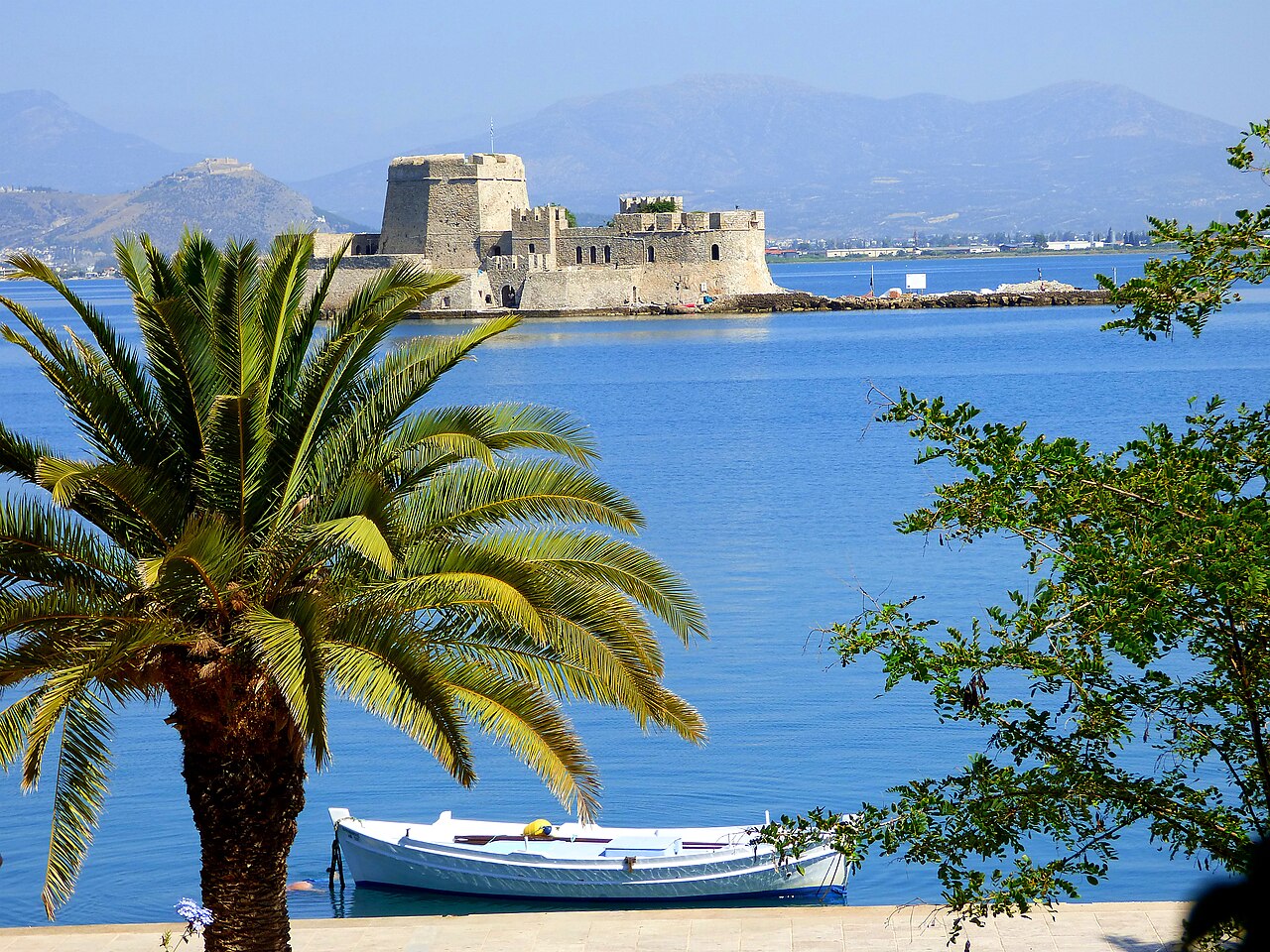
The Bourtzi is a small Venetian castle on an islet in the harbour of Nafplio, built in the fifteenth century to defend the port. Reached by a short boat trip from the waterfront, it is the emblem of the town and one of the most photographed sights in Greece.
It is the symbol of Nafplio. The little fortress sitting alone on its rock in the middle of the harbour, framed by the town and the fortress hill behind, is the image most associated with Nafplio, and its picturesque isolation makes it one of the most romantic and photographed sights in the country.
It was built to guard the port. The Venetians raised the Bourtzi in the fifteenth century to defend the entrance to the harbour, and over the centuries it served as a fortress, a residence for the town executioner, and even a hotel, a varied history for such a small castle.
A boat trip reaches it. Small boats run out to the Bourtzi from the Nafplio waterfront, a short crossing that gives a close view of the castle and the town from the water, and a sunset boat to the Bourtzi is among the most memorable experiences the town offers. See the full Bourtzi castle guide for the boats, the tickets and the story of the harbour chain. For sailing cruises of the Argolic Gulf, see the guide to Nafplio boat trips.
What is Acronafplia?
Acronafplia is the rocky headland and old citadel above the Nafplio old town, the oldest fortified part of the city, with Byzantine, Frankish, Venetian and Ottoman walls. Lower and older than Palamidi, it is easily reached on foot and gives fine views over the town and harbour.
It is the town’s original fortress. Long before Palamidi was built, the rocky ridge of Acronafplia above the old town was the fortified heart of Nafplio, and its walls carry the marks of every era, from Byzantine and Frankish to Venetian and Ottoman, making it the oldest part of the city.
It is the easiest fortress to visit. Rising directly above the old town rather than on a distant hill, Acronafplia is reached on foot or by a short drive and a lift, so it offers fortress walls and wide views over Nafplio and the gulf without the long climb of Palamidi.
It links the town to its past. Walking the walls and ruins of Acronafplia, with the old town below and Palamidi and the Bourtzi in view, ties together the different ages of Nafplio’s long history of fortification, and it makes a rewarding shorter alternative to the great Venetian fortress above. See the full guide to Acronafplia, the oldest fortress of Nafplio.
What is there to see in Nafplio old town?
Nafplio old town is a maze of marble-paved streets, neoclassical mansions with Venetian balconies, and squares. The highlights are Syntagma Square, the churches of Saint Spyridon and Agios Georgios, the old mosques, and the waterfront promenade beneath Acronafplia.
The old town is made for wandering. Its narrow streets, paved in marble and lined with elegant neoclassical houses, bougainvillea and small shops and cafés, invite an unhurried stroll, and the pleasure of Nafplio is as much in this atmosphere as in any single monument. See the full guide to Nafplio old town, its squares, streets and churches.
Syntagma Square is its heart. The main square, a handsome open space paved in marble and ringed by neoclassical buildings, former mosques and the archaeological museum, is the social centre of the old town, lined with cafés and filled with the evening promenade. See the full guide to Syntagma Square.
The churches and mosques mark its history. The church of Saint Spyridon, scene of the assassination of Kapodistrias, the church of Agios Georgios where Otto was crowned, and the Ottoman mosques repurposed over the years all stand among the lanes, so the old town rewards those who look beyond its beauty to its past. For the full list, see the guide to the best things to do in Nafplio, covering the fortresses, the museums, the beaches and the day trips.
What are the best beaches near Nafplio?
The best beaches near Nafplio are Arvanitia, a small pebble beach just below Acronafplia within walking distance of the old town, Karathonas, a long sandy beach a short drive south, and the beaches around Tolo, a resort a few kilometres away with shallow, sandy bays.
Their shallow, sandy bays and the town’s flat, walkable centre make Nafplio easy with children, covered in the guide to Nafplio with kids.
Arvanitia is the town beach. A small pebble cove tucked beneath the Acronafplia rock, Arvanitia is reachable on foot from the old town or along the scenic promenade that rounds the headland, and it is where the town swims on a hot afternoon, close and convenient though not large. See the full guide to Arvanitia beach and promenade.
Karathonas is the long sandy option. A couple of kilometres south of the town, reached by road or a longer walk past Arvanitia, Karathonas is a long sweep of sand backed by tamarisk trees with tavernas along it, the nearest proper beach day to Nafplio. See the full guide to the Nafplio beaches, from Arvanitia and Karathona to Tolo and the quieter coast.
Tolo adds a resort choice. A few kilometres further, the small resort of Tolo has shallow, sandy, family-friendly beaches and a string of hotels and tavernas, so those wanting a beach holiday alongside the sights of the Argolid often base themselves there, within easy reach of Nafplio. See the full guides to Tolo and Karathona beach.
What museums does Nafplio have?
Nafplio has the Archaeological Museum on Syntagma Square, with finds from the Argolid including Mycenaean material; the Peloponnesian Folklore Foundation museum; the War Museum; and the Komboloi Museum devoted to worry beads, an unusual and characteristic Nafplio collection.
The Archaeological Museum anchors the square. Housed in a handsome Venetian building on Syntagma Square, it displays finds from across the Argolid, from prehistoric and Mycenaean material to classical antiquities, giving context to the ancient sites of Mycenae and the wider region.
The folklore and war museums add breadth. The award-winning Peloponnesian Folklore Foundation museum shows the costumes, textiles and daily life of the region, and the War Museum records the military history of modern Greece, both reflecting Nafplio’s place in the nation’s story.
The Komboloi Museum is uniquely Nafplio. Devoted to the komboloi, the Greek worry beads, this small private museum displays a collection of beads from around the world, set out in the Komboloi museum, a quirky and characteristic stop that reflects the town’s association with the craft, and its shop is a good place for a distinctive souvenir to take home from Greece. See the full guide to the Nafplio museums.
What food and wine is Nafplio known for?
Nafplio is known for Peloponnesian cooking and the wines of nearby Nemea, Greece’s premier red-wine region. The town has excellent tavernas and mezedopoleia, is famous for its gelato and sweets, and its food-and-wine walking tours take in local cheese, charcuterie, wine and ice cream.
The Peloponnese sets the table. Nafplio’s tavernas serve the hearty cooking of the region, from slow-cooked meats and stuffed vegetables to local cheeses and olive oil, and the town’s mezedopoleia and ouzeri offer small plates with ouzo and tsipouro in the old-town lanes and on the waterfront.
Nemea supplies the wine. Just inland lies Nemea, the largest and most celebrated red-wine region in Greece, home of the Agiorgitiko grape, so Nafplio is an excellent place to drink Peloponnesian wine, and wineries in the Nemea valley welcome visitors for tastings on a day trip. See the full guide to Nemea wine, the Agiorgitiko grape and visiting the wineries.
The town is famous for sweets and gelato. Nafplio has a strong tradition of sweets and is especially known for its gelato, with celebrated ice-cream shops on and around Syntagma Square, and a food-and-wine walking tour of the old town takes in cheese, charcuterie, wine and ice cream in a single afternoon. See the full guide to the Nafplio food tour. See the full guide to Nafplio restaurants and food, from the marina seafood to the tavernas, gelato and Nemea wine.
What day trips can you take from Nafplio?
From Nafplio you can visit the greatest ancient sites of the Argolid: the citadel of Mycenae, the theatre of Epidaurus, Ancient Corinth and the Nemea wine region, all within about an hour. Nafplio is the ideal base for exploring the archaeology of the north-eastern Peloponnese.
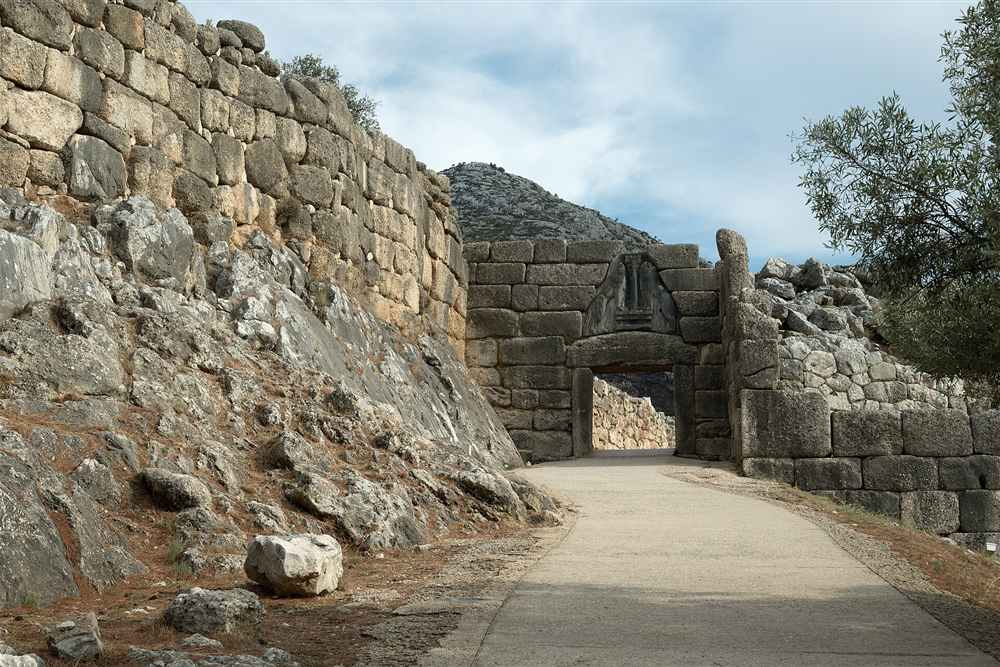
Mycenae is the essential trip. The citadel of Mycenae, with its Lion Gate and beehive tombs, the seat of Agamemnon and one of the greatest sites of the Bronze Age Aegean, lies about half an hour from Nafplio, and it is the first day trip most visitors make from the town. The nearby town of Argos, one of the oldest in the world, adds its great ancient theatre and the Larissa castle.
Epidaurus is the second. The ancient theatre of Epidaurus, famed for its perfect acoustics and still used for performances, together with the sanctuary of Asklepios, sits a short drive to the east, and it ranks among the finest ancient sites in Greece, an easy half-day from Nafplio. See the full guide to Epidaurus, its theatre and the Sanctuary of Asklepios.
Corinth and Nemea complete the region. Ancient Corinth, with its temple of Apollo and the towering Acrocorinth above, and the wine region and ancient site of Nemea both lie within reach, See the full guides to Ancient Corinth and Ancient Nemea, so Nafplio serves as the base for the whole ancient Argolid and Corinthia, as the guide to the Nafplio day trip sets out. See the full guide to day trips from Nafplio for Mycenae, Epidaurus, Mystras, Monemvasia and the islands.
How many days do you need in Nafplio?
You need at least one full day for Nafplio itself, two to see it comfortably with a beach, and three to four to use it as a base for the ancient sites of Mycenae, Epidaurus, Corinth and Nemea. Many visitors stay two or three nights in the town.
One day covers the town. A single full day is enough to climb or drive to Palamidi, wander the old town and Syntagma Square, take a boat to the Bourtzi and enjoy a meal and the evening promenade, capturing the essentials of Nafplio itself.
Two to three days add depth and day trips. With more time you can add a beach day at Karathonas or Tolo, the museums and Acronafplia, and day trips to Mycenae and Epidaurus, so two or three nights let the town breathe and open up the surrounding Argolid.
Three to four days make it a base. For those wanting to see the full ancient region, including Corinth and a Nemea wine tour, alongside the town and its beaches, three or four nights in Nafplio make an ideal Peloponnese base, far more rewarding than a rushed day trip from Athens. See the full Nafplio itinerary for one, two and three days.
How do you get to Nafplio?
Nafplio is about two hours from Athens by road, reached by car on the motorway via Corinth or by frequent KTEL bus from the Kifissos terminal. There is no train or airport, so most visitors come by car or bus, and a car is best for exploring the surrounding ancient sites.
The drive from Athens is straightforward. Nafplio lies roughly 140 kilometres south-west of Athens, about two hours by car on the motorway across the Corinth Canal and through the Argolid, an easy and scenic drive that makes the town a popular weekend escape from the capital.
Buses run frequently. Regular KTEL coaches connect Athens with Nafplio from the Kifissos bus terminal, taking around two to two and a half hours, so the town is reachable without a car, and local buses and taxis link it with Tolo and the nearer sites. See the full guide on how to get to Nafplio, by bus, by car and from the airport.
A car helps with the region. While the town itself is walkable and reachable by bus, a hire car is the best way to explore the surrounding ancient sites of Mycenae, Epidaurus, Corinth and Nemea at your own pace, as the guide to the Nafplio day trip from Athens explains.
Where should you stay in Nafplio?
The best place to stay in Nafplio is the old town, in a restored neoclassical mansion or boutique hotel among the marble lanes, close to the squares, the waterfront and Palamidi. Tolo and Karathonas offer beach-based alternatives a short drive away.
The old town is the finest base. Staying among the marble-paved streets of the old town, in one of its restored mansions or boutique hotels, puts you within walking distance of the squares, the waterfront, the museums and the foot of Palamidi, and immerses you in the atmosphere that makes Nafplio special.
It suits a romantic or cultural trip. The character of the old-town hotels, the evening promenade and the restaurants on the doorstep make Nafplio a favourite for couples and for travellers drawn to history and elegance rather than a beach resort, though the town beach of Arvanitia is close.
The beaches offer an alternative. For a beach-focused stay, the resort of Tolo and the sands of Karathonas, both a short drive from the town, provide sandy beaches and family hotels while keeping Nafplio and the ancient sites within easy reach, a good base for a longer Argolid holiday. See the full guide to where to stay in Nafplio, covering the old town, the waterfront, Acronafplia and Tolo.
When is the best time to visit Nafplio?
The best time to visit Nafplio is spring and autumn, from April to June and September to October, when the weather is mild for climbing Palamidi and touring the ancient sites, and the crowds are thinner. Summer is hot and busy, and winter is quiet but pleasant for the town.
Spring and autumn are ideal. The mild weather of April to June and September to October suits the climb to Palamidi, the exploration of Mycenae and Epidaurus and long walks in the old town, without the fierce heat of high summer, and the light and greenery of these seasons flatter the town and the Argolid. See the full guide to the best time to visit Nafplio, season by season and month by month.
Summer is hot and lively. July and August bring strong heat, which makes the fortress climb and the open ancient sites hard work at midday, along with the largest crowds and higher prices, though the beaches and the warm evenings and the Epidaurus summer festival draw many all the same.
Winter is quiet but rewarding. Nafplio is a real town that lives year-round, so a winter visit finds it calm and uncrowded, its cafés and restaurants open and its fortresses and museums quiet, a pleasant off-season city break even if the weather is cooler and the beaches out of season.
What is the komboloi, and what crafts is Nafplio known for?
Nafplio is strongly associated with the komboloi, the Greek worry beads, and has a museum and specialist shops devoted to them. The town is also known for its jewellery, ceramics and traditional sweets, and its old-town shops make it one of the best places in Greece for distinctive crafts.
The komboloi is the town’s signature craft. The string of beads that Greek men traditionally handle to pass the time, the komboloi, is closely linked with Nafplio, where the Komboloi Museum displays antique and worldwide examples and specialist workshops sell beads of amber, coral, bone and semi-precious stone, a characteristic souvenir of the town.
The old-town shops are a pleasure in themselves. Beyond the worry beads, the marble lanes are lined with shops selling handmade jewellery, ceramics, leather, olive-oil products and the region’s foods, so browsing the old town is part of the Nafplio experience, and it makes the town a good place to buy gifts.
Sweets are a local speciality. Nafplio has a strong tradition of confectionery, from the local sweet moustokouloura and spoon sweets to its celebrated gelato, and the sweet shops around Syntagma Square and the old town are an institution, so a taste of the town’s sweets, and an ice cream on Syntagma Square, belongs on any visit to Nafplio.
What festivals and events take place in Nafplio?
The best-known event near Nafplio is the Athens & Epidaurus Festival, whose summer performances fill the ancient theatre of Epidaurus nearby. Nafplio itself holds a lively carnival before Lent, cultural events through the year, and celebrations around Greek Independence Day, reflecting its role as first capital.
Epidaurus brings ancient drama to life in summer. As part of the Athens & Epidaurus Festival, the ancient theatre of Epidaurus, a short drive from Nafplio, hosts performances of classical Greek drama and music through the summer, staged in one of the finest ancient theatres in the world, and many visitors base themselves in Nafplio to attend.
Nafplio’s carnival is among the liveliest in Greece. In the weeks before Lent the town holds a large and colourful carnival, with parades, costumes and events filling the old town and squares, one of the more celebrated carnivals in the country and a lively time to visit.
Its history shapes its calendar. As the first capital of modern Greece, Nafplio marks the national holidays, above all Greek Independence Day in March, with particular meaning, and cultural events, concerts and exhibitions run through the year in the town’s historic buildings and squares, so there is often something on.
What is Nafplio like in the evening?
Nafplio in the evening is at its most romantic: the old town and waterfront fill with the volta, the promenade, the squares and the seafront cafés and restaurants come alive, and the floodlit Palamidi and Bourtzi glow above the town. The nightlife is relaxed, centred on bars and long dinners rather than clubs.
The evening promenade is the heart of it. As the heat eases, Nafplio takes to its streets and waterfront for the volta, families and couples strolling the marble lanes and the seafront beneath Acronafplia, and the squares and cafés fill, so the early evening is one of the loveliest times to be in the town.
Dinner is a central pleasure. The old town and waterfront are full of tavernas, mezedopoleia and restaurants serving Peloponnesian food and Nemea wine, and a long evening meal, followed by a gelato or a drink in a square, is how much of Nafplio spends its night, an elegant and unhurried scene.
The nightlife is refined rather than wild. Nafplio has cocktail bars, wine bars and music bars in the old town and along the waterfront, busiest at weekends and in summer, but it is a sophisticated, relaxed scene rather than a party-island one, in keeping with the character of the town, floodlit fortresses glowing above it.
Who is Nafplio best for?
Nafplio is best for couples, culture travellers, and anyone using the Peloponnese as a base. Its elegance and romance suit a couple’s break, its history and museums reward culture lovers, and its position makes it ideal for exploring the ancient Argolid, while its beaches add a family option.
It is one of Greece’s most romantic towns. The marble streets, neoclassical hotels, seafront promenade and floodlit fortresses make Nafplio a favourite for couples and honeymooners, an elegant, atmospheric alternative to the party islands, and a place made for slow evenings and long dinners by the sea.
It rewards the history-minded traveller. As the first capital of modern Greece, with its fortresses, museums and churches, and on the doorstep of Mycenae, Epidaurus and Corinth, Nafplio offers an unusually rich concentration of history, so travellers drawn to the past find it deeply rewarding.
It works for families and base-seekers too. The shallow beaches at Tolo and Karathonas, the boat trips and the compact, walkable town suit families, and the central position in the Argolid makes Nafplio the ideal base for a wider Peloponnese trip rather than a single stop, as the guide to the Nafplio day trip from Athens shows.
What is Tiryns, and how far is it from Nafplio?
Tiryns is a Mycenaean citadel on a low rocky ridge about 4 km north of Nafplio, on the road to Argos. Its Cyclopean walls survive better than those of any other Mycenaean fortress. UNESCO listed it with Mycenae in 1999.
Homer called it Tiryns of the great walls. The walls are built of huge unworked limestone blocks. Pausanias wrote that a pair of mules was unable to move even the smallest of them.
Two corbelled galleries run inside the thickness of the walls. A ramp brought chariots up to the main gate. On the summit stood the palace, with a throne room built round a circular hearth.
Heinrich Schliemann excavated Tiryns in 1884. The visit takes about 45 minutes. The site stays quiet because the coaches keep to Mycenae. See the full guide to Tiryns.
What is the Argive Heraion?
The Argive Heraion is the sanctuary of Hera on a terraced hillside between Argos and Mycenae, north of Nafplio. Its three terraces hold the remains of two temples, stoas and Roman baths. The site looks across the whole Argive plain to the gulf.
The first temple burned in 423 BC. Thucydides wrote that a priestess left a lit lamp beside the garlands and fell asleep. A new temple rose on the terrace below. It held a gold-and-ivory statue of Hera by Polykleitos.
The Argives held games at the sanctuary, with a bronze shield as the prize. The American School of Classical Studies excavated the site between 1892 and 1895. On the slope below lies Prosymna, a Mycenaean cemetery of chamber tombs.
The Heraion stands near the village of Chonika. From its terraces the view takes in Mycenae, Tiryns and Argos at once.
Which prehistoric sites lie near Nafplio besides Mycenae?
Near Nafplio lie the citadel of Midea, the tombs of Dendra, the headland of Asine above Tolo, the House of the Tiles at Lerna and the Franchthi cave at Kilada. Together they span the Stone Age and the Bronze Age of the Argolid.
Midea is the third Mycenaean citadel of the plain. It stands on a steep hill above the village of Dendra. A tomb at Dendra held a full suit of bronze armour with a boar’s-tusk helmet, found in 1960. The Dendra armour is on show in the Archaeological Museum of Nafplio.
Asine stands on the headland at the east end of Tolo beach. Swedish archaeologists excavated it in the 1920s. Lerna lies on the shore south of Argos. Its House of the Tiles is an Early Bronze Age building roofed with fired clay tiles. The springs beside it are the setting of the myth of Herakles and the Hydra.
The Franchthi cave overlooks the bay of Kilada in the south of the Argolid. People lived in it from the Palaeolithic to the Neolithic. Its layers hold obsidian from Milos, carried by sea in the 11th millennium BC. This is among the earliest evidence of seafaring in the Aegean.
Midea, Tiryns and Mycenae were destroyed or abandoned around 1200 BC, as the history of Mycenae explains.
What else stands at Epidaurus beyond the great theatre?
Beyond the great theatre, Epidaurus has the healing sanctuary of Asklepios and its museum, a small ancient theatre above the harbour of Palaia Epidavros, a sunken Roman settlement in the bay, and the Mycenaean bridge at Arkadiko on the road from Nafplio.
Patients at the sanctuary slept in the abaton, a long hall, and waited for a healing dream. The round tholos stands on foundations that hide a stone maze. The site museum shows surgical instruments and stone tablets that record the cures. UNESCO listed the sanctuary in 1988.
The small theatre of Palaia Epidavros was uncovered in the 1970s. It seats about 2,000 people and hosts the Musical July festival. Off the quay, walls and floors of a Roman settlement lie in about 2 m of water. A mask is enough to see them.
The bridge at Arkadiko, near Kazarma, carried the Bronze Age road from Tiryns to Epidaurus. It is built of Cyclopean blocks from about 1300 BC. It ranks among the oldest bridges in the world still in use. The theatre lies about 35 minutes by road from Nafplio. Coaches from the capital reach it on the Epidaurus day trip from Athens.
How did the Greeks capture Palamidi in 1822?
Greek fighters led by Staikos Staikopoulos climbed into Palamidi on the night of 29 November 1822 and took it from the Ottoman garrison. The surrender of the town of Nafplio followed. The Venetians had lost the new fortress to the Ottomans in 1715.
The attackers went over the wall at the bastion of Achilles. The night was the eve of the feast of Saint Andrew. The bastion of Agios Andreas keeps a chapel to the saint and a relief of the Venetian lion.
After independence the bastion of Miltiades served as a prison. Theodoros Kolokotronis, the general of the revolution, was held there in 1834. The Bavarian regency had condemned him for treason. He was released the following year.
The stair from Arvanitia faces full sun. Opening time and late afternoon are the cool hours for the climb in summer.
What lies on the Argolid coast south of Nafplio?
South of Nafplio the Argolid holds Ermioni on its wooded headland, the yacht bay of Porto Cheli, Kosta with its water taxis to Spetses, the boatyards of Kilada and the crater village of Didyma. Porto Cheli lies about an hour and a quarter from Nafplio.
Ermioni sits on a tongue of land with a harbour on each side. A pine wood called Bisti covers the point. Hydrofoils run from Ermioni to Hydra in about half an hour.
Porto Cheli is a deep round bay of yachts and summer villas. It stands on the site of ancient Halieis, whose walls lie partly under the water. The Porto Cheli yacht charter guide covers the boats that work from the bay. Kosta, on the shore opposite Spetses, sends water taxis to the island in about ten minutes.
Didyma lies inland on the road from Nafplio to Kranidi. Two large sinkholes open beside the village. The smaller one holds the chapels of Agios Georgios and the Metamorfosi, built into its rock wall. Kranidi is the market town of the peninsula. Kilada, below it, still builds wooden boats on its slipway.
Frequently Asked Questions
Is Nafplio worth visiting?
Yes, Nafplio is one of the most beautiful and rewarding towns in Greece, and well worth visiting. As the first capital of the modern Greek state, it combines a rich history with exceptional elegance: a Venetian old town of marble-paved streets and neoclassical mansions, the dramatic Palamidi fortress reached by nearly a thousand steps, the ancient citadel of Acronafplia, and the picturesque island castle of Bourtzi in its harbour, one of the most photographed sights in the country. Beyond the town itself, Nafplio is the ideal base for the greatest ancient sites of the Peloponnese, Mycenae and Epidaurus, both within half an hour, along with Ancient Corinth and the Nemea wine region. It also has good beaches nearby at Arvanitia, Karathonas and Tolo, excellent Peloponnesian food and famous gelato. Whether as a day trip from Athens or, better, a stay of two or three nights, Nafplio offers history, beauty, food and archaeology in one compact and walkable town.
How many days should you spend in Nafplio?
At least one full day is needed for Nafplio itself, but two or three nights are far better. One day is enough to climb or drive up to the Palamidi fortress, wander the old town and Syntagma Square, take a boat out to the Bourtzi and enjoy a meal and the evening promenade. Two to three days let you add a beach day at Karathonas or Tolo, the town’s museums and the Acronafplia citadel, and day trips to the ancient sites of Mycenae and Epidaurus. Three to four nights make Nafplio a full base for the ancient Argolid, adding Ancient Corinth and a Nemea wine tour to the town and its beaches. Because Nafplio is a genuine, elegant town rather than just a stop on the way to the ruins, it rewards a longer stay, and many visitors find it the most enjoyable base in the whole Peloponnese. It also works well as the first or last stop on a wider Peloponnese road trip, paired with Mystras, Monemvasia or Olympia, thanks to its easy road links and central position.
What are the main things to do in Nafplio?
The main things to do in Nafplio are climbing or driving up to the Palamidi fortress, the great Venetian stronghold of eight bastions above the town, for its sweeping views; wandering the marble-paved old town with its neoclassical mansions, squares and churches, including Syntagma Square and the church of Saint Spyridon where Kapodistrias was assassinated; taking a boat out to the Bourtzi, the little island castle in the harbour that is the emblem of the town; and walking the walls of Acronafplia, the old citadel above the old town. Beyond these, visitors swim at Arvanitia and Karathonas beaches, visit the Archaeological and Komboloi museums, enjoy the town’s famous gelato and Peloponnesian food and Nemea wine, and take day trips to the ancient sites of Mycenae and Epidaurus. A food-and-wine walking tour of the old town is a popular way to combine the sights with local tastes, taking in local cheese and charcuterie, wine from the Nemea valley and the town’s famous gelato in a single afternoon.
How do you get from Athens to Nafplio?
Nafplio lies about 140 kilometres south-west of Athens, roughly a two-hour journey. By car, the route follows the motorway across the Corinth Canal and through the Argolid, an easy and scenic drive that makes Nafplio a popular weekend trip from the capital and the natural base for the surrounding ancient sites. By public transport, frequent KTEL coaches run from the Kifissos bus terminal in Athens to Nafplio, taking around two to two and a half hours, so the town is easily reachable without a car. There is no train line or airport at Nafplio. Many visitors also come on an organised day trip from Athens that combines Nafplio with the ancient citadel of Mycenae and the theatre of Epidaurus, a convenient way to see the highlights of the Argolid in a single day, though the town itself rewards a longer, independent stay of two or three nights. These day trips typically run about eleven to twelve hours door to door and include the entrance and a guide, which suits travellers short on time. Renting a car in Athens and driving down gives the most flexibility, letting you continue deeper into the Peloponnese to Mystras, Monemvasia or the Mani after Nafplio rather than returning straight to the capital.