
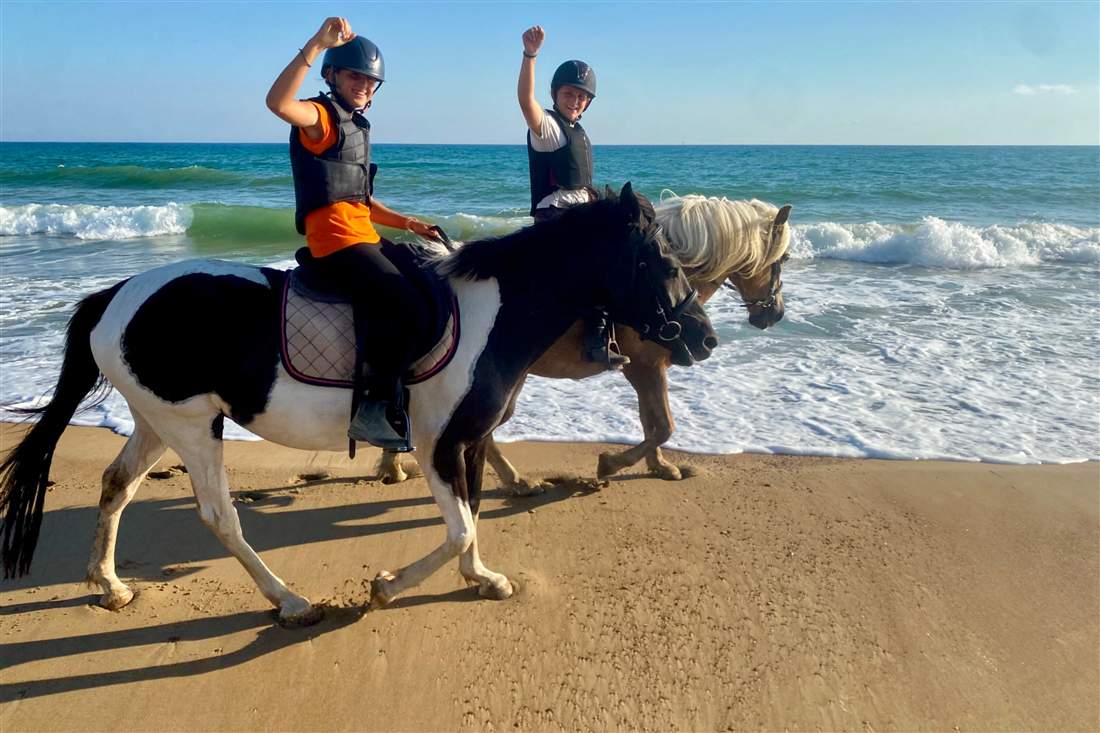
Olympia horse riding puts you in the saddle on the sandy coast of Elis, the land that hosted the horse races of the ancient Games. More rides and tours across the mainland are listed on Greece Tours.
This page covers the rides you can book, Kourouta beach, the cruise-day fit, the ancient hippodrome, the Olympic horse races and common questions.
What is Olympia horse riding?
Olympia horse riding is a guided ride on the coast of Elis, the region of Ancient Olympia, with a stop at Kourouta beach. The bookable rides start from Katakolo, the cruise port for Olympia. They ride near the land where the ancient Games held their horse races.
Ancient Olympia lies in the valley of the Alfeios river, in the western Peloponnese. The site sits about 18 km from the Gulf of Kyparissia, part of the Ionian Sea. The coastline has moved since ancient times, when the sea lay closer to the site. Horses mattered at the sanctuary, because the Games held chariot and horse races.
The modern rides take place on the sandy coast north-west of Olympia, not at the archaeological site itself. Olympia horse riding on Viator comes in two forms: a private ride and a shared ride. Both include Kourouta beach and both start at Katakolo.
Katakolo is a seaside village in the municipality of Pyrgos, 11 km west of the town of Pyrgos. Its port is a regular stop for cruise ships, whose passengers come ashore to visit Olympia. That makes Olympia horse riding a shore day option for cruise guests who have seen the ruins before, or who want a beach day.
Plan the site visit around Olympia horse riding with our Olympia page, which covers the ancient site, the museum and the routes there.
Which Olympia horse riding tours can you book?
Viator lists two Olympia horse riding tours from Katakolo: the Private Horse Riding and Kourouta Beach Tour, and the Shared Horse Riding and Kourouta Beach Tour. GetYourGuide lists no horse ride near Olympia, only beach and site tours.
Both Olympia horse riding tours come from the same supplier on Viator. The private version keeps the ride and the beach time for your own party. The shared version groups riders from different bookings. Both titles name the same pair of stops: a horse ride and Kourouta beach.
The Viator cards show the title and a photo, but no route, length or riding level. Check those details on the Viator product page before you book. Cruise passengers also need to confirm that the return time fits the ship’s all-aboard time.
Riders who want the ancient site on the same day can book a combined tour. Viator lists tours that join Ancient Olympia with Kourouta beach, including one that adds Chlemoutsi Castle. These tours trade the horse ride for the ruins, so pick the one that matches the day you want.
For travellers who skip the ride, GetYourGuide lists Kourouta beach trips from Katakolo. They include a half-day tour at Kourouta beach and a day trip that pairs the beach with ancient Elis. Our page on Katakolo port covers the town, the piers and the transfers.


Where is Kourouta beach, the stop on Olympia horse riding tours?
Kourouta beach lies on the Ionian coast of Elis, about 6 km south-west of the centre of Amaliada. Kourouta and Palouki are the two beaches of Amaliada, and Kourouta is the beach named on both Olympia horse riding tours.
Amaliada is a town in north-western Elis, in the West Greece region. It stands in the plains of Elis, 6 km from the Ionian Sea. The town lies 16 km north-west of Pyrgos, 10 km south-east of Gastouni and 60 km south-west of Patras. It is now the seat of the municipality of Ilida.
Kourouta is one of the settlements of the Amaliada community, together with Marathea, Palouki and others. The beach and the settlement share the name. Riders on Olympia horse riding tours travel north from Katakolo to reach it.
Amaliada took its name from Queen Amalia of Greece in the 1830s. It formed from two older communes, Kalitsa and Dervitselepi. Its streets follow a grid, running almost due north, south, east and west. The main square has pine trees and a fountain. The monastery of Frangavilla stands in the south-east of the town.
Amaliada has a train station on the line from Patras to Pyrgos. The town also lies near the archaeological site of ancient Elis. Elis was the city-state whose territory held the Olympic Games, so Olympia horse riding at Kourouta stays within the old lands of the Games.
How does Olympia horse riding fit a cruise stop at Katakolo?
Olympia horse riding fits a cruise stop because both tours start at Katakolo, the port where ships call for Olympia. The rider swaps the classic site visit for a ride and a beach stop on the same coast.
Olympia horse riding tours leave from Katakolo, which stands on a headland that looks out over the Ionian Sea. The headland closes off the Gulf of Kyparissia to the north. Low hills with forests surround the village. A railway station links Katakolo with Pyrgos and Olympia.
The site of Olympia lies 20 km from Pyrgos. A shore excursion to the site spends the ship’s time on the drive inland and the visit itself. Olympia horse riding heads for the coast instead, so it suits guests on a second visit to Katakolo, or guests who want time outdoors more than time in a museum.
Cruise guests compare the formats on our Olympia shore excursion page. That page sets out the site tours, the beach tours and the private options from the pier. Use it to weigh the ride against a visit to the stadium and temples.
Agios Andreas, a small village north-west of Katakolo, was the natural harbour of Ancient Olympia in ancient times. A ride at Kourouta keeps to the same Ionian coastline, north of the ancient harbour.
What was the Hippodrome of Olympia?
The Hippodrome of Olympia was the course for the horse races and chariot races of the ancient Olympic Games. It lay east of the Altis, the sacred grove, and south of the stadium. No part of the course survives above ground today.
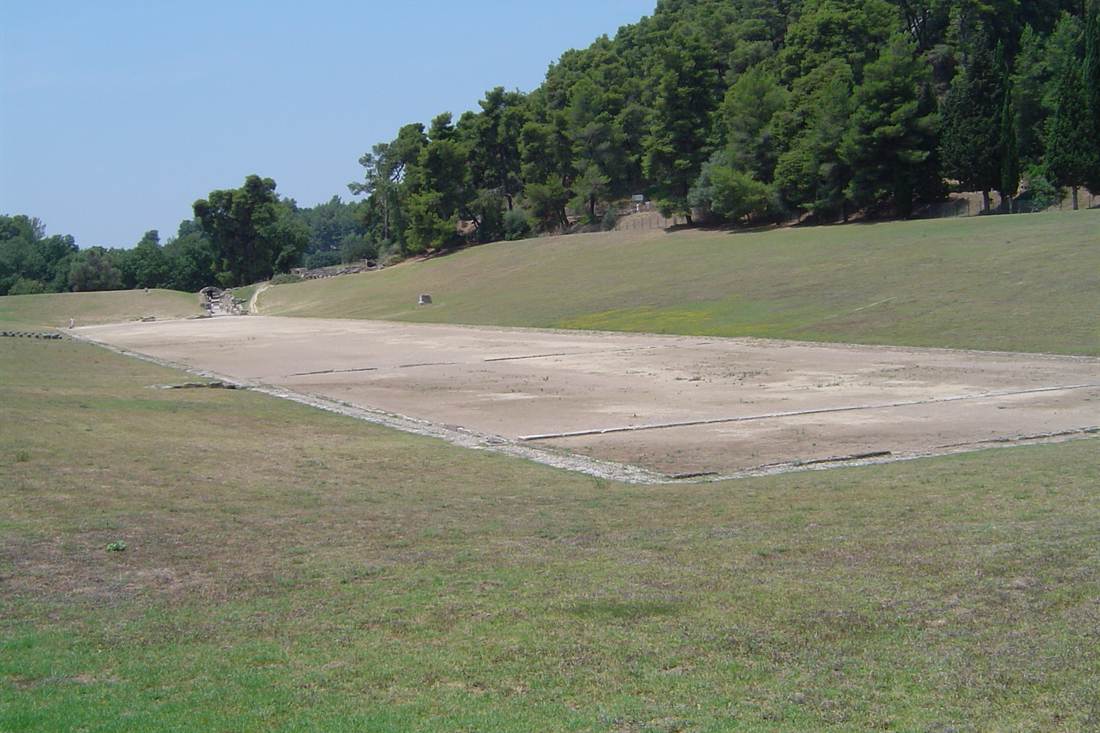
For riders on an Olympia horse riding tour, the old course is a story told in books rather than a ruin. It is known from ancient texts, from modern reconstructions and from a survey of the ground. Pausanias, the Greek travel writer of the 2nd century AD, gives the fullest account. He wrote that the horse-racing area lay beyond the stadium, at the point where the Hellanodikai, the judges of the Games, had their seats.
The starting place had the shape of a ship’s prow. Each of its two sides was more than 400 feet long and held stalls for the teams, given out by lot. A cord stretched in front of the chariots and horses as a barrier until the start.
One side of the course was longer than the other. On the longer side stood the Taraxippus, a structure that Greeks linked with danger to horses and drivers. Its name means “horse frightener”. A turning post stood near it, and the finish line was at a statue of Hippodameia.
No Olympia horse riding tour can visit these spots, since the ground keeps no trace of them. Spectators did not sit on stone stands like those of the later Roman circuses. They gathered on a rampart on the south side and on the hills to the north. The Hellenic Ministry of Culture gives the course a length of four stadia, about 780 m, and a width of about 220 m. Another reading of the ancient evidence gives 1,052 m by 64 m.
Which horse races did the ancient Olympic Games hold?
The ancient Olympic Games held a four-horse chariot race, a two-horse chariot race, a horse race, a mule-cart race, a race for mares and races for foals. The four-horse chariot race came first, in 680 BC.
The history behind Olympia horse riding starts with the equestrian events, which joined the Games one by one. The four-horse chariot race, the tethrippon, was the first, in 680 BC. The horse race, called the keles, followed in 648 BC. The full list grew to six kinds of race:
- Tethrippon: a chariot race with four horses
- Synoris: a chariot race with two horses
- Keles: a race for riders on single horses
- Apene: a race for carts pulled by mules
- Kalpe: a race for mares
- Foal races: races for young horses
The owners of the horses and chariots counted as the competitors, not the riders or drivers. This rule let women win Olympic events by owning the winning team. A Spartan noblewoman trained horse teams for the Olympics and won two races. Married women were banned from watching the Games, while unmarried women were allowed to watch the chariot races.
A chariot race also stood at the heart of the founding myth of Olympia. King Oenomaus raced every suitor for the hand of his daughter Hippodameia. Pelops beat him and, in one legend told by Pindar, founded the Games to mark his victory. Pausanias wrote that the front pediment of the Temple of Zeus showed the preparation for that race.
Today, Olympia horse riding at Kourouta is a leisure ride, not a race. Still, it puts riders on horseback in the same region of Elis that held the horse races of the ancient Games.
How did the Olympia hippodrome start its races?
The hippodrome used a starting gate called the aphesis, with stalls and barriers. A bronze eagle rose and a bronze dolphin fell to signal the start, and the barriers opened in turn until all the teams lined up at the prow.
Pausanias describes an altar near the centre of the prow-shaped starting place. A bronze eagle stood on the altar. A bronze dolphin stood on a rod at the tip of the prow. Nothing of the gate survives, so no Olympia horse riding tour shows it. The eagle was a sign of Zeus, patron of the Games, and the dolphin a sign of Poseidon.
The race starter worked the mechanism from inside the altar. When he set it off, the eagle rose into view and the dolphin dropped. The barriers then fell in order, one after another, until all the teams were lined up at the prow.
Pausanias credits a man named Cleoetas with this starting method. He adds that Aristeides later improved it with another device.
How was the lost hippodrome of Olympia found again?
A research team found traces of the hippodrome in 2008 with geomagnetic mapping and ground radar east of the sanctuary. The Alfeios river had flooded the area and buried the course under silt, so it was long thought lost.
The area that Pausanias described lay in the flood plain of the Alfeios. Over the centuries, the river covered it with silt, and the hippodrome vanished from view. Unlike the stadium, the racecourse left no visible ruins.
In 2008, a team led by Norbert Müller, Christian Wacker and Reinhard Senff surveyed the ground east of the sanctuary. It mapped 10.5 hectares with geomagnetic tools and 3.6 hectares with ground-penetrating radar. The survey found parallel lines under the surface, read as ditches, walls or ramparts, over almost 200 m.
The researchers linked these lines with the hippodrome, the ancient home of Olympia horse riding. They placed the course parallel to the stadium, east of the sanctuary. The stadium itself, with its entrance tunnel and judges’ platform, is covered on our Ancient Stadium of Olympia page.
When is the season for Olympia horse riding?
Olympia horse riding runs on a coast with a hot-summer Mediterranean climate. Summers are hot and dry, which suits a beach stop and a swim. Winters are mild but bring heavy rain.
The Greek weather service records the Katakolo climate as Csa in the Köppen system, the code for a hot-summer Mediterranean climate. In the dry months, Olympia horse riding pairs best with time on the sand at Kourouta.
Rain falls mainly in the mild winter months. Riders who visit then wear a waterproof layer and check the forecast the day before. Olympia horse riding in summer calls for sunscreen, a hat and water.
Where else in Greece can you ride horses?
Beyond Olympia horse riding, Greece has beach rides on Zakynthos and Corfu, mountain rides on Crete and rides below the rocks of Meteora. Each has its own page on our site with the stables, routes and booking options.
The nearest island ride to Olympia horse riding is on Zakynthos, across the sea from the coast of Elis. Our Zakynthos horse riding page covers rides with a swim. In central Greece, the Meteora horse riding page covers rides from Kastraki with views of the monasteries.
Further afield, the Corfu horse riding page covers rides along the north coast of the island. The Crete horse riding page covers rides in the mountains above Heraklion. Each page lists the tours you can book there.
What do travellers ask about Olympia horse riding?
Can you ride horses at the archaeological site of Olympia?
No. The bookable Olympia horse riding tours take place on the coast at Kourouta beach, not at the ancient site. The site of the hippodrome lies under silt east of the sanctuary and has no visible remains.
Where do Olympia horse riding tours start?
Both Olympia horse riding tours on Viator start from Katakolo, the cruise port in the municipality of Pyrgos. One is private and one is shared.
When did horse racing begin at the ancient Olympic Games?
The four-horse chariot race joined the Games in 680 BC. The race for single horses followed in 648 BC.
Who won the chariot races at ancient Olympia?
The owner of the horses won, not the driver. This rule let women win Olympic events as owners of the winning teams.