
The Statue of Zeus at Olympia was one of the Seven Wonders of the ancient world, a colossal image of the king of the gods that towered inside the Temple of Zeus for centuries. Made of gold and ivory over a wooden core by the sculptor Pheidias, the greatest artist of ancient Greece, it showed Zeus enthroned, holding a figure of Victory in one hand and a sceptre crowned by an eagle in the other. About twelve metres tall, it seemed ready to lift the roof from the temple, and it drew pilgrims from across the Greek world until it was carried off and lost. This guide tells the full story of the statue, from its making to its destruction and its lasting legacy.
This guide covers the Statue of Zeus at Olympia in full: what it looked like, its throne, the Nike and the sceptre, how Pheidias made it, the pool of oil that protected it, the ancient descriptions, how it vanished, and why it remains a Wonder of the world. Read it beside the guide to the Temple of Zeus at Olympia that housed it, the Archaeological Museum of Olympia and the full Ancient Olympia guide.
What was the Statue of Zeus at Olympia?
The Statue of Zeus at Olympia was a colossal seated image of the god Zeus, about twelve metres tall, made of gold and ivory over a wooden frame by the sculptor Pheidias. It stood inside the Temple of Zeus at Olympia and was counted among the Seven Wonders of the ancient world, the supreme masterpiece of Greek religious art.
It was a giant seated god. The statue showed Zeus enthroned rather than standing, so even seated it rose almost to the roof of the great temple, an overwhelming presence in the sacred hall.
It was made of gold and ivory. Pheidias worked ivory for the god’s flesh and gold for his robe and throne over a wooden core, so the statue was a chryselephantine masterpiece that shone in the temple’s dim light.
It was a Wonder of the world. Ancient writers listed the statue among the Seven Wonders, so it drew pilgrims from across the Greek world and stood as the most famous image of Zeus ever made.
What did the Statue of Zeus at Olympia look like?
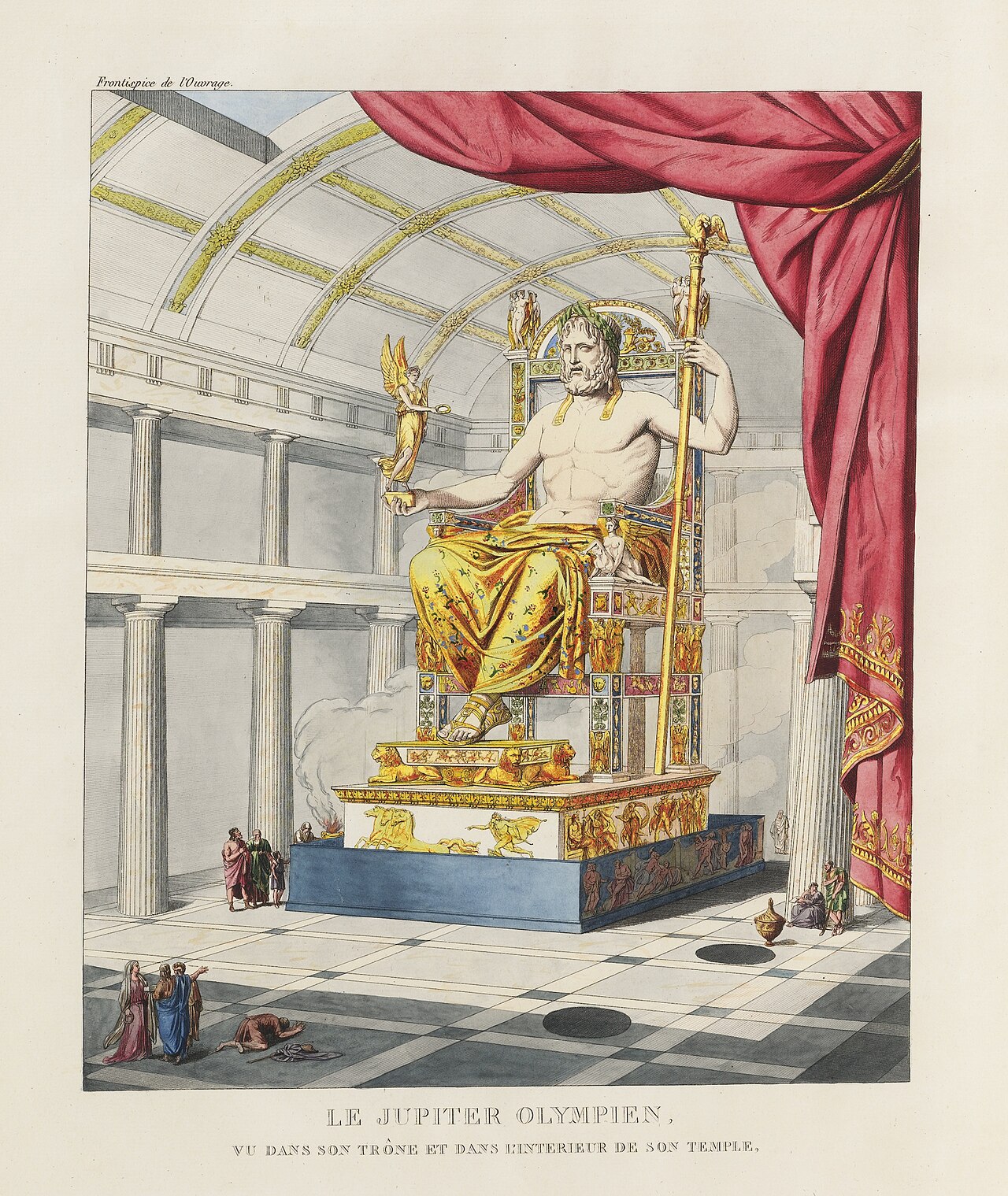
The Statue of Zeus at Olympia showed the god seated on a great throne, his upper body bare and his lower body draped in a golden robe. In his right hand he held a figure of Nike, the goddess of Victory, and in his left a sceptre topped by an eagle. A wreath of olive crowned his head, and his skin was carved from gleaming ivory.
He sat in majesty. Zeus was shown enthroned and calm, radiating the divine majesty and goodness that ancient viewers described, so the statue expressed power and serenity together.
He held Victory and a sceptre. On his outstretched right hand stood a small figure of Nike, and in his left rose a sceptre crowned by an eagle, so the god held the symbols of triumph and kingship.
He was crowned with olive. A wreath of wild olive, the prize of the Olympic Games, rested on the god’s head, so the statue tied the image of Zeus directly to the Games held in his honour.
How big was the Statue of Zeus at Olympia?
The Statue of Zeus at Olympia stood about twelve metres tall, roughly forty feet, filling the height of the temple’s inner hall. The geographer Strabo wrote that a standing Zeus rose far higher than the temple roof itself, so the scale of the statue seemed almost too great for the building that held it.
It rose twelve metres. The seated figure reached about twelve metres, so it was one of the tallest statues of the ancient world despite the god being shown seated.
It filled the temple. The statue occupied the far end of the great hall and rose almost to the ceiling, so it dominated the interior of the Temple of Zeus entirely.
Strabo marvelled at its scale. The ancient geographer noted that a standing Zeus rose higher than the roof, so writers used the statue’s size to convey its overwhelming power.
What was the throne of the Statue of Zeus?
The throne of the Statue of Zeus was as famous as the god himself, an elaborate seat of cedarwood inlaid with gold, ivory, ebony and precious stones. It was carved and painted with figures of gods, heroes, mythical scenes and athletic victories, so the throne was a gallery of Greek art in itself, described in detail by the ancient traveller Pausanias.
It was richly inlaid. The cedarwood throne was decorated with gold, ivory, ebony and jewels, so it glittered beneath the seated god as a masterpiece of craftsmanship.
It was covered with figures. Painted and sculpted scenes of gods, heroes and contests adorned the throne’s legs, bars and back, so it told dozens of myths around the central image.
Pausanias described it. The traveller Pausanias recorded the throne’s decoration in detail, so much of what is known about the statue comes from his careful ancient account.
Who made the Statue of Zeus at Olympia?
The Statue of Zeus at Olympia was made by Pheidias, the greatest sculptor of ancient Greece and the artist behind the statue of Athena in the Parthenon. He created the Zeus in a workshop built beside the temple, working gold and ivory over a wooden frame, and the statue took several years to complete, sealing his fame as the supreme master of Greek sculpture.
Pheidias was the master. Pheidias had already made the great Athena of the Parthenon, so the commission for the Zeus came to the most celebrated sculptor of the age.
He worked beside the temple. Pheidias built and used a workshop next to the Temple of Zeus, so the colossal statue was assembled close to where it finally stood.
It crowned his career. The Zeus was regarded as Pheidias’s finest work, greater even than his Athena, so the statue confirmed him as the supreme artist of ancient Greece.
How was the Statue of Zeus made?
The Statue of Zeus was made by the chryselephantine technique, in which sheets of gold and carved ivory were fixed over a wooden core. Ivory formed the god’s bare flesh and gold his robe, throne and ornaments. Pheidias assembled the pieces in his workshop, and moulds, tools and glass ornaments from that building survive in the Archaeological Museum of Olympia.
It used gold and ivory. Thin plates of carved ivory made the skin and beaten gold the drapery, all fixed to a timber frame, so the statue combined two precious materials over wood.
Pheidias assembled it in stages. The god was built up from many pieces made in the workshop and then set in place, so its construction was a vast and careful undertaking.
Its workshop finds survive. Moulds for the gold robe, tools and Pheidias’s own cup were dug from the workshop, so the museum preserves direct evidence of how the Wonder was made.
Why was there a pool of oil before the Statue of Zeus?
A shallow pool of olive oil lay on the floor before the Statue of Zeus, set there to protect it. The oil kept the air in the temple moist so the ivory of the god’s flesh did not crack or dry in the climate of Olympia, and its dark surface reflected the gold above, adding to the statue’s shimmering splendour.
The oil guarded the ivory. Olive oil kept the temple air from drying the ivory, so the pool preserved the delicate flesh of the statue against cracking.
It mirrored the gold. The dark, still surface reflected the golden god above, so the pool doubled the statue’s gleam and heightened its effect.
Attendants tended it. Priests kept the oil replenished as a duty of the sanctuary, so the care of the statue was part of the daily ritual of Olympia.
What did ancient writers say about the Statue of Zeus?
Ancient writers praised the Statue of Zeus as the greatest image of a god ever made. The traveller Pausanias described it in detail, the geographer Strabo marvelled at its scale, and it was said that no one who had seen it imagined Zeus in any other form. To behold the statue was held to be a religious experience that lifted the spirit.
Pausanias recorded it fully. The traveller’s careful account of the statue and its throne is the main ancient source, so most modern knowledge of the Wonder rests on his words.
It shaped how Greeks pictured Zeus. Ancient writers held that the statue defined the very image of the god, so to see it was to know how Zeus truly looked.
It moved the soul. Viewers described the statue as an uplifting, almost holy sight, so its fame rested on its spiritual power as well as its artistry.
Why was the Statue of Zeus one of the Seven Wonders?
The Statue of Zeus was named one of the Seven Wonders of the ancient world for its colossal scale, its precious materials and its supreme artistry. It was the only Wonder in mainland Greece, the masterpiece of the greatest Greek sculptor, and the grandest image of a god in the ancient world, so ancient travellers ranked it among the marvels every visitor sought to see.
It joined the great marvels. The statue stood among wonders like the Pyramid and the Colossus of Rhodes, so it was one of the seven sights ancient travellers held above all others.
It was Greece’s Wonder. The Zeus was the only one of the Seven Wonders on the Greek mainland, so it carried special pride for the Greek world.
It set the standard of art. As the finest work of Pheidias, the statue was the height of Greek sculpture, so its inclusion honoured Greek artistry itself.
What happened to the Statue of Zeus at Olympia?
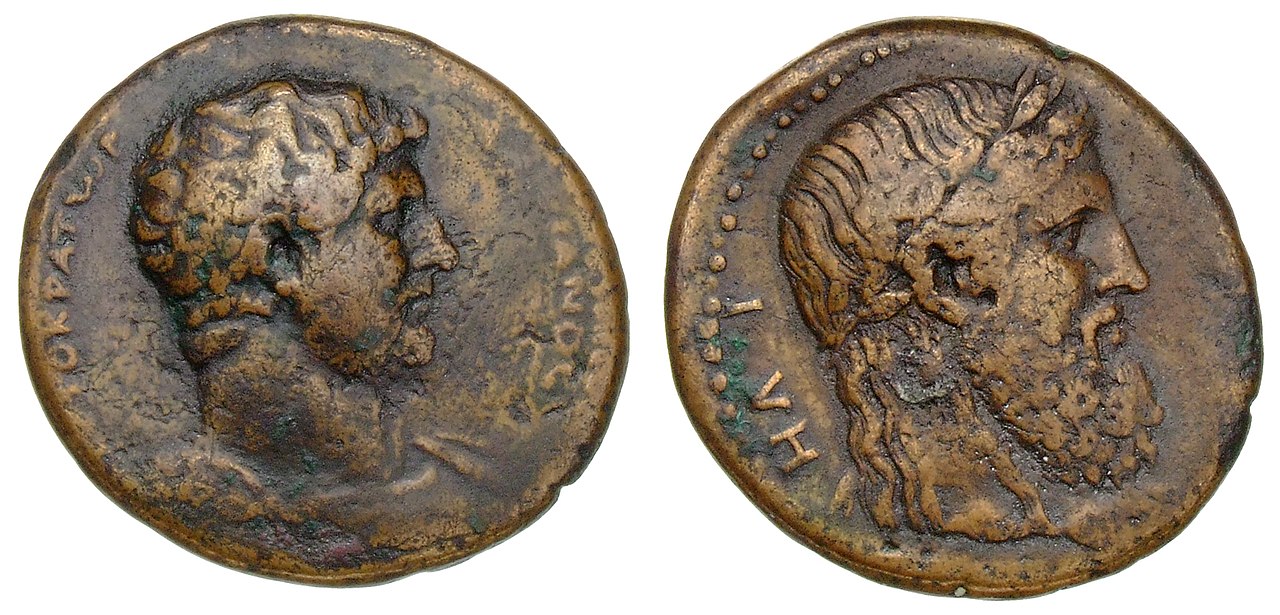
The Statue of Zeus was lost in late antiquity, when pagan worship was banned and the sanctuary of Olympia declined. Ancient accounts say the statue was taken from the temple and carried to Constantinople, where it was destroyed in a great fire. No copy survives, so the statue is known today only from ancient descriptions and its image on coins.
Worship ended its home. When pagan festivals were outlawed, the Temple of Zeus lost its purpose, so the statue was left without the cult that had honoured it.
It was taken to Constantinople. Ancient tradition holds that the statue was carried to a palace in Constantinople, so the Wonder left Olympia for the new capital of the Roman east.
Fire destroyed it. The statue is said to have burned in a great fire in Constantinople, so the greatest work of Pheidias was lost forever, leaving no trace behind.
How is the Statue of Zeus known today?
The Statue of Zeus is known today from ancient written descriptions, above all that of Pausanias, and from small images of the seated god on ancient coins from Elis. No fragment or copy of the statue survives, but the finds from the Workshop of Pheidias in the Archaeological Museum of Olympia, including moulds and his cup, connect visitors directly to the making of the lost Wonder.
Writers preserve its form. The detailed account of Pausanias records the pose, the throne and the ornaments, so the statue’s appearance survives in words.
Coins show the god. Roman coins from Elis carry small images of the seated Zeus, so these miniatures preserve a glimpse of the lost statue.
The workshop finds remain. Moulds, tools and Pheidias’s cup from the workshop are displayed in the museum, so real objects tied to the statue can still be seen at Olympia.
What is the legacy of the Statue of Zeus?
The legacy of the Statue of Zeus is vast, though the statue itself is lost. Its seated, majestic image of a supreme god influenced the way later art depicted rulers and deities, from Roman emperors to Christian images of God enthroned. As a Wonder of the ancient world, it remains a symbol of the height of Greek art and of Olympia itself.
It shaped later art. The enthroned, majestic god became a model for images of power, so echoes of the statue appear in Roman and later Christian art.
It symbolises Olympia. As the sanctuary’s greatest treasure, the statue stands for Olympia in the imagination, so its memory is bound to the birthplace of the Games.
It endures as a Wonder. Though vanished, the statue keeps its place among the Seven Wonders, so it remains one of the most famous works of art never seen by modern eyes, as the full Ancient Olympia guide describes.
What was the Nike held by the Statue of Zeus?
The Nike held by the Statue of Zeus was a figure of the goddess of Victory standing on the god’s outstretched right hand. Itself made of gold and ivory, this smaller statue showed that Zeus commanded victory, both in war and in the Olympic Games held in his honour. It faced the worshipper as a sign of the god’s power to grant success.
Victory stood on his hand. The winged Nike rested on the god’s open right palm, so Zeus appeared to offer victory to those who came before him.
It was itself precious. The Nike was made of gold and ivory like the god, so even this small figure was a costly work within the greater statue.
It linked Zeus to the Games. Victory was the prize of the Olympic contests, so the Nike tied the enthroned god directly to the athletes who competed at Olympia.
What was the sceptre and the eagle of the Statue of Zeus?
In his left hand the Statue of Zeus held a tall sceptre crowned by an eagle, the emblems of the god’s kingship. The sceptre marked Zeus as the ruler of gods and men, and the eagle was his sacred bird and messenger. Together they balanced the figure of Victory in his right hand, so the statue held the symbols of both power and triumph.
The sceptre showed his rule. The staff in the god’s left hand was the sign of a king, so it marked Zeus as sovereign of the gods.
The eagle was his bird. An eagle, sacred to Zeus, perched atop the sceptre, so the god’s own emblem crowned his staff of rule.
They balanced Victory. The sceptre and eagle answered the Nike on the right hand, so the statue held kingship and triumph in perfect balance.
Who was Zeus, the god shown in the statue?
Zeus was the king of the Greek gods, ruler of the sky and lord of Mount Olympos, master of thunder and the guardian of oaths, hospitality and justice. The sanctuary of Olympia and the Olympic Games were dedicated to him, so his statue there was the grandest image of the most powerful god in Greek religion.
He ruled the gods. As king of the Olympian gods and god of the sky, Zeus held the highest place in Greek religion, so his statue was fittingly the greatest.
He guarded justice. Zeus protected oaths, guests and fair dealing, so athletes swore fair play before his image at Olympia.
He owned the Games. The Olympic festival honoured Zeus above all, so his statue crowned the sanctuary that held the Games.
How long did the Statue of Zeus take to make?
The Statue of Zeus took several years to make, with ancient sources suggesting a span of about eight years. Pheidias worked with a team of assistants in a workshop built beside the temple, shaping the wooden core, carving the ivory and beating the gold. The long labour reflected both the vast scale of the statue and the care lavished on its precious materials.
It took years of labour. Ancient tradition puts the work at around eight years, so the statue was a long and demanding project.
A team assisted Pheidias. The sculptor worked with skilled assistants in his workshop, so many hands shaped the colossal figure under his direction.
Its materials demanded care. Carving ivory and beating gold over the wooden frame was slow, exacting work, so the precious statue took years of patient effort.
How did the Statue of Zeus relate to the Olympic Games?
The Statue of Zeus was the sacred heart of the Olympic Games. The Games were a festival in honour of Zeus, and athletes swore their oath of fair play before his image. The statue’s olive wreath matched the crown given to victors, and the Nike on the god’s hand embodied the victory every competitor sought, so the statue bound the Games to their god.
Athletes swore before it. Competitors took their oath of fair play in front of the statue of Zeus, so the god presided over the contests.
Its wreath matched the prize. The olive crown on the god’s head was the same wreath awarded to Olympic victors, so the statue mirrored the reward of the Games.
It embodied victory. The Nike on the god’s hand stood for the triumph athletes sought, so the statue expressed the very purpose of the Games.
How did ancient visitors experience the Statue of Zeus?
Ancient visitors experienced the Statue of Zeus as an overwhelming, almost holy sight. Entering the dim temple, they saw the golden god rising before them, mirrored in the dark pool of oil, glittering in the light from the doorway. Writers described the experience as uplifting and awe-inspiring, a moment that made the power of Zeus feel present and real.
It filled the temple with awe. The vast golden figure loomed in the half-light of the hall, so worshippers felt the presence of the god as they entered.
The oil mirrored the god. The still, dark pool reflected the gold above, so the statue seemed to shimmer and double before the visitor.
It lifted the spirit. Ancient writers called the sight uplifting and consoling, so seeing the statue was held to be a genuine religious experience.
What inspired Pheidias’s image of Zeus?
Ancient tradition held that Pheidias drew his image of Zeus from the poetry of Homer. Asked what model he had used, the sculptor was said to have quoted the lines of the Iliad in which Zeus nods his head and shakes great Olympos. From those words Pheidias formed the calm, majestic god whose serene power made the statue the definitive image of Zeus.
Homer gave the model. Pheidias was said to have taken his vision from the lines of the Iliad describing Zeus, so poetry shaped the greatest statue of the god.
The nod inspired the majesty. The image of Zeus nodding and shaking Olympos gave the statue its calm, commanding power, so the god’s serenity came from Homer.
It defined the god. The result was held to be the true face of Zeus, so Pheidias fixed the image of the god for all who came after.
Were there copies or imitations of the Statue of Zeus?
No full copy of the Statue of Zeus survives, but the image influenced ancient art widely. Roman coins from Elis carried small versions of the seated god, and the enthroned, majestic figure inspired later statues of gods and emperors. Through these echoes the lost Wonder shaped how power and divinity were shown long after the statue itself had vanished.
Coins preserved its image. Small images of the seated Zeus appeared on Roman coins from Elis, so the statue’s form survived in miniature.
It inspired later art. The enthroned, majestic god became a model for images of rulers and deities, so echoes of the statue spread through ancient art.
No full copy remains. Despite its fame, no complete copy of the statue survives, so its exact appearance is known only through descriptions and coins.
What was chryselephantine sculpture?
Chryselephantine sculpture was the ancient Greek art of making statues from gold and ivory over a wooden or metal frame. The word joins the Greek terms for gold and ivory. Reserved for the greatest cult statues of gods, it was costly and technically demanding, and the Statue of Zeus at Olympia and the Athena of the Parthenon were its two supreme examples, both by Pheidias.
It joined gold and ivory. Carved ivory formed the flesh and gold the robes and ornaments, all fixed over a frame, so the technique combined two precious materials.
It was reserved for the gods. Chryselephantine statues were made for the grandest temple images, so the method itself marked a statue as sacred and supreme.
Pheidias mastered it. The Zeus and the Athena, both by Pheidias, were the greatest chryselephantine works, so the sculptor defined the height of the art.
How did the Statue of Zeus compare to the Athena of the Parthenon?
The Statue of Zeus at Olympia and the Athena Parthenos in Athens were the two masterpieces of Pheidias, both colossal chryselephantine cult statues. The Athena stood in the Parthenon and showed the armed goddess standing, while the Zeus showed the enthroned king of the gods. Ancient opinion generally held the Zeus to be the greater and more moving of the two.
Both were by Pheidias. The Athena and the Zeus were the sculptor’s two great gold-and-ivory statues, so together they crowned his career.
They differed in pose. The Athena stood armed in Athens while the Zeus sat enthroned at Olympia, so each suited its god and temple.
The Zeus was held greater. Ancient writers judged the Zeus the finer and more affecting work, so it was ranked among the Seven Wonders while the Athena was not.
Can you see anything of the Statue of Zeus at Olympia today?
You cannot see the Statue of Zeus itself, as nothing of it survives, but you can see where it stood and how it was made. The ruined Temple of Zeus marks the exact spot, and the Workshop of Pheidias still stands nearby. In the Archaeological Museum, moulds for the god’s golden robe, tools and Pheidias’s inscribed cup connect visitors directly to the lost Wonder.
The temple marks the spot. The fallen columns of the Temple of Zeus stand where the statue once rose, so visitors see its exact setting.
The workshop survives. The building where Pheidias made the statue still stands on the site, so the birthplace of the Wonder can be visited.
The museum holds the traces. Moulds, tools and Pheidias’s cup from the workshop are displayed in the Archaeological Museum, so real objects tied to the statue survive, as the museum guide describes.
What happened to Pheidias after he made the Statue of Zeus?
Ancient accounts of Pheidias’s later life differ. Some traditions say he made the Statue of Zeus at the height of his fame after leaving Athens, where he had faced accusations from political enemies. Whatever the details, the Zeus was remembered as the crowning achievement of his career, and his workshop at Olympia preserved his name on a simple cup found among the ruins.
His later years are uncertain. Ancient sources give differing accounts of Pheidias’s life after Athens, so the details of his final years are debated.
The Zeus crowned his work. Whatever befell him, the statue at Olympia was seen as his greatest achievement, so it sealed his fame forever.
His name survives at Olympia. A cup inscribed “I belong to Pheidias” was found in his workshop, so a personal trace of the sculptor endures at the site.
What decorated the base of the Statue of Zeus?
The base of the Statue of Zeus was a broad platform decorated with golden relief figures from Greek myth. Ancient descriptions record scenes of gods gathered for the birth of Aphrodite rising from the sea, framed by the Sun and the Moon at either end. The rich base raised the enthroned god above the worshipper and completed the statue as a single great work of art.
It carried golden reliefs. The platform bore relief figures of gods worked in gold, so even the base was a costly gallery of sculpture.
It showed a divine gathering. The reliefs depicted the gods around the birth of Aphrodite, with the Sun and Moon at the ends, so the base set the enthroned Zeus among the whole company of heaven.
It raised the god. The broad base lifted the statue above the floor, so the god towered over those who came to worship before him.
Why is the Statue of Zeus important?
The Statue of Zeus is important as the supreme masterpiece of Greek religious art, a Wonder of the ancient world, and the defining image of the king of the gods. It fixed how the Greeks pictured Zeus, showcased the skill of Pheidias, drew pilgrims to Olympia for centuries, and shaped later images of gods and rulers, so its influence far outlasted the statue itself.
It defined the image of Zeus. The statue set the way Greeks and later peoples pictured the god, so it shaped religious art for centuries.
It drew the ancient world. Pilgrims travelled to Olympia to see the Wonder, so the statue was a magnet that added to the fame of the sanctuary and its Games.
It outlived itself. Through coins, descriptions and imitations the statue influenced later art, so its importance endured long after the Wonder was lost.
Frequently Asked Questions About the Statue of Zeus at Olympia
How tall was the Statue of Zeus at Olympia?
The Statue of Zeus at Olympia was about twelve metres tall, roughly forty feet, even though the god was shown seated. Ancient writers said that a standing Zeus rose higher than the roof of the temple itself, so the statue nearly filled the whole height of the great hall that held it.
Its great height, unusual for a seated figure, made the statue one of the largest of the ancient world and a marvel to every visitor who entered the temple.
Is the Statue of Zeus at Olympia still standing?
No, the Statue of Zeus at Olympia no longer exists. It was lost in late antiquity, most likely carried to Constantinople and destroyed by fire. No fragment or copy survives, so the statue is known only from ancient descriptions, coins and the finds from the workshop where Pheidias made it, now in the Olympia museum.
Visitors to Olympia today see the ruined temple that held the statue and the workshop where it was made, so the setting of the Wonder survives even though the statue itself is gone.
Where was the Statue of Zeus kept?
The Statue of Zeus was kept inside the Temple of Zeus at Olympia, standing at the far end of the temple’s inner hall. It faced the entrance across a shallow pool of oil, so worshippers entering the temple saw the golden god rising before them, framed by the columns of the great Doric building.
The temple was built around the statue, so the ruins of the Temple of Zeus at Olympia still mark the exact place where the Wonder once stood.
Who was Pheidias?
Pheidias was the greatest sculptor of ancient Greece, active in the fifth century BC. He directed the sculptures of the Athenian Acropolis, made the great gold-and-ivory Athena of the Parthenon, and created the Statue of Zeus at Olympia. His name became a byword for the height of Greek art, and his workshop at Olympia is preserved among the ruins.
Pheidias shaped the art of the classical age, so his two chryselephantine masterpieces, the Athena and the Zeus, remain the most famous statues of the ancient Greek world.
Was the Statue of Zeus the biggest of the Seven Wonders?
The Statue of Zeus was not the biggest of the Seven Wonders, but it was among the most admired. The Colossus of Rhodes and the Great Pyramid were far larger in scale, yet the Zeus was praised above them for its beauty, its precious materials and its spiritual power, so it held a special place among the marvels of the ancient world.
Size did not decide the statue’s fame, so its artistry and majesty rather than its scale earned it a place among the greatest wonders.
What material was the Statue of Zeus made of?
The Statue of Zeus was made of gold and ivory over a core of wood, the technique known as chryselephantine. Carved ivory formed the god’s bare flesh and hammered gold his robe, throne and ornaments, all fixed to a wooden frame. Precious stones, ebony and glass added colour, so the statue combined the richest materials of the ancient world.
The gold and ivory over a wooden core made the statue both colossal and precious, so it ranked among the most costly and admired works of art ever created in the ancient Greek world.