
The mythology of Olympia is as rich as its ruins, for the sanctuary was woven through with legends that explained the origin of the Olympic Games and bound them to the gods. Several founding myths were told: that Zeus himself founded the Games after defeating his father Kronos; that his son Herakles established them after his Twelve Labours and paced out the length of the stadium; and that the hero Pelops founded them to celebrate his victory in a deadly chariot race for the hand of a princess. These stories, carved on the temples and told at the festival, gave the Games their sacred meaning. This guide covers the myths of Zeus, Herakles and Pelops and how legend shaped Olympia.
This guide covers the mythology of Olympia in full: the myths of Zeus, Herakles and Pelops, the sacred olive, the pediment sculptures and how myth shaped the Games. Read it beside the full Ancient Olympia guide, the guide to the ancient Olympic Games and the Temple of Zeus.
What is the mythology of Olympia?
The mythology of Olympia is the body of legends that explained the origin of the Olympic Games and tied the sanctuary to the gods. Several founding myths were told, crediting Zeus, his son Herakles, and the hero Pelops with establishing the Games. Woven through the sanctuary’s worship and carved on its temples, these myths gave the Games their sacred meaning and their deep roots in the Greek imagination.
It explains the Games’ origin. The myths told how the Olympic Games began, so they gave the festival its founding story.
It ties Olympia to the gods. The legends bound the sanctuary to Zeus and the heroes, so they made it sacred.
It has several versions. More than one founding myth was told, so Olympia’s mythology is rich and layered.
How did Zeus found the Olympic Games in myth?
In one myth, Zeus himself founded the Olympic Games to celebrate his victory over his father Kronos, whom he defeated in a great struggle for supremacy among the gods. Having become king of the gods, Zeus established the Games at Olympia in his own honour, and the sanctuary became his greatest cult centre. This myth made the Games a festival of Zeus from their very beginning.
Zeus defeated Kronos. The god overcame his father in a struggle for power, so his victory was worth celebrating.
He founded the Games. Zeus established the Olympic Games in his own honour, so they were his festival from the start.
Olympia became his sanctuary. The site became the greatest cult centre of Zeus, so the Games and the god were one.
How did Herakles found the Olympic Games in myth?
In another myth, Herakles, the son of Zeus, founded the Olympic Games in honour of his father after completing his Twelve Labours. He is said to have marked out the length of the stadium by pacing six hundred of his own feet, setting the standard measure called the stade. Herakles also brought the sacred wild olive to Olympia, from whose branches the victors’ crowns were cut.
He honoured his father. Herakles founded the Games in honour of Zeus, so they celebrated the god through his son.
He paced the stadium. Herakles measured out the stadium with six hundred of his feet, so he set the length of the stade race.
He brought the olive. Herakles is said to have brought the sacred olive to Olympia, so its branches crowned the victors.
What is the myth of the five brothers and Herakles?
An older myth tells of a different Herakles, the Idaean Herakles, one of five brothers who came from Crete to Olympia in the infancy of Zeus. To amuse the young god, the brothers held a foot race, and the winner was crowned with a wreath of wild olive. This race, held every fifth year, was said to be the origin of the Olympic Games and their olive crown.
Five brothers came from Crete. The Idaean Herakles and his brothers travelled to Olympia, so the myth reaches back to Crete.
They raced for Zeus. The brothers held a foot race to amuse the infant Zeus, so the Games began as play for the god.
The winner won olive. The victor was crowned with wild olive, so the myth explains the Olympic crown.
What is the myth of Pelops at Olympia?
The most famous founding myth of Olympia is that of Pelops, a prince who sought the hand of Hippodameia, daughter of King Oinomaos of Pisa. The king challenged every suitor to a chariot race and killed those he beat. Pelops won by sabotaging the king’s chariot, married Hippodameia, and founded the Olympic Games to celebrate his victory. The Peloponnese, the land of Pelops, is named after him.
He sought Hippodameia. Pelops wished to marry the daughter of King Oinomaos, so he faced the king’s deadly challenge.
He won the chariot race. Pelops beat the king by sabotaging his chariot, so he won his bride and a kingdom.
He founded the Games. Pelops established the Olympic Games to celebrate his victory, so the race lay at their origin.
Who were Oinomaos and Hippodameia?
Oinomaos was the king of Pisa, near Olympia, and Hippodameia was his daughter. Warned by a prophecy that his son-in-law was fated to kill him, or unwilling to lose his daughter, Oinomaos challenged every suitor to a chariot race and put the losers to death. Pelops defeated him and married Hippodameia, and her name and his were honoured at Olympia, where the chariot race myth was carved on the Temple of Zeus.
Oinomaos was the king. He ruled Pisa near Olympia, so his challenge took place close to the sanctuary.
Hippodameia was his daughter. The princess was the prize of the chariot race, so she was central to the myth.
They were honoured at Olympia. Their story was carved on the Temple of Zeus, so the myth was celebrated at the site.
How does the myth of Pelops appear at Olympia?
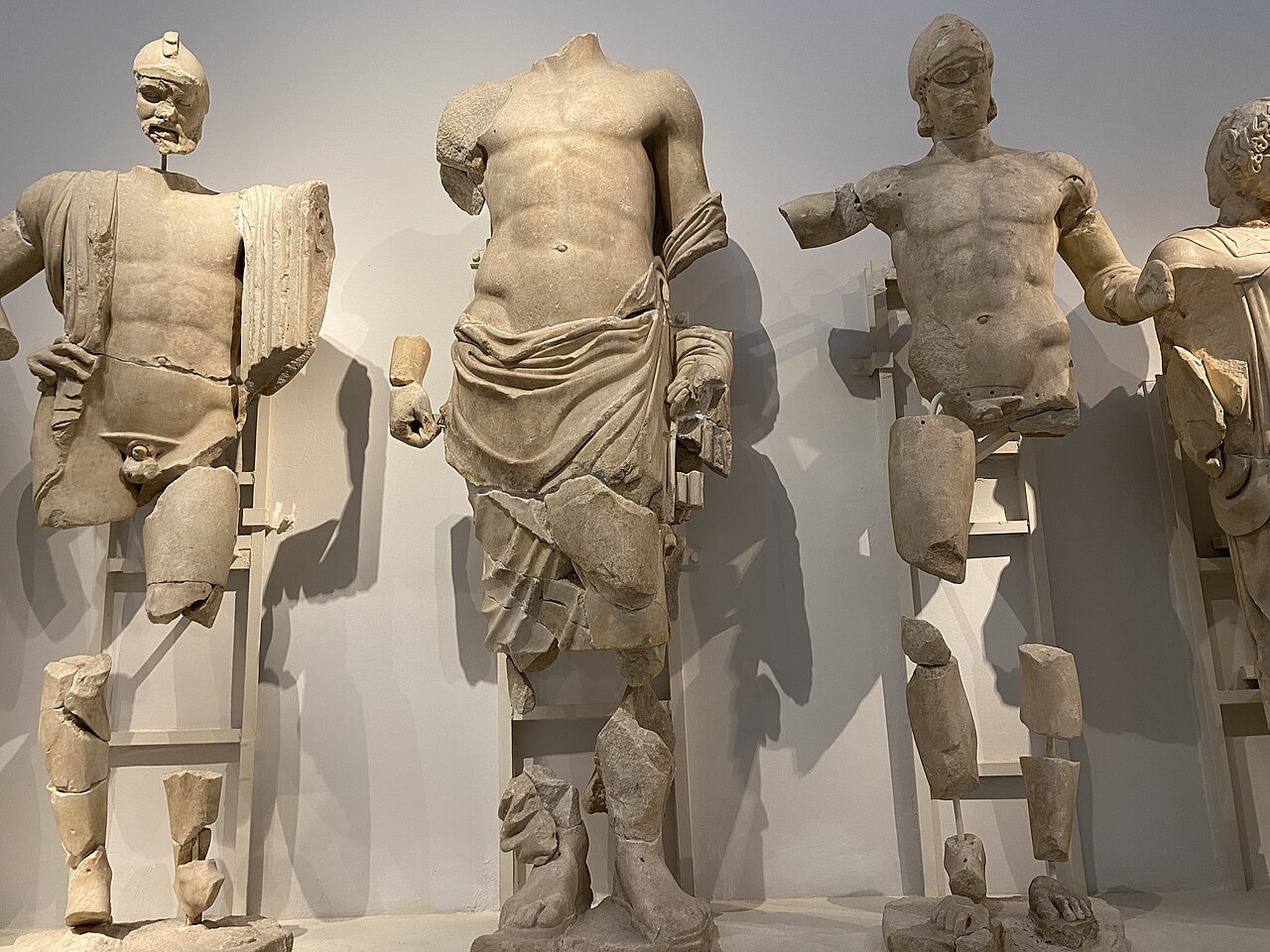
The myth of Pelops appears at Olympia in the shrine of Pelops, the Pelopion, in the sacred Altis, and above all on the east pediment of the Temple of Zeus, whose sculptures show the tense moment before the fatal chariot race, with Zeus at the centre, Oinomaos and Pelops with their chariots, and Hippodameia. So the founding myth of the Games was displayed on the greatest temple for every visitor to see.
The Pelopion honoured him. A shrine to Pelops stood in the Altis, so the hero was worshipped at Olympia.
The pediment shows the race. The east pediment of the Temple of Zeus carved the moment before the chariot race, so the myth crowned the temple, as the guide to the Temple of Zeus describes.
Zeus stands at the centre. The god presides over the scene as its silent judge, so the myth was placed under his authority.
What is the sacred olive of Olympia?
The sacred olive of Olympia was the wild olive tree, said to have been brought to the sanctuary by Herakles, from whose branches the wreaths, the kotinos, that crowned the Olympic victors were cut. Growing beside the Temple of Zeus, the sacred tree was carefully guarded, and its olive crown was the only prize of the Games, a symbol of honour rather than material reward.
Herakles brought it. Myth says Herakles brought the wild olive to Olympia, so the tree had a heroic origin.
It crowned the victors. Branches from the sacred olive formed the winners’ wreaths, so the tree gave the Olympic prize.
It symbolised honour. The olive crown was the sole reward, so the tree stood for glory rather than riches.
Who was Zeus, the god of Olympia?
Zeus was the king of the Greek gods, ruler of the sky and lord of Mount Olympos, master of thunder and the guardian of oaths, hospitality and justice. Olympia was his greatest sanctuary, and the Olympic Games were held every four years in his honour. His colossal gold-and-ivory statue, a Wonder of the ancient world, stood in his temple, so the god presided over the whole of Olympia.
He ruled the gods. As king of the Olympians and god of the sky, Zeus held the highest place, so Olympia was his.
He guarded justice. Zeus protected oaths and fair dealing, so athletes swore before him at the Games.
His statue crowned the site. The Wonder of the world stood in his temple, so the god dominated the sanctuary, as the guide to the Statue of Zeus describes.
How did mythology shape the Olympic Games?
Mythology shaped the Olympic Games at every level. The founding myths gave the Games their origin and their sacred purpose, honouring Zeus and the heroes; the myth of Herakles set the length of the stadium and the olive crown; and the myth of Pelops was carved on the greatest temple. Woven into the rituals, the prizes and the monuments, myth made the Games a religious festival as much as a contest.
It gave them purpose. The founding myths made the Games a sacred festival for Zeus, so they were worship as well as sport.
It set their forms. Myth explained the stade, the olive crown and the rituals, so legend shaped the Games’ details.
It filled the sanctuary. The myths were carved on the temples and honoured in the shrines, so Olympia was steeped in legend.
What role did Kronos play in the myth of Olympia?
Kronos, the father of Zeus and the leader of the Titans, plays a double role in the myth of Olympia. He was the god whom Zeus defeated to become king of the gods, an event that one myth links to the founding of the Games. And the wooded hill that rises over the sanctuary, the Kronion, is named after him and was sacred to Kronos, so the father of Zeus is honoured in the very landscape of Olympia.
He was defeated by Zeus. Kronos lost his struggle with Zeus, so his defeat was tied to the founding of the Games.
He was the father of Zeus. As the leader of the Titans and Zeus’s father, Kronos was a great figure of myth, so his presence marks the site’s antiquity.
His hill overlooks Olympia. The Kronion hill is named after him and was sacred, so Kronos is honoured in the landscape itself.
What is the myth of the Heraia and Hippodameia?
The myth of the Heraia links the women’s games at Olympia to Hippodameia, the bride of Pelops. In thanks to the goddess Hera for her marriage, Hippodameia was said to have founded the Heraia, a festival of foot races for women held in Hera’s honour. So the myth of Pelops and Hippodameia gave Olympia not only the men’s Games but also the women’s, both rooted in the same legend.
Hippodameia gave thanks to Hera. In gratitude for her marriage, Hippodameia honoured the goddess, so she founded a festival.
She founded the Heraia. The women’s games of foot races were credited to her, so myth explains their origin.
It parallels the men’s Games. The Heraia matched the Olympics in Hera’s honour, so the two festivals shared a legend, as the guide to the Temple of Hera describes.
What is the myth of Zeus and Ganymede at Olympia?
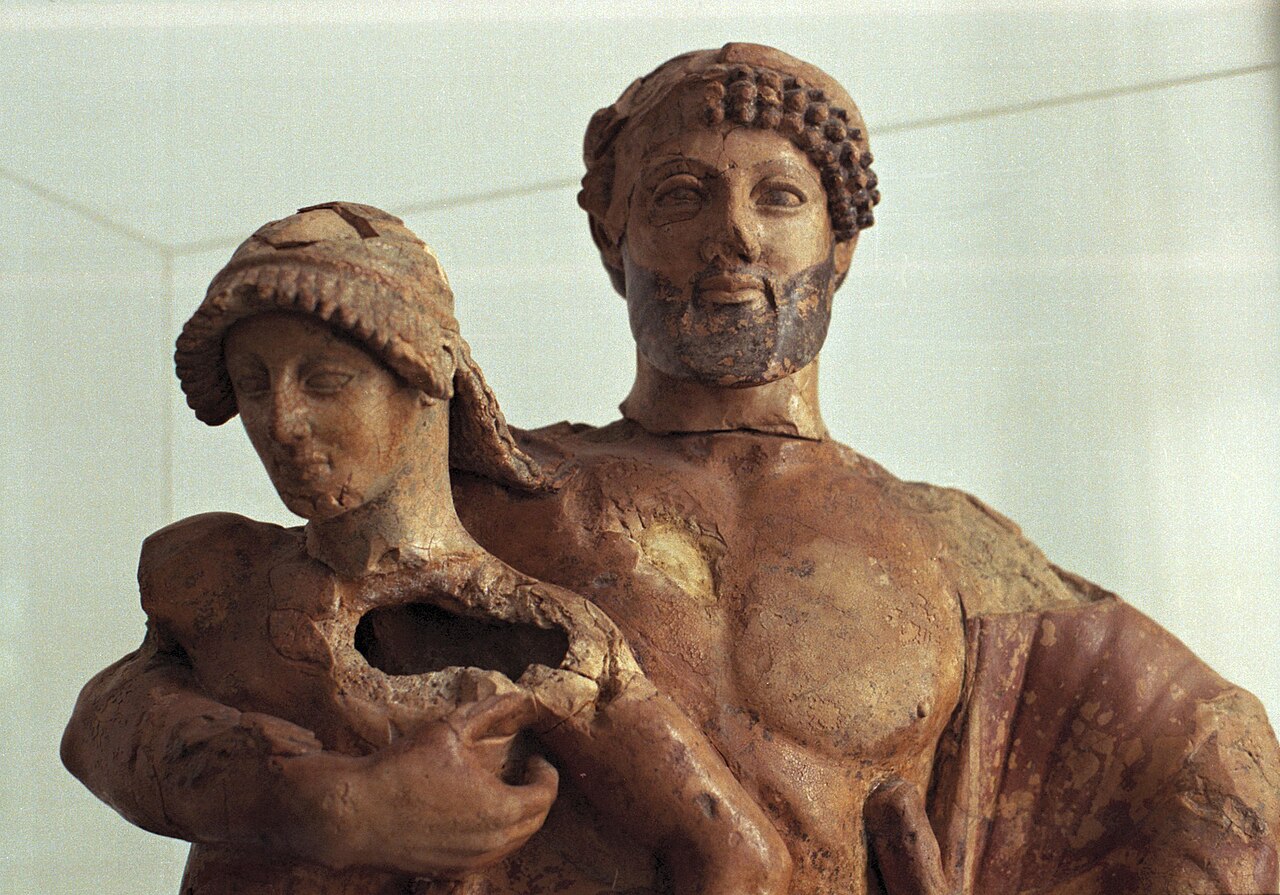
The myth of Zeus and Ganymede tells how the god, taken by the beauty of the young Trojan prince Ganymede, carried him off to Mount Olympos to be cupbearer of the gods. This myth is preserved at Olympia in a fine painted terracotta group, displayed in the Archaeological Museum, showing Zeus striding away with the boy under his arm, a vivid survival of a famous legend of the king of the gods.
Zeus took Ganymede. The god carried the young prince to Olympos to serve the gods, so the myth shows Zeus’s power.
A terracotta preserves it. A painted clay group at Olympia shows the scene, so the myth survives in art.
It is in the museum. The group is displayed in the Archaeological Museum, so visitors see the legend, as the museum guide describes.
What myths are carved on the Temple of Zeus?
The Temple of Zeus at Olympia carried two great mythological programmes. The east pediment shows the chariot race of Pelops and Oinomaos, the founding myth of the Games; the west pediment shows the battle of the Lapiths and Centaurs, with Apollo bringing order to chaos; and the twelve metopes carve the Labours of Herakles, the hero credited with founding the Games. So the temple’s sculpture was a gallery of the myths of Olympia.
The east pediment tells the race. The chariot race of Pelops crowned the temple’s front, so the founding myth led the sculpture.
The west pediment shows a battle. The fight of Lapiths and Centaurs filled the rear gable, so order confronted chaos in marble.
The metopes show Herakles. The Twelve Labours were carved on the metopes, so the founder-hero appeared on the temple, as the guide to the Temple of Zeus sets out.
How did the myths connect to the rituals of the Games?
The myths connected closely to the rituals of the Games. Athletes swore their oath before Zeus, whose victory over Kronos the Games recalled; the olive crown came from the tree Herakles was said to have brought; the stade race ran the length Herakles paced; and offerings were made at the shrine of Pelops. So every part of the festival, from the oath to the prize, was rooted in the myths of Olympia.
The oath honoured Zeus. Athletes swore before the god whose myth the Games recalled, so ritual met legend.
The crown came from myth. The olive of Herakles gave the victors’ wreaths, so the prize was mythical in origin.
Offerings honoured Pelops. Sacrifices were made at the hero’s shrine, so the founder was worshipped at the Games.
Frequently Asked Questions About the Mythology of Olympia
Why is Olympia named Olympia?
Olympia takes its name from Olympian Zeus, the king of the gods to whom the sanctuary was dedicated. The name links the site to Zeus, lord of Mount Olympos, the mythical home of the gods, though the sanctuary itself lies far from that mountain in the western Peloponnese. So Olympia is named for the god, not for the mountain, and its whole meaning centres on the worship of Zeus.
Because the sanctuary was dedicated to Olympian Zeus, its name honours the king of the gods rather than the distant Mount Olympos.
Is the Peloponnese named after Pelops?
Yes, the Peloponnese is named after Pelops, the hero whose chariot-race victory founded the Olympic Games in myth. The name means the island of Pelops, and the great southern peninsula of Greece, in which Olympia lies, carries his name. So the founding hero of the Games gave his name to the whole region around the sanctuary.
Because Pelops was so central to the myth of Olympia and the Games, the entire peninsula came to bear his name, linking the land to the founding hero.
Which founding myth of the Games is the most famous?
The most famous founding myth of the Olympic Games is that of Pelops and his chariot race against King Oinomaos, both because of its dramatic story and because it was carved on the east pediment of the Temple of Zeus. The myths of Zeus defeating Kronos and of Herakles founding the Games are also widely told, so several legends share the honour of explaining the origin of the Games.
Because it was displayed on the greatest temple and tells so dramatic a tale, the myth of Pelops is the best known of Olympia’s several founding legends.
Why were there several founding myths for the Games?
There were several founding myths for the Olympic Games because the Games were very ancient, and different regions and periods preserved different traditions about their origin. The myths of Zeus, of Herakles and of Pelops each explained the Games in a way that honoured a great figure of legend. Rather than competing, these stories layered over one another, so Olympia gathered a rich body of founding myth over the centuries.
Because the Games were so old and so important, many traditions grew up to explain their origin, and Olympia preserved them all as a rich and layered mythology.
Is the mythology of Olympia connected to Mount Olympus?
The mythology of Olympia is connected to Mount Olympus only through the god Zeus, not by location. Mount Olympus, far to the north, was the mythical home of the gods, while Olympia is the sanctuary in the western Peloponnese dedicated to Olympian Zeus. The shared name reflects their shared link to Zeus, king of the gods, but the two places are distinct and lie far apart in Greece.
Because both take their name from Olympian Zeus, Olympia and Mount Olympus are linked through the god, though they are entirely different places far apart in Greece.
How does the mythology of Olympia enrich a visit?
The mythology of Olympia greatly enriches a visit, for knowing the legends brings the ruins to life. Standing before the Temple of Zeus, a visitor who knows the chariot race of Pelops reads its pediment as a story; walking the stadium, one recalls Herakles pacing its length; and seeing the shrine of Pelops, one meets the founding hero. The myths turn stones into a living world of gods and heroes.
Because the legends give meaning to the temples, the stadium and the shrines, knowing the mythology of Olympia transforms a walk among ruins into an encounter with the world of Greek myth.
What did Herakles have to do with Olympia?
Herakles, the son of Zeus, is central to the mythology of Olympia. One myth credits him with founding the Olympic Games in honour of his father after the Twelve Labours, pacing out the length of the stadium and bringing the sacred olive from which the victors’ crowns were cut. His Twelve Labours were carved on the metopes of the Temple of Zeus, so the hero appears throughout the myth and the art of the sanctuary.
Because Herakles was said to found the Games, set the stadium’s length and bring the sacred olive, he stands among the most important figures in the mythology of Olympia.
Was Pelops worshipped at Olympia?
Yes, Pelops was worshipped at Olympia as a hero, at his shrine the Pelopion in the sacred Altis. As the legendary founder of the Games and the hero who gave his name to the Peloponnese, Pelops received offerings and sacrifices, and his cult was second in importance only to that of Zeus. So the founding hero of the Games was honoured with his own sacred enclosure at the heart of the sanctuary.
Because he was the founding hero of the Games, Pelops had his own shrine in the Altis and was honoured second only to Zeus among the powers worshipped at Olympia.
How old are the myths of Olympia?
The myths of Olympia are very ancient, reaching back to the earliest days of the sanctuary and beyond. The legends of Zeus, Kronos, Pelops and Herakles belong to the deepest layers of Greek myth, and worship at Olympia is older than its oldest temple. Passed down through poetry and ritual over many centuries, these founding stories were already ancient when the classical temples rose, so they carry the memory of a distant mythical past.
Because they belong to the oldest strata of Greek legend and predate even the earliest temples, the myths of Olympia are among the most ancient in the Greek world.