
Planning a visit to Ancient Delphi begins with the ticket. This guide sets out the price of admission to the archaeological site and the Delphi Archaeological Museum, the summer and winter opening hours, the combined ticket that covers both, the free-admission days, and the ways to buy in advance or at the gate. It also covers guided and skip-the-line options, what the ticket includes, accessibility, and the tips that keep the visit running smoothly.
Delphi sits on the slopes of Mount Parnassus, and its sanctuary of Apollo, the oracle’s home and the navel of the ancient world, rewards an early start and a clear plan. Book ahead in the high season, arrive at opening, and read the layout before the climb. You can also see the site with a licensed guide through My Greece Tours.
How much does a ticket to Ancient Delphi cost?
A full-price combined ticket to Ancient Delphi costs around 12 euros in the high season and covers both the archaeological site and the Delphi Archaeological Museum, with a reduced rate near 6 euros for eligible visitors and a lower single-site or single-museum price in the low season.
The high-season combined ticket bundles entry to the sanctuary of Apollo and the museum into one purchase at the standing full price of roughly 12 euros. In the low season the ministry drops the price, and a single-site ticket or a single-museum ticket runs near 6 euros when the combined pass is not on sale. The reduced rate of about 6 euros applies year-round to the categories the Greek Ministry of Culture defines, and the ticket desk sells both the full and reduced tiers at the entrance to the archaeological site of Delphi.
Reduced admission covers EU students holding a valid student card and visitors aged 65 and over from EU member states on proof of age. Free admission covers children and EU nationals under 25 on proof of identity. The price tiers stand as follows:
- Full price: around 12 euros for the combined site-and-museum ticket in the high season.
- Reduced price: around 6 euros for EU students and EU visitors aged 65 and over.
- Low-season price: around 6 euros for a single-site or single-museum ticket.
- Free: children, EU nationals under 25, and the other exempt categories the ministry lists.
The ticket office accepts payment at the entrance, and the same tiers govern entry whether a visitor buys at the site gate or at the museum counter. Groups and school parties follow the ministry’s group rate on advance arrangement.
What are the opening hours of the Delphi site and museum?
Ancient Delphi opens on longer summer hours of roughly 08:00 to 20:00 and shorter winter hours of roughly 08:30 to 15:30, with the archaeological site and the museum keeping slightly different schedules, last admission set before the posted closing time, and reduced hours on named public holidays.
The archaeological site runs the extended summer schedule from early morning to the evening across the high season, then contracts to the shorter winter block once the season turns. The museum keeps its own hours alongside the site, and the two published times differ by a short margin, so a visitor confirms both the site gate and the museum counter for the exact day of the visit. Last admission falls before the stated closing, and the staff clear the sanctuary of Apollo and the Delphi Archaeological Museum as the closing time approaches.
Named public holidays carry reduced hours or a full closure the ministry sets, so the schedule on a national holiday differs from an ordinary day. The core opening blocks stand as follows:
- Summer hours: roughly 08:00 to 20:00 at the archaeological site.
- Winter hours: roughly 08:30 to 15:30 at the archaeological site.
- Museum hours: aligned with the site across the season, differing by a short margin on the published times.
- Last admission: set a fixed interval before the posted closing time.
A morning arrival gives the fullest run of both the site and the museum, since the winter closing in the mid-afternoon leaves a narrow window. Visitors combining Delphi with a same-day return to Athens plan the visit against the shorter winter block to clear both the sanctuary and the galleries before the gate closes.
Is there a combined ticket for the archaeological site and the museum?
A single combined ticket covers both the sanctuary of Apollo and the Delphi Archaeological Museum, stays valid across the visit, and costs less than two separate single tickets bought apart, with the Marmaria and Athena Pronaia sanctuary included inside the archaeological site under the same admission.
The combined ticket is the standard high-season purchase, and it admits the holder to the main sanctuary of Apollo and to the museum on the same pass. Bought together, the combined price undercuts the total of a single-site ticket plus a single-museum ticket purchased on their own, so the combined pass is the direct route for a visitor who intends to see both. The pass carries the holder through the sacred way, the Temple of Apollo terrace, the theatre, the stadium above the sanctuary, and the museum galleries that hold the finds from the site.
The Marmaria terrace, home to the Athena Pronaia sanctuary and its round tholos, sits inside the archaeological site boundary and enters under the same site admission, so the combined ticket reaches it without an extra charge. The comparison stands as follows:
- Combined ticket: one purchase for the sanctuary of Apollo and the museum, at the lower bundled price.
- Single-site ticket: admission to the sanctuary and the Marmaria terrace only.
- Single-museum ticket: admission to the museum galleries only.
The combined ticket keeps its validity across the visit rather than expiring on a single entry, which lets a visitor tour the sanctuary, cross to the Marmaria terrace, and walk the museum in one admission. The low season is the point at which the single-site and single-museum tickets sell on their own at the reduced price.
When is entry to Delphi free?
Entry to Ancient Delphi is free on the national free-admission days the Greek Ministry of Culture sets, such as the first Sunday of each winter month and named national culture days, and it is free year-round for children, EU nationals under 25, and the further exempt categories the ministry defines.
The ministry publishes a fixed calendar of free-admission days that applies across state archaeological sites and museums, and Delphi follows it. The recurring free days include the first Sunday of the winter months and a set of national culture dates the ministry names each season. On those days the ticket desk waives admission to the sanctuary of Apollo and the museum for every visitor, so the free calendar is the point at which the combined ticket drops to no charge.
Alongside the calendar days, a set of categories enters free every day of the year on proof of eligibility at the gate. The year-round free categories stand as follows:
- Children and minors on proof of age.
- EU nationals under 25 on proof of identity.
- Students of Greek and EU universities on a valid student card.
- Accredited guides, teachers on educational visits, and the further professional categories the ministry lists.
A visitor who falls inside a free category presents the qualifying document at the ticket desk and passes without payment, and a visitor arriving on a free-admission calendar day enters without a ticket regardless of category. The free-admission days draw the fullest attendance of the season, so a morning arrival on those dates clears the sanctuary and the museum before the crowd builds toward the shorter winter closing.
How do you buy tickets for Ancient Delphi — online or on site?
You buy Ancient Delphi tickets two ways: in advance through the official Greek e-ticket portal at hhticket.gr, or in person at the ticket office beside the site entrance. Both accept cards and cash, and the advance e-ticket loads on a phone screen for scanning at the gate.
The hhticket.gr portal is run by the Hellenic Heritage state ticketing service and covers the archaeological site of Delphi together with the Delphi Archaeological Museum. You select the date, pick the combined site-and-museum ticket or a single entry, pay by card, and receive a QR-coded PDF by email. Print the sheet or open it on a phone at the turnstile — the staff scan the code from the screen, so no paper is required.
Buying at the entrance ticket office works the same way at the counter, where card and cash both settle the fee and a paper ticket prints on the spot. The difference shows in high season, when Athens coaches unload in waves and the on-site queue backs up along the road. An advance e-ticket carries you past that line straight to the scanner, which turns twenty minutes of standing into a walk to the gate. Book the e-ticket the night before a summer visit and arrive at opening to combine both advantages.
Are there skip-the-line and guided-tour tickets?
Yes. Licensed-guide tours bundle entry with a walking commentary in small-group or private form, day trips from Athens fold the ticket into the coach fare, and audio-guide tickets add a recorded route. A guide turns fragmented ruins into a readable story, which is the core value at a site this hard to interpret alone.
Guided tickets pair the entry fee with a state-licensed archaeologist or guide who leads the Sacred Way, the Temple of Apollo and the museum in one narrative. Small-group departures cap the party for closer access to the commentary, while private tours set the pace and the stops around one family. Both include the entry ticket in the price, so the guide clears the gate for the group and the standing queue never applies.
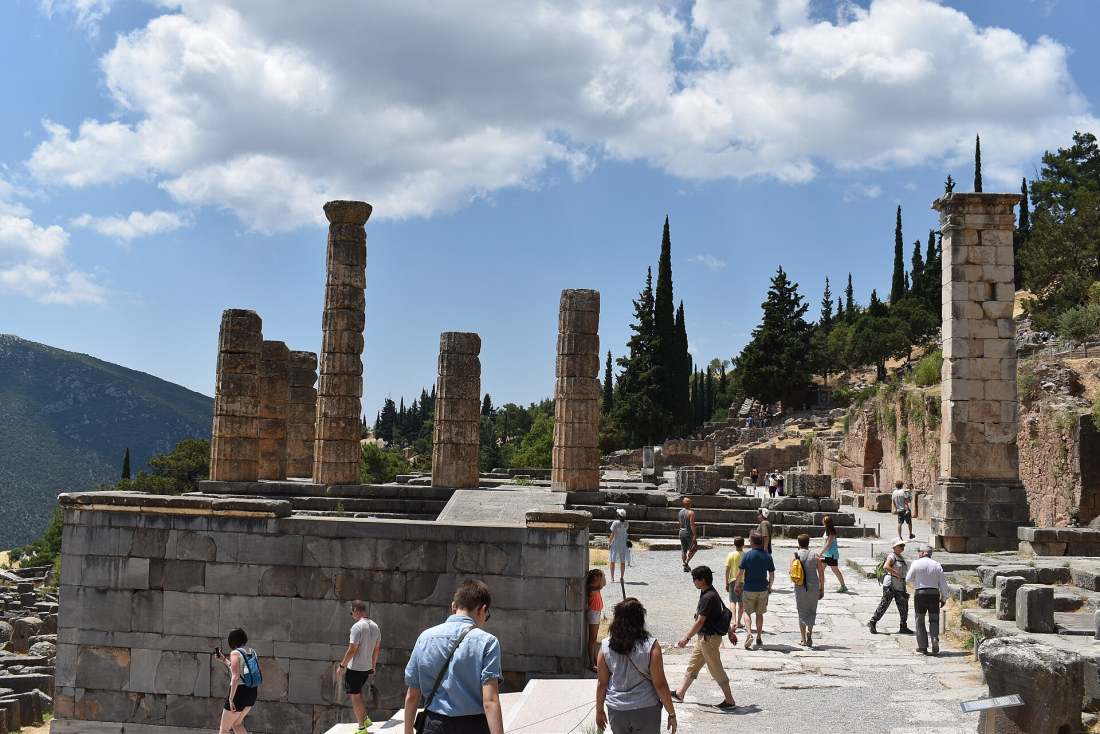
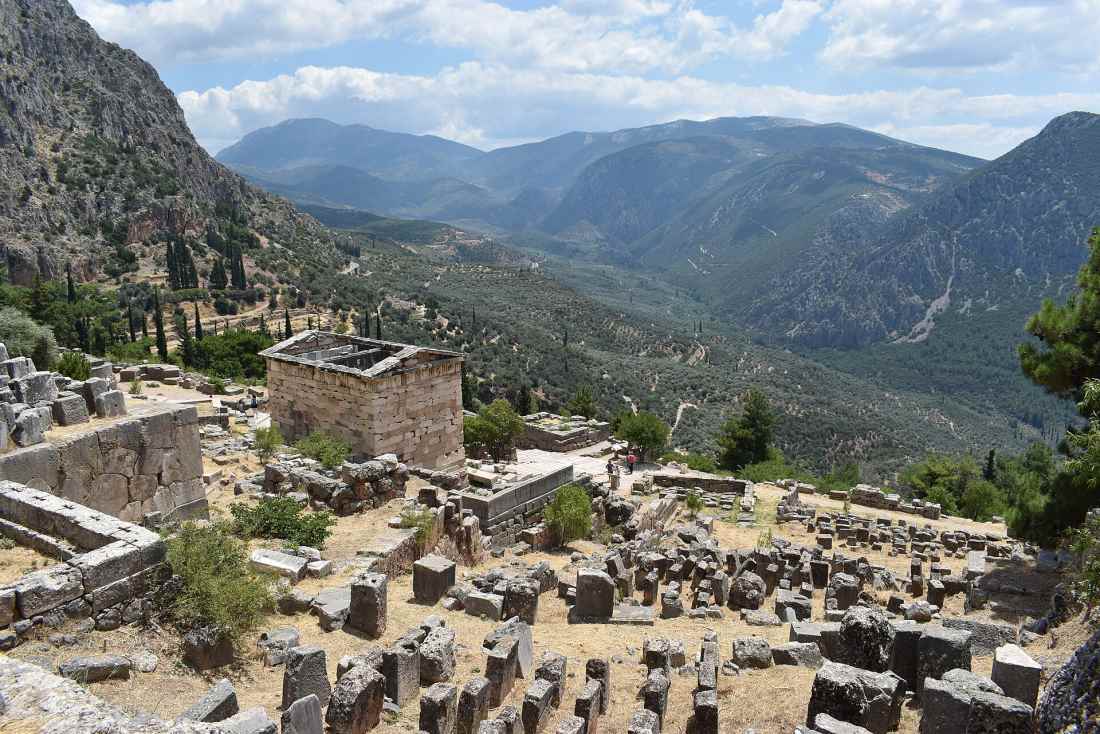
Day trips from Athens run the full round trip by coach in a single day, with the Delphi ticket and a guide priced into the seat. Audio-guide tickets suit independent visitors who prefer their own rhythm: a handset or phone app times a route past each monument. At Delphi the terraces read as low walls and scattered column drums to an unaided eye, so a guide or audio track names the Treasury of the Athenians, the omphalos and the retaining wall that anchor the layout. Pair the visit with the Temple of Apollo as the centrepiece stop, where the six standing columns mark the seat of the oracle.
What does the Delphi ticket include, and how much time do you need?
The combined ticket covers the sanctuary of Apollo with the Sacred Way, Temple of Apollo, theatre and stadium; the Athena Pronaia sanctuary at Marmaria; and the Delphi Archaeological Museum with the bronze Charioteer. Plan three to four hours to walk the hillside, cross to Marmaria and finish in the galleries.
The main sanctuary climbs the slope of Mount Parnassus in a single ascent. The Sacred Way switches back past treasury foundations to the Temple of Apollo, then rises further to the theatre carved into the hill and, at the top, the stadium where the Pythian Games were run. Marmaria sits below the road on the Itea side, where the round tholos of the Athena Pronaia sanctuary stands as the most photographed structure on the whole site.
- Sanctuary of Apollo — the Sacred Way, Temple of Apollo, ancient theatre and stadium.
- Athena Pronaia at Marmaria — the circular tholos and its terrace below the main site.
- Delphi Archaeological Museum — the bronze Charioteer, the twin kouroi, the Sphinx of Naxos and the omphalos stone.
Three hours cover an unhurried loop of the sanctuary and the galleries; four hours add Marmaria and the walk up to the stadium at the summit. Time the museum for the middle of the day, when the outdoor terraces bake and the air-conditioned halls hold the Charioteer in even light. A short detour to the Castalian Spring in the gorge between the two sanctuaries fits the same ticket window.
Is Ancient Delphi wheelchair accessible, and what facilities are there?
Access is limited. The sanctuary climbs a steep hillside on uneven marble and stepped paths, so wheelchairs reach only the lower terraces near the entrance, not the theatre or stadium. The museum sits on level ground with ramp access, and the gate area holds parking, a café, a shop, toilets, shade and water.
The archaeological site rises through a sequence of retaining walls linked by ramps of worn marble and stone steps. The gradient and the polished surface put the upper Sacred Way, the theatre and the summit stadium out of reach for wheelchairs, though the first terraces past the turnstile stay navigable on a firmer path. The Delphi Archaeological Museum, by contrast, spreads across level floors with lift and ramp access to every gallery, so the Charioteer and the main collection remain open to all visitors.
Facilities cluster at the entrance. A car park serves the gate, a café and a shop sit beside the ticket office, and toilets stand near the museum. Shade is scarce on the open slope, so the terraces run hot under the midday sun, and refilling water before the climb matters on a summer afternoon. The Delphi hub sets out the full monument-by-monument layout for planning the route in advance.
What are the best tips for visiting Delphi?
Arrive at opening to beat the Athens coaches and the midday heat, wear grippy shoes for the polished marble, and carry water and sun cover on the exposed slope. Save the museum for last in the cool of the galleries, and combine the visit with Arachova or the Castalian Spring in the same trip.
The first hour after opening belongs to early arrivals, before the coach fleet from Athens reaches the gate around mid-morning. Starting the climb early clears the Sacred Way of crowds and puts the steepest section behind you while the air stays cool. The marble underfoot turns slick where centuries of feet have worn it smooth, so shoes with grip hold the ramps far better than smooth soles.
- Arrive at opening to walk the site ahead of the Athens coaches and the midday heat.
- Wear grippy shoes for the worn, slippery marble of the Sacred Way and terraces.
- Carry water and sun cover — a hat and sunscreen for the shadeless open slope.
- Visit the museum last, in the cool galleries, once the outdoor terraces heat up.
- Combine the day with the mountain village of Arachova or a stop at the Castalian Spring.
Arachova sits ten minutes up the road, a stone village of tavernas and weaving shops that anchors a lunch after the site. The Castalian Spring, where pilgrims once purified themselves before consulting the oracle, marks the gorge between the two sanctuaries and slots neatly into the walk. Sequencing the day this way — site at opening, museum at midday, village or spring after — keeps the climb cool and the galleries for the heat of the afternoon.
How does visiting Delphi differ between high and low season?
High season brings the longer 08:00 to 20:00 hours, the full-price combined ticket around 12 euros, and the heaviest crowds from the Athens coaches; low season brings the shorter 08:30 to 15:30 hours, cheaper single tickets near 6 euros, quiet terraces, and the free-admission winter Sundays.
The season sets the whole shape of the visit. Through the warm high-season months the site stays open into the evening, the combined ticket runs at the full rate, and the coach fleet from Athens fills the Sacred Way from mid-morning. The long daylight lets a visitor climb to the stadium late in the day and still reach the museum, and the extended hours suit a leisurely loop of both sanctuaries.
The low-season winter months trade the evening opening for a mid-afternoon close near 15:30, so the window to see the site and the museum narrows to a single unhurried morning. The ministry drops the price, selling single-site and single-museum tickets near 6 euros, and the first Sunday of each winter month admits every visitor free. The terraces stay quiet, the light turns clear and cold, and snow often caps the peaks of Parnassus above the ruins.
- High season — long hours to 20:00, full-price combined ticket, busy coach crowds, warm dry days.
- Low season — short hours to 15:30, cheaper single tickets, quiet terraces, free winter Sundays.
A visitor who values the quiet and the lower fare plans for the low season and arrives at opening; a visitor who wants the long day and the full circuit picks the high season and books the ticket ahead.
Frequently Asked Questions
How much is a ticket to Ancient Delphi?
The combined ticket for the archaeological site and the museum costs around 12 euros full price in the high season, with a reduced rate near 6 euros for EU students and visitors aged 65 and over. Children and EU nationals under 25 enter free.
What are the opening hours of Delphi?
The site opens on summer hours of roughly 08:00 to 20:00 and winter hours of roughly 08:30 to 15:30, with last admission set before closing. The museum keeps closely aligned hours, and named public holidays carry reduced times.
Can you buy Delphi tickets online?
Yes. The official Greek e-ticket portal at hhticket.gr sells the combined site-and-museum ticket in advance, delivering a QR-coded ticket to a phone that scans at the gate and skips the on-site queue in the high season.
Do you need a combined ticket for the site and the museum?
The combined ticket is the best value, covering the sanctuary of Apollo, the Athena Pronaia sanctuary at Marmaria, and the museum on one pass for less than two separate single tickets. Allow three to four hours to see all three.