
The Delphi Archaeological Museum stands just steps from the ancient sanctuary on the slopes of Mount Parnassus, and it holds the treasures that pilgrims once carried to the most sacred oracle in the Greek world. Inside its cool, well-lit galleries you meet the bronze Charioteer, marble kouroi, sculpted friezes, and the strange stone that the ancients believed marked the centre of the earth. The museum turns a hillside of ruins into a story you can follow object by object, gallery by gallery. It is one of the richest collections in all of Greece, and the easiest way to see it well is on a guided visit with the expert local team at My Greece Tours. Plan the whole trip with Greece Tours.
This article explains what the museum is, what it holds, and how to weave it into a visit to the site, and it forms part of our wider Delphi travel guide. The sections below cover what the museum is, why the Charioteer of Delphi is so famous, the other treasures on display, how the galleries are organised for visitors, and how to combine the museum with the archaeological site for one seamless day at Delphi.
What is the Delphi Archaeological Museum?
The Delphi Archaeological Museum is the on-site museum beside the ancient sanctuary of Apollo, holding the sculptures, bronzes, and votive offerings unearthed at Delphi. It preserves the art the Greek city-states dedicated to the oracle, ranking among the country’s most important collections.
The museum sits at the entrance to the archaeological site, tucked into the same steep landscape of Mount Parnassus that made Delphi feel so charged with meaning to the ancients. It exists because Delphi was not simply a temple but a treasury of the whole Greek world: cities, kings, and victorious athletes sent gifts here for centuries, and when the sanctuary was excavated those offerings needed a permanent home close to where they were found. Rather than scattering the finds among distant collections, the museum keeps them beside their original setting, so the sculpture you admire indoors once stood a short walk uphill among the ruins you can still trace along the Sacred Way.
What it holds is essentially the material memory of the oracle. The galleries move from early bronze figurines and monumental kouroi through the sculpted friezes of city treasuries to the famous bronze Charioteer, gathering the finest religious art the Greeks produced. Because Delphi drew the whole Mediterranean, the collection is unusually varied, reflecting the wealth and rivalry of the states that consulted the priestess. To understand why these objects were dedicated here at all, it helps to know the Oracle of Delphi and the prophetic power that drew pilgrims up the mountain. That reputation explains the extraordinary quality of the offerings, and none is more celebrated than the bronze Charioteer.
Why is the Charioteer of Delphi so famous?
The Charioteer of Delphi is one of the finest surviving ancient Greek bronzes, prized for its lifelike calm, inlaid glass-and-stone eyes, and superb craftsmanship. It survived because a rockfall buried it, sparing it from the melting-down that destroyed most ancient bronze statues.
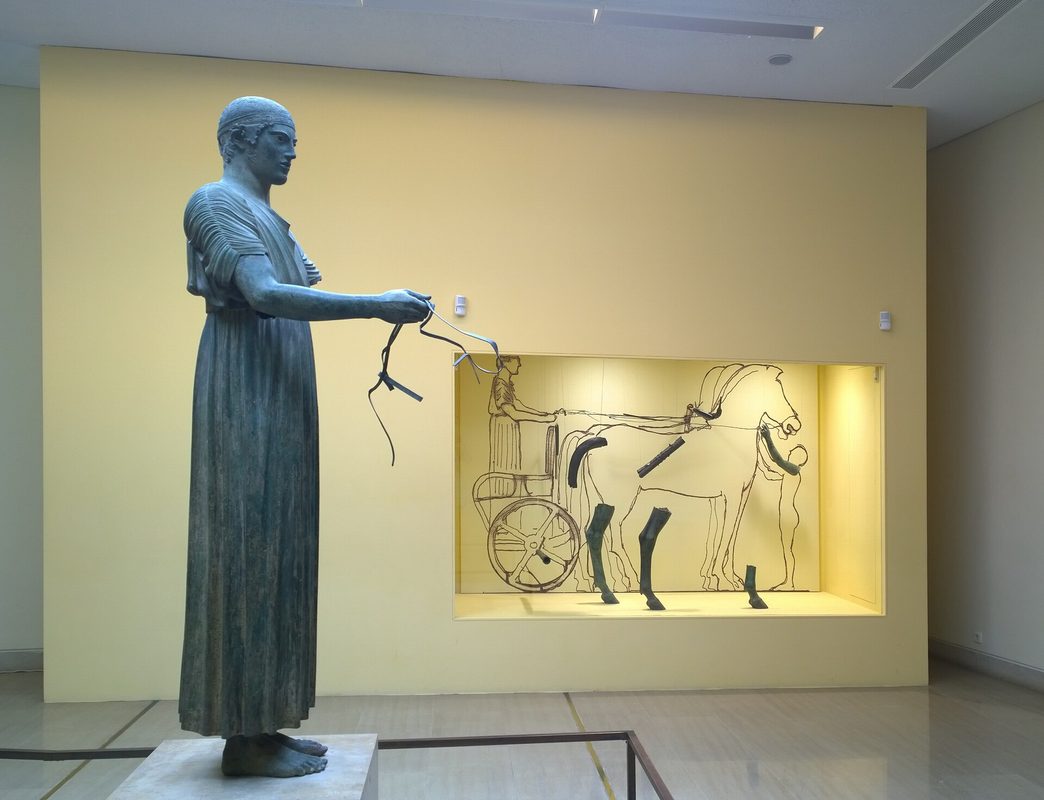
The Charioteer of Delphi is a life-size bronze of a young chariot driver, standing quietly with the reins still in his right hand, his long belted tunic falling in fluted folds like the columns of a temple. What astonishes visitors is how alive he feels. The eyes are inlaid with white glass and dark stone, the lashes are fine copper, and the lips and lashes carry touches of colour that make the face seem to breathe. Cast by the demanding lost-wax method, in which a wax model is encased in clay and melted out so molten bronze can take its place, the figure shows the moment of victory rendered with restraint rather than triumph, a composure the Greeks admired above showy display.
The statue survived by accident, and that accident is the reason we can meet it at all. Almost every large bronze from the ancient world was eventually melted down for its metal, which makes originals like this exceedingly rare. The Charioteer escaped because a rockfall on the slope above buried it, hiding it until excavators uncovered it in fragments and reassembled the figure. It was originally part of a larger votive group, a bronze chariot, horses, and driver dedicated to Apollo to mark a chariot victory at the Pythian Games held at Delphi. Winning a chariot race here was among the highest honours a Greek earned, and such a gift proclaimed it forever. The museum holds many other treasures alongside this masterpiece.
What other treasures does the museum hold?
Beyond the Charioteer, the museum displays the twin kouroi Kleobis and Biton, the towering Sphinx of the Naxians, the sculpted frieze of the Siphnian Treasury, the omphalos navel-stone, the acanthus column dancers, the statue of Antinous, and a rare silver-gilt bull.
Among the earliest highlights are Kleobis and Biton, a pair of massive archaic kouroi carved as stiff, powerful young men, celebrated in an ancient story as devoted sons rewarded by the gods. Nearby rises the Sphinx of the Naxians, a winged creature with a woman’s face that once perched atop a tall column overlooking the sanctuary, a proud gift from the island of Naxos. The sculpted frieze of the Siphnian Treasury is a marvel of early relief carving, showing gods, giants, and heroes locked in battle with remarkable energy and depth, the sort of showpiece that wealthy islands built to advertise their status before the oracle. Each object records a different city trying to impress Apollo and everyone who passed by.
Other treasures deepen the story further. The omphalos stone, a carved dome wrapped in a net-like pattern, represented the navel of the world, marking Delphi as the earth’s sacred centre in Greek belief. The graceful acanthus column of the dancers lifts three young women in swirling drapery high on a plant-like shaft, while the serene statue of Antinous, the beautiful youth deified by an emperor, shows how Delphi kept attracting devotion long after its archaic heyday. A delicate silver-gilt bull, pieced together from precious sheet metal, hints at the sheer richness once stored here. Seeing all of this rewards a little planning, which is why it helps to know how the galleries are arranged.
How is the museum organised and what do visitors experience?
The museum is arranged chronologically across a series of connected galleries that follow the sanctuary’s history from its early days to Roman times. Reconstructed pediments and treasury friezes anchor each room, the layout is step-free and accessible, and most visitors spend roughly an hour to ninety minutes inside.
The galleries unfold in the order the sanctuary itself grew, so a walk through the rooms doubles as a walk through the history of Delphi. You begin among the oldest votive offerings and archaic sculpture, move through the great period of the city treasuries and their carved friezes, and end with later works from Hellenistic and Roman times, closing near the Charioteer, which is given a hall of its own. Along the way, reconstructions help the pieces make sense: fragments of temple pediments are mounted as they once fitted together, and sections of treasury walls are rebuilt so you can read the sculpture in its intended arrangement rather than as loose stones.
For practical visiting, the museum is comfortable and manageable. Displays carry clear labels, the building is climate-controlled and largely step-free with lifts and ramps for step-free access, and the scale is human rather than exhausting, so you can see the highlights without rushing. Most travellers find an hour to ninety minutes is enough to enjoy the star exhibits and read the context around them, though enthusiasts happily linger longer. Photography without flash is generally allowed, and a shaded courtyard and facilities make a natural pause. Once you have seen the objects indoors, the natural next step is to walk out and place them back in the landscape they came from.
How do visitors combine the museum with the Delphi site?
Visitors buy a combined ticket that covers both the museum and the archaeological site, then pair the indoor galleries with a walk up the Sacred Way past the treasuries to the temple. Most people spend a half to full day, arriving early to beat heat and crowds.
The two experiences are designed to work together, and a single combined ticket admits you to both the galleries and the ruins, so there is no reason to choose between them. Many visitors tour the museum first to learn what the objects are, then climb the Sacred Way, the winding processional path lined with the foundations of the city treasuries, among them the Treasury of the Athenians, until they reach the great terrace and the columns of the Temple of Apollo at Delphi, where the oracle once spoke. Others reverse the order, walking the sanctuary while it is cool and saving the shaded museum for midday. Either way, seeing the Charioteer indoors and then standing where it was dedicated turns scattered marble into a living place. This pairing is exactly what makes a well-planned Delphi day trip from Athens so rewarding.
Timing is the difference between a hurried visit and a memorable one. Delphi sits high on Parnassus, where midday sun can be fierce, so arriving early rewards you with softer light, thinner crowds, and cooler air for the uphill walk. Wear sturdy shoes for the uneven ancient paths, carry water, and allow time to sit and take in the sweep of the valley below, which is part of the site’s enduring magic. A half day covers the essentials comfortably, while a full day lets you savour both the sanctuary and the museum without watching the clock. Plan your visit and tours through our Delphi travel guide.
What is the Sphinx of Naxos in the Delphi museum?
The Sphinx of Naxos is a marble mythical creature with a woman’s head, a lion’s body, and the wings of a bird of prey, dedicated by the island of Naxos and set on a tall Ionic column beside the temple terrace at Delphi.
The Naxians carved the sphinx from a single block of gleaming Naxian marble in the sixth century BC. The figure stands 2.22 metres tall, and the fluted Ionic column that raised her lifted the whole monument to a height above 12 metres, so pilgrims climbing the Sacred Way met her gaze against the sky. The column carried 44 flutes and an Ionic capital of the earliest type, and the Naxians renewed their right of promanteia — priority in consulting the oracle — through this gift.
The sphinx sits on her haunches with wings raised in a sickle curve. Her face wears the archaic smile, the fixed upturned mouth that marks Greek sculpture of this period, and her hair falls in beaded braids over the shoulders in the manner of Ionian workshops. The sphinx served the Greeks as a guardian of tombs and sacred ground, a watcher set over the sanctuary. The monument stood near the polygonal retaining wall below the Temple of Apollo, and the museum now displays the figure high on a plinth so visitors read her at her original elevation.
The Naxian dedication belongs to the same age of island wealth that filled the sanctuary with votive columns and treasuries. A visit to the wider site at Delphi sets the sphinx among the monuments the Naxians, Siphnians, and Athenians raised in rivalry along the Sacred Way.
Who are Kleobis and Biton?
Kleobis and Biton are twin archaic kouroi, two colossal marble youths carved by Polymedes of Argos in the early sixth century BC, honouring the brothers of the Herodotus story who yoked themselves to their mother’s cart and drew her to the sanctuary of Hera.
Herodotus records the tale in the words of Solon to King Croesus. The mother of the two young men, a priestess of Hera at Argos, had to reach the Heraion for a festival, and the oxen failed to arrive from the field. The brothers put the yoke on their own shoulders and hauled the cart 45 stades to the temple. Their mother prayed to Hera to grant her sons the best gift a mortal receives. The youths lay down in the temple after the feast, fell asleep, and died in that sleep, and the Argives set up their statues at Delphi as the finest of men.
The two figures stand in the rigid kouros pose that defines the archaic period:
- The left foot advances while the weight stays even, the earliest stance of monumental Greek sculpture.
- The arms lock straight at the sides with fists clenched against the thighs.
- The hair falls in a broad beaded mass down the back, held by a fillet across the brow.
- The faces carry the archaic smile and the wide almond eyes of the age.
An inscription on the base names Polymedes of Argos as the sculptor, which ranks the pair among the earliest signed works of Greek art. Each figure rises above two metres, and the compact Peloponnesian modelling of the muscles marks the Argive workshop apart from the softer Ionian style of the Naxian sphinx in the same museum.
What does the frieze of the Siphnian Treasury show?
The frieze of the Siphnian Treasury shows a continuous Ionic relief running around all four sides of the building, carved with the Gigantomachy — the battle of the gods against the giants — together with scenes of the Trojan War, an assembly of the gods, and the abduction of women.
The people of Siphnos built the treasury in the late sixth century BC from the wealth of the gold and silver mines of their island, and the Siphnians paid a tithe of that yield to Apollo. Two caryatids — standing female figures in place of columns — carried the porch, and above ran the marble frieze that made the building the richest sculptural monument of its date at Delphi. The reliefs kept traces of painted colour and added bronze attributes such as spears and reins.
The four sides carry distinct programmes:
- North frieze: the Gigantomachy, with the gods in a driving line against the giants; a lion of Kybele’s chariot tears into a giant, and each combatant once bore a painted name.
- East frieze: the gods seated in assembly on Olympos, divided into the partisans of Troy and the partisans of the Greeks, above a clash of warriors over a fallen body before the walls of Troy.
- South and west friezes: the abduction of women and the judgement of Paris, the events that set the Trojan War in motion.
The pediment held a further scene, the contest of Herakles and Apollo for the Delphic tripod. The museum reassembles the frieze blocks at eye level so the crowded overlapping figures, the drilled drapery folds, and the deep undercutting of the Ionian carvers read in full. This mastery of narrative relief prepared the ground for the later sculptural treasuries that lined the Sacred Way.
What are the metopes of the Athenian Treasury?
The metopes of the Athenian Treasury are 30 carved marble panels from the square fields of the Doric frieze, cut in Parian marble in the early fifth century BC with the labours of Herakles on one range and the deeds of Theseus on the other, the two heroes set as parallels.
The Athenians built the treasury from Parian marble to hold offerings to Apollo, and the building stands rebuilt on the site at the first turn of the Sacred Way while the original metopes rest in the museum. The choice of subjects joined the panhellenic hero Herakles to the Athenian hero Theseus, and the pairing advanced the claim of Athens to a place beside the older powers of Greece.
The panels divide across the four sides of the building:
- Deeds of Theseus: the front and one flank carry the exploits of the Athenian king, including Theseus with the goddess Athena, the killing of the Minotaur, and the fight with the Amazon Antiope.
- Labours of Herakles: the rear and the other flank carry the panhellenic hero against the beasts and adversaries of his twelve tasks, among them the cattle of Geryon.
- Amazonomachy: panels of Greeks against the mounted Amazon warriors extend the theme of order set over disorder.
The carving marks the moment Greek sculpture crossed from the archaic to the early classical manner, with figures that turn in space and muscles that answer the weight of the action. The Athenian Treasury and the Charioteer belong to the same age of Athenian and civic dedication at the sanctuary, and the deeper accounts sit alongside the museum’s other headline works: read the full story of the Treasury of the Athenians at Delphi and the bronze Charioteer of Delphi that crowns the collection.
What are the gold-and-ivory treasures and the silver bull?
The chryselephantine treasures are three gold-and-ivory statues and the fittings of a life-size silver bull, all found buried in two pits beneath the Sacred Way. The three figures are identified with Apollo, Artemis and Leto; the bull is the largest surviving silver work of the Greek world.
Workmen laying a drainage channel along the Sacred Way struck the pits and lifted a mass of scorched ivory, gold sheet and silver plate. The material had been damaged by fire, gathered up as sacred debris and given ritual burial rather than reuse. The Delphi Archaeological Museum devotes one room to the reconstructed pieces, mounted on modern armatures that carry the surviving ancient fragments.
The chryselephantine technique built a statue over a wooden core: ivory carved and fitted for the flesh, hammered gold sheet for the hair, drapery and ornament. The Delphi group is one of the earliest sets of the technique recovered in Greece, dated to the sixth century BC. The three deities are read as the Delphic triad:
- Apollo, patron of the sanctuary, rendered in ivory with gilded hair.
- Artemis, his sister, in matching ivory and gold.
- Leto, their mother, completing the family group.
Alongside the three deities the pits held further worked ivory: heads with inlaid eyes, hands, and sheets of gold stamped with rosettes, griffins and winged creatures that once sheathed drapery. The gold ornaments carry the animal repertoire of Near Eastern and Ionian workshops, which places the commission among imports brought to Delphi by wealthy dedicators of the archaic period. The burial preserved the material precisely because the community treated the fire-damaged offerings as consecrated to the god and forbidden from resale.
The silver bull dominates the same room. Its body is built from silver sheets hammered over a wooden frame and joined with bronze nails, the horns, forehead lock and hooves plated in gold. At full life size it stands as the largest silver object preserved from antiquity. The bull is a votive offering, the animal of prestige sacrifice, dedicated to Apollo and set along the route pilgrims climbed toward the Temple of Apollo. Conservators reassembled the flattened plates over a shaped support, recovering the stance of the standing animal from the crushed metal.
What is the statue of Antinous at Delphi?
The Antinous of Delphi is a polished marble statue of a nude youth, carved in the second century AD after Antinous, the companion of the emperor Hadrian, drowned in the Nile. Hadrian ordered his worship across the empire, and Delphi holds one of the finest of these idealised portraits.
Antinous of Bithynia travelled with Hadrian and died in Egypt during an imperial tour. The emperor established a cult in his name, founded the city of Antinoöpolis on the Nile bank, and commissioned images set up in sanctuaries from Egypt to Greece. The Delphi statue was dedicated within the sanctuary of Apollo, where Antinous received honours as a new deity, and it was recovered near the temple terrace.
The sculptor worked the marble to a high sheen that imitates young skin. The head tilts downward, the hair falls in thick carved curls, and the body follows the proportions of Classical athlete statues rather than Roman portrait realism. Traces on the head show where a metal wreath or diadem was once fixed. The work stands among the small number of Antinous images preserved with the head and body together, and it marks the point where Delphi continued to attract imperial patronage into the Roman centuries.
The pose repeats a formula used across the empire for the cult of the deified youth: weight on one leg, the free leg relaxed, the gaze lowered in a melancholy cast that separates these images from standard Roman portraiture. Delphi held Pythian games in Antinous’s honour, and the statue stood as the focus of that cult within the sanctuary. Its recovery near the temple confirms that the Roman administration inserted the new god into the oldest sacred ground of Apollo rather than a peripheral shrine.
What is the Acanthus Column of the Dancers and the omphalos?
The Acanthus Column of the Dancers is a tall marble column rising through carved acanthus leaves to three dancing women who supported a bronze tripod. The omphalos is a carved stone marking Delphi as the navel of the earth. Both stand in the same hall of the museum.
The column climbs from a base of stacked acanthus foliage. Near its top three young women turn in a ring, their arms raised, dressed as Thyiades, the female worshippers of Dionysus who danced on Mount Parnassus. Their heads carry a flat platform that once held a bronze tripod, the emblem of Apollo and of prophecy. The monument dates to the fourth century BC and rose within the sanctuary as a dedication tied to the oracle.
Displayed beside the column is a carved marble omphalos, its surface covered in a net of raised bands representing woollen fillets. The word omphalos means navel. Greek tradition held that Zeus released two eagles from the ends of the earth and that they met over Delphi, fixing the spot as the centre of the world. The stone marked that centre inside the Delphi sanctuary and stood near the temple where the Pythia delivered her responses. The two objects together set out the ritual core of the site:
- The tripod, seat of the Pythia and prize of prophecy.
- The dancing Thyiades, the human worship that framed the god.
- The omphalos, the geographic claim that Delphi was the earth’s centre.
The three dancers are carved as a single ring around the column shaft, each figure stepping in the same direction so the group reads as continuous motion. Their short chitons, bare shoulders and raised heels mark the Thyiades in mid-dance rather than in repose. The acanthus base, the tall fluted stem and the figures form one dedication that carried its bronze tripod above the heads of pilgrims. The marble omphalos on display is the copy kept within the temple precinct; the raised web across its surface renders the agrenon, the woollen net that draped the sacred stone during ritual. Set together in the museum, the column and the stone fix Delphi’s double claim, that it was the seat of prophecy and the measured centre of the earth.
What do the pediment sculptures of the Temple of Apollo show in the museum?
The museum displays the surviving fragments of the two pediments of the Temple of Apollo. The east pediment shows Apollo arriving at Delphi in a chariot with attendant figures; the west pediment shows Dionysus among the Thyiades. Both are set out under cover, protected from the mountain weather.
The pediments crowned the fourth-century BC temple whose foundations remain on the terrace above the museum. Sculptors filled the two triangular gables with the divided year of the sanctuary. Through the warm months Apollo presided; through the winter months, when the god withdrew, Dionysus held the site. The two gables gave that calendar a fixed sculptural form on the front and back of the building:
- East pediment: Apollo enthroned or standing at the centre, arriving in his chariot, flanked by Leto, Artemis and the Muses.
- West pediment: Dionysus with the Thyiades, the maenad dancers who took over Parnassus in winter.
Ancient sources name the Athenian sculptors Praxias and Androsthenes as the carvers of the pediments, and the surviving heads confirm the transition in style toward the fourth-century BC treatment of hair and drapery. The east gable turned toward the rising sun and the approach of pilgrims, so Apollo’s arrival met the visitor climbing the Sacred Way; the west gable faced the setting sun, matching the winter reign of Dionysus. The pairing tied the sculpture to the ritual calendar that governed when the oracle spoke and when it fell silent.
Earthquake and rockfall shattered the compositions, and the museum shows the pieces that endured: heads, torsos and drapery blocks mounted at viewing height rather than restored into full scenes. The display places these figures a short walk from the temple platform itself, so the carved gods can be read against the ruins they once crowned. Seeing the pediments in the museum and then climbing to the Temple of Apollo completes the link between the sculpture and the wall it decorated.
How was the Delphi Archaeological Museum built and expanded?
The Delphi Archaeological Museum stands beside the sanctuary to hold the finds of the French School’s Great Excavation. Crews raised the first galleries in the late nineteenth century, then rebuilt and enlarged the halls across the following century into fourteen rooms arranged in chronological and thematic order.
The museum belongs to the excavation. When the French School at Athens cleared the sanctuary of Apollo, the recovered bronzes, marble statues and inscribed stones needed a permanent home on the spot rather than a distant capital. The state built the original stone galleries directly below the archaeological terraces, so that a visitor walks from the ruins into the rooms that display what those ruins once carried.
Two later campaigns transformed the building. The first reconstruction widened the halls and added the reinforced room that carries the weight of the votive monuments. A full modernisation ahead of the Athens Olympic Games doubled the exhibition space, opened new daylight galleries and gave the Charioteer of Delphi a hall of his own. The route now moves forward in time:
- early bronze offerings and the omphalos that marked the centre of the earth;
- Archaic sculpture, the twin kouroi and the Sphinx;
- the carved treasuries of the city-states;
- the Classical bronzes;
- the Roman gallery that closes the sequence.
Because the galleries sit against the Delphi archaeological site, the collection reads as a continuation of the terraces outside. The Sacred Way passes the empty bases of the treasuries; the museum holds the friezes that once stood on them. The building expanded to keep that link intact as excavation added to the collection decade after decade.
How was the collection excavated and formed?
The French School at Athens formed the collection through the Great Excavation of the sanctuary. Archaeologists first bought out and demolished the village of Kastri that sat over the ruins, then dug the whole slope of Apollo and lifted the bronzes, marble sculptures and inscribed stones now displayed in the museum.
Kastri stood directly on top of the sanctuary. Its houses covered the Sacred Way, the temple terrace and the treasuries, so no wide dig was possible while the village remained. The Greek state and the French School relocated the inhabitants to the new settlement of modern Delphi on the ridge to the west, cleared the abandoned houses and exposed the ancient ground beneath.
The dig ran across the entire sanctuary of Apollo, the precinct of Athena Pronaia at Marmaria, the gymnasium and the Castalian spring. The finds fall into clear groups:
- Bronzes — the Charioteer, votive tripods, griffin protomes and figurines buried in a Sacred Way pit;
- Marble sculpture — the Naxian Sphinx, the twins Kleobis and Biton, the treasury friezes and pediments;
- Inscriptions — treaties, victor lists, manumission records and the two Delphic hymns to Apollo with their musical notation.
The buried pit under the Sacred Way protected the finest pieces. Damaged sacred objects held religious weight and stayed inside the sanctuary rather than leaving it, so priests laid them in a trench. That deposit preserved the Charioteer, the silver bull and the gold-and-ivory statues through the centuries, and the excavators recovered them as a single group that anchors the museum today.
What is the room-by-room walkthrough of the museum?
The halls run in a forward chronological line. A visitor passes the early bronzes and the omphalos, the Archaic kouroi and the Sphinx, the Siphnian and Athenian treasury sculptures, the room of the Charioteer, and the Roman gallery with Antinous, so the collection advances from the sanctuary’s founding to its final centuries.
The entrance hall sets the frame with the marble omphalos, the carved navel-stone that fixed Delphi as the centre of the earth. From there the order is fixed:
- Bronze hall — griffin cauldrons, tripods and figurines from the first offerings, plus the colossal repoussé pieces of the Sacred Way deposit.
- Archaic sculpture rooms — Kleobis and Biton, the twin Argive kouroi, alongside fragments of the first temple pediments.
- Sphinx hall — the Naxian Sphinx on its tall Ionic column, set beside the eastern frieze of the Siphnian Treasury.
- Treasury galleries — the frieze and pediment of the Siphnian Treasury and the metopes of the Athenian Treasury, carved with the labours of Herakles and Theseus.
- Charioteer room — the bronze Charioteer of Delphi alone under focused light, a monument that marked a Panhellenic chariot victory in the same circuit of games that ran through Olympia.
- Later halls — the Acanthus Column with its three dancers, the tondo of the seated philosopher, and the Roman gallery closing on the portrait of Antinous.
The line ends where the sanctuary ended. Roman emperors kept Delphi as a place of prestige, and the youthful Antinous marks that final phase before the oracle fell silent. Walking the rooms in order traces the sanctuary from its first bronze gifts to its last imperial statue.
Frequently Asked Questions
Where is the Delphi Archaeological Museum located?
The museum stands on the slopes of Mount Parnassus in central Greece, right at the entrance to the archaeological site of Delphi and just outside the modern village that shares the name. It sits above the Gulf of Corinth, roughly a two-and-a-half to three-hour drive northwest of Athens, which makes it a popular day-trip destination as well as an overnight stop. Because the museum and the ancient sanctuary sit side by side, you can walk from the galleries to the ruins in a couple of minutes, seeing the sculptures indoors and then the places they came from without needing any transport in between. The setting is part of the experience: the mountain rises steeply behind the buildings, and the valley of olive groves spreads out far below, giving the whole visit a sense of standing at a threshold between the earthly world and the sacred.
How long do you need at the Delphi museum and site together?
Plan for at least half a day to enjoy both the museum and the archaeological site without feeling rushed, and a full day if you want to linger. The museum itself typically takes about an hour to ninety minutes, long enough to admire the Charioteer, the treasury friezes, and the other highlights while reading the context around them. The site takes a similar amount of time or more, since the Sacred Way climbs uphill past the treasuries to the Temple of Apollo, the theatre, and the stadium higher up the slope, and the uneven paths reward an unhurried pace. Many travellers combine both in a single visit, touring the cooler museum during the hottest part of the day and walking the open ruins in the softer light of morning or late afternoon. If you are coming from Athens, factoring in travel time makes a full day the most comfortable and satisfying option.
What is the most famous object in the Delphi Archaeological Museum?
The undisputed star is the bronze Charioteer of Delphi, one of the best-preserved large bronze statues to survive from the ancient Greek world. It depicts a young chariot driver standing calm and upright, once part of a larger votive group of chariot and horses dedicated to Apollo to celebrate a victory at the Pythian Games. What draws visitors is its extraordinary lifelike quality: the inlaid eyes of glass and stone, the fine copper eyelashes, and the beautifully rendered folds of the tunic all give it a quiet, almost breathing presence. The statue survived because a rockfall buried it, protecting it from the fate of most ancient bronzes, which were melted down for their metal. Given a hall of its own within the museum, the Charioteer is the piece most people travel to Delphi to see, and it rewards close and unhurried attention from every angle.