
The Charioteer of Delphi is one of the most complete and moving bronze statues to survive from the ancient Greek world. Known in Greek as the Heniochos, meaning the rein-holder, this life-size figure of a young chariot driver stands calm and upright, his long belted robe falling in fluted folds and his inlaid eyes still fixed on some distant finish line. He was cast to commemorate a chariot victory in the sacred games held at Delphi, and he has held visitors spellbound ever since he emerged from the earth. If you want to stand before him and understand what you are seeing, the easiest way is a guided tour with My Greece Tours. Plan the whole trip with Greece Tours.
Delphi sits on the slopes of Mount Parnassus, a sanctuary of Apollo where Greeks once came to consult the oracle and to compete in the Pythian Games. For planning your route, opening times, and the wider site, see our Delphi travel guide. The sections below cover what the Charioteer of Delphi is, how it was made, why it survived when other bronzes did not, the votive group it once belonged to, and how visitors see it in the museum today.
What is the Charioteer of Delphi?
The Charioteer of Delphi is a life-size ancient Greek bronze statue of a young chariot driver, known as the Heniochos. It stands in the Delphi Archaeological Museum and ranks among the finest surviving bronzes of classical antiquity, prized for its lifelike detail and rare completeness.
The statue shows a young man standing straight, holding a set of reins in his outstretched right hand, dressed in a long ankle-length tunic called a chiton that is gathered high and belted at the chest. He is a little larger than life, measuring about 1.8 metres tall, and he was designed to be seen from below and slightly to the side, so that visitors looking up meet his steady, inlaid gaze. Delphi itself was the great sanctuary of Apollo, home of the famous oracle that Greek cities consulted before wars, colonies, and treaties. It is no accident that so priceless an offering was dedicated here; a victory monument at the seat of the Oracle of Delphi carried unmatched prestige across the Greek world.
What makes the Heniochos so famous is not only its beauty but its survival. Bronze was the prestige material of ancient Greek sculpture, yet almost every large bronze from the period has vanished, leaving us marble Roman copies instead of the original metal. The Charioteer is one of the very few that came down to us intact enough to reveal how these masters truly worked: the tension in the fingers, the veins on the feet, the fall of the drapery like the flutes of a temple column. Today he is the undisputed star of the Delphi Archaeological Museum. To appreciate why he looks so astonishingly real, it helps to understand exactly how such a figure was made.
How was the Charioteer of Delphi made?
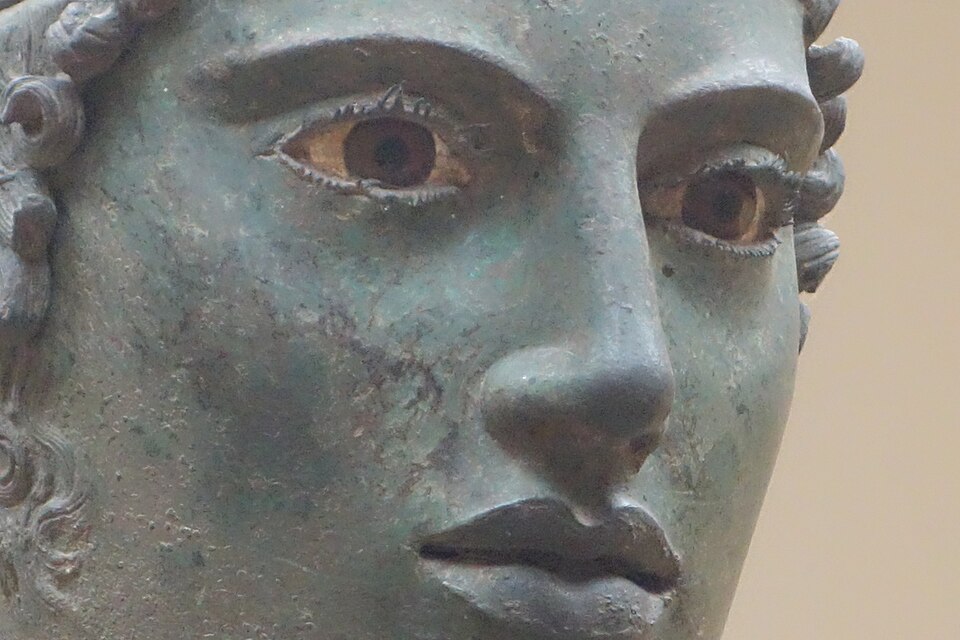
The Charioteer was cast in bronze using the lost-wax technique, built up in several separately cast pieces that were then joined. Craftsmen added inlaid glass and stone eyes, delicate copper eyelashes and lips, and a headband inlaid with silver, giving the figure its uncanny lifelike presence.
In the lost-wax method, sculptors modelled the figure in wax over a clay core, encased it in a mould, then melted the wax out and poured molten bronze into the cavity it left behind. A statue this size was not poured in one go, so the arms, the torso, the feet, and the head were cast as separate pieces and carefully fitted together, the joins hidden with skill. The long chiton was worked so that its vertical folds echo the fluting of a marble column, giving the standing body a quiet architectural strength. Look closely and you can still read the seams and repairs that betray this piece-by-piece construction, the fingerprints of a workshop at the height of its powers.
The details that startle visitors most are in the face. The eyes are not blank sockets but inlays of coloured stone and glass paste, ringed by individually applied eyelashes cut from thin copper, so the gaze looks moist and alert. The lips and the nipples were inlaid with copper too, warming the metal with a reddish tint, and the headband that ties back his hair, the fillet worn by a victor, was inlaid with silver that once caught the light. These touches of colour and texture were meant to dissolve the boundary between metal and living flesh. Such refinement did not happen by accident, and understanding why this particular bronze reached us unmelted is the next part of the story.
Why did the Charioteer survive when other bronzes did not?
The Charioteer survived because it was buried by debris rather than recycled. Most ancient bronzes were melted down for their valuable metal, but this statue was covered by a rockfall or earthquake collapse inside the sanctuary, protecting it underground until archaeologists recovered its fragments during excavation.
Bronze was always worth more as raw metal than as art to those who did not care for it. Across late antiquity and the centuries that followed, countless masterpieces were dragged to furnaces and turned into coins, weapons, tools, and cannon. That is why the great names of Greek sculpture survive mostly as Roman marble copies rather than the gleaming originals; the metal simply proved too tempting. Any bronze that escaped the melting pot did so through luck, usually by being lost, sunk, or buried before the recyclers reached it. The Charioteer’s good fortune was to be swallowed by the earth of Delphi itself.
At some point the terraces of the sanctuary, perched on the unstable slopes of Parnassus, gave way, and a rockfall or seismic collapse sent stone and soil sliding down over the monuments below. The Charioteer and parts of his group were knocked from their base and buried under this rubble, sealed away from looters and metal-hunters for many centuries. When systematic excavation of Delphi finally reached that layer, the pieces came to light: the standing driver in remarkable condition, along with fragments of the horses, the chariot, and a small figure. Piecing together what those fragments once formed leads directly to the question of the larger monument he belonged to.
What votive group did the Charioteer belong to?
The Charioteer was only one figure in a large bronze votive group showing a four-horse chariot, its team, and a young groom. It was dedicated to Apollo to celebrate a chariot victory at the Pythian Games, offered by a Sicilian Greek ruler, though only the driver and fragments now survive.
The complete monument was a full bronze display: a bronze chariot drawn by four horses, the young Heniochos at the reins, and a small groom or attendant beside the team, all mounted on a stone base within the sanctuary. Such a group was a thank-offering, a votive dedication to Apollo, set up by a victor to broadcast his triumph in the most sacred setting imaginable. The victory it celebrated came in the chariot race of the Pythian Games, the great athletic and musical festival held at Delphi every four years in honour of the god. Winning a chariot race there was among the highest honours a wealthy Greek claimed.
The dedication is generally attributed to a ruler of the Greek cities of Sicily, one of the ambitious tyrants who poured their wealth into monuments at the panhellenic sanctuaries to advertise their power far from home. Delphi, drawing pilgrims from every corner of the Greek world through its ties to Apollo and his oracle, was the perfect stage for such a display. Time and disaster have left us only the driver and scattered fragments of the horses and chariot, so we must imagine the rest, yet even alone the Charioteer conveys the confidence of that offering. Seeing him in person makes the loss of the group easier to picture, which is why the museum display matters so much.
How do visitors see the Charioteer of Delphi today?
Visitors see the Charioteer in his own dedicated hall in the Delphi Archaeological Museum, displayed at eye level so the inlaid eyes meet your gaze. Most travellers combine the museum with the adjacent ancient sanctuary, walking the site first and viewing the bronze at the end.
The Charioteer stands in a quiet gallery near the end of the museum route, positioned so that you can circle him and study the details up close, from the copper lashes to the fluted folds of the chiton. Give yourself time here; after the open ruins of the sanctuary, the hush of this hall and the sudden nearness of a living-seeming face from antiquity is the emotional high point of any Delphi visit. Many people reach Delphi from the capital in a single day, and a well-organised Delphi day trip from Athens lets you see both the archaeological site and the museum without the stress of driving the mountain roads yourself.
For the best experience, walk the ancient sanctuary first, climbing the Sacred Way past the treasuries to the temple of Apollo and the theatre, then finish inside the museum so the Charioteer becomes the climax rather than the prelude. Arrive early or late in the day to avoid the tour crush in his small hall, and bring a little patience, since he is the most photographed object in the collection. A knowledgeable guide can point out the seams, the inlays, and the victory fillet that a quick glance misses, turning a photo stop into a real encounter with the ancient world. Plan your visit and tours through our Delphi travel guide.
Who dedicated the Charioteer of Delphi and why?
Polyzalos, tyrant of Gela in Sicily, dedicated the Charioteer of Delphi to Apollo. He belonged to the Deinomenid dynasty of Syracuse as brother of Gelon and Hieron, and the monument commemorated a four-horse chariot victory won at the Pythian Games.
The surviving inscription on the limestone base names Polyzalos as the dedicator. The lettering identifies the sanctuary of Apollo at Delphi as the setting and records the tethrippon, the four-horse chariot race, as the event that earned the offering. The dedication ties the bronze directly to a named victor of the western Greek elite.
The Deinomenid tyrants of Syracuse used Delphi to broadcast their wealth and power at the Panhellenic centre. A victory monument at the shrine of Apollo carried the family name before pilgrims from across the Greek world:
- Gelon ruled Syracuse and led the Deinomenid house.
- Hieron succeeded him and patronised poets such as Pindar.
- Polyzalos governed Gela and paid for the Charioteer group.
The base once carried an earlier text that was cut away and recarved, a change that ties the monument to the shifting fortunes of the Deinomenid brothers as power passed between Gela and Syracuse. The offering set a Sicilian dynasty permanently among the dedications that lined the sanctuary of Apollo.
What does the Charioteer reveal about the Severe Style?
The Charioteer stands as a defining work of the Severe Style, the Early Classical phase of the early fifth century BC that bridged the Archaic kouros and the High Classical. It exchanges the fixed Archaic smile for a calm, restrained expression and precise anatomical modelling.
The sculptor rendered the feet, ankles and collarbone with naturalistic detail that the earlier kouroi lacked. The long chiton falls in fluted vertical folds that echo the flutes of a Doric column, and the belted upper body breaks the drapery into measured planes. The eyes retain their inlaid glass paste and the lashes their fine bronze strands.
The figure belongs to the same moment in Greek sculpture as the works that mark the transition to the Classical. Visitors who study these bronzes and marbles read the shift firsthand at the Delphi Archaeological Museum:
- The Riace Bronzes, two warrior figures cast in the same generation.
- The Kritios Boy, a marble youth that abandons the rigid Archaic stance.
- The Charioteer of Delphi, the fullest bronze survival of the phase.
The head turns slightly to the right and the lips part as if to draw breath, a naturalism the Archaic tradition never attempted. The Severe Style set the direction that Myron and Polykleitos carried to its height in the decades that followed, and the Charioteer preserves the phase in bronze where nearly every parallel work has been lost. The bronze serves as the reference point for the phase, the yardstick against which scholars measure the lost masterpieces of early Classical casting and read the birth of naturalism in Greek art.
Frequently Asked Questions
Where is the Charioteer of Delphi located?
The Charioteer is displayed in the Delphi Archaeological Museum, which sits directly beside the ancient sanctuary of Apollo on the slopes of Mount Parnassus in central Greece, roughly a two-and-a-half to three-hour drive northwest of the capital. Inside the museum he occupies his own dedicated hall near the end of the visitor route, presented at eye level and lit so that his inlaid eyes seem to follow you. Because the museum and the archaeological site share the same location, most visitors buy a combined ticket and see both in one trip, exploring the ruins outdoors before stepping inside to meet the bronze. The statue does not travel, so Delphi is the only place in the world where you can stand before the original Heniochos rather than a cast or photograph, which is a large part of why the site draws so many travellers each year.
What is the Heniochos and why is it called that?
Heniochos is simply the ancient Greek word for the Charioteer, meaning the one who holds the reins, from the Greek words for reins and to hold. It is the traditional name scholars and Greeks use for the statue, describing exactly what the figure is doing: standing at the front of a chariot with the leather reins gathered in his outstretched hand, ready to guide the team of horses. The name reflects the moment the sculptor chose to capture, not the wild motion of a race but the composed instant of the victory lap or the presentation to the crowd, when the driver stands tall and still. Calling the statue the Heniochos also reminds us that he was never meant to be seen alone; he was the human centre of a larger bronze group of chariot, horses, and groom, the rein-holder who gave the whole monument its focus and meaning.
Why is the Charioteer important in the history of art?
The Charioteer is a landmark because it captures the moment Greek sculpture shifted from the stiff, smiling figures of the Archaic period toward the naturalism of the Classical age, a phase art historians call the Severe Style. Earlier statues stood frozen and symmetrical; the Charioteer, by contrast, shows a real human presence, with subtle asymmetry, carefully observed feet and hands, and a calm, serious expression that gives him inner life rather than a fixed grin. At the same time he keeps a restrained, upright dignity that later Classical works loosened into full movement, so he sits exactly on the hinge between two great eras. Because he survives in original bronze, complete with his inlaid eyes, copper lashes, and silver-inlaid headband, he lets us see the refinement of technique that marble copies can only hint at. For all these reasons the Heniochos is treasured not just as a beautiful object but as key evidence for how Greek art learned to portray the living human body.