
The Pythian Games were one of the great pan-Hellenic festivals of the ancient Greek world, staged high on the slopes of Mount Parnassus at the sanctuary of Delphi in honour of the god Apollo. Held once every four years, they ranked second only to the Olympic Games in prestige, drawing athletes, musicians, poets and spectators from every corner of Greece. What set them apart was their marriage of art and sport: alongside foot races and chariot contests, competitors sang, played and recited for a crown of sacred laurel. Standing in the theatre and stadium today, you can still feel that atmosphere, and a guided tour with My Greece Tours brings the whole sanctuary vividly to life. Plan the whole trip with Greece Tours.
Delphi was regarded by the Greeks as the navel of the world, and the games were the beating heart of its calendar. Our Delphi travel guide sets the sanctuary in its wider context for anyone planning a visit. The sections below cover what the Pythian Games actually were, their mythical origin in Apollo’s victory over Python, the events contested, the prize and prestige of winning, and the venues at Delphi where it all unfolded.
What were the Pythian Games?
The Pythian Games were a pan-Hellenic religious festival held at Delphi every four years in honour of Apollo. One of the four great crown games of ancient Greece, they combined musical and artistic contests with athletics and chariot racing, ranking second only to the Olympics in prestige.
The Pythian Games belonged to a select group of four festivals known as the Panhellenic or crown games, so called because the reward was not money but a wreath of living plants. Alongside the Olympic, Nemean and Isthmian Games, the Pythia formed a sacred sporting circuit that bound the scattered Greek city-states together in shared worship and friendly rivalry. Every free-born Greek was welcome to compete or watch, regardless of which city he called home. The festival unfolded at Delphi, the mountain sanctuary that the Greeks believed marked the very centre of the earth, making the games a spiritual as much as an athletic occasion for the entire Hellenic world.
The scale of the Pythian Games was enormous for their day. Delegations arrived from distant colonies, sacred embassies bearing offerings filed into the sanctuary, and merchants, poets and pilgrims crowded the sacred way. The festival lasted several days and was framed by grand religious ceremony, processions and sacrifices to Apollo. Because it fell in the third year of each Olympiad, the Pythia neatly filled the gap in the four-year rhythm of Greek athletic life, giving the Greek world a major gathering to look forward to between Olympic celebrations. To understand why the games were held here at all, we must turn to the myth that founded them.
What is the mythical origin of the Pythian Games?
The Pythian Games were founded to celebrate Apollo’s victory over Python, the monstrous serpent that guarded Delphi. According to myth, the young god slew the creature, claimed the oracle for himself, and instituted funeral games that grew into the great festival, protected by a sacred truce.
In the oldest versions of the story, Delphi was guarded by Python, a great earth-serpent born of Gaia, who terrorised the surrounding country. Apollo, still a youthful god, travelled to the site, shot the serpent with his arrows and took possession of the sacred spring and prophetic seat. From that moment Delphi became his own, home to the priestess who spoke his prophecies, and the sanctuary grew into one of the most revered religious centres in Greece. The games were established as commemorative contests, part funeral rite for the slain Python and part triumphant celebration of Apollo’s mastery, and the fame of the site drew pilgrims to the Oracle of Delphi for centuries. Myth and ritual were thus woven together from the very beginning.
At first the Pythian festival was chiefly a musical one, centred on a hymn sung to Apollo in memory of his victory. In time the organisers reorganised and expanded the programme, adding a full slate of athletic and equestrian events and setting the festival on its four-year cycle. Crucial to its success was the sacred truce: heralds travelled across Greece announcing the games, and warfare was suspended so that competitors and spectators journeyed to Delphi in safety. This protected passage allowed even rival cities to meet peacefully at the sanctuary. That blend of solemn music and hard-fought sport shaped the distinctive programme of events that followed.
What events were held at the Pythian Games?
The Pythian Games featured musical and artistic contests, athletic events and chariot racing. Competitors sang to the kithara and aulos, and later performed drama, while runners, wrestlers and charioteers contested the athletic programme. The prominence of the arts set the Pythia apart from every rival festival.
The signature of the Pythian Games was the artistic competition, a feature no other crown festival matched with the same emphasis. The oldest and most honoured contest was singing to the kithara, a large lyre, in praise of Apollo, the god of music himself. Players of the aulos, a reed pipe, competed too, both as soloists and as accompanists to singers. Over time the programme broadened to embrace instrumental solos, recitation and dramatic performance, so that poets and actors won Pythian glory beside athletes. This celebration of skill, harmony and voice reflected Apollo’s own patronage of the arts and gave the festival a refinement that the more purely athletic Olympia never claimed.
Yet the Pythia was also a serious athletic occasion. Its programme mirrored the great sporting events of Greece, with sprint races the length of the stadium, longer distance runs, wrestling, boxing, the pankration and the demanding pentathlon. Grandest of all was the equestrian programme held on the plain below, where teams of horses thundered around the turning posts in the chariot race, a spectacle reserved for the wealthy who funded such teams. Boys competed in their own categories alongside the men. The winners of these contests earned a reward that carried meaning far beyond the arena itself.
What was the prize and prestige of winning?
Victors at the Pythian Games received a wreath of laurel, the bay tree sacred to Apollo, rather than any cash reward. The honour was immense: champions were celebrated with statues, victory monuments and commissioned odes, and their triumph brought lasting glory to themselves and their home cities.
The Pythian prize was a simple crown of bay laurel, gathered from trees sacred to Apollo, sometimes said to come from the Vale of Tempe. Its value lay entirely in what it symbolised. To be crowned at Delphi placed an athlete or musician among the elite of the Greek world, and the fame followed him home, where he was welcomed with public celebration, feasting and privileges for life. Cities prized their Pythian victors as sources of collective honour, erecting statues and dedications in their names. The great poet Pindar composed some of his most magnificent victory odes for Pythian champions, ensuring their triumphs echoed across generations through the power of verse.
The Pythian crown gained added lustre from its place in the panhellenic cycle. An athlete who won at Olympia, Delphi, Nemea and the Isthmus in turn earned the rare and coveted title of periodonikes, a circuit victor, the summit of an athletic career. The four festivals were carefully spaced so that their dates rarely clashed, allowing champions to chase glory across the whole rotation. Winning at Delphi was therefore both an end in itself and a step toward that ultimate distinction. To picture these triumphs, it helps to know exactly where at Delphi they were won.
Where were the Pythian Games held at Delphi?
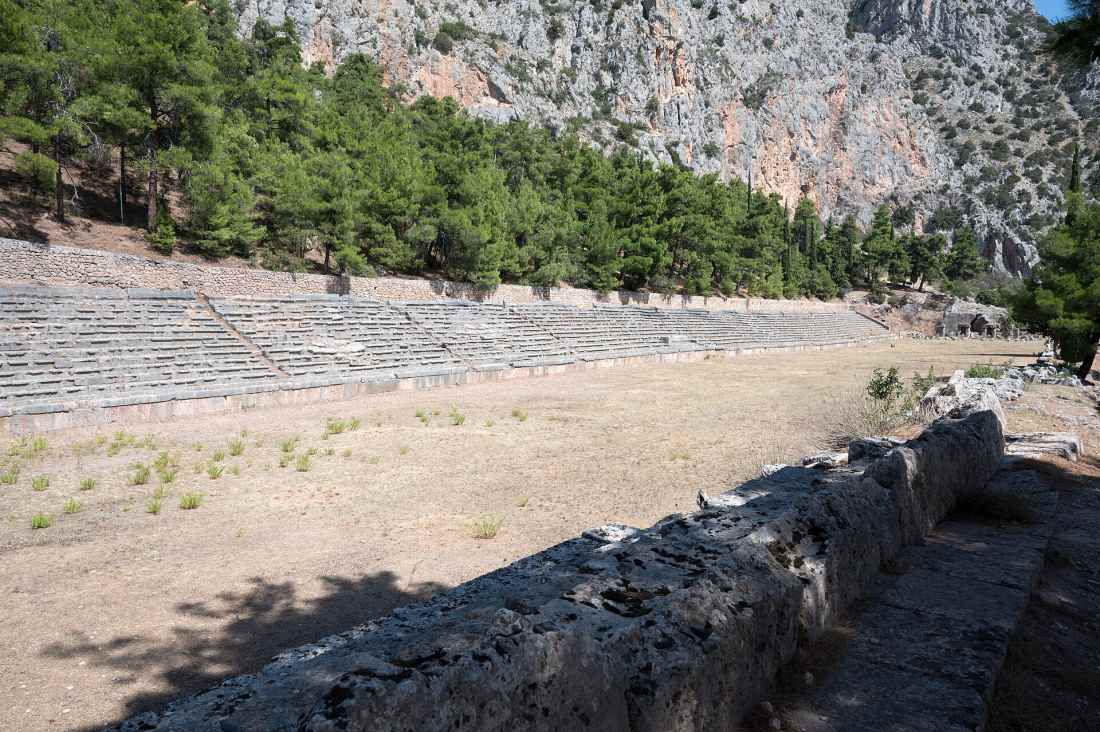
The Pythian Games unfolded across the sanctuary of Delphi. Musical and dramatic contests took place in the theatre, the athletic events in the stadium at the top of the site, and the chariot races on the plain below near the sea. All three venues can still be visited today.
The musical and dramatic competitions were staged in the theatre of Delphi, a beautifully preserved semicircle of stone seats set into the hillside above the temple of Apollo, offering the audience a sweeping view down the valley. Higher still, reached by a climb through the sanctuary, lies the Delphi stadium, one of the best preserved in all of Greece, where the running tracks and stone seating rows survive almost intact. Walking between them today, you follow the same steep path that ancient spectators trod, from the sacred temple up past treasuries and monuments to the arenas where champions were made. Few archaeological sites let you trace an entire festival so completely.
The horse and chariot races, needing far more room than the mountain offered, were held on the flat plain of Krisa far below the sanctuary, near the coast at modern Itea. From the theatre and stadium the eye still travels down over a vast sea of olive trees toward the gulf where those races once ran. A Delphi day trip from Athens comfortably takes in the temple, theatre and stadium in a single visit, letting you stand where the Pythian Games came alive. Plan your visit and tours through our Delphi travel guide.
How were the Pythian Games organised and scheduled?
The Amphictyonic League administered the Pythian Games on a four-year cycle, in the third year of each Olympiad. Heralds called theoroi proclaimed a sacred truce across the Greek world, and the panegyris gathered competitors and pilgrims to Delphi under appointed judges and officials.
Governance of the festival rested with the Amphictyonic League, the council of tribes and city-states that owned and protected the sanctuary of Apollo. The League set the calendar, controlled the treasury of the games, and appointed the presiding officials. Its reorganisation of the contest in the sixth century BC turned a local musical celebration into a Panhellenic festival that stood beside the Olympic, Isthmian, and Nemean Games in the periodos, the circuit of the four crown competitions of ancient Greece.
The scheduling followed a fixed rhythm. The games fell every four years, in the third year of each Olympiad, in the Delphic month of Boukatios in late summer. Before each celebration the League dispatched heralds known as theoroi, and the spondophoroi who carried the truce, to the cities of the mainland, the islands, and the colonies. These envoys announced the dates and proclaimed the ekecheiria, the sacred truce that suspended warfare and guaranteed athletes, delegations, and spectators safe passage to and from Delphi.
The truce transformed the sanctuary into the panegyris, the great gathering. Official delegations arrived as theoriai representing their home cities, pitching camp on the slopes below the temple and along the road from the coast. The judges, drawn from the Amphictyonic membership, enforced the rules of each contest, ruled on disputes, and awarded the crown of laurel cut from the sacred grove in the valley of Tempe. Fines and dedications enriched the sanctuary, and the roster of victors was recorded in the archive that later chronologists, including Aristotle and Callisthenes, compiled into a formal victor list.
What was the musical programme that set the Pythian Games apart?
Music stood at the centre of the Pythian Games. The festival began as a contest of song and instrument, and it kept that programme alongside its athletics, unlike the Olympic Games, which crowned only physical competitors. The nomos Pythikos on the aulos and kithara led the roster.
The oldest event was the contest for kitharodes, singers who accompanied themselves on the kithara in praise of Apollo. When the Amphictyonic League expanded the games in the sixth century BC, it added instrumental categories: the solo kithara, the solo aulos, and aulody, in which a singer performed to the reed pipe. The centrepiece of the instrumental programme was the nomos Pythikos, a set composition that narrated Apollo’s combat with the serpent Python in distinct movements, from the god’s approach through the fight to the death of the monster. Sacadas of Argos won the first recorded performance of this piece on the aulos.
The musical roster grew across the following centuries. Contests for painters entered the programme, and the tradition of poetic and dramatic performance drew on the same slope of Parnassus, where the audience assembled in the stone theatre of Delphi above the temple. The mousikoi agones, the artistic competitions, ranged across the disciplines that the Greeks grouped under the Muses:
- Kitharody, the sung performance to the kithara.
- Aulody, the sung performance to the aulos.
- Solo kithara and solo aulos, purely instrumental events.
- The nomos Pythikos, the programmatic piece on Apollo and Python.
- Painting, added in the later organisation of the festival.
This artistic core defined the character of the Pythian Games. Athletes competed in the stadium above the sanctuary and charioteers in the plain of Krisa below, yet the crown at Delphi honoured the poet, the singer, and the piper on equal terms with the runner and the wrestler, binding the festival to Apollo as the god of prophecy and of music alike.
Who were the famous victors, and how did poets celebrate them?
Pindar composed fourteen Pythian Odes for victors who came from Syracuse and Akragas in Sicily to Cyrene in Libya. Bronze statues rose across the sanctuary to record their triumphs, and the Charioteer of Delphi survives as the dedication of Polyzalos of Gela.
The victory poets fixed the names of the champions in verse. Pindar’s Pythian Odes, fourteen in number, honour a roster that reaches across the Greek world: Hieron of Syracuse for the single-horse race and the chariot, Arcesilas of Cyrene for the four-horse chariot, Xenophon of Corinth, Telesikrates of Cyrene for the race in armour, and Aristomenes of Aegina for the boys’ wrestling. The odes name the victor, his city, and his family, and set each triumph against a myth of Apollo or Herakles, carrying the Delphic crown from the temple terrace to courts as distant as the tyrants’ halls of Sicily.
The wealthy owners of racing teams dominated the equestrian events, because the crown fell to the owner rather than the driver. Rulers of the western colonies entered chariots to advertise their power at the sanctuary, and their agents managed the horses and the professional charioteers who held the reins. Runners, boxers, wrestlers, and pentathletes took the crowns of the stadium and the palaestra, and their home cities recorded the results on inscribed stone.
Victors marked their success with dedications along the Sacred Way and on the terraces of the temple. Polyzalos of Gela, brother of Hieron of Syracuse, set up a bronze chariot group after a Pythian equestrian win in the early fifth century BC; the surviving driver from that monument is the Charioteer of Delphi, one of the few large bronzes to survive from antiquity. Statues, tripods, and treasuries crowded the sanctuary as generations of champions turned their crowns into standing memorials to Apollo.
How did the Pythian Games compare with the other Panhellenic Games?
The Pythian Games formed one of the four Panhellenic crown festivals, the periodos circuit, and ranked second only to the Olympic Games. Every winner received a stephanitic crown of Delphic laurel rather than money, and a champion in all four contests earned the title periodonikes.
The four crown games of the Greek athletic and religious calendar met on a fixed rotation, and each honoured a presiding god at a distinct sanctuary. Together they defined the summit of competition for Greek athletes, poets, and musicians:
- The Olympic Games at Olympia, sacred to Zeus, awarded a crown of wild olive and stood first in prestige.
- The Pythian Games at Delphi, sacred to Apollo, awarded a crown of laurel and stood second.
- The Isthmian Games near Corinth, sacred to Poseidon, awarded a crown of pine and later celery.
- The Nemean Games at Nemea, sacred to Zeus, awarded a crown of wild celery.
The Olympic and Pythian Games met every four years, while the Isthmian and Nemean Games met every two years, so the circuit filled each Olympiad with competition. The Pythian Games fell in the third year of each Olympiad, in the Delphic month Boukatios, which placed them between the Olympic celebrations and gave athletes a second premier stage. This scheduling turned the periodos into a continuous professional season for the touring competitor.
The stephanitic principle united the four festivals and separated them from the many prize games that distributed cash, tripods, or oil. A Pythian victor carried home a laurel crown cut from the sacred grove in the vale of Tempe, plus the honour, statues, and public rewards his own city voted him on his return. The athlete who took the crown at Olympia, Delphi, the Isthmus, and Nemea gained the rank of periodonikes, the mark of total mastery across the entire Panhellenic circuit, and Greek cities recorded these men on inscribed victor lists for public memory.
What role did the Sacred Wars and the Amphictyonic League play in the games?
The First Sacred War against Kirrha reorganised and enlarged the games in the early sixth century BC, and the Amphictyonic League governed the sanctuary and the festival. Philip II of Macedon presided over the games after his victory in the Third Sacred War.
The First Sacred War pitted the Amphictyonic League against the coastal town of Kirrha, which controlled the road to Delphi and taxed pilgrims approaching the oracle of Apollo. The League destroyed Kirrha, dedicated its plain to the god, and refounded the festival on a grander scale in the early sixth century BC. From that reorganisation the games gained their four-year athletic programme, the crown of laurel, and their place on the Panhellenic circuit alongside Olympia.
The Amphictyonic League, a council of twelve tribes drawn from central Greece and Thessaly, held authority over the sanctuary at Delphi and administered the Pythian Games through appointed officials. The council managed the sacred treasury, judged disputes over the god’s land, and sent representatives called hieromnemones and pylagoroi to its meetings. Control of the festival carried political weight, because the states that governed the games governed the prestige and the pilgrim traffic of the most consulted oracle in Greece.
The Third Sacred War arose when Phocis seized the sanctuary and melted its treasures to pay mercenaries, and the conflict drew in Thebes, Thessaly, and Macedon. Philip II of Macedon defeated the Phocians, took their two votes on the Amphictyonic council, and presided over the Pythian Games as the agonothetes, the president of the festival. His presidency demonstrated Macedonian dominance over the sacred institutions of southern Greece and marked the passage of Delphic authority into royal hands, a transfer that his son Alexander and the Hellenistic kings inherited.
How have the Pythian Games been revived in modern times?
The poet Angelos Sikelianos and Eva Palmer-Sikelianos staged the Delphic Festivals in the sanctuary in the early twentieth century AD, reviving ancient drama and contests. A contemporary movement now stages a modern Pythian Games as a cultural and artistic revival built on the ancient model.
Angelos Sikelianos, a Greek poet, conceived a Delphic Idea that placed Delphi at the centre of a renewed international culture, and his wife Eva Palmer-Sikelianos, an American artist and scholar, gave the vision its practical form. In the early twentieth century AD the pair organised the Delphic Festivals in the ancient theatre and stadium of the sanctuary, returning performance and competition to the site of Apollo after many centuries of silence. Eva Palmer-Sikelianos wove the costumes on Greek looms, trained the chorus, and directed the staging herself.
The festivals presented the tragedies of Aeschylus, including Prometheus Bound, in the open-air theatre below the Temple of Apollo, together with athletic contests in the stadium, folk dances, craft exhibitions, and choral music. Spectators travelled from Athens and abroad to watch drama performed in the setting for which the classical form arose, and the events revived the union of art, athletics, and religion that defined the original Pythian programme. The financial demands of the productions exhausted the couple’s private fortune.
The Delphic Idea outlived the festivals and shaped later efforts to renew the ancient contests as a cultural institution. A contemporary movement stages a modern Pythian Games that draws on the ancient model, adding competitions in music, dance, painting, sculpture, literature, and the performing arts to athletic events, and it carries the name and the spirit of Apollo’s festival to new host cities. The revival frames the Pythian tradition as a living meeting of the arts, and it links the modern celebration directly to the sanctuary at Delphi where the original games honoured the god.
What happened to the Pythian Games in late antiquity?
The Pythian Games continued under Roman rule for centuries, drew emperors and celebrity performers, then ended when Christianity displaced the cult of Apollo and the emperor Theodosius banned the pagan festivals, closing the contest after more than a thousand years at Delphi.
Rome kept the games alive and honoured them. Roman magistrates and emperors funded the sanctuary, competitors travelled from across the empire, and the festival held its place on the Panhellenic circuit. The emperor Nero, a devoted performer, entered the musical contests on his tour of Greece and collected crowns from the sacred games, and later emperors continued to patronise the celebration.
The long decline followed the fortunes of the oracle. As Christianity spread through the eastern Mediterranean, the pagan cult that gave the games their meaning lost its worshippers and its revenue, and the plundering of Delphi by Sulla and by Nero had already stripped the sanctuary of its wealth. In the fourth century AD the emperor Theodosius outlawed pagan worship across the empire, and the ban ended the sacred contests. The Pythian Games gave their last crown, the theatre and stadium fell silent, and the festival that had honoured Apollo since the sixth century BC passed into memory until its modern revival. The long silence at Delphi lasted until poets and scholars returned to the ancient ground and staged performance once more beneath the Temple of Apollo.
Frequently Asked Questions
How often were the Pythian Games held?
The Pythian Games were celebrated once every four years, following the same broad rhythm as the Olympic Games but on a different point in the cycle. They fell in the third year of each Olympiad, which meant that between two Olympic celebrations the Greek world had the Pythia to look forward to, along with the biennial Nemean and Isthmian Games. This careful spacing was deliberate. The four crown festivals together formed an almost continuous sporting calendar, so that in any given year a Greek athlete had a major panhellenic contest to aim for somewhere in the land. For competitors, the four-year gap between each Pythian celebration made every edition precious, since a career allowed only a handful of chances to win the Delphic laurel. For Delphi itself, the games anchored the sanctuary’s calendar and drew crowds, offerings and prestige to Apollo’s home on Mount Parnassus.
How were the Pythian Games different from the Olympic Games?
The most important difference was the artistic programme. While the Olympic Games were devoted almost entirely to athletics and horse racing, the Pythian Games gave equal honour to music, poetry and, in time, drama. This reflected the character of Apollo, the god of music and the arts, in whose sanctuary the festival was held. Competitors won Pythian fame by singing to the kithara or playing the aulos, contests that had no equivalent at Olympia. The prizes differed too: Olympic victors received a wreath of wild olive, while Pythian champions were crowned with laurel, the bay sacred to Apollo. The two festivals also sat at different points in the four-year cycle, so an ambitious athlete or musician aimed for both. In prestige the Olympics stood first and the Pythia second, but for artists and poets the Pythian Games were the grandest stage in the Greek world, a place where skill in verse and song counted as highly as speed and strength.
Can you still visit the sites of the Pythian Games at Delphi?
Yes, and Delphi is one of the most rewarding ancient sites in Greece to explore. The theatre where the musical contests took place survives in excellent condition, set just above the temple of Apollo with a magnificent view over the valley. A short climb higher brings you to the stadium, remarkably well preserved, where you can see the starting lines, the running track and the stone seating that once held thousands of spectators. Below in the plain toward Itea and the sea lies the ground where the chariot races were held. The adjacent Delphi Archaeological Museum houses treasures found on the site, including the famous bronze Charioteer of Delphi, a masterpiece connected to those very races. The whole sanctuary is easily explored on foot in a few hours, and it makes an ideal day trip from Athens. Standing among the ruins, with Mount Parnassus rising behind and olive groves stretching to the gulf, it is easy to imagine the Pythian Games in their full glory.