
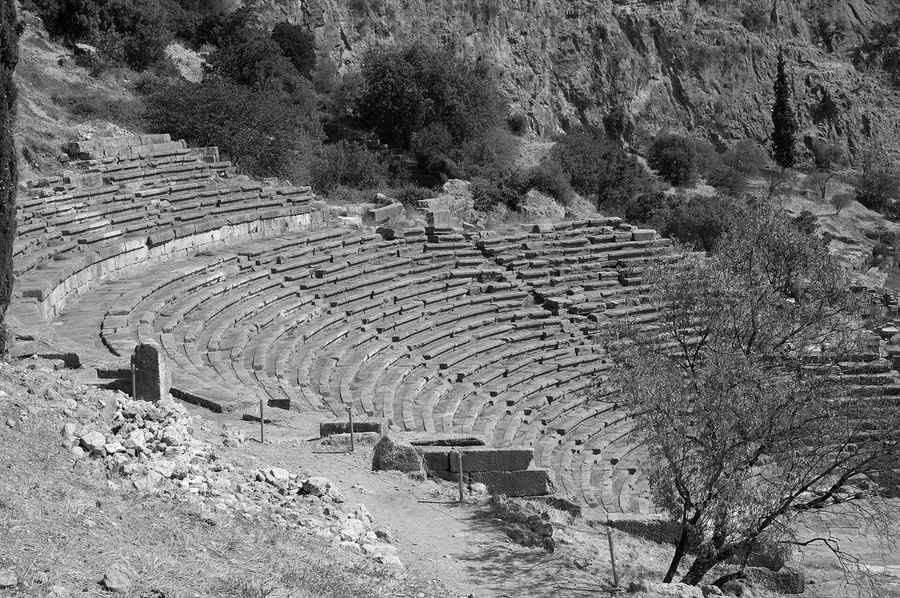
High on the southern slope of Mount Parnassus, cradled inside the sacred precinct of Apollo, the ancient theatre of Delphi rises in curving rows of grey limestone above the ruins of the god’s temple. It is one of the best-preserved theatres of the classical Greek world, built to hold the musical and dramatic contests that made Delphi famous far beyond its role as home of the oracle. From its topmost seats the whole sanctuary spreads out below, framed by mountains and a river of olive trees running toward the distant sea. Many travellers reach it comfortably on a guided tour with My Greece Tours. Plan the whole trip with Greece Tours.
This page sits within our wider Delphi travel guide, which covers the sanctuary, the oracle and the surrounding region in depth. The sections below cover what the ancient theatre of Delphi is, how it was built and what it looked like, the events that were held inside it, why its view is considered so special, and how visitors experience the theatre today.
What is the ancient theatre of Delphi?
The ancient theatre of Delphi is a stone Greek theatre inside the sanctuary of Apollo on Mount Parnassus, built directly above the god’s temple. It hosted musical and dramatic performances, above all the artistic contests of the Pythian Games held in Apollo’s honour.
The theatre stands within the wider religious complex known as the sanctuary of Apollo, the heart of ancient Delphi. Pilgrims climbed a paved processional route called the Sacred Way, passing treasuries, statues and altars, until they reached the Temple of Apollo where the oracle delivered her prophecies. The theatre was raised on the terrace immediately above that temple, so it was woven into the sacred landscape rather than set apart from it. Its purpose was not everyday entertainment but worship expressed through art: hymns, choral songs and dramatic works performed as offerings to the god. For the ancient Greeks, honouring Apollo with music and poetry was as devout an act as sacrifice at his altar.
Understanding the theatre means understanding its neighbour just below, the Temple of Apollo at Delphi, whose great columns still frame the view from the lowest rows of seats. Temple and theatre worked as one stage set for the same devotion, the audience literally looking down onto the holiest building in the sanctuary while performers sang below. This closeness gave the theatre a meaning few others match, binding drama and prophecy in a single sacred space. To appreciate that setting fully, it helps to picture how the theatre itself was shaped and constructed.
How was the theatre of Delphi built and what did it look like?
The theatre was carved into the natural hillside in the classic Greek form, with about 35 rows of curved stone seats wrapped around a semicircular orchestra and backed by a stage building. Built largely of local limestone, it seated roughly five thousand spectators.
Greek theatres were designed to use the land rather than fight it, and Delphi is a textbook example. The builders shaped the slope of Parnassus into a wide bowl, the koilon, and set the seating into it so the ground itself supported the audience. Around 35 rows of stone benches climb the hillside in a great curve, divided by stairways into wedge-shaped blocks that let people find their places easily. At the foot lay the orchestra, a near-circular space of beaten earth and stone where the chorus danced and sang. Most of the visible stonework is local limestone quarried nearby, its pale grey tone blending with the mountain so that the theatre seems to grow out of the rock instead of being placed upon it.
Facing the seats stood the skene, or stage building, which served as a backdrop and gave actors somewhere to change and enter. Between it and the orchestra ran the narrow stage on which performers appeared, while side entrances called parodoi let choruses file in from left and right. The acoustics were remarkable: a voice from the orchestra carried clearly to the highest of the roughly five thousand seats without any amplification, a feat of careful proportion rather than machinery. Every element, from the sweep of the rows to the placement of the stage, was tuned for both sound and spectacle. That refined design existed to serve particular events, and it is worth looking at exactly what filled these seats.
What events were held in the theatre?
The theatre hosted the musical and dramatic contests of the great festival held for Apollo, including singing to the lyre, choral hymns and theatrical performances. These artistic competitions honoured Apollo as the god of music and stood beside the athletic games as a central part of the celebrations.
The theatre was the artistic stage of the Pythian Games, one of the four great panhellenic festivals of the ancient Greek world. Unlike games devoted only to athletics, the festival at Delphi grew out of a musical competition and always kept art at its core. Here performers competed in singing to the kithara and lyre, in playing the aulos, and in choral and dramatic works staged in honour of the god. Judges awarded the coveted crown of laurel, the leaves sacred to Apollo, to the finest musicians and poets. Crowds gathered from across the Greek cities, so a victory in this theatre carried fame that travelled home with the winner and echoed for a lifetime.
These performances were acts of devotion as much as displays of talent, because Apollo was worshipped as the god of music, poetry and harmony. Choral hymns called paeans praised him directly, while dramatic pieces explored the myths that bound the sanctuary to its god. Over the centuries the theatre was repaired and refined, keeping it in use for generations of festivals and gatherings. Standing among the seats today, it is easy to imagine the sound of massed voices rising toward the mountain. Part of what made those moments unforgettable was not only the music but the extraordinary panorama that opened beyond the stage.
Why is the view from the theatre of Delphi so special?
Perched high on the hillside, the theatre looks straight down over the Temple of Apollo, the Sacred Way and the ruins of the sanctuary, then out across a vast valley of olive groves toward the mountains and the distant sea. It offers one of the finest views of any ancient theatre in Greece.
Because the seats climb the slope above the temple, spectators enjoyed a stage backed not by a painted wall alone but by the entire sacred landscape. From the upper rows the eye falls first onto the columns of the Temple of Apollo directly below, then follows the winding Sacred Way past treasuries and monuments, and finally sweeps out over the deep ravine of the Pleistos river. Beyond it stretches a sea of silver-green olive trees filling the valley toward the town of Itea and the Gulf of Corinth glinting in the distance. Few ancient sites place their audience so perfectly between built beauty and natural grandeur, and the effect is unforgettable in the clear mountain light.
This union of drama and landscape was surely deliberate, for the Greeks chose their theatre sites with an eye for setting as much as sound. A performance here unfolded against layers of meaning: the god’s temple, the pilgrims’ route, the sheltering peaks of Parnassus and the endless valley below. Morning light rakes across the ruins and softens toward gold in late afternoon, so the view changes character through the day. Little wonder that the climb to the seats is a highlight for almost every visitor. Reaching that vantage point, though, is part of the wider experience of exploring the sanctuary today.
How do visitors see the theatre of Delphi today?
Visitors reach the theatre by climbing the Sacred Way past the Temple of Apollo within the main archaeological site. It is remarkably well preserved and, although the seats are often roped off for protection, the whole structure is clearly visible and easily combined with the stadium above and the site museum.
Entering the archaeological site of Delphi, you follow the ancient Sacred Way uphill, winding past the treasuries and the great Temple of Apollo until the theatre opens above you. Continuing on the same path leads higher still to the Delphi stadium, where the athletic contests were held, so the two monuments are naturally visited together in one steady climb. Many travellers reach the site on a Delphi day trip from Athens, which pairs the sanctuary with the excellent archaeological museum and its famous bronze charioteer. Comfortable shoes, water and sun protection make the ascent far more enjoyable, especially in the warmer months.
The theatre is one of the best-preserved parts of the whole sanctuary, its rows of seats and orchestra still clearly defined even after centuries of weather and earthquakes. To protect the fragile stone, the seating area is frequently roped off, so you admire it from the edge rather than sitting in the rows, yet the structure is fully in view and easy to photograph from the surrounding path. Arriving early in the day helps you enjoy the cooler air and the quiet before larger groups appear, and pausing at the top for the valley view rewards the effort of the climb. Plan your visit and tours through our Delphi travel guide.
What does the seating and layout of the theatre look like in detail?
The koilon holds 35 rows of seats in two tiers split by a horizontal diazoma walkway, radiating stairways cut the rows into wedge-shaped kerkides, and the seating wraps a paved circular orchestra 18.5 metres across, all built of Parnassus limestone.
The auditorium climbs the slope directly above the Temple of Apollo, its curve following the contour of the hillside. The lower tier carries 27 rows and the upper tier 8 rows, the two divided by the diazoma, a level walkway that let spectators reach their places without climbing the full bank. The kerkides fan outward from the orchestra, each wedge bordered by a stone stairway, so movement runs on radial and horizontal lines across the whole koilon.
The orchestra is a flat paved circle where the chorus and musicians performed, ringed by a stone drainage channel that carried rainwater off the slope and away from the seats. Retaining walls, the analemma, close the two ends of the auditorium and hold the earth of the cavea in place.
- Seating rows: 35, in a lower tier of 27 and an upper tier of 8
- Dividing walkway: one diazoma between the tiers
- Capacity: between 4,500 and 5,000 spectators
- Orchestra diameter: 18.5 metres, paved and circular
- Material: local limestone quarried on Mount Parnassus
How did the theatre serve the Pythian Games?
The theatre hosted the mousikoi agones, the musical and dramatic contests of the Pythian Games, where performers competed in singing, instrumental playing on the kithara and the aulos, and staged drama before the assembled pilgrims of the sanctuary.
Music stood at the origin of the festival. The oldest event of the Pythian Games was the nomos Pythikos, a set composition that re-told Apollo’s victory over the serpent Python. Players performed it on the kithara and later on the aulos, shaping the melody into named movements that traced the god’s approach, the combat, the death of the serpent, and the victory hymn.
From that musical core the programme widened. Contestants competed as solo singers to the kithara, as instrumentalists on the aulos, and as choral groups, and the festival added dramatic performances that filled the theatre during the celebrations.
- Nomos Pythikos: the set piece narrating Apollo and Python
- Instruments: the kithara and the aulos
- Vocal contests: solo song to the kithara and choral competition
- Drama: staged performances added to the musical programme
What Roman-era changes did the theatre receive?
Under Roman rule the theatre gained a rebuilt seating bank and a stone stage building, and the front of the stage carried a carved frieze depicting the labours of Herakles, work funded through imperial and royal patronage of the sanctuary.
The Roman refurbishment renewed the worn limestone seats and reset the orchestra, adapting the auditorium to the audiences of the period. A masonry stage building, the proskenion, stood across the front of the orchestra and framed the performing area with a permanent architectural backdrop rather than a temporary timber structure.
The relief frieze ran along the proskenion and showed scenes from the labours of Herakles, tying the stage front to the mythology honoured at the site. Royal benefaction reached back into the Hellenistic period as well: Eumenes II of Pergamon numbered among the patrons whose gifts supported building at Delphi, and the Roman programme continued that tradition of external funding.
- Seating: Roman renewal of the rows and orchestra
- Stage: a stone proskenion across the orchestra front
- Decoration: a carved frieze of the labours of Herakles
- Patronage: royal and imperial gifts, including Eumenes II of Pergamon
What construction phases and restorations shaped the theatre?
The theatre took its enduring stone form in the fourth century BC, received a Hellenistic rebuilding and Roman repairs across the following centuries, and now stands under a modern conservation programme that restricts visitor access to protect the fragile limestone.
The first monumental theatre rose in the fourth century BC, replacing earlier arrangements on the slope with a fixed koilon of stone seats. Hellenistic builders reworked the auditorium and orchestra, and Roman crews later renewed the seating and added the stage building, so the structure visible today carries the marks of successive phases stacked on one plan.
Weathering, seismic movement, and centuries of exposure loosened the seats and cracked the limestone. Archaeologists working at Delphi now run a long conservation campaign that stabilises the stone, resets displaced blocks, and keeps visitors off the seating, so the theatre is viewed from marked paths rather than entered.
- Fourth century BC: the first stone koilon
- Hellenistic period: rebuilding of auditorium and orchestra
- Roman period: renewed seating and the stage building
- Modern era: conservation work and restricted access
What festivals besides the Pythian Games used the theatre?
The theatre hosted the Soteria festival, founded to commemorate the repulse of the Gaulish invasion under Brennus in the third century BC, along with dithyrambic contests, dramatic competitions, choral performances, and the singing of the two Delphic Hymns to Apollo.
The Soteria, meaning “festival of deliverance”, entered the sacred calendar after the Aetolian League drove the Gauls of Brennus back from the sanctuary. Delphi reorganised the celebration as a Panhellenic event, and the Amphictyonic decrees that regulated it name the tragic poets, comic poets, chorus trainers, kitharodes, and pipers who competed. These contests ran in the same auditorium that served the Pythian Games, and the prize inscriptions record the victors by city.
The two Delphic Hymns to Apollo carry the earliest substantial surviving musical notation from Greece. Stonemasons carved the melody in vocal notation and instrumental notation above the lyrics on the wall of the Athenian Treasury, and the Athenians who commissioned them performed the hymns during a sacred embassy to Delphi in the second century BC. The theatre and its neighbouring terrace framed exactly this kind of choral procession and sung dedication.
- Soteria — deliverance festival marking the defeat of Brennus and the Gauls.
- Dithyrambic contests — circular choruses of fifty singers dedicated to Dionysus.
- Dramatic competitions — tragedy and comedy staged for civic and religious prizes.
- The Delphic Hymns — two paeans to Apollo preserved with their carved musical notation.
What inscriptions survive on and around the theatre?
The analemma retaining walls and the stones around the theatre carry hundreds of manumission inscriptions that freed slaves by dedicating them to Apollo, together with civic decrees, proxeny grants, and honorific texts, making the theatre terrace part of Delphi’s wider epigraphic archive.
Manumission at Delphi took a sacral form. An owner sold a slave to the god Apollo through a fictive purchase, and the priests inscribed the act on the sanctuary walls so that the record stood under divine protection. The polygonal wall below the temple bears the densest concentration, and the analemmata flanking the theatre koilon continue the practice. Each text names the freed person, the former owner, the guarantors, and the conditions of release, which supplies a register of names, prices, and origins across several centuries.
The theatre stones also preserve public documents. The Amphictyonic Council posted decrees regulating the festivals, cities recorded honours voted to benefactors, and the sanctuary published grants of proxeny that gave foreign envoys formal standing at Delphi. Read together, these inscriptions turn the auditorium and its walls into a legal and diplomatic ledger rather than a silent monument.
- Manumission acts — slaves freed by dedication to Apollo, with names, prices, and terms.
- Amphictyonic decrees — rulings of the council that governed the sanctuary and its games.
- Proxeny grants — honours giving foreign representatives official rights at Delphi.
- Civic honours — dedications recording benefactors, victors, and sacred embassies.
How does the theatre connect to Dionysus and the ritual calendar?
Delphi divided its year between two gods: Apollo governed the nine warm months, and Dionysus held the sanctuary through the three winter months while Apollo travelled to the Hyperboreans. The theatre, as the home of drama, belonged to Dionysus during that Dionysiac season.
Greek writers record that during winter the paean fell silent and the dithyramb rose in its place, and priests tended the tomb of Dionysus that stood inside the temple beside the omphalos. The theatre gave this rotation a physical stage. Drama itself grew from the worship of Dionysus, so the auditorium that rose above the temple served the winter god as directly as it served Apollo in the season of the Pythian contests.
The ritual reached beyond the sanctuary onto the mountain above. The Thyiades, companies of women from Delphi and Athens, climbed to the Corycian Cave and the high ground of Mount Parnassus to hold their winter rites for Dionysus. Their ecstatic dances and torchlit ascent formed the counterpart on the heights to the choral performance staged in the theatre below, binding the drama space to the wider Dionysiac calendar of the region.
- Winter months — Dionysus governs Delphi while Apollo is among the Hyperboreans.
- Dithyramb — the choral song of Dionysus that replaces the Apolline paean.
- The Thyiades — women whose rites on Parnassus mirror the theatre’s Dionysiac role.
How does the theatre of Delphi compare with other ancient Greek theatres?
The theatre of Delphi shares the hillside koilon form of the Theatre of Dionysus at Athens and the theatre at Epidaurus, cutting its seating straight into the natural slope. Its distinction lies in its integration with the sanctuary and its view over the valley of Phocis.
Greek builders set their auditoriums against hillsides so that the ground itself carried the tiers of seats. The Theatre of Dionysus on the south slope of the Athenian Acropolis established the model, and the theatre at Epidaurus refined the geometry into its wide fan of stone. Delphi follows the same principle, with its rows of local limestone rising in a curve above the Temple of Apollo. The scale is smaller than Epidaurus, yet the position is more dramatic, because the seats look directly down across the sacred precinct.
The setting is what sets Delphi apart. From the upper rows a spectator takes in the temple terrace, the Sacred Way, and the olive-filled valley that runs toward the harbour of Itea. No other major Greek theatre folds a working sanctuary and a mountain landscape into a single frame in this way, which links the auditorium to the whole complex of Delphi rather than standing as an isolated venue.
Modern scholarship documents these theatres as a connected group. The Diazoma network catalogues the ancient theatres of Greece, records their condition, and supports their study and protection, placing Delphi within a mapped family of monuments that stretches from Athens and Epidaurus across the mainland and the islands.
- Theatre of Dionysus, Athens — the birthplace of drama and the model for the hillside plan.
- Theatre of Epidaurus — the widest and most complete koilon of the classical world.
- Theatre of Delphi — the auditorium set inside a sanctuary above a temple and a valley.
- The Diazoma network — the modern body documenting Greece’s ancient theatres as one archive.
What do we know about the stage building and its scenery?
The stage building of the Ancient Theatre of Delphi stood as a two-part structure: a rear skene that housed actors and machinery, and a proskenion, a columned facade that closed the far edge of the orchestra and carried the raised platform on which the performers spoke.
The proskenion at Delphi presented a row of stone columns facing the audience, and its flat roof formed the logeion, the elevated speaking platform where actors delivered their lines in the later stage of the theatre’s use. Between the columns of this stage front the crews slotted pinakes, painted wooden panels that carried the scenery. A panel of a palace facade, a temple front, or a rocky landscape converted the same stone frame into the setting each drama demanded, and the panels lifted out and changed between plays.
Access to the orchestra ran through the two parodoi, the side passages between the ends of the seating and the flanks of the stage building. Performers of the chorus entered along these open corridors, and the audience read a fixed convention into them: one parodos stood for arrivals from the countryside or a harbour, the other for arrivals from the town or a distant land. The paved circular orchestra between the parodoi held the chorus and the altar, while the actors worked above them on the logeion.
The scenery of the theatre passed from timber to stone across its building history. The earliest stage arrangement rested on wooden posts and removable planking set on cut foundations, an economy that suited a structure rebuilt after rockfalls on the steep upper slope of the sanctuary. Later masons raised the proskenion in dressed limestone, gave the logeion a permanent stone core, and left sockets and cuttings in the surviving blocks that record where the painted panels and the timber superstructure once locked into place. The finds recovered from this area now inform the displays of the nearby Delphi Archaeological Museum.
How do the acoustics of the theatre work?
The acoustics of the Delphi theatre rest on its shape and its stone: the curved hillside seating gathers sound toward the circular orchestra, the hard limestone rows reflect the voice upward through the tiers, and the paved orchestra floor returns the sound as a sounding surface, so a speaker at the centre reaches the highest seats without amplification.
The koilon, the banked semicircle of seats cut into the slope above the Temple of Apollo, wraps the orchestra in a concave arc. That geometry directs the reflected sound of a voice back toward a common focus rather than scattering it across the valley, and it places the listener in a bowl that concentrates rather than disperses what reaches the ear. A voice raised from the centre of the orchestra radiates outward and meets the rising ranks of seats as an ordered wavefront.
The material of the seating carries the effect. The rows are cut and laid in dense limestone, a hard surface that reflects sound cleanly instead of absorbing it, and each tier of stone passes the reflected voice to the tier behind and above it. The circular orchestra, paved in stone slabs, acts as a further reflecting plane at the base of the bowl, so the direct sound from the speaker and the sound bounced off the paving arrive at the seats in close succession and reinforce one another.
The open valley beyond the stage shapes the way the theatre is heard. With no rear wall to trap and blur the sound and no crowd of buildings behind the seats, late reflections that muddy speech in an enclosed hall fall away into the ravine of the Pleistos and the slopes of Mount Parnassus. The listener receives the strong early sound from the orchestra and the near seating, while the valley drains the rest, and an unamplified line spoken below carries to the top row of the koilon set high above the temple terrace.
What modern performances have revived the theatre?
The Delphic Festivals revived performance in the sanctuary in the early twentieth century, when the poet Angelos Sikelianos and his wife Eva Palmer-Sikelianos staged ancient Greek drama at Delphi, mounting the tragedies of Aeschylus in the setting of the sanctuary as part of their campaign to renew what they named the Delphic Idea.
Sikelianos conceived the Delphic Idea as a plan to restore Delphi to its old role as a meeting point for the peoples of the world, a centre of art, thought, and reconciliation. Eva Palmer-Sikelianos, trained in weaving, music, and the study of ancient Greek song, built the productions from that programme: she wove the costumes on the loom to designs drawn from vase painting and sculpture, reconstructed the movement of the chorus, and set the choral parts to melodies she based on Byzantine and folk tradition. The festivals joined the drama to athletic contests, an exhibition of folk art, and a concert of ancient music, so the revival addressed the whole sanctuary rather than the theatre alone.
The tragedy that anchored the revival was the Prometheus Bound of Aeschylus, staged in the sanctuary with a large chorus and the audience seated on the slope of Parnassus, and a later festival added the Suppliants of the same poet. The Delphic Festivals of Sikelianos and Palmer-Sikelianos opened the modern practice of returning ancient tragedy to the places for which it was made.
That practice grew into a settled tradition of performing ancient drama in Greek theatres. Companies now mount the tragedies of Aeschylus, Sophocles, and Euripides and the comedies of Aristophanes in the surviving stone theatres of Greece, and the revival begun at Delphi stands behind the summer stagings of ancient plays across the country. Visitors who walk up from the temple terrace to the theatre stand where that modern revival placed its chorus, and the wider story of the Delphi sanctuary frames what they see.
When was the theatre excavated, and what did the dig reveal?
The theatre was uncovered by the Great Excavation of the French School at Athens in the late nineteenth century, a campaign that first cleared the village of Kastri built over the ruins, then dug out the sanctuary above the temple and exposed the seating, the orchestra, and the foundations of the stage building along with a body of inscriptions.
The village of Kastri stood directly on top of the ancient sanctuary, its houses spread across the terraces and the theatre slope, and the excavation required the removal of the whole settlement to a new site nearby before the digging began. Once the ground was cleared the French School worked up the steep hillside from the Temple of Apollo, and the theatre emerged on the terrace above the temple, set into the koilon that the ancient builders had cut into the rock.
The dig recovered the full plan of the monument. The excavators cleared the curved rows of the seating and the diazoma that divides the lower tiers from the upper, exposed the paved circular orchestra at the foot of the bowl, and traced the cut foundations of the skene and proskenion at the downhill edge. The recovered blocks preserved the sockets, drains, and support cuttings that record how the stone and timber of the stage fitted together.
The excavation of the theatre area yielded a rich epigraphic harvest. The retaining wall of the theatre and the blocks around it carried inscriptions:
- lists of victors and honours from the Pythian and Soteria festivals;
- decrees of the Delphic community recording grants of privileges to individuals and cities;
- records of manumission that freed enslaved people through dedication to Apollo;
- the texts and musical notation of the Delphic Hymns to Apollo, found on stones from the sanctuary and now central to the study of ancient Greek music.
These inscribed stones, together with the architectural blocks and the finds from the surrounding terraces, passed into the record of the sanctuary and the collections that document the history of Delphi.
Frequently Asked Questions
How many people did the ancient theatre of Delphi hold?
The ancient theatre of Delphi seated roughly five thousand spectators, a substantial capacity for a mountain sanctuary that was not a large city. Its seating is arranged in about 35 rows of stone benches carved into the slope of Mount Parnassus and wrapped in a curve around the semicircular orchestra below. Stairways divide the rows into wedge-shaped blocks so the crowd moved to their places without confusion. That capacity made sense because the theatre served a panhellenic festival, drawing visitors and competitors from across the Greek world rather than only local residents. During the great celebrations in honour of Apollo, the seats filled with pilgrims, officials and admirers of music who came to watch the contests and share in the worship. Even today, standing at the top and looking down over five thousand empty places gives a vivid sense of the crowds that once gathered here to hear song rise toward the peaks.
Can you sit in the theatre of Delphi when you visit?
In most cases you cannot sit in the rows of the theatre of Delphi, because the seating area is usually roped off to protect the ancient limestone from wear. The stone has survived for a very long time, and constant footsteps and weight gradually damage the delicate benches and stairways, so the site authorities restrict access to preserve them for future generations. This is not a disappointment in practice, since the theatre is fully visible from the surrounding path and the Sacred Way that passes beside it. You can walk right up to the edge, look down across the orchestra and the temple ruins below, and take in the sweeping valley view without ever stepping onto the seats. For photography the outer path is arguably the best vantage point anyway, letting you capture the whole curved bowl of the theatre against the mountain backdrop. Always follow the posted signs and any guidance from site staff, as protective arrangements can change with conservation work.
How long does it take to visit the theatre and the wider sanctuary of Delphi?
Most visitors spend around two to three hours exploring the archaeological site of Delphi, and the theatre forms one memorable stop within that walk. From the entrance you follow the Sacred Way uphill, passing the treasuries and the Temple of Apollo before reaching the theatre, then many continue higher to the stadium at the top of the sanctuary. Allowing time to pause at the theatre for the view, and to climb steadily in the mountain air, makes the experience far more rewarding than rushing. Beyond the site itself, the Delphi archaeological museum deserves at least another hour, as it houses the celebrated bronze charioteer and many finds from the sanctuary. Travellers arriving on an organised excursion from Athens typically have a full day, with the long scenic drive through the mountains included, so the theatre fits comfortably into a well-paced itinerary. If you enjoy walking slowly, photographing the ruins and soaking in the atmosphere, giving yourself a generous half day lets you appreciate the theatre and its extraordinary setting without haste.